Madrasa Website: Pages, Notices and Donations Every Madrasa Needs
In this article 15 sections
- 1.What a Madrasa Website Is Really For
- 2.The 15 Pages Every Madrasa Website Should Plan
- 3.Notices: Keeping the Madrasa Website Current
- 4.Admission Pages and Online Admission Forms
- 5.Results, Befaq Results and Certificate Checks
- 6.Prayer Times, Hijri Date and Islamic Calendar Content
- 7.Donations on a Madrasa Website: Funds, Trust and Transparency
- 8.Hostel, Routine, Meals and Fees: Answering Parents' Practical Questions
- 9.Photos, Videos and Respectful Content
- 10.Language, Mobile Speed, Domain and Search
- 11.What a Madrasa Website Costs in Bangladesh
- 12.Common Madrasa Website Mistakes
- 13.Website Only or Madrasa Website Plus Management System?
- 14.How Nexteio Can Help Your Madrasa Online
- 15.Frequently asked questions
A madrasa website is often the first place a guardian, a donor or a former student looks before they call the office. They want to know whether admission is open, when the Befaq results come out, what the hostel costs and how to send Zakat or Lillah support safely. If the site answers those questions clearly, the office phone rings less and the madrasa earns trust before anyone visits.
Many madrasas in Bangladesh still rely on a Facebook page, a printed notice board and word of mouth. Those channels work for people who already know the madrasa. They work poorly for a family in another district comparing Hifz departments, a donor living abroad, or an alumnus trying to verify a certificate.
This guide is for the muhtamim, the madrasa committee and the office staff who will plan and run the site. It explains which pages to build, how to keep notices current, how to handle results and certificates, how to present Islamic calendar information and how to set up donation funds people can trust.
It also covers costs, common mistakes, and the difference between a simple website and a website connected to an office management system, with examples from our own Madrasa Management Software where they help.
What a Madrasa Website Is Really For
Before choosing a design, list the people who will use the site and what each of them needs. A madrasa serves more groups than most schools, and each group arrives with a different question.
- Current guardians: notices, exam schedules, results, fees, holiday dates and the daily routine.
- Families considering admission: departments, admission rules, hostel facilities, fees and the teachers.
- Donors and well-wishers: how to give, which funds exist and what the money is used for.
- Alumni: news, events and a way to stay connected.
- Other institutions and employers: a way to confirm that a certificate or testimonial is genuine.
- Teachers and job seekers: vacancies and information about the staff.
A good madrasa website gives each of these groups a clear path from the homepage. The homepage itself should not try to show everything. It should show the latest notices, the admission status, a short introduction and clear links to the main sections.
The site also speaks for the madrasa when nobody is in the office. A guardian checking a notice at night or a donor reading about a construction project on a Friday should find the same accurate information the office would give in person. Our guide to running an online madrasah shows how the website, fee payment and a guardian app can work together.
The 15 Pages Every Madrasa Website Should Plan
Not every madrasa needs every page on the first day, but planning the full structure early avoids a messy site later. The table below lists the pages most madrasas in Bangladesh end up needing, and what each should hold.
| Page | What it should hold |
|---|---|
| 1. Home | Latest notices, admission status, a short introduction, quick links |
| 2. About the madrasa | History, aims, the muhtamim's message, committee |
| 3. Departments and classes | Hifz, Nurani or Maktab, Kitab or Alia classes, with levels |
| 4. Teachers | Names, roles and qualifications, with photos only if the madrasa allows |
| 5. Notices | All notices, newest first, with dates and attachments |
| 6. Admission | Rules, required documents, dates and the application form |
| 7. Exam schedule | Internal and central exam dates |
| 8. Results | Result search and published Befaq or board results |
The remaining seven pages cover the practical and community side of the madrasa:
| Page | What it should hold |
|---|---|
| 9. Fees | A clear fee table by class, including hostel and meals |
| 10. Hostel and routine | Facilities, daily routine and the weekly meal menu |
| 11. Donation | Funds, projects, how to give and contact for donors |
| 12. Gallery and events | Event photos, programs and annual gatherings |
| 13. Lecture videos | Recorded talks and recitations, if the madrasa publishes them |
| 14. Alumni and honor board | Graduates, huffaz who completed the Quran, alumni news |
| 15. Contact and FAQ | Address, map, phone, office hours and common questions |
Some madrasas also add a certificate check page, a page for daily verses or hadith, and a career page for teacher vacancies.
Keep the main menu short and group the rest under clear headings, so a guardian on a small phone screen can find a page in two taps. If you are building from a blank page, a custom-designed madrasa site lets you shape the menu around these sections instead of forcing them into a ready theme.
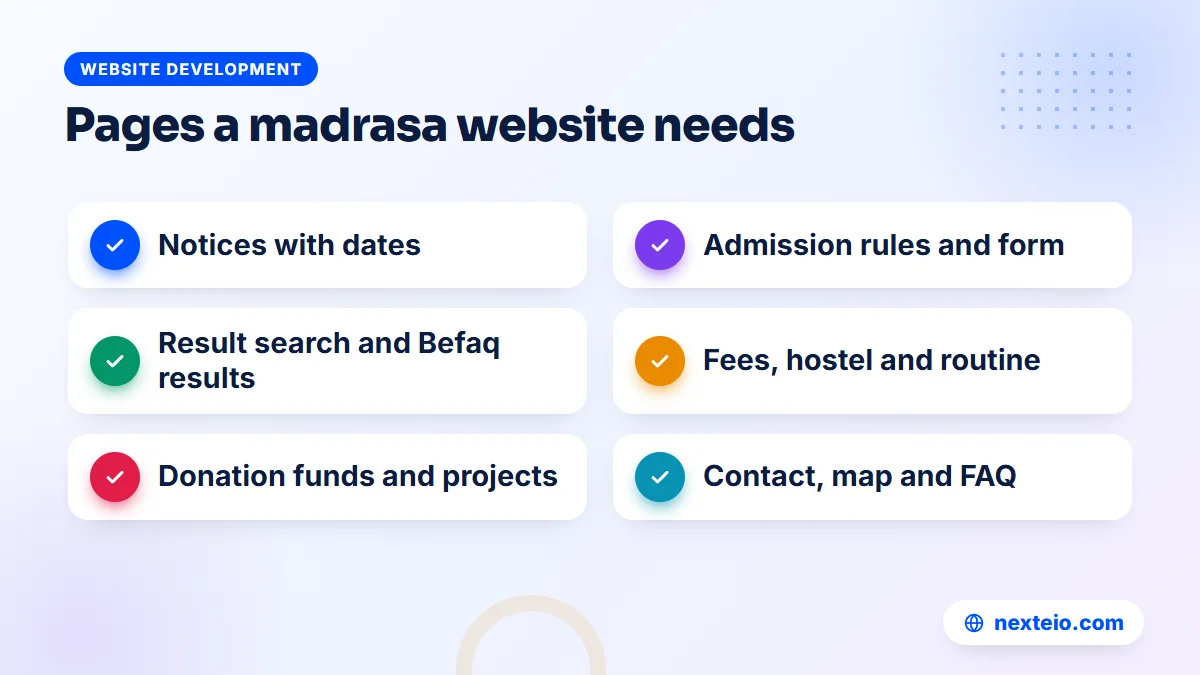
Our Madrasa Management Software includes most of these pages on its public website: notices with a ticker, departments and classes, teachers, gallery, events, exam schedule, contact, daily routine, hostel facilities, the weekly meal menu, a fee table by class, a Hifz honor board, Befaq results, alumni, lecture videos and an FAQ. The office updates them from the same dashboard it uses for daily work. Behind the honor board sits the daily Hifz record, which our guide to Hifz Quran progress tracking explains step by step.
Notices: Keeping the Madrasa Website Current
Notices are the most visited part of almost every madrasa website. Exam dates, holiday announcements, admission deadlines, Befaq form fill-up dates and fee reminders all start as notices. When notices are late or missing, guardians stop checking the site and go back to calling the office.
A few habits keep the notice section reliable:
- One person posts, one person approves. Usually an office assistant posts and the muhtamim or the head teacher approves.
- Write the notice as text, not only a photo. A scanned image is hard to read on a phone and invisible to search engines. Attach the signed PDF if you need to, but put the key details in the text.
- Date every notice. Both the Gregorian and the Hijri date help, since many madrasa events follow the Hijri calendar.
- Remove or archive old notices. Last year's admission notice on the homepage confuses families.
- Use a short ticker for urgent items. A scrolling line at the top of the page is enough for a sudden holiday or a schedule change.
Bangla matters here more than anywhere else.
Most guardians read notices in Bangla, while some donors and alumni abroad may prefer English. A site with a simple language switch lets the office publish both without building two separate websites.
In our system, notices appear with a ticker on the website, and the same notice can be sent to guardians as a bulk SMS from the dashboard. The site and the dashboard switch between Bangla and English with one click, and each user's choice is remembered.
Admission Pages and Online Admission Forms
Admission season is when a madrasa website does its most important work. Families compare several madrasas, often from a distance, and they decide which ones to visit based on what they find online. A clear admission page can be the difference between a full Hifz class and empty seats.
An admission page should answer these questions without a phone call:
- Which departments and classes are taking new students this year?
- What are the age limits or entry requirements for each department?
- Which documents are needed, such as a birth certificate and photos?
- What are the admission, monthly, hostel and meal fees?
- When are the admission test and interview, if any?
- How does a family apply, and how will they hear back?
An online admission form saves time for both sides. The family fills it in once, and the office receives the details in a structured form instead of handwritten papers. The office should still review every application, call the family where needed and confirm the next step.
A simple admission season timeline
Admission content works best when it is published in stages rather than all at once on the last day. A typical sequence looks like this:
- Several weeks before: publish the admission notice with departments, seats, age limits, fees and required documents.
- When applications open: switch on the online form and pin the notice to the homepage ticker.
- During the test period: post the test schedule, the venue and what the child should bring.
- After selection: publish the list of selected applicants by application number, not by name and photo.
- Before classes start: post the first-day routine, hostel arrival time and the books or items needed.
Each step answers a question families would otherwise phone in.
Our Madrasa Management Software includes an online admission form on the website, and the office reviews applications in the dashboard. Once a student is admitted, the profile, guardian details and hostel room are kept in the same system, so the office does not type everything again.
Promotion helps too. Many madrasas share the admission page on social media during admission season, and some run small Facebook ads aimed at families in nearby areas. Whatever you do, the link should lead to a page with full details, not just a poster image.
Results, Befaq Results and Certificate Checks
Results bring the highest traffic spikes to any madrasa website. On result day, many guardians open the site within the same hour. If results are posted as a single large image or a heavy PDF, the page loads slowly on mobile data and the office phones start ringing again.
A result search by registration number is the cleaner option. The guardian types the number and sees only that student's result. That is faster, and it also keeps other students' results private.
Central exam results need their own place too. Qawmi madrasas whose students sit the Befaq exams often publish their students' Befaq results as a point of pride. Alia madrasas follow the Bangladesh Madrasah Education Board, whose official results remain the authority, but a madrasa can still share its own students' achievements on its site.
Certificate checks solve a real problem. When a student moves to another madrasa, applies for further study or seeks a job, the receiving side may want to confirm a testimonial or transfer certificate. A public check by serial number or QR code lets them do it without calling the office.
Our Madrasa Management Software supports result search by registration number and certificate checks by serial number or QR code on the public website. It handles Befaq divisions such as Mumtaz, Jayyid Jiddan, Jayyid and Maqbul for Qawmi, Hifz and Nurani results, and GPA for Alia. You can see these features in our Darul Uloom model madrasa project.
Related guides for institutions planning their websites:
- Educational website design for schools, colleges and madrasas
- School management software: the features an institution needs
- Non-profit website design: pages and features that matter
Prayer Times, Hijri Date and Islamic Calendar Content
A madrasah website has content that a general school site does not. Prayer times, the Hijri date, a verse or hadith of the day and countdowns to Ramadan, Shab-e-Barat and Eid are useful to guardians, students and the wider community. They also give people a reason to return to the site between notices.
This content needs care. Two points matter most:
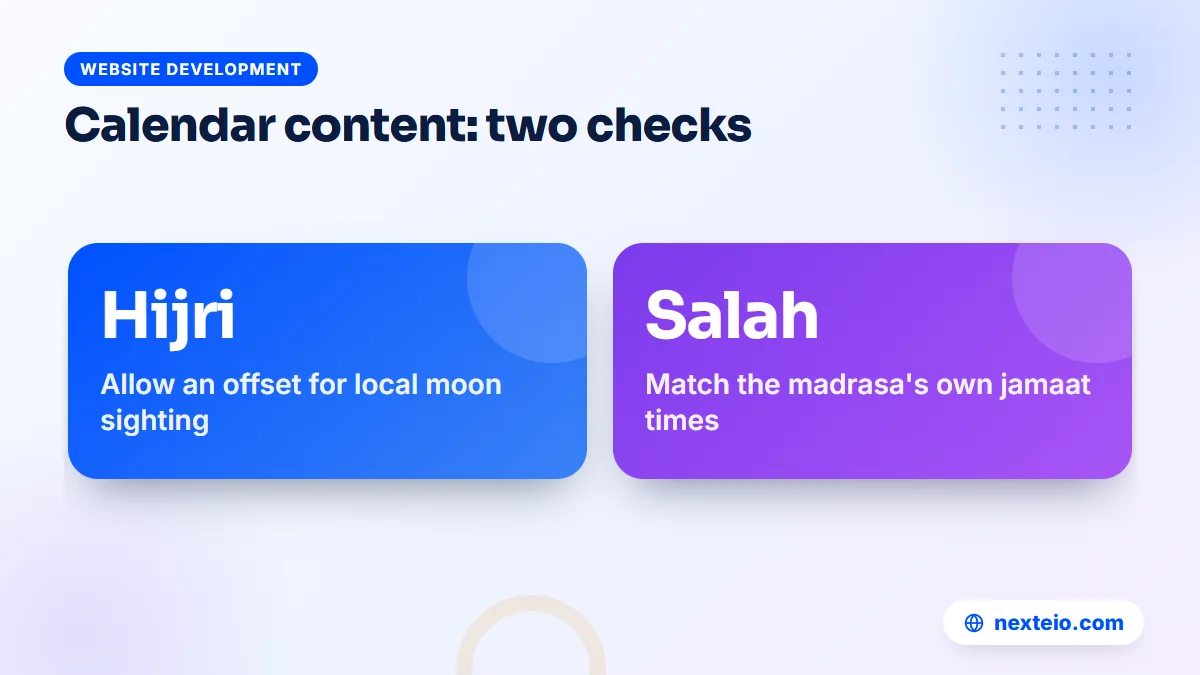
- Hijri dates in Bangladesh follow local moon sighting. Dates announced by the national moon sighting committee can differ by a day from calculated calendars. Any automatic Hijri date or countdown should allow an offset so the madrasa can match the local announcement.
- Prayer times should match the madrasa's own timetable. Check the times shown on the site against the jamaat times the madrasa follows, and correct them where needed.
Our software shows prayer times with a countdown to the next prayer, the Hijri date, a verse, hadith and dua of the day, and countdowns to Shab-e-Barat, Ramadan and Eid. The calendar uses Umm al-Qura calculations with an adjustable offset, so the office can shift dates by a day when the local moon sighting differs.
Choose daily verses and hadith with the guidance of the madrasa's scholars, include the reference for each one, and avoid publishing rulings or opinions on the website that the senior teachers have not approved. A madrasa's reputation rests on the accuracy of what it publishes.
Donations on a Madrasa Website: Funds, Trust and Transparency
For many madrasas, donations pay for scholarships, Lillah boarding, construction and daily running costs. A donation page can reach supporters far beyond the local area, including people working abroad who want to support a madrasa back home. It only works if donors trust where their money goes.
Trust comes from clear structure. Donors want to know which fund they are giving to, and many want their Zakat kept separate from general donations. Which uses of each fund are permitted is a question for the madrasa's own scholars, and the website should simply state the policy they set. A good donation page shows:
- Separate funds, such as Zakat, Lillah, Sadaqah, construction and general.
- Specific projects, such as a new classroom or a hostel floor, with a target and progress.
- How to give: online payment, bank account, mobile financial services or in person.
- A contact person for donors who have questions or want a receipt.
- Regular updates on completed projects, with photos where appropriate.
Our Madrasa Management Software includes a donation page with funds and project progress bars. In the office, it keeps separate Zakat, Lillah, Sadaqah, construction and general funds, with a donor list, vouchers and a monthly report, so the accounts match what the website shows.
For online donations, the current version supports bKash Tokenized Checkout, which Nexteio connects during setup. Card payments, SSLCommerz and a Nagad gateway are not part of the current version. Cash, Nagad and bank transfers can still be recorded by hand in the accounts. On the public demo, online donation shows "coming soon" because bKash is not connected there. Our guide to accepting online payments in Bangladesh explains the wider options.
Donation pages have a lot in common with NGO sites. Clear funds, honest updates and an easy way to ask questions matter more than design effects.
Hostel, Routine, Meals and Fees: Answering Parents' Practical Questions
Families sending a child to a residential madrasa have practical questions that often go unanswered online. Where will my child sleep? What is the daily routine? What do the students eat? How much will it cost each month? A madrasa website that answers these openly removes a lot of worry before the first visit.
Useful content for this section includes:
- Hostel facilities: rooms, washrooms, study space, supervision and visiting rules.
- The daily routine from Fajr to bedtime, including study, meals and rest.
- The weekly meal menu, which many mothers in particular want to see.
- A fee table by class, showing admission, monthly, hostel, meal and exam fees separately.
- Rules for leave, gate passes and guardian visits.
Be honest about fees. A clear table with every charge listed avoids misunderstandings later. If the madrasa offers concessions for orphans or families in need, say that support is available and explain how to ask for it, without publishing anyone's personal details.
The website that comes with our software has pages for daily routine, hostel facilities, the weekly meal menu and a fee table by class. Behind the scenes, the office can apply fee concessions such as half, full, Lillah boarding or a set amount.
Photos, Videos and Respectful Content
Photos and videos show the real life of the madrasa: classes, annual programs, completion ceremonies and new buildings. They help families and donors picture the place. They also need more care on a madrasa site than on most other websites.
Set a written policy before publishing anything. Decide whether students' faces will be shown, how photos of female students and staff will be handled, and who approves each album. Many madrasas choose to show buildings, classrooms from behind, events and teachers rather than close-ups of children. Whatever your policy, apply it consistently.
Lecture videos and recitations can be published on the site or embedded from a channel. Keep them short where possible, add a clear title and date, and check the audio before publishing. A good video editing service can clean up sound, add Bangla captions and cut long recordings into shorter clips that load well on mobile data.
Large images are the most common cause of slow madrasa sites. Resize and compress photos before uploading, and avoid homepage sliders with ten full-size pictures. Google's guide to Core Web Vitals explains how loading speed is measured on real phones.
Language, Mobile Speed, Domain and Search
Most visitors open a madrasa website on a phone, often on mobile data in an area with a weak signal. The site must load quickly, show text clearly on a small screen and keep buttons large enough to tap. Our guide to responsive website design explains why this matters for every kind of organization.
The domain name is the madrasa's address online. A .com, .org or .bd address can all work. Our explainer on internet domains covers .com, .com.bd, .edu.bd and the other common options. Whatever you choose, register it in the madrasa's name with an official email, not in a staff member's personal account.
Write Bangla content as real text, not as images of typed pages. Unicode Bangla text can be read on any phone, enlarged by older guardians with weak eyesight, copied into a message and found through search. Notices typed in old non-Unicode fonts often appear as broken characters on phones, so convert them before publishing.
Search matters as well. Families search for terms like the madrasa's name, "Hifz madrasa" with their area, or "Qawmi madrasa admission". A site with clear page titles, a proper description of each department and the full address helps search engines understand it. Google's own SEO starter guide is a good plain-language reference, and our SEO service handles this work for institutions that want help.
Finally, keep the site secure and maintained. A madrasa website that holds admission forms and result searches needs HTTPS, regular backups and updates. Our guide to website maintenance services explains what ongoing care should include.
What a Madrasa Website Costs in Bangladesh
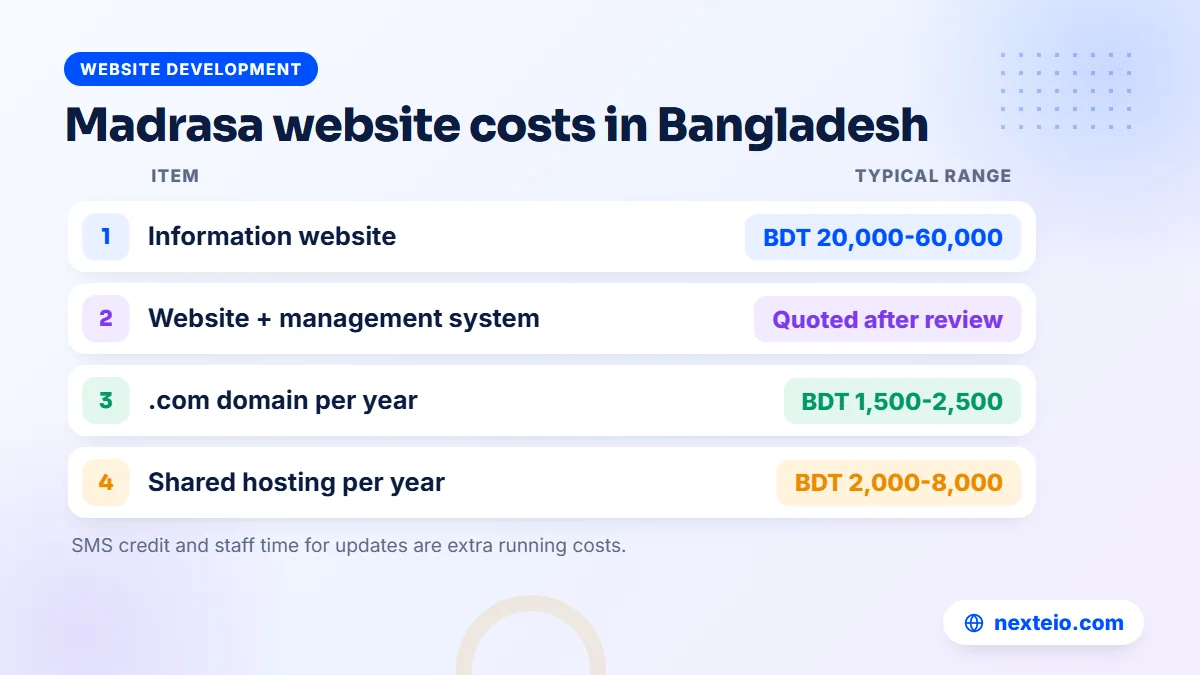
Costs depend on what the madrasa wants the site to do. A site that shows information is one thing. A site connected to admission, results, fees and donations is a software project. The table below shows typical market ranges in Bangladesh.
| Item | Typical market range | Notes |
|---|---|---|
| School or madrasa information website | BDT 20,000 to 60,000 | Pages, notices, gallery, contact; depends on design and page count |
| Website with a management system | Quoted after a requirements review | Often BDT 150,000 to 1,200,000 or more, depending on modules and users |
| .com domain | About BDT 1,500 to 2,500 a year | Renew on time and keep it in the madrasa's name |
| Shared hosting | About BDT 2,000 to 8,000 a year | Larger systems may need stronger hosting |
Ongoing costs also include SMS credit if the madrasa sends notices and absence alerts by SMS, and the time of the staff member who keeps the site updated. Budget for these from the start, because a site without updates quickly loses its value.
We do not publish a fixed price for our Madrasa Management Software. The cost depends on the madrasa's needs, hosting and setup. A simple information site can be built through our custom website design service, and a full system is quoted after we understand your requirements. You can request a quote through our project form.
Common Madrasa Website Mistakes
Most weak madrasa websites share the same problems. None of them is hard to fix once you know to look for it.
- A Facebook page treated as the website. Notices disappear in the feed, and the madrasa does not control the page's future.
- Notices posted only as photos. They are hard to read on a phone and cannot be searched.
- Old information left on the homepage. Last year's admission dates or fees confuse families.
- The domain in one person's name. When that person leaves, the madrasa can lose its address.
- No clear fund separation for donations. Donors hesitate when Zakat and general donations look mixed.
- Heavy images and sliders. The site loads slowly on mobile data.
- Nobody responsible for updates. The site is launched, then forgotten.
The last mistake is the most common.
Before launch, name the person who posts notices, the person who approves them and how often each section will be checked. A site that is updated every week will do more for the madrasa than an expensive design that is never touched.
Website Only or Madrasa Website Plus Management System?
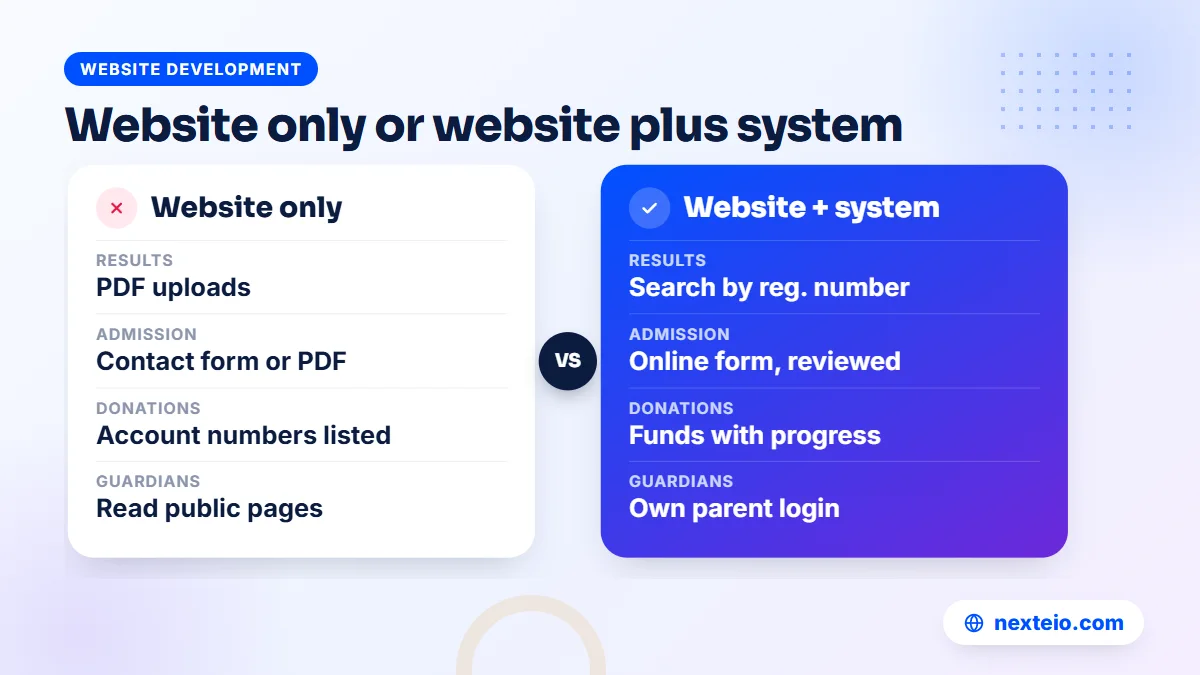
Some madrasas need only a public website. Others find that the website works best when it is connected to the office system, because results, fees, admission and donations all start in the office. The right choice depends on the size of the madrasa and how much of its work is still on paper.
A website alone suits a small madrasa with few students, where the office is comfortable with registers and the main need is a public presence. A WordPress website or a site from our madrasa website design work can handle notices, pages and a gallery well.
A connected system suits a madrasa with several departments, a hostel, many guardians and regular donations. In that case, results published on the site come straight from the marks entered in the office, the admission form feeds the student records, and the donation page matches the accounts. Our guide to madrasa management software explains what such a system should cover, department by department.
Our Madrasa Management Software combines both. Alongside the public website, it includes an office dashboard, a teacher and staff app and a parent app, with attendance, fees, exams, the daily Hifz report, Befaq registration, accounts, canteen, library and SMS. It is built with Laravel, and our Laravel web application service covers custom additions where a madrasa needs them.
If you are unsure, start by listing the jobs the office does every week and the questions guardians ask most often. If most of those jobs involve information that should appear on the website, a connected system will save time. If not, a well-built information site is a sensible first step.
How Nexteio Can Help Your Madrasa Online
At Nexteio, we build madrasa websites in two ways. For a madrasa that needs a public presence, we design and build an information site through our custom website design service, with the pages, notices and Bangla and English content described in this guide.
For a madrasa that wants the website and office work in one place, we set up our Madrasa Management Software on the madrasa's own domain and hosting, with its own name and logo. During setup we connect the SMS company and bKash for fees and website donations, and we can import existing student data. Try the live madrasa demo first: you can log in with one click as the muhtamim, the accountant, a teacher or a guardian, and the demo data resets every 30 minutes.
You can see a finished example in our madrasa website project, browse the rest of our portfolio or see all our services. When you are ready, send your requirements through the project form for a quote, or reach us on the contact page.
Keep reading: learning management systems for schools, what a website really costs in Bangladesh, or browse all our website development guides.
Frequently asked questions
Does a small madrasa really need a website if it has a Facebook page?
A Facebook page is useful for sharing news, but notices disappear in the feed and the madrasa does not control the page's rules or future. A website gives a permanent place for notices, admission details, fees, results and donation information that families and donors can find through search. Many madrasas use both, with Facebook posts linking back to the website.
Should our madrasa website be in Bangla or English?
Bangla should come first, because most guardians read notices in Bangla. English helps donors abroad, alumni and other institutions. A site with a simple language switch lets the office publish both without maintaining two separate websites.
Can we accept Zakat and other donations online through the website?
Yes, if a payment method is connected. Our Madrasa Management Software supports online donations through bKash Tokenized Checkout, which we connect during setup, and keeps Zakat, Lillah, Sadaqah, construction and general funds separate. Card payments are not part of the current version, but cash, Nagad and bank transfers can be recorded by hand in the accounts.
How should a madrasa publish exam results online?
A result search by registration number is better than a large image or PDF. Each guardian sees only their own child's result, the page loads quickly on mobile data, and other students' results stay private. Central results such as Befaq results can be shown on a separate page.
Is it acceptable to show students' photos on a madrasa website?
That is a decision for the madrasa's leadership and scholars. Many madrasas choose to show buildings, events and teachers rather than close-ups of children, and handle photos of female students with particular care. Whatever policy you set, write it down and apply it to every album.
How long does it take to build a madrasa website?
A simple information site usually takes a few weeks, most of it spent collecting content such as the madrasa's history, teacher details, fees and photos. A site connected to a management system takes longer, because student data, classes, fees and staff roles need to be set up and checked before launch.
Who should update the madrasa website after launch?
Name one office staff member to post notices and updates, and one senior person, such as the muhtamim or head teacher, to approve them. The developer should handle backups, security and technical updates. A website that is updated every week does far more for the madrasa than one that is launched and forgotten.