Hifz Quran Progress: How a Madrasa Can Track Sabak, Sabqi and Amukhta
In this article 16 sections
- 1.What Hifz Quran Progress Tracking Actually Means
- 2.Why Paper Registers Break Down in a Busy Hifz Program
- 3.What a Good Daily Hifz Record Should Capture
- 4.Setting Daily Targets That Fit Each Student
- 5.Counting and Recording Mistakes Fairly
- 6.Revision Cycles: Keeping Sabqi and Amukhta Strong
- 7.Weekly and Monthly Reviews for the Hifz Quran Department
- 8.Keeping Guardians Informed Without Extra Work for Teachers
- 9.Hifz Students in a Residential Madrasa: Attendance, Leave and Routine
- 10.Exams, Befaq Hifz Results and Completion Records
- 11.Choosing Hifz Quran Tracking Software: What to Check
- 12.Moving From Paper to Software Without Disrupting Classes
- 13.Common Mistakes Madrasas Make When Tracking Hifz Quran Progress
- 14.How a Hifz Record Fits Into the Wider Madrasa System
- 15.How Nexteio Can Help Your Hifz Department
- 16.Frequently asked questions
Hifz Quran progress is easy to lose track of when one teacher listens to twenty or thirty students every morning. Each student recites a new lesson, revises recent pages and keeps older paras fresh, and each of those three parts can slip without anyone noticing for weeks. A clear daily record of sabak, sabqi and amukhta is what keeps a student moving forward without forgetting what was learned last month.
Most madrasas in Bangladesh still keep the Hifz Quran record in a register, a khata or the teacher's memory. That works while the class is small and the teacher never changes. It starts to break when the Hifz department grows, when a teacher goes on leave, or when a guardian asks why a child who finished ten paras is struggling to recite the third.
This guide is written for the people who run the department: the muhtamim, the head of the Hifz section, the teachers and the office staff who support them. It covers what to record each day, how to set fair targets, how to count mistakes, how to plan revision cycles and how to share progress with guardians.
It also explains what to look for in software, and shows how our Madrasa Management Software handles the daily Hifz report, so you can judge whether a digital record would help your own madrasa.
What Hifz Quran Progress Tracking Actually Means
Hifz ul Quran, the memorization of the whole Quran, is not a straight line from the first page to the last. A student adds new lines every day, but the same student must also keep every earlier page strong. Hifz Quran progress tracking means recording both sides of that work: how far the student has moved forward and how well the old portions are holding.
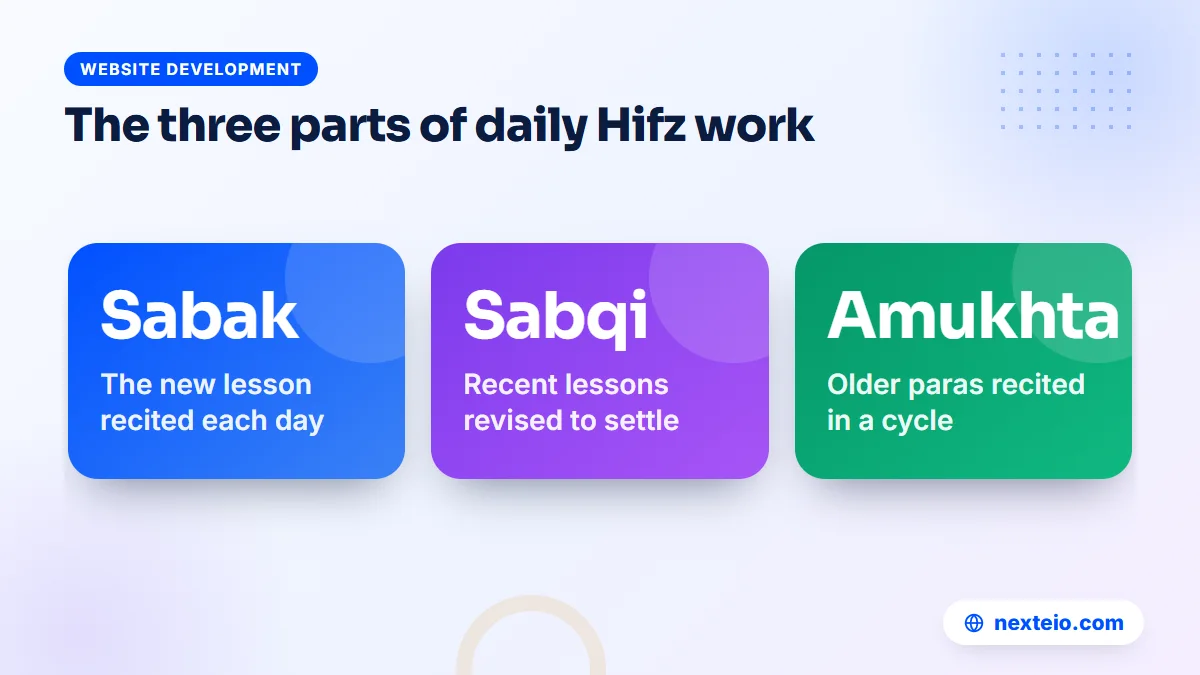
Most Hifz teachers in Bangladesh organize the daily work into three parts. The names can differ slightly from one madrasa to another, but the idea is the same:
- Sabak: the new lesson. The student memorizes a fixed portion, often a number of lines or a part of a page, and recites it to the teacher.
- Sabqi: the recent revision. The student recites the portions learned over the last several days or the current para, so new memory settles before it fades.
- Amukhta: the older revision. The student recites a set amount from paras completed earlier, moving through all of them in a cycle.
A student who does well in sabak but poorly in amukhta is building on a weak base. A student who is strong in amukhta but slow in sabak may need a smaller daily target or more time with the teacher. Only a record of all three shows the full picture.
Tracking also covers the position in the Quran. The teacher needs to know the current para, the surah and the ayat range of each recitation. Without that, the record says "sabak done" but cannot tell anyone where the student actually is.
Why Paper Registers Break Down in a Busy Hifz Program
A paper register is cheap and familiar, and many good huffaz were trained with nothing more. The problem is not the paper itself. It is what happens when a Hifz program grows and more people need the same information.
Here are the most common problems madrasa heads describe:
- The register stays with one teacher, so the muhtamim only sees progress when he asks for it.
- Entries get shorter on busy days, and "sabak OK" replaces the surah and ayat range.
- Mistakes are rarely written down, so a weak para is only noticed when the student fails to recite it in an exam.
- When a teacher leaves or changes shifts, the new teacher starts with little history.
- Guardians, especially those of residential students, hear about progress only on visiting days.
- Monthly summaries have to be counted by hand, which takes hours that nobody has.
None of these problems means a teacher is careless.
A teacher listening to a full class between Fajr and breakfast simply does not have time to write long notes and add up totals. The record has to be quick to fill in, or it will not be filled in at all.
That is the real test for any system, paper or digital. If it takes longer than a minute per student, it will slowly be skipped. If it is quick and the summary appears without extra work, teachers keep using it because it helps them.
What a Good Daily Hifz Record Should Capture
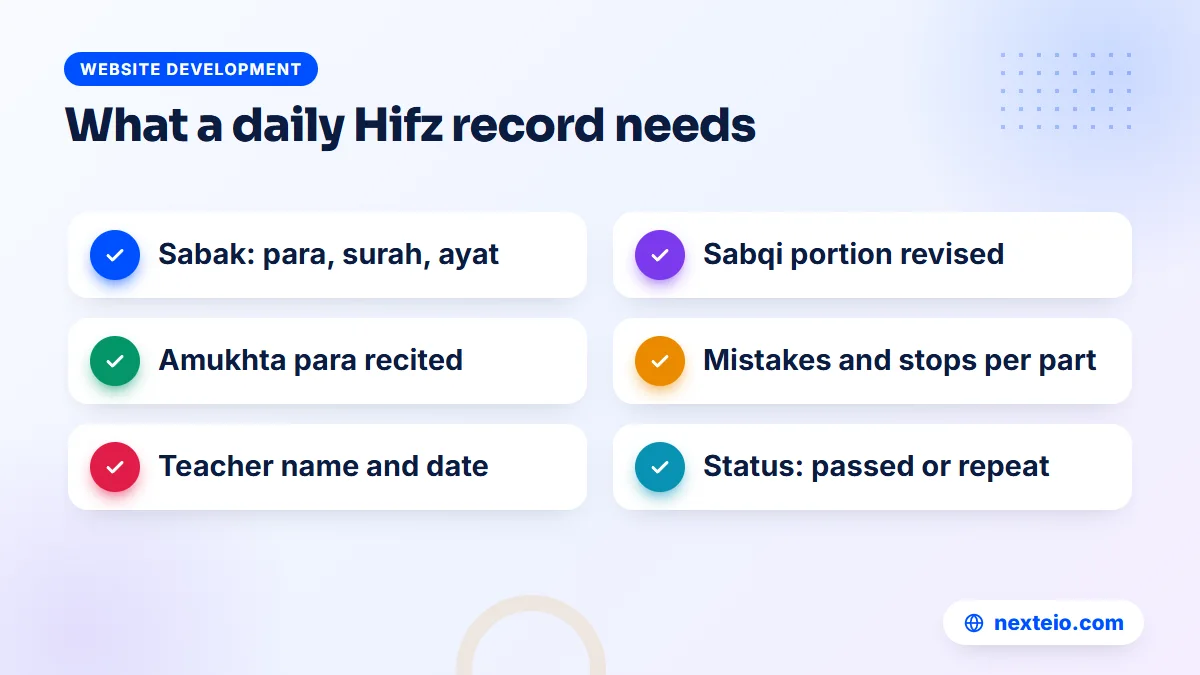
Before choosing any tool, agree inside the madrasa on what a daily Hifz Quran entry must contain. This step matters more than the software. A department that records the same fields every day can compare students, teachers and months fairly.
| Field | What to record | Why it matters |
|---|---|---|
| Date and teacher | Who heard the recitation and when | Keeps the record accountable when teachers change |
| Sabak | Para, surah and ayat range of the new lesson | Shows the exact forward position |
| Sabqi | The recent portion revised that day | Shows whether new memory is settling |
| Amukhta | The older para or portion recited | Shows whether earlier paras are holding |
| Mistakes | Number of mistakes and stops in each part | The early warning sign of a weak portion |
| Status or remark | Passed, repeat tomorrow, or a short note | Tells the next teacher what to do |
Some madrasas also record the student's attendance in the Hifz class separately from general attendance, because a student may be present in the madrasa but absent from the early session. Others add a field for tajweed comments. Keep the extra fields few. Each one adds time to every entry, every day.
Our Madrasa Management Software was built around this same structure. Its daily Hifz report records sabak, sabqi and amukhta, the para, the surah and ayat range, and the mistakes for each student, which is the core of what a Hifz teacher writes in a register today.
Setting Daily Targets That Fit Each Student
Daily targets are where a Hifz Quran class shows its quality. A target that is too high leads to weak memorization and a growing pile of forgotten pages. A target that is too low wastes years. Experienced teachers adjust the target for each student rather than giving the whole class the same amount.
A practical way to set targets is to start small in the first weeks and increase slowly. A young student might begin with a few lines of sabak, while an older student with strong recitation may handle much more. The right amount is the one the student can recite cleanly the next day and still recall a week later.
Signs a target needs to change
- The student completes sabak every day, but sabqi mistakes keep rising.
- The same sabak has to be repeated several days in a row.
- Amukhta of recent paras is already weak only a few weeks after they were finished.
- The student finishes sabak very quickly and recites it with almost no mistakes over a long period.
The first three signs suggest lowering the target or adding revision time. The last one suggests the student can take more. A written record makes these patterns visible. Without it, the teacher relies on impression, and impressions are easily shaped by how a student behaves rather than how well he memorizes.
Targets should also respect the calendar. Ramadan, exam weeks and long holidays change the routine. Many madrasas reduce new sabak before a Befaq exam and spend more time on revision. Recording these planned changes avoids the wrong conclusion later that a student "slowed down" for no reason.
Counting and Recording Mistakes Fairly
Mistake counts are the most useful number in Hifz Quran tracking, and also the most sensitive. A count that is recorded carelessly can discourage a hardworking student. A count that is recorded consistently becomes the clearest guide to where revision is needed.
Agree inside the department on what counts as a mistake. Teachers usually separate at least two kinds:
- Stops: the student hesitates, gets stuck and needs a prompt to continue.
- Errors: a wrong word, a skipped line, a mixed-up ayat or a pronunciation fault the teacher corrects.
Some teachers also note which portion caused the trouble. That small detail is valuable. If a student keeps stumbling on the same few pages in amukhta, those pages can be added to sabqi for a week until they are strong again.
The aim of counting is to guide revision, not to rank children against each other in public. Many madrasas share mistake counts only with the student, the teacher and the guardian, and use them to plan the next week. Questions about how strictly to treat a particular kind of error belong with the senior teachers and scholars of the madrasa, and the record should simply follow the standard they set.
Consistency between teachers matters too. If one teacher records every hesitation and another records only serious errors, comparing their students is meaningless. A short written guide for the department, agreed once and reviewed each year, solves most of this.
Revision Cycles: Keeping Sabqi and Amukhta Strong
Revision is where most memorization is won or lost. A Hifz Quran student who has finished fifteen paras needs a cycle that brings each of those paras back regularly. If the cycle is too long, the oldest paras fade before their turn comes. If it is too short, there is no time left for new sabak.
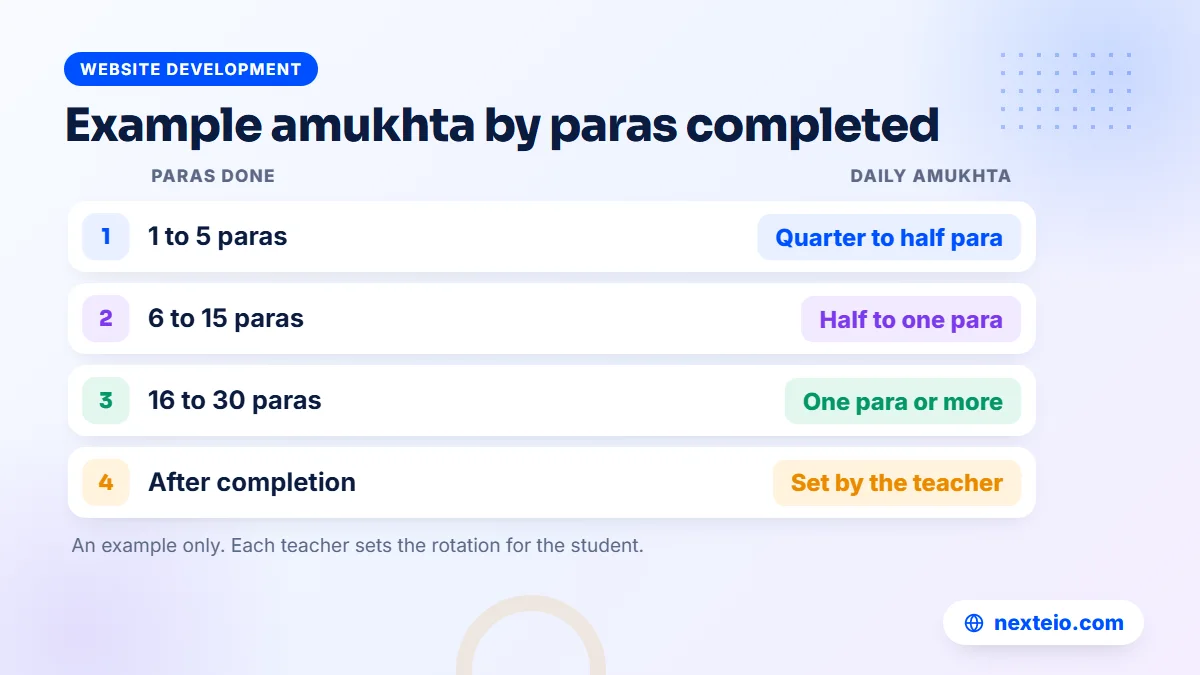
The usual approach is to divide the completed paras into a rotation. The size of each day's amukhta grows as the student completes more of the Quran. Here is an illustrative example of how a madrasa might adjust the amukhta portion as a student progresses:
| Paras completed | Example daily amukhta | Approximate cycle |
|---|---|---|
| 1 to 5 | A quarter to half a para | Every para returns within about two weeks |
| 6 to 15 | Half a para to one para | Every para returns within two to three weeks |
| 16 to 30 | One para or more | Every para returns within three to four weeks |
| After completion | Set by the teacher, often several paras | A full cycle of the Quran on a fixed rhythm |
These numbers are only an example. Each madrasa and each teacher sets the actual rotation according to the student's age, strength and routine. The point is that the cycle should be written down, so anyone can check whether a para is overdue.
A daily record makes overdue paras easy to find. If the amukhta column shows that para 4 has not been recited for five weeks, the teacher knows exactly where to look. Without a record, that gap is only discovered when the student falters in front of an examiner.
Related guides for madrasa and school leaders planning their systems:
- Educational website design for schools, colleges and madrasas
- Learning management systems for schools: features, costs and setup
- School management software: features a school in Bangladesh needs
Weekly and Monthly Reviews for the Hifz Quran Department
Daily records are for the teacher. Weekly and monthly reviews are for the head of the department and the muhtamim. Their questions are different: which students are stuck, which teachers need support, and whether the department as a whole is moving at a healthy pace.
A simple monthly review can follow these steps:
- List each student's position at the start and end of the month: para, surah and ayat.
- Note the number of days with sabak completed and the days it was repeated.
- Look at the trend of mistakes in sabqi and amukhta, not just the total.
- Mark students whose amukhta mistakes are rising, even if their sabak looks fine.
- Meet each teacher briefly to agree on changes for the coming month.
The review should end with decisions, not just numbers. A student may get a smaller sabak, an extra revision session or a different teacher for amukhta. Writing the decision next to the review means next month's meeting can check whether it worked.
Good reviews also recognize effort. Many madrasas keep a Hifz honor board for students who complete the Quran, and some mention steady improvement as well. Recognition is far more motivating when it is based on a fair record that everyone trusts.
With our Madrasa Management Software, the daily Hifz reports sit in one place, so the muhtamim and the department head can open a student's history without collecting registers from the classroom. The madrasa's website can also show a Hifz honor board, which many guardians and well-wishers like to see.
Keeping Guardians Informed Without Extra Work for Teachers
Guardians of Hifz Quran students often feel far from the process. In a residential madrasa, a father may visit once a month. In a day madrasa, the child comes home tired and says little about the lesson. When progress is shared clearly, guardians support the routine at home and are less likely to be surprised by a weak exam.
The challenge is that teachers do not have time to call every family. The information has to flow from the daily record itself. A good approach is to share three kinds of updates:
- Daily: attendance and the day's lesson, visible to the guardian without a phone call.
- Exceptions: an SMS when the student is absent, so the family knows the same day.
- Periodic: exam results and a short teacher remark, shared at the end of each term.
Our Madrasa Management Software includes a parent app that guardians open on their phone at the /parent address of the madrasa's own site. After logging in with a mobile number and password, or an SMS one-time code, a guardian can see attendance, daily lessons, results, fees, notices and messages, and can switch between children if more than one studies there. Guardians whose madrasa connects bKash can also pay fees from the app.
When a guardian adds the parent app to the phone's home screen from Chrome, and the site runs on HTTPS, the app can send instant notifications and a daily summary at 8 PM. Google explains how this works in its guide to installing web apps in Chrome. The absence SMS works separately through the madrasa's SMS company. Our guide to running an online madrasah explains how to help guardians install the app during the first week.
Respect privacy as well. Each guardian should only see their own child, and mistake counts should be explained with context. A message like "three stops in para 6 amukhta, we will revise it this week" builds trust. A bare number with no explanation can cause worry at home.
Hifz Students in a Residential Madrasa: Attendance, Leave and Routine
Many Hifz Quran students live in the madrasa. Their day starts before Fajr and runs through several sessions, meals, rest and study. Tracking progress in a residential setting means tracking more than the lesson. A student who was out on leave, unwell or late back from home cannot be judged on the same scale as one who attended every session.
Useful records for a residential Hifz department include:
- Session attendance, including the early morning class.
- Leave and gate passes, with the time a student left and returned.
- Hostel room and guardian contact details, kept current.
- Health notes that explain a sudden drop in performance.
Our Madrasa Management Software handles several of these alongside the Hifz report. It keeps student profiles with guardians and hostel rooms, takes student and staff attendance, and sends an SMS to the guardian when a student is absent. Its gate pass feature records who is outside and for how long, and raises an alert when a student is late returning.
Attendance can be taken by hand or with a QR gate scanner, where a phone or laptop camera reads the student's ID card at entry, break and exit and marks them present or late. For a residential madrasa, this removes the morning roll call bottleneck and gives the office an accurate picture before the first class ends.
Some madrasas also track daily deeds, known as amal, and self-accounting, or muhasaba, as part of character training. The software includes a muhasaba and amal record with a ranking, which a madrasa can use or switch off according to its own approach.
Exams, Befaq Hifz Results and Completion Records
Daily tracking prepares Hifz Quran students for formal exams. In Bangladesh, many Qawmi madrasas send Hifz students to the central exams of Befaqul Madarisil Arabia Bangladesh, known as Befaq, alongside their own internal tests. Alia madrasas follow a different system under the Directorate of Madrasah Education and the Madrasah Education Board, and some Alia madrasas also keep a Hifz section.
Whatever the exam route, the madrasa needs three kinds of records:
- Internal exam marks and results for each term.
- Registration details and results for central exams such as Befaq.
- A completion record when a student finishes the whole Quran, with the date and the teacher.
Befaq results use divisions, commonly Mumtaz, Jayyid Jiddan, Jayyid and Maqbul. Our Madrasa Management Software supports these divisions for Qawmi, Hifz and Nurani results, and GPA for Alia. It also includes Befaq registration and a Befaq report covering Ibtidaiyyah to Takmil and Hifz, and the website can publish Befaq results.
For completion, the software can issue testimonials and transfer certificates with a serial number and a QR code, and the public website offers a certificate check by serial number or QR. That helps when a hafiz moves to another madrasa or applies for further study, because the receiving institution can confirm the document is genuine.
Choosing Hifz Quran Tracking Software: What to Check
If you decide a digital record would help, judge any software against the way your Hifz department really works. A good-looking dashboard means little if teachers cannot fill in the daily report quickly between students.
Use this checklist when you see a demo:
- Does the daily entry separate sabak, sabqi and amukhta, with para, surah and ayat?
- Can mistakes be recorded for each part, quickly?
- Can the muhtamim see one student's full history on one screen?
- Can guardians see daily lessons and attendance without calling the office?
- Does it handle the rest of the madrasa too: admission, fees, exams, hostel and accounts?
- Can each role see only what it should, set by the madrasa?
- Does it work in Bangla and English, on a phone with a slow connection?
- Who holds the data, and how are backups made and restored?
The last point deserves attention, because a Hifz record built over years is valuable.
Ask where it is hosted, whether it runs on the madrasa's own domain and how backups work. Our software runs on the madrasa's own domain and hosting, takes a nightly backup with download and restore, and can keep an optional copy in Google Drive.
Security is the other question to ask. Staff accounts can hold guardian phone numbers, fee records and student details. Two-step login, a login history and an audit log help the office see who changed what. Our system supports two-factor login through Google Authenticator, QR login on phone, login history and an audit log.
What it costs
Prices for madrasa and school management systems vary widely, because they depend on the modules, the number of students and users, hosting and setup work. Custom software of this kind is usually quoted after a requirements review. As a broad market guide, custom management systems in Bangladesh often range from about BDT 150,000 to 1,200,000 or more, depending on scope.
We do not publish a fixed price for our own software. The best way to get a clear figure is to try the demo, list what your madrasa needs, and ask us for a quote through the project form. If your needs go beyond the standard modules, our Laravel web application service covers custom additions.
Moving From Paper to Software Without Disrupting Classes
The worst time to change a Hifz Quran record system is the week before an exam. The best time is the start of a term or the weeks after a long holiday, when routines are being reset anyway. Plan the change so that no student's history is lost and no teacher feels rushed.
A practical sequence looks like this:
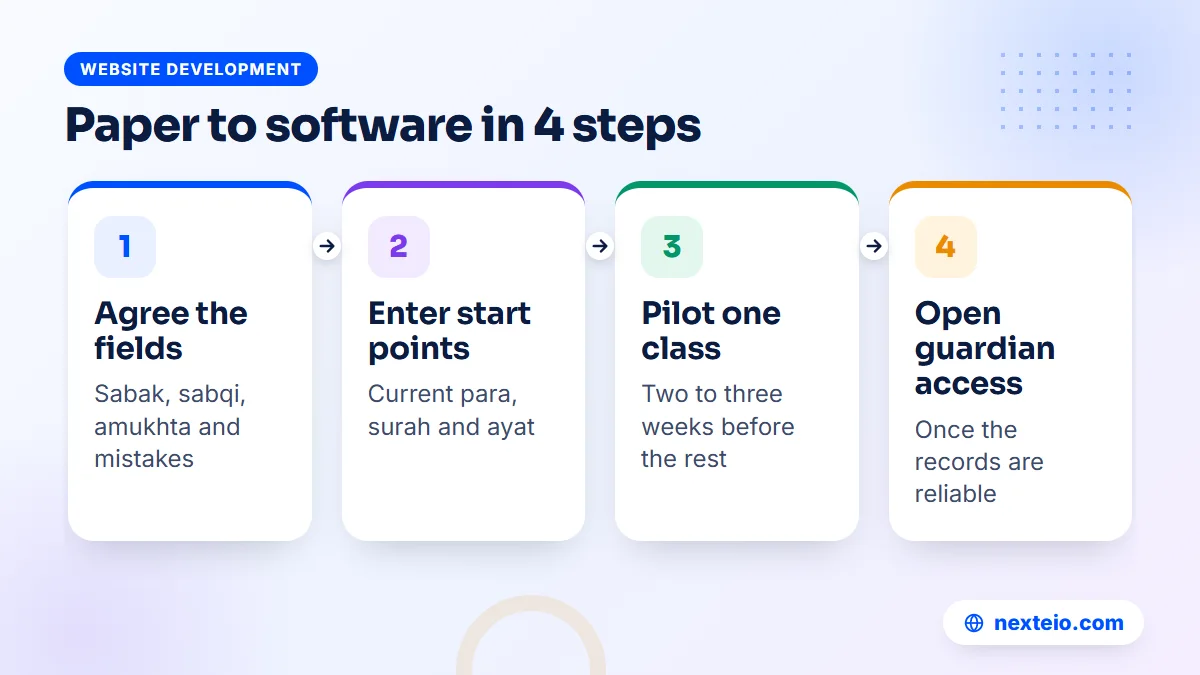
- Agree the fields. Decide what a daily entry contains and how mistakes are counted.
- Record the starting point. For each student, enter the current para, surah and ayat, plus completed paras.
- Run one class first. Let one teacher use the system for two or three weeks while others continue on paper.
- Fix the routine. Adjust who enters data and when, based on what the first teacher found.
- Extend to all classes. Then open guardian access once the records are reliable.
Keep the paper registers for a while after switching. They are the backup if something was entered wrongly during the first weeks, and some older teachers will feel more comfortable knowing the old record still exists.
Think about who enters the data. In some madrasas the Hifz teacher enters it during the session on a phone. In others, the teacher marks a small slip and an office assistant enters it later. Both can work. Our software lets the madrasa set permissions for each role with simple ticks, so the arrangement can match your staff rather than forcing one method. If your department follows a very different routine, that workflow can be built as custom Laravel development on top of the standard system.
Connectivity is a real concern in many parts of Bangladesh. Pages in our system are built mobile-first and load quickly, but a madrasa should still test the daily entry on the actual phones and networks its teachers use. Load-shedding affects office computers more than phones, so a phone-based routine is often more reliable for early morning sessions.
Common Mistakes Madrasas Make When Tracking Hifz Quran Progress
Most problems with Hifz records are not technical. They come from habits that slowly weaken the record until nobody trusts it. These are the most common ones:
- Recording only sabak. Forward progress looks good on paper while old paras quietly fade.
- No agreed mistake standard. Each teacher counts differently, so numbers cannot be compared.
- Reviewing too late. Problems are found at exam time instead of within a week or two.
- Too many fields. Teachers stop filling in long forms, and the record goes blank.
- Sharing raw numbers with guardians. Families see counts without context and worry.
- One person holds everything. The record disappears when that teacher leaves.
The fix for each is simple to describe and needs discipline to keep. Record all three parts, agree on a standard, review monthly, keep the form short, explain numbers to guardians and keep the record where the department can reach it.
A related mistake is buying software before the department agrees on its process. Software can make a good routine faster. It cannot decide what a mistake is or how big a sabak should be. Settle those questions first, then choose a tool that fits them.
How a Hifz Record Fits Into the Wider Madrasa System
A Hifz department rarely runs alone. The same madrasa usually has Nurani or Maktab classes, Kitab classes, perhaps an Alia section, a hostel, a kitchen, a library and an accounts office. When the Hifz record sits in a separate notebook, the office cannot connect it with fees, attendance or hostel information. Our guide to madrasa management software walks through what a system should cover in each of those departments.
Bringing these together has practical benefits. A guardian who calls about a fee can also hear about the child's progress. The muhtamim can see that a student's falling amukhta matches a period of absence. The accounts office can apply a fee concession, such as half, full or Lillah boarding, for a student the department has recommended.
Our Madrasa Management Software covers these areas in one system: admission, student profiles, attendance, fees with SMS receipts and reminders, exams and results, staff salaries, a canteen and library, and separate Zakat, Lillah, Sadaqah, construction and general funds. You can read how a madrasa website and office system work together in our Darul Uloom model madrasa project.
The public side matters too. Families looking for a Hifz Quran madrasa usually search on their phones, read the website and watch a recitation video before they visit. A clear site built through custom website design, basic search optimization so the madrasa appears for local searches, and well-edited recitation clips from a video editing service all help during admission season. Some madrasas also run small Facebook ad campaigns before admissions open, and point them to the online admission form.
If you are comparing broader options, our guides on campus management system software and custom software development explain when a ready product fits and when an institution needs its own build. The system itself is a Laravel web application, and our article on the Laravel framework explains why many institutions choose it for long-term systems. Laravel's own documentation is public for any technical staff who want to look deeper.
How Nexteio Can Help Your Hifz Department
At Nexteio, we built our Madrasa Management Software for Hifz, Qawmi Kitab, Alia and Nurani departments in Bangladesh, and the daily Hifz report is one of its core features. The best first step is to see it working. Open the live madrasa demo, log in with one click as the muhtamim, a teacher or a guardian, and try the Hifz report, attendance and the parent app. The demo data resets every 30 minutes, so you can test freely.
When a madrasa decides to go ahead, we set the software up on the madrasa's own domain and hosting, with its own name and logo. During setup we connect the SMS company and, where the madrasa wants it, bKash for fees and website donations. We can also import existing student data so the department does not start from an empty system.
If you need features beyond the standard modules, our Laravel development team can discuss custom additions. You can see the finished madrasa website in our madrasa portfolio project and other work in our portfolio, or read more about Nexteio. To get a quote, send your requirements through the project form, or reach us on the contact page.
Keep reading: what an organization should build first, web or app, accepting online payments in Bangladesh, or browse all our website development guides.
Frequently asked questions
What is the difference between sabak, sabqi and amukhta?
Sabak is the new portion a student memorizes and recites each day. Sabqi is the revision of recently learned portions, so new memory settles. Amukhta is the revision of older paras in a rotating cycle, so nothing learned months ago is forgotten. Some madrasas use slightly different names, but most Hifz teachers in Bangladesh follow this three-part structure.
How many lines should a Hifz student memorize each day?
There is no single correct amount. Teachers set the daily sabak for each student based on age, strength and how well yesterday's lesson and the revision went. A good rule is that the student should recite the new lesson cleanly the next day and still recall it a week later. If sabqi mistakes keep rising, the target is usually too high.
How long does a Hifz program usually take to complete?
It varies a great deal. Many students take a few years, but the time depends on the starting age, the daily hours, the size of each sabak and how much revision the teacher requires. Finishing quickly matters less than finishing with strong memory, which is why revision records are as important as forward progress.
Can guardians see their child's Hifz progress on a phone?
With our Madrasa Management Software, yes. Guardians log in to the parent app with a mobile number and password or an SMS code and can see attendance, daily lessons, results, fees and notices. If the madrasa runs on HTTPS and the guardian adds the app to the home screen from Chrome, phone notifications and a daily evening summary also work.
Does the software suit a madrasa that has Hifz, Kitab and Nurani sections together?
Yes. It was built for Hifz, Qawmi Kitab, Alia and Nurani or Maktab departments in one system. Each department keeps its own classes, and results can use Befaq divisions for Qawmi, Hifz and Nurani, or GPA for Alia. Fees, attendance, hostel and accounts are shared across the whole madrasa.
Do teachers need internet in the classroom to record the daily report?
The software is a web application, so entering data needs a connection, either on a phone or a computer. In practice, many madrasas let the teacher enter reports on a phone during the session, while others mark a short paper slip and have an office assistant enter it later the same day. Test both on your own network before deciding.
How much does Hifz Quran tracking software cost?
There is no fixed public price for our software, because the cost depends on the modules, the number of users, hosting and any custom work. Systems of this kind are usually quoted after a requirements review. Try the live demo first, list what your madrasa needs, and send it through our project form for a quote.