Non Profit Website Design for NGOs: Pages and Features That Matter
In this article 15 sections
- 1.What a Non Profit Website Design Has to Achieve
- 2.The 11 Pages Most NGOs Need
- 3.Building Trust: Governance, Registration and Financial Transparency
- 4.Program and Project Pages That Donors Actually Read
- 5.Telling Impact Stories Honestly and With Consent
- 6.Donation Pages and Payments in Bangladesh
- 7.Volunteers, Job Circulars and Procurement Notices
- 8.Bangla, English and Accessibility
- 9.Designing for Field Offices, Slow Connections and Small Teams
- 10.Choosing a Platform and Budget for an NGO Website
- 11.Search, Social Media and Free Google Tools for NGOs
- 12.Mistakes NGO Websites Often Make
- 13.Running the Project: Approvals, Donor Rules and Handover
- 14.How Nexteio Can Help With Non Profit Website Design
- 15.Frequently asked questions
Non profit website design is less about looking polished and more about earning trust from people who will never visit your office. For an NGO in Bangladesh, the website is where a donor's program officer checks your track record, where a government official confirms your registration, and where a young graduate looks for your latest job circular. Each of them is quietly asking the same question: is this organization real, accountable and worth working with?
Many NGO websites answer that question badly. The site was built for a past project, the latest annual report is three years old, and the only way to donate is a phone number that nobody answers after five o'clock. None of this reflects the actual work happening in the field, but visitors only see what is online.
The good news is that an NGO website does not need to be expensive or complicated. It needs the right pages, honest content, clear records and simple ways for people to help.
This guide covers the pages most NGOs need, how to show governance and financial transparency, how to structure program pages and impact stories, how to accept donations in Bangladesh, and how to plan the budget, platform and approvals for the project.
What a Non Profit Website Design Has to Achieve
A company website usually has one main goal: bring in customers. An NGO website has several goals at once, and they pull in different directions. It has to reassure institutional donors, inform the communities you serve, recruit staff and volunteers, and keep a public record of your work.
Start by listing who visits and what they need. For most NGOs and foundations in Bangladesh, the list looks something like this:
| Visitor | What they are looking for | Where the site should send them |
|---|---|---|
| Donor or funding agency | Track record, governance, financial reports, past partners | About, reports, program pages |
| Government or regulator | Registration details, areas of work, contact person | About page and footer |
| Community member or beneficiary | Services, eligibility, nearest office, complaint channel | Program pages and contact |
| Job seeker or volunteer | Open positions, deadlines, how to apply | Careers and volunteer pages |
| Individual or corporate donor | Causes, how money is used, how to give | Donate and impact pages |
| Journalist or researcher | Reports, data, media contact | Publications and news |
You cannot put all of these people at the top of the homepage. Decide which two groups matter most for the next few years, usually donors and the people you serve, and design the main routes for them. Everyone else should still find what they need within one or two clicks.
This is where non profit website design differs from ordinary web design. Accountability content, such as reports, policies and board details, is not an afterthought. For many visitors it is the main reason they came.
The 11 Pages Most NGOs Need
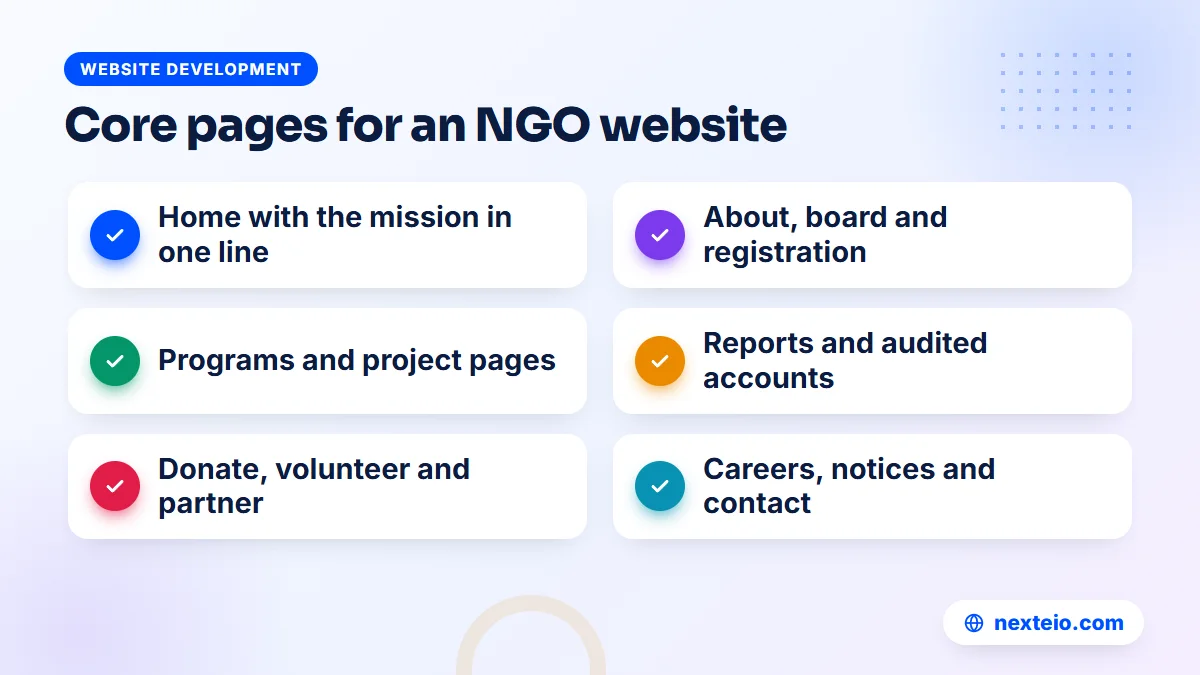
Small community organizations can start with fewer pages, and large international partners may need more. For most registered NGOs in Bangladesh, though, these eleven pages cover the essentials. Start with the pages that explain who you are and what you do:
- Home: your mission in one plain sentence, your main programs, a few results and clear routes to donate or partner.
- About and governance: history, mission, board or executive committee, senior staff and registration details.
- Programs: an overview of your thematic areas, such as health, education, livelihoods or climate resilience.
- Project pages: one page per major project, with location, partners, donors, activities and results.
- Impact and stories: real stories from the field, told with consent, plus key results.
- Reports and publications: annual reports, audited financial statements, research and policy briefs.
Then add the pages that help people act and that keep the organization accountable:
- News and events: updates, workshops and campaign news, kept current.
- Donate: clear options for giving, with an explanation of how funds are used.
- Volunteer and partner: how individuals, companies and organizations can work with you.
- Careers and notices: job circulars, procurement and tender notices, with dates.
- Contact and policies: head office and field offices, a feedback channel, and policies such as privacy and safeguarding.
Not every page needs to be large. A careers page with two open positions and a clear application process is better than a long page full of general statements. What matters is that each page exists, is easy to find in the menu, and is kept up to date.
Building Trust: Governance, Registration and Financial Transparency
Before a donor agency signs a grant, its staff usually check your website alongside the documents you send. If the website shows no board, no reports and no address beyond a phone number, the documents have to do all the work. A well-built transparency section makes due diligence faster and gives a good first impression. In non profit website design, this part of the site often matters more than the homepage.
What to show about governance
- The names and roles of board or executive committee members, with short profiles.
- Senior management, with photos and one or two lines each.
- Your legal registration details, such as the registering authority and registration number.
- Registration with the NGO Affairs Bureau, if you receive foreign funding, and with other regulators that apply to your work.
- Your head office address and the districts where you work.
Check registration numbers and names carefully before publishing them. A typo in a registration number on your own website looks careless to anyone who compares it with official records.
Financial transparency
Publish your annual reports and audited financial statements for recent years, with the year clearly marked in each file name and link. If you are not comfortable publishing full accounts, at least share a summary of income and spending by program, along with a note on how to request the full statements.
Policies belong here too. Many donors expect to see a safeguarding policy, an anti-fraud or anti-corruption policy, a complaints mechanism and a privacy policy. If you have them, link them from the footer of every page. If you do not have them yet, the website project is a good moment to ask your management to prepare them.
Program and Project Pages That Donors Actually Read
Program pages are the core of any NGO site, and they are where non profit website design most often falls short. Too many project pages are a single paragraph copied from a proposal, followed by a photo of a banner at a workshop. A program officer reading that page learns almost nothing about what you achieved.
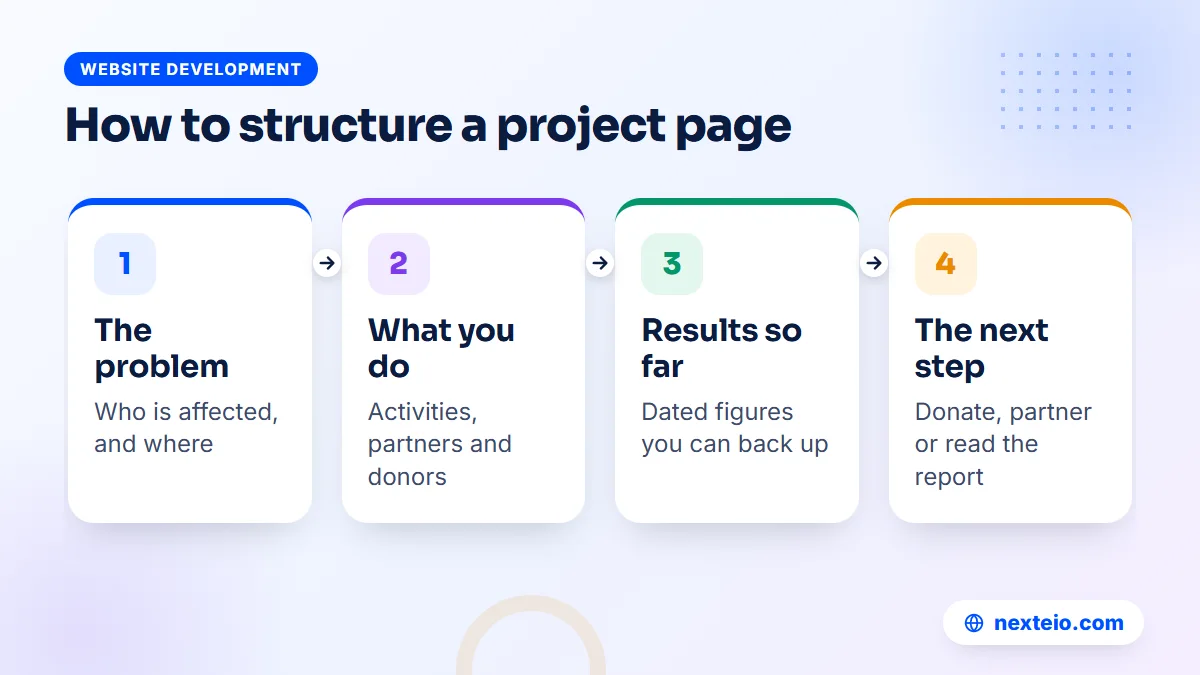
A better project page follows a predictable structure, so visitors can scan it quickly:
| Section | What to include |
|---|---|
| Summary | Two or three sentences on what the project does and for whom |
| Key facts | Location, duration, donor or funding partner, implementing partners |
| The problem | The local issue, explained with sources where you cite data |
| Activities | What your team actually does, in plain language |
| Results | Dated, verifiable outputs and outcomes, with the reporting period |
| Stories and media | One or two consented stories, photos or a short video |
| Documents | Links to related reports, evaluations or briefs |
Keep a status label on every project, such as "ongoing" or "completed in 2024". Completed projects should stay online as part of your track record, clearly marked, rather than being deleted. Donors often want to see what you did five years ago as much as what you are doing now.
If you run many projects, the site should let visitors filter them by theme, district or donor. That requires a little more planning in the build, but it turns a long, confusing list into a useful record. On a WordPress website, this is usually handled with custom post types and categories. A larger organization with a monitoring database may prefer a custom system.
Telling Impact Stories Honestly and With Consent
Stories are what make people care, and they are also where NGOs can do harm without meaning to. A photo of a child, a survivor of violence or a family in crisis can reach far more people online than it would in a printed report. Once published, it is hard to take back.
A few rules protect both the people in your stories and your organization:
- Get informed consent before publishing a person's name, photo or story, and record it.
- For children, get consent from a parent or guardian and avoid details that identify where they live.
- Change names and blur faces when the person could face risk, stigma or retaliation.
- Show people with dignity, as active participants rather than as helpless recipients.
- Use real figures only, with the period they cover and where they came from.
Numbers deserve as much care as photos. If your report says a project reached a certain number of households, use the same figure on the website, with the same period. Rounding up or mixing targets with achievements is easy to spot when a donor compares documents.
Short videos can tell a story well, especially on phones. Keep them short, add Bangla and English subtitles where possible, and host them on a video platform rather than uploading heavy files to your own server. If you need help turning field footage into a clean short film, our video editing service can cut it for both the website and social media.
Related guides that help with the content side of the project:
- How to write website content that people actually read
- Planning content for every stage of a visitor's journey
- What a business video edit includes and costs in Bangladesh
Donation Pages and Payments in Bangladesh
A donation page should make giving simple, and it should explain what happens to the money. Many NGO sites only list a bank account at the bottom of the contact page. That works for institutional partners who will send a formal transfer, but it loses individuals who want to give a small amount on their phone right now.
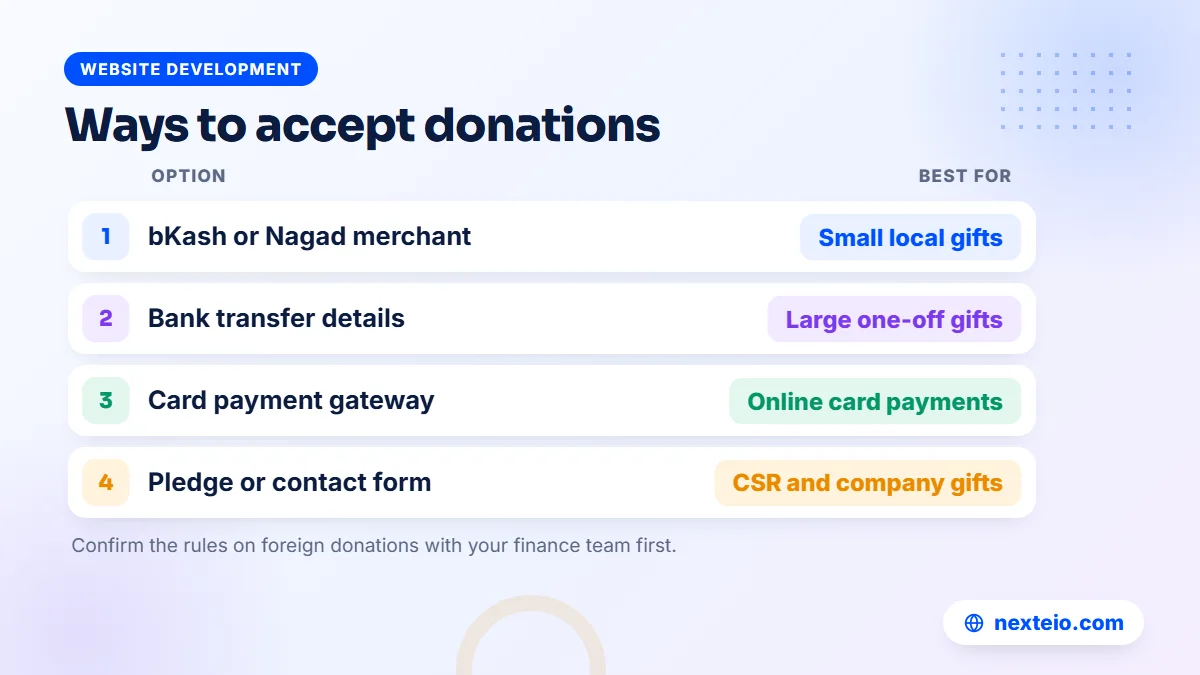
The right mix of options depends on who gives to you. Here is how the common choices compare:
| Option | Good for | Things to consider |
|---|---|---|
| bKash or Nagad merchant account | Small and medium local gifts from phones | Use an organization account, not a staff member's personal number |
| Bank transfer details | Large gifts, companies and institutions | Show the full account name exactly as registered |
| Online card payment gateway | Card payments through a checkout page | Needs a merchant agreement and proper reconciliation |
| Pledge or contact form | CSR partnerships and in-kind support | Someone must follow up within a working day or two |
A local payment gateway such as SSLCommerz can accept cards and mobile financial services in one checkout, but it needs a merchant agreement and the right paperwork from your organization. Donations from abroad raise a separate question. NGOs in Bangladesh that receive foreign contributions work under specific rules, so talk to your finance team and confirm what is allowed before you add an international donation option.
Whatever payment options you choose, the donate page in a non profit website design should be calm and clear. Say what a gift supports, show a few example amounts with what they mean in practice, and explain how donors will get a receipt. Avoid pressure tactics such as countdown timers. Trust is the reason people give to NGOs, and a donation page that feels pushy works against it.
Volunteers, Job Circulars and Procurement Notices
For many NGOs, the busiest pages on the website are not the program pages but the careers and notices section. Job circulars draw large numbers of visitors, and many applicants check the site daily during a recruitment season. Procurement and tender notices bring suppliers who need exact dates and documents.
These pages need a clear, consistent format:
- Every circular and notice shows a publish date and a deadline near the top.
- Expired notices move to an archive automatically or are clearly marked as closed.
- Each notice has a text version on the page, with the PDF as an extra, not the only copy.
- Application instructions say exactly what to send, where and by when.
- Volunteer forms ask only for what you need, and explain how the data is used.
The text version matters more than it seems. A scanned PDF image cannot be searched, read by screen readers or opened easily on a weak connection. A short text summary on the page, with the full PDF linked below it, helps both applicants and search engines.
Plan who will post these notices. In most organizations, HR and procurement staff should be able to publish them through the admin panel without calling the developer each time, using accounts with limited permissions rather than full administrator access.
Bangla, English and Accessibility
Most NGOs in Bangladesh work with two audiences who read different languages. Donors and international partners read English. Communities, local government and many volunteers read Bangla. A good non profit website design treats both languages as first-class, rather than translating a few pages and leaving the rest in English.
A practical approach is to decide which content each language needs. Donor-facing pages such as reports, governance and project summaries must be in English. Community-facing pages such as services, eligibility, office locations and complaint channels should be in Bangla. Key pages such as the homepage, about page and contact page should exist in both, with a clear language switch near the top of the screen.
Accessibility matters for every organization, and even more for NGOs that work with people with disabilities, older people or communities with lower literacy. Basic steps include:
- Readable text sizes and strong contrast between text and background.
- Descriptive alt text for meaningful images, written in the language of the page.
- Headings in a logical order, so screen readers can move through the page.
- Forms with clear labels, not only placeholder text inside the boxes.
- Bangla text set as real Unicode text, not as images.
The MDN accessibility guides explain these practices in detail for developers. If your organization works on disability rights, your website is a visible test of whether you practice what you advocate.
Designing for Field Offices, Slow Connections and Small Teams
NGO websites are often used in places with weak connections. Field staff open them on phones in rural upazilas, applicants check them on mobile data, and partner organizations download reports from offices with unstable internet. A site that loads well only in a city office is failing a large part of its audience.
Keep pages light. Compress photos before uploading, avoid autoplay video and heavy sliders, and keep PDFs reasonably small by exporting them properly instead of scanning printed pages. Our guide to website speed and SEO explains how lighter pages help both visitors and search rankings.
Hosting deserves attention too. A site hosted on a reliable data-centre server stays online during load-shedding at your office, and a basic uptime alert tells someone when it goes down. Keep the domain and hosting accounts in the organization's name, with an official email address, so they do not disappear when a staff member leaves.
Finally, design for the team you actually have. Most NGOs do not have a full-time web person. The admin panel should be simple enough that a communications officer can post a story, an HR officer can publish a circular, and a program officer can update a project page, each after a short training session.
Choosing a Platform and Budget for an NGO Website
For most non profit website design projects, WordPress is a sensible choice. It is widely known, easy for staff to update, and flexible enough for project pages, reports, news and notices. Our comparison of WordPress and custom websites explains the trade-offs in more detail.
A custom web application makes sense when the website needs to do real work behind the scenes. Examples include a beneficiary registration system, a monitoring and evaluation dashboard, a scholarship application portal or a member database for a network of partner organizations. These are better built as a Laravel web application with proper user roles and data protection.
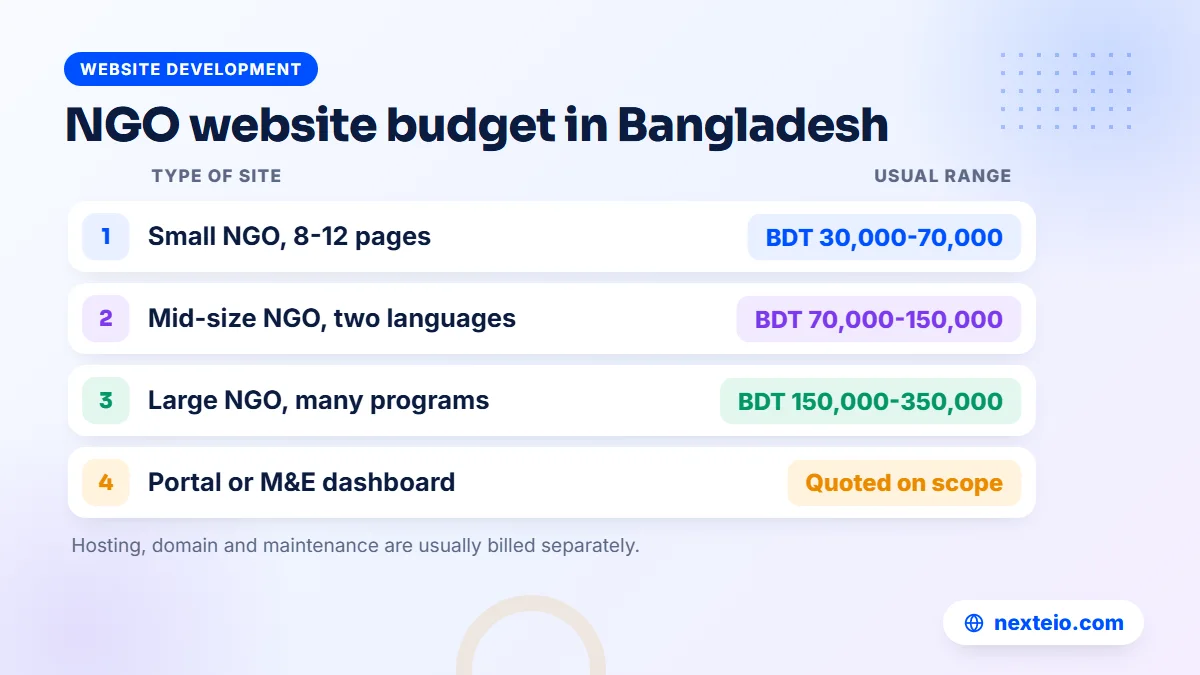
Budgets vary widely. In our experience, NGO websites in Bangladesh usually fall into these broad bands, depending on the number of pages, languages, features and how much content work is included:
- Small NGO or foundation site with eight to twelve pages: usually around BDT 30,000 to 70,000.
- Mid-size NGO site with project pages, reports, notices and two languages: often BDT 70,000 to 150,000.
- Large NGO site with many programs, filters and several editors: often BDT 150,000 to 350,000.
- Portals and dashboards: quoted on scope, since they vary most.
These are market ranges, not fixed prices. Hosting, domain renewal and ongoing maintenance are usually billed separately. If the website is funded through a donor project, check whether the budget line covers maintenance after the project ends, because many sites fall into neglect once the grant closes. At Nexteio, we can give you a figure based on your actual scope once you share your requirements.
Search, Social Media and Free Google Tools for NGOs
People search for NGOs in two ways. Some search your name directly, often after hearing about you from a partner. Others search for a cause or a service, such as a scholarship program, a legal aid service or a health camp in their district. Your site should be easy to find for both.
For name searches, the basics matter most: a clear homepage title, your full organization name and abbreviation in the text, and a consistent name across your website, social pages and directories. For cause and service searches, each program page needs useful, plain-language text that answers the questions people actually ask. Our SEO service handles this for organizations that want steady search visibility.
Structured data can help search engines understand who you are. Schema.org has a specific NGO type, and Google's guide to organization structured data explains how to describe your name, logo, address and contact details in a form search engines can read.
Google also runs Google for Nonprofits, which offers eligible organizations free or discounted tools, and in some cases advertising support through Ad Grants. Eligibility depends on your country and registration, so check the current rules for Bangladesh before you plan around it. If you run paid campaigns, our Facebook ads team can help you reach donors and volunteers, and our guide to Meta ads targeting in Bangladesh explains how audiences work.
Social media is useful for daily updates, but it does not replace a website. Facebook posts scroll away within days, while your website keeps a permanent, organized record that donors and officials can check years later.
Mistakes NGO Websites Often Make
Most weak NGO websites are not the result of bad intentions. They are the result of a site built once for a specific moment, then left alone while the organization grew. These are the most common problems:
- A project site, not an organization site: the website was built for one donor project and never expanded.
- Outdated reports: the latest annual report is several years old, which raises questions.
- Personal accounts: donations go to a staff member's mobile number, or the domain is registered in a former employee's name.
- Logo walls without context: donor logos shown with no explanation of the partnership or its dates.
- Scanned PDFs only: job circulars and reports that cannot be read on a phone or found in search.
- Missing contact details: no physical address, no named contact person and no field office information.
Each of these can be fixed without a full rebuild, but together they usually signal that the site needs a fresh, properly planned website.
Running the Project: Approvals, Donor Rules and Handover
NGO website projects often involve more people than company projects. The executive director, communications team, program heads, finance and sometimes the board all want a say. Donors may also have branding and visibility rules about how their logos and names appear on materials they fund, so check your grant agreements before design starts.
A simple process keeps things moving:
- Name one focal person who collects input from all departments and gives final feedback.
- Gather content first: reports, project summaries, photos with consent records and policies.
- Agree the page list and menu before the visual design begins.
- Review the design once with all decision-makers in one meeting, rather than in separate rounds.
- Train the staff who will update the site before launch, not after.
If your organization needs several quotations for procurement, ask each provider to quote against the same written scope, so you compare like with like. Our guide to hiring a WordPress developer lists the questions worth asking.
At handover, make sure the organization owns everything: the domain, the hosting account, the admin logins and a recent backup. Keep these details in a safe place known to at least two senior staff. Then plan for maintenance, since a site that nobody updates will slowly undo the trust it was built to create.
How Nexteio Can Help With Non Profit Website Design
We build websites for NGOs, foundations and development organizations across Bangladesh through our custom website design service. Every project starts with your audiences and your accountability needs: who funds you, who you serve, and which records must be easy to find.
From there, we plan the page list and menu with your focal person, then design and build the site with project pages, reports and publications, careers and notices, and donation options that fit how your supporters give. We set up Bangla and English content where you need it, keep pages light for slow connections, and give your staff simple admin accounts with training, so they can post stories and circulars without waiting for a developer.
When your work needs more than a website, such as an application portal or a monitoring dashboard, we can plan it as a custom web system built around your process. The domain, hosting and admin access stay in your organization's name. You can see examples in our portfolio, browse all our services, send us a project brief or contact us to talk it through. If you are comparing options, you can also read more about how we plan and build websites.
Keep reading: technical SEO basics every website owner should know, how to build a professional website that gets results, or browse all our website development guides.
Frequently asked questions
What pages should an NGO website have?
At minimum, a homepage, an about page with governance and registration details, program or project pages, reports and publications, a donate page, careers and notices, and a contact page with your policies. Larger organizations often add news, impact stories and a partner page. Good non profit website design keeps all of these within one or two clicks of the homepage.
Should an NGO publish its audited financial statements online?
Publishing recent audited statements or annual reports builds trust with donors and the public, and many donors look for them. If your board is not comfortable sharing full accounts, publish a clear summary of income and spending by program and explain how to request the full statements.
Can our NGO accept donations through bKash or Nagad on the website?
Yes, as long as you use an account registered in the organization's name rather than a staff member's personal number. You can show the merchant details on the donate page or connect a payment gateway that supports mobile financial services. Make sure your finance team can match every payment to a receipt.
Can we accept donations from abroad through our website?
NGOs in Bangladesh that receive foreign contributions work under specific regulations, so check with your finance team and the relevant authority before adding an international option. Once the rules are clear, a payment gateway or bank transfer details for foreign donors can be added to the donate page.
Is Facebook enough, or does an NGO really need a website?
A Facebook page is good for daily updates and reaching supporters, but posts disappear from view quickly and the platform controls what people see. A website gives donors, officials and partners a permanent, organized place to check your registration, reports and projects. Most NGOs benefit from both, with the website as the official record.
How long does it take to build an NGO website?
A small site can be ready in a few weeks once content is available, while a larger site with many projects, two languages and a reports library may take a couple of months. Content collection and internal approvals usually take longer than the design and build, so start gathering reports, photos and project summaries early.
Who should own the domain and hosting for an NGO website?
The organization itself, registered with an official email address and kept on record by at least two senior staff members. Your web provider can have its own login to do the work, but the main accounts should never depend on one staff member or an outside developer.