Web Design Services: What a Professional Package Should Include
In this article 16 sections
- 1.What Web Design Services Cover and How the Terms Differ
- 2.Discovery and the Project Brief
- 3.Sitemap, Content Plan and Wireframes
- 4.Visual Design That Fits Your Brand
- 5.Development: Turning Designs Into a Working Website
- 6.Content Entry, SEO Setup and Analytics at Launch
- 7.Speed, Accessibility and Testing on Real Devices
- 8.Launch, Training and Handover
- 9.What Professional Web Design Services Usually Leave Out
- 10.Template, Semi-Custom or Fully Custom: Three Levels of Service
- 11.Reading a Web Design Proposal Line by Line
- 12.What Web Design Services Cost in Bangladesh and How Long They Take
- 13.What You Need to Provide as the Client
- 14.After Launch: How to Tell Whether the Website Works
- 15.How Nexteio Can Help With Web Design Services
- 16.Frequently asked questions
Web design services cover far more than a nice-looking homepage. A professional package takes your organization from a rough idea to a working website that loads on a phone, explains what you do, collects inquiries and can be updated by your own staff. When a quote leaves out half of that, you usually find out after the final payment.
Two quotes for "a company website" can differ by five times in price, and both can be honest. One might include planning, custom design, content entry, search setup, testing and training. The other might be a theme installed with your logo dropped in. The words on the invoice look the same, and the result does not.
This guide lists what a proper package should include at each stage, what is usually charged separately, how to read a proposal line by line and what you need to provide from your side. It is written for the people who actually manage these projects: office managers, marketing officers, principals, administrators and business owners who need to get a site approved, built and launched without surprises.
What Web Design Services Cover and How the Terms Differ
The terms get used loosely, so it helps to separate them. Website design services cover planning and appearance: the structure of the site, page layouts, colors, type, images and how visitors move from page to page. Web development services cover the build: turning those designs into working code, setting up the content management system, forms, databases and any connections to other software.
Most agencies sell both together, and for an organization that is usually the right choice, because the designer and developer need to work as one team. You will also see "website building services", which often describes a lighter offer built on a template or a site builder. None of these labels is wrong. What matters is the list of deliverables behind the label.
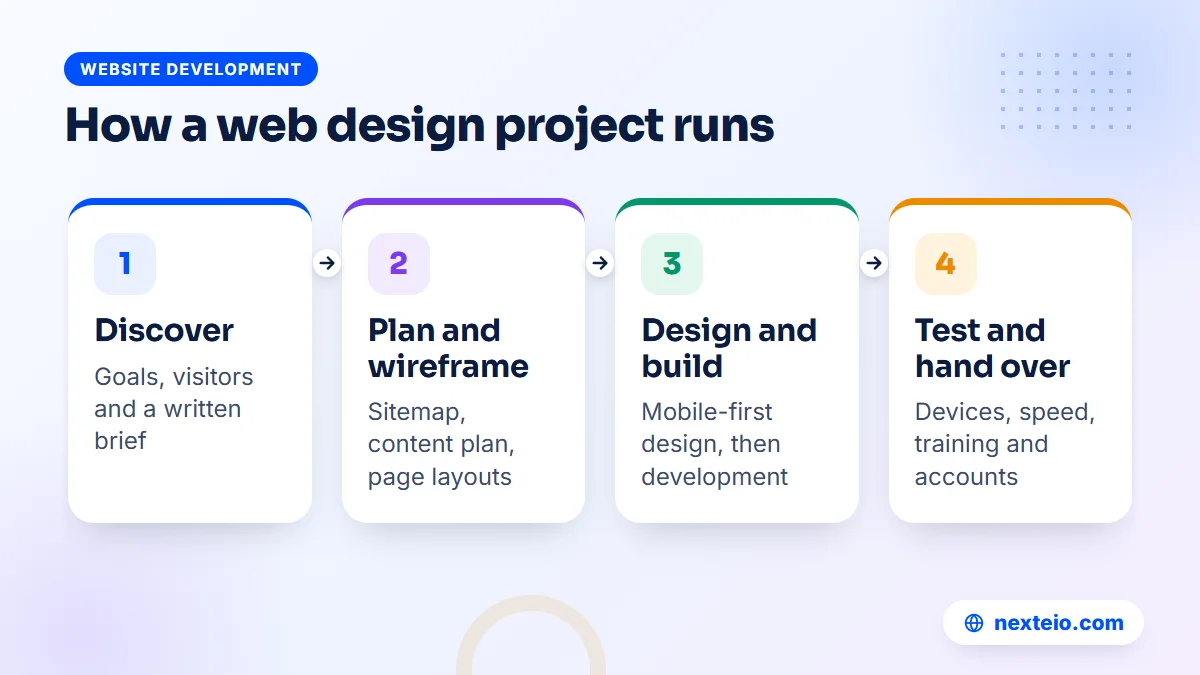
A complete package of web design services should cover these stages from start to finish:
- Discovery and a written brief.
- Sitemap, content plan and wireframes.
- Visual design for mobile and desktop.
- Development on a suitable platform.
- Content entry, basic SEO and analytics setup.
- Speed, accessibility and device testing.
- Launch, training and a full handover of accounts.
If a proposal skips a stage, ask who handles it. Sometimes the answer is reasonable, such as "you are writing the content yourselves". Sometimes nobody has thought about it, and that gap becomes your problem in week six.
Discovery and the Project Brief
Good web design services start with questions, not with colors. In the discovery stage, the provider learns who the site is for, what those visitors need to find or do, and what the organization wants in return: calls, admission inquiries, appointment requests, quote requests or donations.
Expect questions like these in the first meetings:
- Who are your main visitors, and what do they usually ask your staff by phone?
- What should a visitor do after reading the homepage?
- Which competitor or peer websites do you like or dislike, and why?
- Who will approve the design and content, and how long do approvals usually take?
- Do you need Bangla, English or both?
- What systems must the site connect to, such as an admission database, payment gateway, SMS service or ERP?
The output of discovery should be a written brief, usually two to five pages, that both sides agree on. It records the goals, the audience, the main pages, the features and any limits on budget or deadline. If the provider skips this and goes straight to design, every later disagreement becomes a matter of memory rather than a document.
A clinic, for example, may assume "online appointments" means a full booking calendar, while the designer assumes a simple request form. The brief is where that gets settled, at the cost of one conversation instead of two weeks of rework.
Sitemap, Content Plan and Wireframes
Once the brief is agreed, the provider turns it into a sitemap: a simple tree that shows every page and where it sits in the menu. For a corporate group, that might mean a main site with sections for each sister concern. For a college, it means admissions, departments, notices, results and contact, arranged so a guardian can find the right page in two taps.
Alongside the sitemap comes a content plan. It lists what each page needs, such as text, photos, documents or forms, and who will supply it. This is where many projects slip, because the organization assumed the agency would write the text, and the agency assumed it would arrive in a folder. Our guide to writing website content people actually read is useful here, even if your own staff will do the writing.
Wireframes before visual design
Wireframes are plain gray layouts that show what goes where on a page, without colors or final images. They let you approve structure before anyone spends time on visual polish. A good provider produces wireframes at least for the homepage, one inner page and any page with a form or a special feature.
Wireframes are also the cheapest place to make changes. Moving a section on a gray sketch takes minutes. Moving it after the design is coded can take a day. Ask to see wireframes for mobile as well as desktop, since most of your visitors in Bangladesh will open the site on a phone.
Visual Design That Fits Your Brand
Visual design applies your brand to the approved structure. The designer picks a color palette from your logo and brand guide, chooses fonts that read well in both English and Bangla, and designs the key pages as full mockups. You should see these mockups before any development starts.
A professional design stage should deliver:
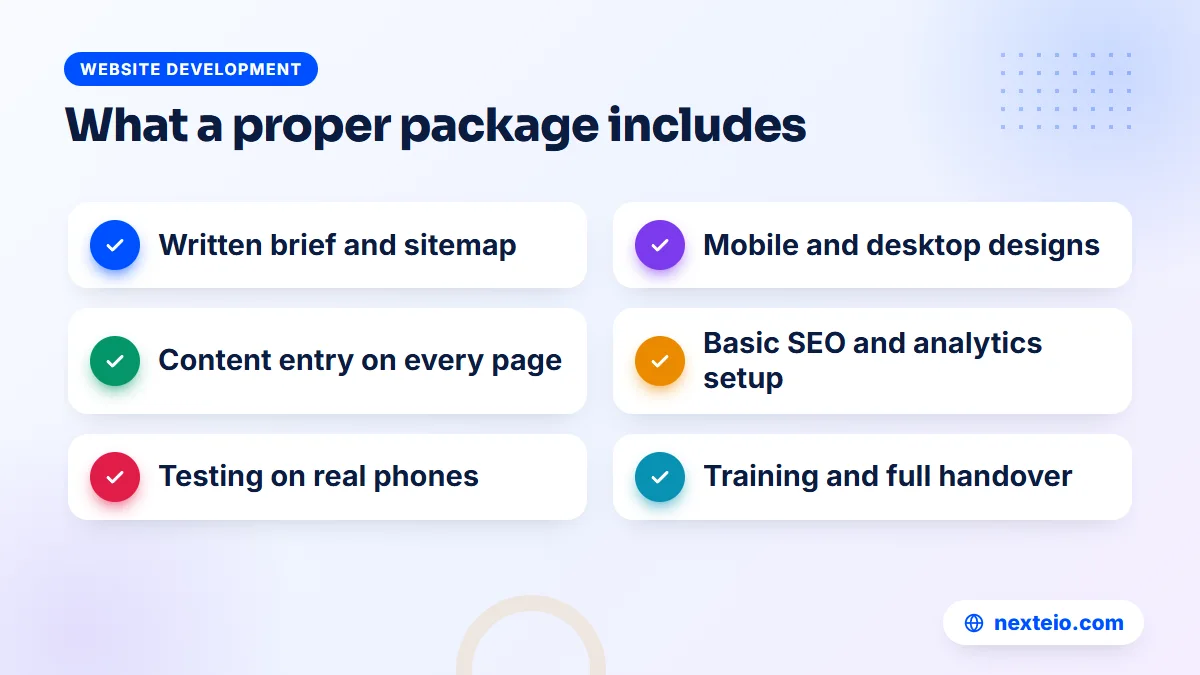
- Homepage and key inner-page designs for both mobile and desktop.
- A small style guide: colors, fonts, button styles, heading sizes and spacing rules.
- Designs for forms, error messages and empty states, not just the attractive pages.
- Icons and image treatments that match across the site.
- A clear number of revision rounds, usually two or three.
The revision count matters more than it seems. Without a limit, a design can bounce between departments for months. With a limit, everyone knows feedback must be gathered and sent together. Agree inside your organization who gives final approval, so the designer is not caught between the managing director's preference and the marketing team's.
This is the stage where a custom website design differs most from a template. With a template, the layout is mostly fixed and the designer adjusts colors and images. With custom design, the layout is built around your content and visitors, which is why it costs more and usually works better for organizations with specific needs.
Development: Turning Designs Into a Working Website
Development is where approved designs become a real website. The developer builds the pages, connects the content management system, sets up forms and email delivery, and adds any special features from the brief. A solid website development service also builds the admin side, so your staff can post notices, add products or update team pages without calling the developer.
The platform choice belongs in the proposal, with a reason. Common options for organizations in Bangladesh include:
- WordPress for company sites, schools, NGOs and blogs where staff need an easy editor. A well-built WordPress website covers most organization needs.
- Laravel or another framework for portals, booking systems, dashboards and anything with complex logic. A Laravel web application fits workflows that a normal CMS cannot handle.
- E-commerce platforms such as WooCommerce or a custom store for selling online with cash on delivery, bKash or Nagad.
Our comparison of WordPress and custom websites explains how to choose between the first two in more depth. Whatever the platform, the proposal should say who owns the code, which paid plugins or licenses are included, and how updates will be handled after launch.
Features that need clear scope
Some features sound simple and are not. A "search" box might mean basic keyword search or filtered search across thousands of products. "Online admission" might be a downloadable form or a full application with document uploads and payment. "Multilingual" might mean a few translated pages or a complete Bangla mirror of the site. Each of these should be described in a sentence or two in the scope, with what is included and what is not.
Content Entry, SEO Setup and Analytics at Launch
A website with empty pages or placeholder text is not finished. Professional web design services include entering the approved content, compressing and placing images, and setting up the pages so search engines can read them. Ask whether content entry is included for every page or only a fixed number.
Basic search setup at launch should cover these items:
- A unique title and meta description for each main page.
- One clear H1 heading per page and a logical heading order below it.
- Clean page addresses, such as /admission rather than /page?id=17.
- Alt text on meaningful images.
- An XML sitemap and a robots.txt file.
- Redirects from old page addresses if this replaces an existing site.
Google's SEO starter guide covers these basics in plain language and is worth a read before you sign off. For a step-by-step version, our guide to on-page SEO for beginners walks through a single page from top to bottom.
Measurement should be set up on day one, not months later. That means connecting the site to Google Search Console under your organization's own account, and installing analytics so you can see visits and form submissions. Google's help page on setting up Analytics for a website shows what is involved. Launch-day setup is not the same as an ongoing SEO service, which works on rankings month by month, but it gives that later work a clean start.
Speed, Accessibility and Testing on Real Devices
Testing is the part of web design services most often squeezed when deadlines slip, and it is the one visitors notice most. A professional provider tests on real phones, on slower mobile data, and in the main browsers before launch.
Speed
Pages should load quickly on a mid-range Android phone over 4G, not only on the office broadband. Google's Core Web Vitals describe the measures that matter: how fast the main content appears, how quickly the page responds to a tap, and whether the layout jumps around while loading. Ask the provider to share speed results for the homepage and one inner page before launch. Our article on website speed and SEO explains why these numbers affect both visitors and rankings.
Accessibility
An accessible site works for people with poor eyesight, color blindness or motor difficulties, and for anyone using a small screen in bright sunlight. The basics are readable text sizes, strong color contrast, buttons large enough to tap, labels on every form field and images with alt text. Mozilla's guide to web accessibility is a solid reference for developers. Universities, government-linked bodies and NGOs working with donors often have accessibility expectations, so raise it early.
A pre-launch test list
- Every page opens on Android and iPhone, in Chrome and Safari, without broken layouts.
- Every form submits, the thank-you message shows, and the email reaches the right inbox.
- Phone numbers are tappable and open the phone dialer.
- All internal links work, and no page still shows placeholder text.
- Bangla text displays correctly in headings, menus and forms.
- The site loads over HTTPS with no security warnings.
Related guides that help with planning a new site:
- How to build a professional business website that gets results
- Content strategy for every stage of the customer journey
- How to create a high-converting landing page for ads
Launch, Training and Handover
Launch day is not the end of the service. A professional provider moves the site to live hosting, points the domain, checks everything again on the live address and watches for problems over the first few days. Then comes the part that protects you for years: handover.
A proper handover should include:
- Administrator access to the website in your organization's name, not only the agency's.
- Domain and hosting accounts registered to your organization with an official email.
- Search Console and analytics owned by your account, with the provider added as a user.
- A short written guide, or recorded video, showing staff how to update common pages.
- A training session for the people who will post notices, news or products.
- A copy of the final files, or source code for a custom build, plus a recent backup.
Training deserves real time. A school's office assistant who learns to post a notice in ten minutes will keep the site current. One who was never shown will send every change back to the agency, which costs you both money and time.
Many providers also include a short support period after launch, often a few weeks, to fix bugs that appear once real visitors arrive. Ask how long it lasts and what it covers. After that, ongoing care is usually a separate maintenance agreement.
What Professional Web Design Services Usually Leave Out
Some items sit outside a standard package, and that is normal. Problems start only when nobody says so in writing. Check whether each of these is included, quoted separately or left to you:
| Item | Often included? | Notes |
|---|---|---|
| Copywriting for all pages | Sometimes | Many packages include editing, not writing from scratch |
| Professional photography | Rarely | Stock images are common; real photos of your premises work better |
| Logo and brand identity | Rarely | Usually a separate branding project |
| Domain and hosting fees | Sometimes for the first year | Check the renewal price and whose name the accounts are in |
| Premium plugins or licenses | Varies | Ask whether renewals are included after the first year |
| Ongoing maintenance | Short period only | Usually a separate monthly plan |
| Ongoing SEO or paid ads | No | Separate services with their own goals and budgets |
| Video production | No | A homepage or about-us video is usually quoted apart |
Video is a good example. A short factory tour or campus video can help a homepage, but shooting and editing it is a separate job. If you need one, a video editing service can turn your own footage into a clip that suits the site.
Once the site is live, you may also want to send paid traffic to it. A landing page built for a Google Ads campaign has different needs from a general company page, so mention any planned campaigns during discovery rather than after launch.
Template, Semi-Custom or Fully Custom: Three Levels of Service
Most offers you receive will fall into one of three levels. Knowing which one you are looking at makes quotes far easier to compare.
Template-based. The provider installs a ready-made theme, adds your logo, colors and content, and sets up basic pages. It is fast and affordable. It suits a small office, a new business or an NGO that needs a clean presence quickly. The trade-off is that the layout and features are limited to what the theme offers, and the site may look like many others.
Semi-custom. The provider starts from a framework or theme but designs key pages around your content, adds custom sections and adjusts the structure. It suits many corporate and education sites that need a distinct look without a fully original build.
Fully custom. Every page is planned and designed for your organization, then built to match. It costs the most and takes the longest, and it is the right choice for groups with several brands, institutions with complex information, and any site with special features or integrations. If that sounds like your organization, a fully custom website build is worth the extra time.
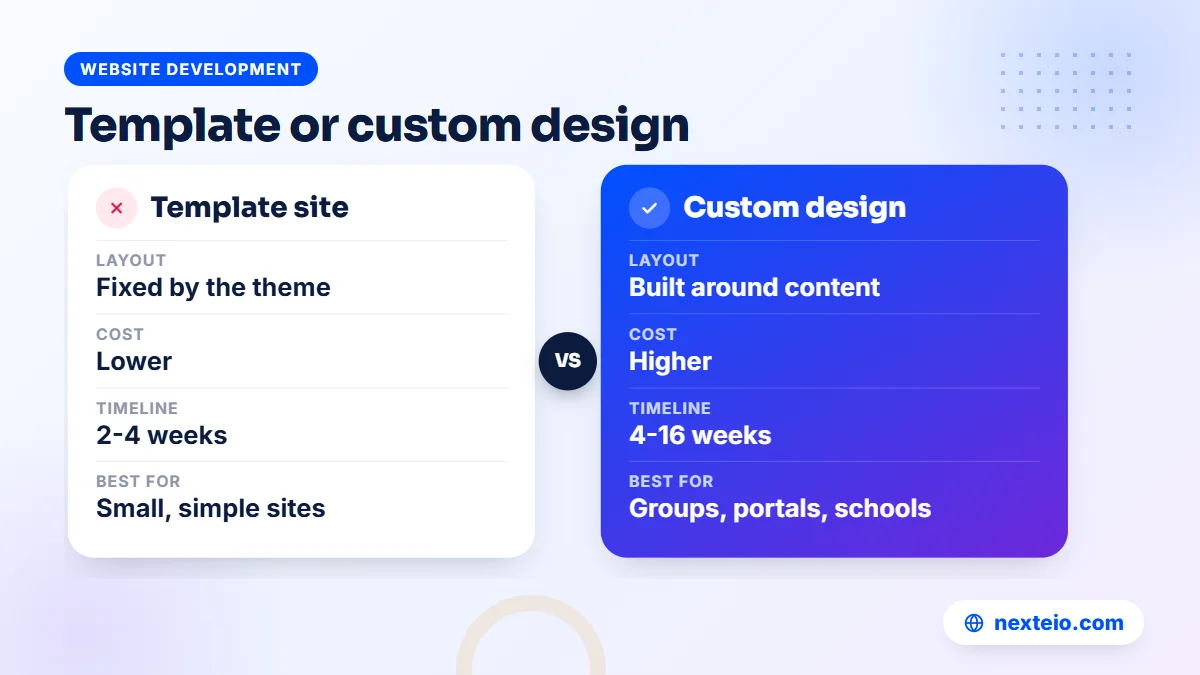
None of these levels is automatically better. A garment buying house with five pages and a clear message may be well served by a strong template. A university with forty departments will not be. Our buyer's checklist for choosing a web design company helps you judge which providers can deliver the level you need.
Reading a Web Design Proposal Line by Line
A good proposal reads like a plan, not a brochure. Before you send it up the approval chain, check that it answers each of these points in plain words:
| Section | What it should say |
|---|---|
| Scope | Every page and feature by name, with the number of templates and forms |
| Platform | Which CMS or framework, and why it suits your needs |
| Design | Mobile and desktop designs, and the number of revision rounds |
| Content | Who writes, who edits, who enters it, and how many pages are included |
| SEO and analytics | Which launch tasks are done, and who owns the accounts |
| Testing | Devices, browsers and speed checks before launch |
| Timeline | Milestones with dates, and what happens if feedback is late |
| Payment | Amounts tied to milestones, not to calendar dates alone |
| Ownership | Who owns the design files, code, domain and hosting at the end |
| Support | Length of the post-launch support period and what it covers |
If a section is missing, ask for it in writing before the budget goes for approval.
Red flags in a proposal
- A single line such as "complete website, all pages, full SEO" with no detail.
- No mention of mobile design or testing.
- The domain or hosting will be registered in the provider's name.
- Full payment requested before any design is shown.
- Guaranteed first-page Google rankings, which no honest provider can promise.
- No limit on revisions, which sounds generous but usually leads to disputes.
A common and fair payment structure is a share upfront, a share on design approval and the rest at launch. Linking payments to approved milestones keeps both sides focused and gives your accounts team clear points to release funds.
What Web Design Services Cost in Bangladesh and How Long They Take
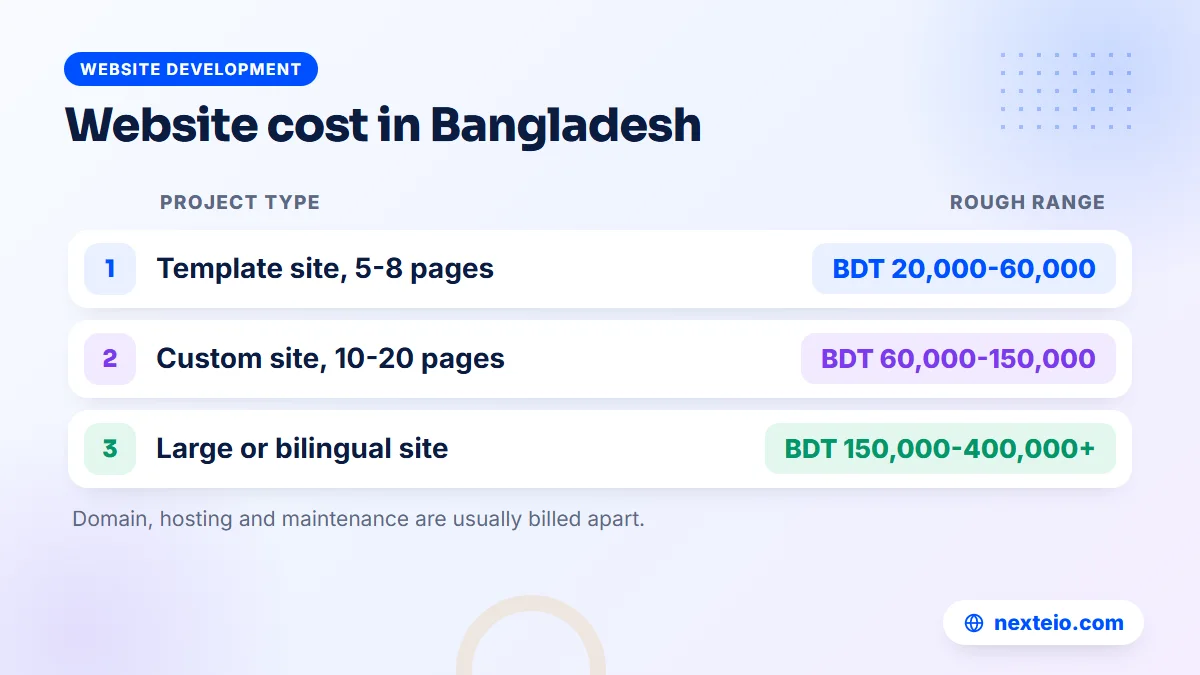
Prices for web design services depend on the number of pages, the level of design, the platform, the features and how much content work is included. The figures below are rough market ranges for organizations in Bangladesh, not fixed prices. Use them to sense-check the quotes you receive.
| Project type | Rough cost range | Typical timeline |
|---|---|---|
| Template-based company or NGO site, 5 to 8 pages | About BDT 20,000 to 60,000 | 2 to 4 weeks |
| Semi-custom or custom corporate site, 10 to 20 pages | About BDT 60,000 to 150,000 | 4 to 8 weeks |
| Large custom site with two languages or integrations | About BDT 150,000 to 400,000 or more | 8 to 16 weeks |
Timelines depend on your side as much as the provider's. The most common delay is content: text and photos that arrive weeks after the design is approved. The second is approval chains, where every change has to pass through several people. If your organization needs board or director approval, build that time into the schedule from the start.
Be careful with very low quotes. A full corporate site priced like a template install usually means something important is missing, whether it is testing, content entry, mobile design or the handover. If you want a realistic figure for your own project, send us a short brief and we will tell you what fits.
What You Need to Provide as the Client
Even the best web design services cannot finish a site alone. Projects move fastest when the client side is organized. Before the project starts, prepare these:
- One decision-maker who collects feedback from colleagues and sends it as one list.
- Your logo and brand files in good quality, plus any brand guide you already have.
- Content, or at least the facts behind it: services, history, team, contact details, policies.
- Real photos of your office, campus, factory or team where possible.
- Access details for the existing domain, hosting and old website, if any.
- A realistic approval schedule that matches how your organization actually signs things off.
For organizations with layered approval, it helps to agree up front which decisions need senior sign-off, such as design direction and final launch, and which the project lead can approve alone, such as small text changes. This one step can save weeks.
Finally, think beyond launch day. Decide who will update the site each week, which pages are likely to change and how you will measure success. A site that brings visitors but no inquiries usually has a content or call-to-action problem, which our guide on why a website gets traffic but no customers covers in detail.
After Launch: How to Tell Whether the Website Works
A launch date is a milestone, not a result. The real test of any web design project is whether the site does the job described in the brief. Set a review at 30 days and again at 90 days, and look at a short list of numbers rather than general impressions.
- Inquiries: form submissions, calls from the website and messages, compared with the months before launch.
- Top pages: which pages people visit most, and whether they match the pages you expected to matter.
- Search queries: the words people use to find you in Search Console, and which pages appear for them.
- Mobile behavior: how many visitors use phones, and whether they leave key pages quickly.
- Staff updates: whether notices, news and products are actually being posted on time.
These numbers tell you where to act. If people reach the admission page but few submit the form, the form is probably too long or unclear. If almost nobody finds the site through search, the content and on-page setup need work. If staff stopped posting after the first month, the admin training or the editing process needs another look.
A provider who offers web design services seriously will be interested in these reviews, because they show whether the planning was right. Some issues are quick fixes inside the post-launch support period. Others are new work, such as a stronger landing page or extra content, and should be scoped like any other change.
How Nexteio Can Help With Web Design Services
Nexteio designs and builds websites for companies, schools, colleges, clinics, NGOs and other organizations across Bangladesh. Our custom website design service follows the stages in this guide: we start with your goals and visitors, agree the page structure, design for mobile and desktop, then build the site so your staff can update it without help.
We choose the platform to fit the job. Content-led sites usually run on WordPress, while portals, booking tools and other workflow-heavy systems are built on Laravel. For online selling, our e-commerce website development work covers cash on delivery, bKash and Nagad checkouts. In every case, we recommend keeping the domain, hosting and admin accounts in your organization's name, and we show your team how to manage the site before handover.
If you are comparing quotes, we are happy to explain what a professionally planned website would include for your organization. You can see examples in our portfolio, browse all our services, start a project brief or reach us through the contact page.
Keep reading: what to check before hiring a WordPress developer, common SEO mistakes that hurt business websites, or browse more website development guides.
Frequently asked questions
What is the difference between web design and web development?
Design decides how the site is organized and how it looks: page structure, layouts, colors, fonts and images. Development turns those designs into working code, sets up the content management system, forms and databases, and connects any outside services. Most organizations hire one team for both so nothing gets lost between the two.
How long does it take to design and build a business website?
A template-based site of a few pages can be ready in two to four weeks. A custom corporate site usually takes four to eight weeks, and large bilingual sites or portals can take three to four months. Late content and slow internal approvals are the most common reasons projects run over.
How many design revisions should a package include?
Two or three rounds of revisions on the main designs is common and usually enough if feedback is gathered properly. Each round should collect all comments from your side in one list. Unlimited revisions sound generous but often lead to endless back-and-forth and a delayed launch.
Should the web designer write our website content?
It depends on the package. Many providers edit and format the text you supply but charge separately for writing every page from scratch. Your team knows the facts best, so a good approach is to supply the details and let a writer shape them for the web, with clear headings and calls to action.
Are the domain and hosting included in web design services?
Sometimes the first year is included, sometimes not. Either way, make sure both accounts are registered in your organization's name with an official email, and check the renewal prices. Hosting and domain renewals after the first year are almost always billed separately.
Can our staff update the website after launch?
They should be able to. A professional build includes an easy admin panel and a short training session, so staff can post notices, news, products or job openings themselves. Technical tasks such as updates, backups and security are better handled under a maintenance agreement.
What should we prepare before contacting a web design company?
Write down the main purpose of the site, who visits it, the pages you think you need and any features such as forms, payments or two languages. Gather your logo, existing content, photos and access details for any current domain or hosting. A rough budget range and deadline also help providers give realistic quotes.