Google Performance Max: How It Works and How to Set It Up
In this article 16 sections
- 1.What Google Performance Max Is
- 2.How Performance Max Decides Where Your Ads Show
- 3.When Google Performance Max Makes Sense
- 4.Before You Start: Tracking, Feeds and Brand Rules
- 5.How to Set Up a Google Performance Max Campaign
- 6.Building Asset Groups That Give Google Something to Work With
- 7.Audience Signals: Suggestions, Not Targeting
- 8.Bidding and Budget for Google Performance Max
- 9.The First Six Weeks: Learning and Patience
- 10.A Worked Example: An Online Clothing Shop
- 11.Reading Performance Max Reports
- 12.Google Performance Max vs Search and Shopping Campaigns
- 13.Common Google Performance Max Mistakes
- 14.Your Website Decides What the Campaign Can Do
- 15.How Nexteio Can Help With Performance Max
- 16.Frequently asked questions
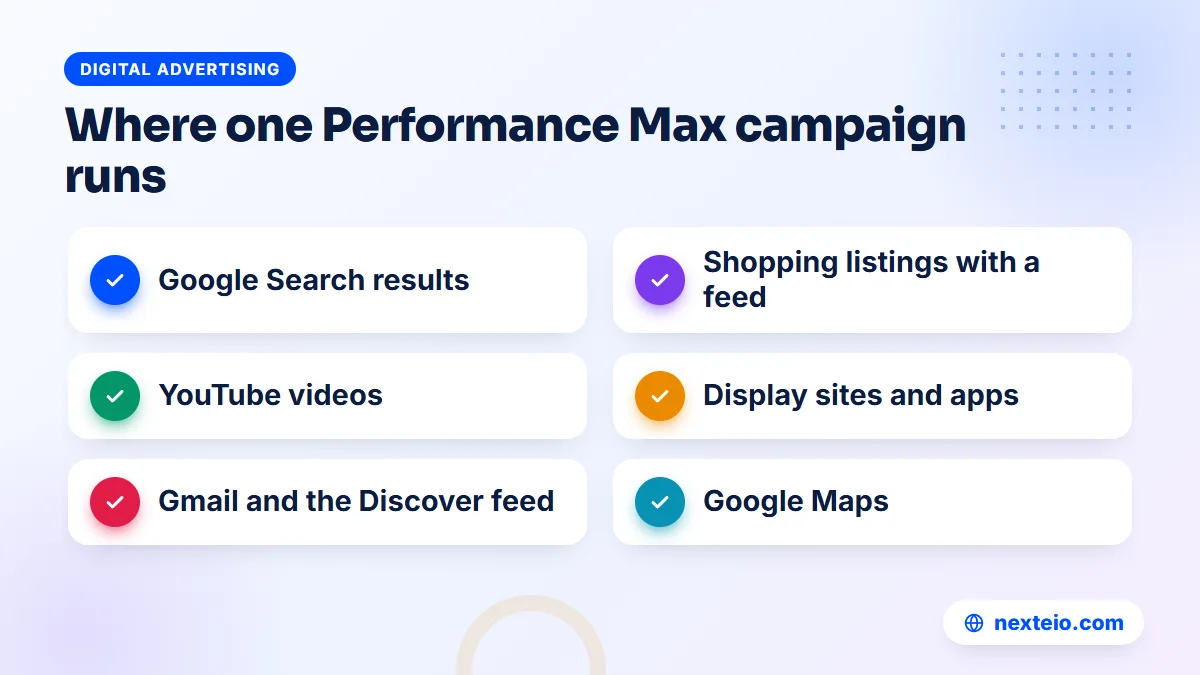
Google Performance Max is a campaign type that lets one campaign show ads across Search, YouTube, Display, Gmail, Discover and Maps, with Google's systems deciding where each impression goes. You give it a goal, a budget, your creative assets and some hints about your customers. Google then mixes and matches those assets and chooses the channels it expects to bring the most conversions at your target cost.
That sounds like the simplest option in Google Ads, and in some ways it is. You do not pick keywords, placements or ad formats one by one. But that simplicity moves the hard work to other places: conversion tracking, the quality of your assets, the landing page and how patiently you judge the results.
For an online shop with a product feed, a training institute that tracks form submissions, or a clinic that measures booked calls, Performance Max can work well. For a business with no tracking and a tiny budget, it often spends money on cheap placements that bring little back.
This guide explains how the campaign works, when it fits, how to set it up step by step, what assets to prepare, how to choose bidding and budget, how to read the reports, and the mistakes that most often waste spend.
What Google Performance Max Is
Google launched Performance Max to all advertisers in late 2021, and in 2022 it replaced Smart Shopping and Local campaigns. Advertisers often shorten the name to Google PMax, and some even type "Google Perf Max" when they search for help. Whatever you call it, the idea is the same: one goal-based campaign instead of a separate campaign for each channel.
In a standard Search campaign, you choose keywords and write text ads, and Google shows them on its results pages. In a Performance Max campaign, you provide building blocks instead:
- A conversion goal: purchases, leads, calls, store visits or another action you track.
- A budget and a bid strategy: how much to spend and whether to aim for more conversions or more conversion value.
- Asset groups: headlines, descriptions, images, logos, videos and a landing page.
- Audience signals: hints about who your customers are, such as your customer list or the searches they make.
- A product feed (optional): for online shops, a Google Merchant Center feed with prices and stock.
Google's own overview of Performance Max campaigns describes it as a way to complement keyword-based Search campaigns, not to replace every other campaign type. Keep that in mind, because many accounts get into trouble when Performance Max is the only campaign running.
How Performance Max Decides Where Your Ads Show
Every time someone could see an ad, Google predicts how likely that person is to convert and what the conversion might be worth. Then it decides whether to bid, how much, and which combination of your assets to show. A shopper searching for "running shoes price" might see a product listing. Someone watching a fitness video on YouTube might see a short video ad. A person browsing a news site might see an image ad.
Assets are combined automatically
You do not design each ad. Google assembles ads from your asset group to fit each channel and screen. One headline might appear with one image on Display and with a different description on Search. The more good, varied assets you give it, the more combinations it can test.
Smart Bidding sets the price
Performance Max always uses Smart Bidding, Google's automated bidding that sets a bid for each auction based on many signals at once. Google's guide about Smart Bidding explains the strategies. You choose whether to maximize conversions or conversion value, with an optional target cost or return.
Final URL expansion
By default, Google can send people to a different page on your site than the one you set, if it thinks that page fits the search better. For a large shop that can help. For a company with old blog posts, job pages or a login page, it can send paid traffic to the wrong place. You can turn this off or exclude specific URLs.
When Google Performance Max Makes Sense
Google Performance Max works best when three things are true: you track a conversion that matters, that conversion happens often enough for the system to learn, and you have the creative assets to run on visual channels. Missing any one of these makes the campaign much harder to control.
Here is how the fit usually looks for common types of business in Bangladesh:
| Business type | Usual fit | Why |
|---|---|---|
| Online shop with many products | Strong | Product feed, clear purchases and values to optimize for |
| Coaching centre or training institute | Good in admission season | Plenty of form leads if tracking is set up properly |
| Clinic or diagnostic centre | Mixed | Works if calls and bookings are tracked; health ad rules apply |
| Real estate developer | Mixed | Leads are fewer and slower, so learning takes longer |
| B2B manufacturer or exporter | Weak | Small, specific buyer pool better reached by Search keywords |
None of these are fixed rules. They show where the campaign usually earns its keep.
Performance Max is also a poor first campaign for a brand new account. Without past conversion data, Smart Bidding has little to learn from. Many advertisers start with a focused Search campaign, get conversion tracking right, and add Performance Max once conversions are coming in. Our guide to what Google Ads costs for a small business explains how to size that first budget.
Before You Start: Tracking, Feeds and Brand Rules
Conversion tracking comes first
Performance Max optimizes toward whatever you tell it is a conversion. If you count page views or button clicks that do not lead anywhere, it will find cheap traffic that produces those clicks and little else. Set up tracking for real outcomes: purchases with values, form submissions that reach your inbox, or calls longer than a set number of seconds.
For lead businesses, the strongest setup imports the outcome of each lead back into Google Ads, so the system learns which leads became customers. Our step-by-step guide to Google Ads conversion tracking covers the basic tags and how to test them.
A clean product feed for shops
Online shops connect a Google Merchant Center account so that products, prices and stock appear in ads. Titles should say what the product is in the words people search, prices must match the website, and out-of-stock items should drop from the feed. Shopping ad availability differs by country, so confirm in Merchant Center that your target country is supported. If it is not, Performance Max can still run with asset groups alone.
Brand and URL rules
Before launch, decide two things. First, should Performance Max show ads on searches for your own brand name? Those people were probably going to find you anyway, so many advertisers exclude brand terms and cover them with a cheap Search campaign. Second, which pages should never receive paid traffic? Login pages, job posts, policy pages and old news usually belong on the exclusion list.
How to Set Up a Google Performance Max Campaign
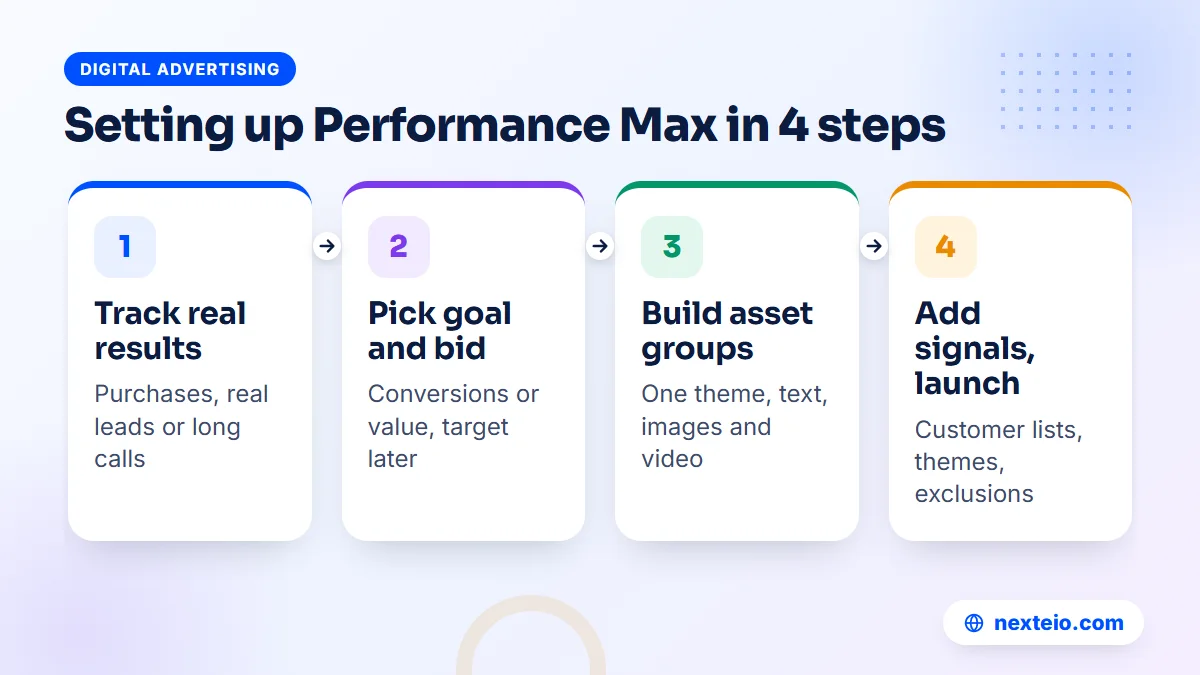
Google's help page on creating a Performance Max campaign lists the current screens, which change from time to time. The order of decisions stays fairly stable. Start with the campaign settings:
- Create a new campaign and choose a goal such as Sales or Leads, then pick the conversion actions it should count.
- Select Performance Max as the campaign type, and link Merchant Center if you sell products.
- Choose a bid strategy: conversions or conversion value, with an optional target CPA or target ROAS.
- Set locations, such as all of Bangladesh or specific areas, and the languages your customers use.
- Decide on final URL expansion and add URL exclusions.
Then build what people will see:
- Create the first asset group around one product category or service.
- Add headlines, long headlines, descriptions, images, logos and at least one video.
- Add audience signals and, if offered, a few search themes.
- Set the daily budget, review the summary and publish.
Keep the first campaign simple. One campaign with two or three clear asset groups is easier to read than five campaigns with overlapping products.
If you want an experienced team to handle this setup, our Google Ads management service covers tracking, campaign structure and assets together, since a weak link in any one of them drags the others down.
Building Asset Groups That Give Google Something to Work With
An asset group is a bundle of creative assets plus a landing page, built around one theme. A furniture shop might have one asset group for sofas and another for office chairs. A training institute might separate IELTS courses from computer courses. Each group should speak to one type of customer with one clear offer.
Text assets and their limits
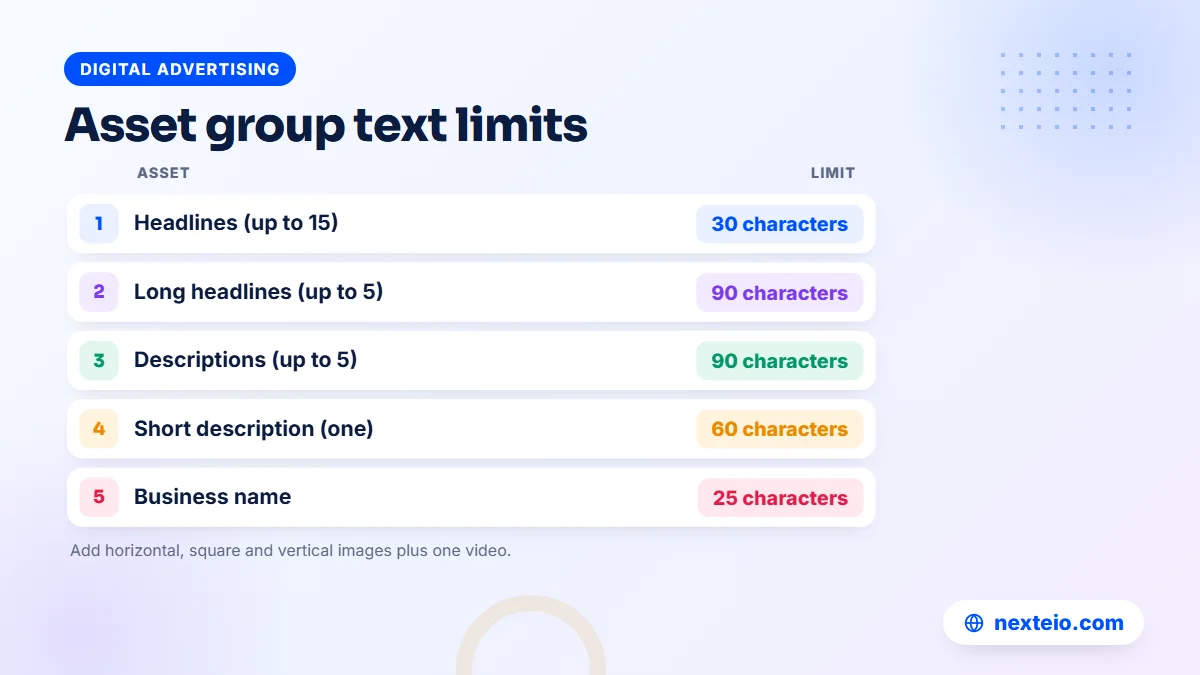
Google sets character limits for each text asset. These are the main ones at the time of writing:
| Asset | How many | Character limit |
|---|---|---|
| Headlines | Up to 15 | 30 each |
| Long headlines | Up to 5 | 90 each |
| Descriptions | Up to 5 | 90 each, one of them 60 or less |
| Business name | 1 | 25 |
Write headlines that each say something different: the product, the price point, the delivery promise, the payment options, a proof point.
Avoid ten headlines that repeat "best quality" in slightly different words. Mention practical details people in Bangladesh look for, such as cash on delivery, bKash payment, delivery time or a Bangla-speaking support line. The same discipline that helps improve Quality Score in Search campaigns, matching the ad to the landing page, applies here too.
Images and logos
Upload horizontal, square and vertical images, because each channel needs a different shape. Use real product or service photos where you can. Overlaid text should be minimal, since Google may crop images for different placements. Add your logo in square and wide formats.
Video
If you do not add a video, Google may build one automatically from your images and text. Those auto-made videos are rarely flattering. Even one simple, well-edited 15-30 second video gives you more control over how you appear on YouTube. Our video ad editing service can cut horizontal, square and vertical versions from the same footage, and our YouTube ads service is there if video becomes a channel in its own right.
Audience Signals: Suggestions, Not Targeting
Audience signals are the part of Performance Max most often misunderstood. In other campaign types, an audience limits who sees your ads. In Performance Max, a signal is only a starting hint. Google uses it to find people faster, then shows ads to anyone it thinks is likely to convert, inside or outside that audience.
Good signals still speed up learning. The useful ones are:
- Your own data: customer email lists, website visitors and people who converted before.
- Custom segments: people who searched for terms like your product names, or who visit sites similar to competitors.
- Interests and life events: such as people planning a wedding, moving home or starting university.
- Demographics: age and gender, used sparingly.
Your own customer data is usually the strongest signal, because it shows what real buyers look like.
Some accounts can also add search themes to an asset group. These work like extra hints for Search placements, a bit like keywords without match types. If you already know which searches convert for you from a Search campaign or your own keyword research, add those themes.
Bidding and Budget for Google Performance Max
Choosing a bid strategy
If your conversions all have similar value, such as course enquiries, choose maximize conversions. If values differ a lot, such as an online shop selling items from BDT 300 to BDT 30,000, choose maximize conversion value so the system aims for bigger orders, not just more orders.
Add a target only once you have a few weeks of data. A target CPA (cost per acquisition) or target ROAS (return on ad spend) that is too strict at launch can stop the campaign from spending at all. Start without a target, see what the campaign delivers, then set a target close to the actual result and tighten it slowly.
How much budget is enough
There is no minimum that guarantees results, but there is a practical floor. A common rule of thumb is a daily budget of at least two to three times your target cost per conversion, so the campaign can win enough conversions each day to learn. Here is the math with example numbers:
| Item | Example |
|---|---|
| Acceptable cost per lead | BDT 500 |
| Daily budget at 3 times that cost | BDT 1,500 |
| Monthly spend (30 days) | About BDT 45,000 |
| Leads if the target is met | About 90 |
If that spend is beyond your budget, a focused Search campaign is usually the better first step.
Ad costs vary with your industry, competition and season, so treat any figure as a planning example, not a quote. Payment is usually made with a card that allows international transactions, so confirm your card limits before launch.
Related guides for planning a Google Ads account:
- Google Ads tips for better results on a small budget
- How to get more leads from Google Ads
- A buyer's guide to Google Ads services in Bangladesh
The First Six Weeks: Learning and Patience
A new Performance Max campaign goes through a learning period while it tests channels, audiences and asset combinations. Results in the first one to two weeks are often uneven: costs may jump, conversions may arrive in clumps, and spend may lean toward one channel. Google's guidance suggests judging a new campaign over several weeks, not a few days.
During this time, change as little as possible. Large budget jumps, new bid targets, swapped asset groups and edited conversion goals all send the system back to learning. If something is clearly broken, such as a tracking error or a wrong landing page, fix it. Otherwise, write down what you would like to change and wait.
A sensible review rhythm looks like this:
- Daily, first week: check that spend is pacing and conversions are recording.
- Weekly: review cost per conversion, asset performance and search term insights.
- After about six weeks: compare results with your other campaigns and decide on targets and budget.
- Monthly after that: replace weak assets and review exclusions.
When you do raise the budget, move in steps of around 20 percent rather than doubling it overnight.
A Worked Example: An Online Clothing Shop
Picture a clothing shop in Bangladesh that sells panjabis, sarees and kids' wear through its own website, with cash on delivery and bKash. It already runs a small Search campaign for its brand name and a few product terms. Here is how a first Google Performance Max campaign could be planned for it.
Tracking. The shop counts only completed orders as conversions, with the order value passed to Google Ads. Cash on delivery orders that are later cancelled are a known problem, so the team notes the cancellation rate each month and compares it with what Google reports.
Structure. One campaign, three asset groups: men's panjabis, sarees and kids' wear. Each group links to its own category page, uses its own photos and has headlines that mention fabric, sizes, delivery time and payment options. Each group also gets a short vertical and horizontal video cut from the same product shoot.
Signals and exclusions. The shop uploads its past customer list and adds website visitors from the last 90 days. It adds search themes such as "eid panjabi" for the panjabi group. Brand terms are excluded, because the existing Search campaign already covers them, and the blog and careers pages are excluded from final URL expansion.
Bidding and timing. The campaign starts on maximize conversion value with no target, about six weeks before Eid, so learning is finished before the busiest weeks. Once the return settles, the shop sets a target ROAS slightly below the actual result and raises the budget in small steps as Eid gets closer.
Nothing here is unusual. The difference between a campaign that works and one that burns money is usually this kind of preparation, done before launch.
Reading Performance Max Reports
Performance Max used to be criticized as a black box. Google has added more reporting over time, and what you see now depends on your account, but most advertisers can review these areas:
- Asset group performance: conversions and cost for each group.
- Asset ratings: labels showing which headlines, images and videos perform well or poorly.
- Insights: search term categories, audience segments and trends behind the results.
- Channel and placement reports: how spend splits between Search, YouTube, Display and other channels, and where ads appeared.
- Ad strength: a rating from Poor to Excellent for how complete each asset group is.
Read these reports for patterns, not single numbers.
Watch where the money goes. If most of the spend lands on Display placements while conversions come from Search, your assets or conversion settings may be steering the campaign toward cheap impressions. Placements in mobile apps and games with accidental clicks are a common example. Exclude placements that clearly do not fit your business.
Most important, compare the conversions in Google Ads with what your business actually received. If Google reports 60 leads and your sales team only saw 35 real enquiries, the tracking is counting something it should not. If nobody on your team has time to dig into these reports, our Google Ads specialists can review them with you.
Google Performance Max vs Search and Shopping Campaigns
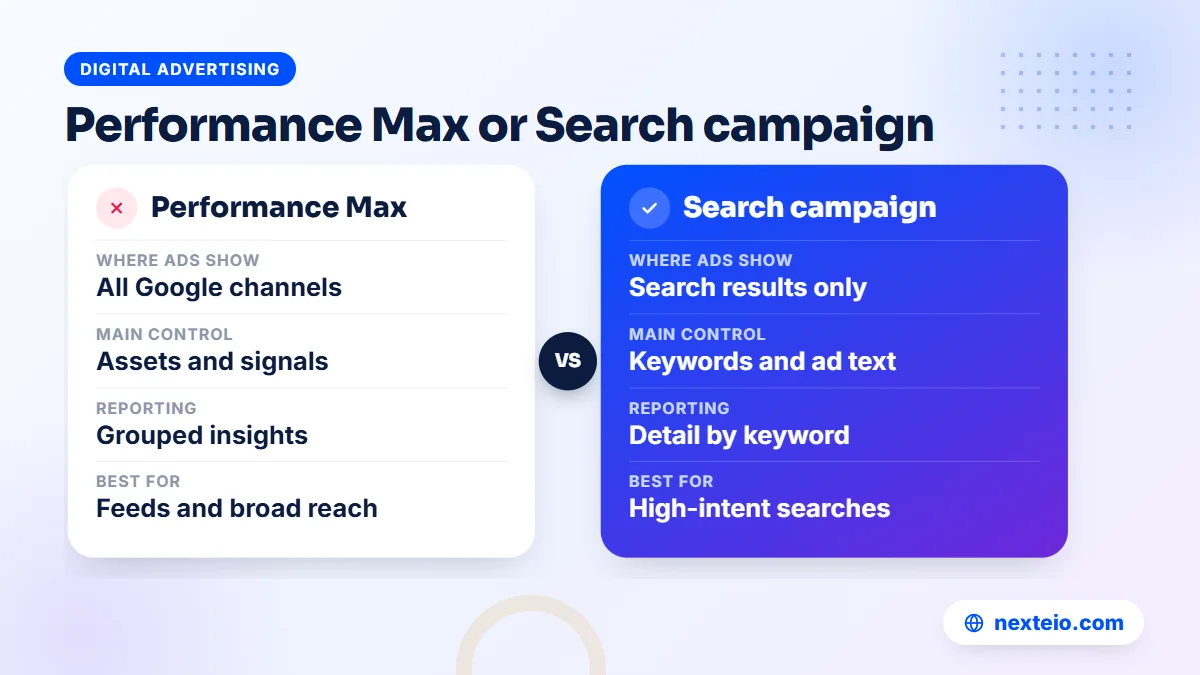
Performance Max does not have to replace your other campaigns. In most accounts it works best alongside a Search campaign. When a search exactly matches an exact match keyword in your Search campaign, Google gives the Search campaign priority. For other searches, the campaign with the stronger ad rank wins.
That gives you a useful structure. Your most important, high-intent keywords live in a Search campaign where you control the ad text and landing page. Performance Max then looks for extra conversions across channels you could not easily reach on your own. This way each campaign has a clear job, with less overlap between them.
For online shops, Performance Max with a product feed has largely taken over from standard Shopping campaigns. Some advertisers still keep a standard Shopping campaign for specific products where they want tighter control over bids and search terms.
Common Google Performance Max Mistakes
These are the patterns that most often make a Performance Max campaign look expensive or useless:
- Counting the wrong conversions. Page views, scroll depth or "clicked WhatsApp" alone teach the system to find clickers, not buyers.
- Launching with weak assets. Three headlines, one blurry image and no video give Google little to work with.
- One asset group for everything. Mixing unrelated products or services blurs the message and the signals.
- Leaving brand traffic in. Results look great because Performance Max claims people who were searching for you anyway.
- Changing settings every few days. Each change resets learning before results settle.
- Ignoring the landing page. A slow, unclear page wastes every click, whatever the channel.
Most of these come from treating Performance Max as an autopilot rather than a system that learns from what you feed it.
A seventh mistake is quieter: no offline check. Without comparing reported conversions with real sales or enquiries every month, an account can run for months on numbers that look good only inside the dashboard.
Questions to ask whoever runs your campaign
If an agency or freelancer manages Google Performance Max for you, these questions show quickly whether the account is under control:
- Which conversion actions does the campaign optimize for, and how were they tested?
- Are brand searches included or excluded, and why?
- How is spend split between Search, YouTube and Display this month?
- Which assets were replaced recently, and based on what rating?
- How do reported conversions compare with our actual orders or leads?
Clear answers with numbers are a good sign. Vague answers about "the algorithm" are not.
Your Website Decides What the Campaign Can Do
Performance Max sends people from many channels to the same pages, so the landing page carries a heavy load. It should load fast on mobile data, show the price or the next step without scrolling, and make it easy to call, message or buy. Google's guidance on Core Web Vitals explains the speed measures that matter, and our guide to a high-converting landing page covers layout and copy.
For online shops, product pages need clear photos, prices that match the feed, delivery charges and payment options such as bKash and cash on delivery. If your current store struggles with speed or checkout, fixing it may do more for your ads than any bid change. Typical market ranges in Bangladesh for an e-commerce store are BDT 25,000-60,000 with a ready theme, BDT 60,000-150,000 for a custom design, and BDT 150,000 and above for a custom-built store with integrations. A store built for how Bangladesh buys gives Performance Max better pages to send people to.
Paid and organic traffic also support each other. Product pages that rank on Google lower your reliance on ads over time, which is the work our e-commerce SEO service does. If you run ads on several platforms, our ads campaign service keeps budgets and tracking in one plan.
How Nexteio Can Help With Performance Max
We set up and manage Performance Max campaigns as part of our Google Ads service, and we start where this guide starts: tracking. Before any budget goes live, we check which conversions are counted, set up purchase or lead tracking that reflects real outcomes, and connect Merchant Center for shops.
Then we plan the campaign structure, decide which searches belong in a Search campaign and which in Performance Max, and build asset groups around your products or services. That includes writing headlines and descriptions, preparing images and editing short videos so Google does not have to generate them. We set brand and URL exclusions, choose the bid strategy, and review results against the enquiries and orders your team actually receives.
If your landing pages are the weak link, we can build or improve those too. Share your goals and current account details through our project brief form, look at our portfolio, browse all our services, or reach us on the contact page. When you are ready, start a Performance Max project or ask about Google Ads management for your whole account.
Keep reading: how to find high-intent keywords, Google Ads vs Meta Ads for profit, or browse all our digital advertising guides.
Frequently asked questions
Is Google Performance Max good for small businesses?
It can be, but only once conversion tracking works and the budget allows enough conversions each week for the system to learn. Very small budgets usually do better in a focused Search campaign first. Add Performance Max when you have steady conversion data and good creative assets.
Can I choose keywords in a Performance Max campaign?
Not in the usual way. You cannot add keywords with match types, but some accounts can add search themes as hints, and Google has added negative keyword and brand exclusion options over time. If you need exact control over which searches trigger your ads, keep those terms in a Search campaign.
Do I need a product feed to run Performance Max?
No. A Merchant Center feed is needed only if you want product listings with prices to appear. Lead-based businesses such as schools, clinics and service companies run Performance Max with asset groups alone, using text, images, videos and a landing page.
How long does Performance Max take to show results?
The first one to two weeks are usually a learning period with uneven results. Google suggests judging new campaigns over several weeks rather than days, and many advertisers wait around six weeks before comparing them seriously with other campaigns. Avoid big changes during that time.
Will Performance Max take sales away from my Search campaigns?
It can overlap with them. When a search exactly matches an exact match keyword in your Search campaign, Google gives Search priority. For other searches, the campaign with the stronger ad rank wins, so watch for brand traffic and check whether total conversions really grew.
Why is my Performance Max budget going mostly to Display?
Usually because the campaign is counting easy conversions, the assets suit Display better than Search, or there is not enough conversion data to guide it. Check your conversion actions first, then review placement reports and exclude apps or sites that send poor traffic.
Should I add a video to Performance Max if I do not have one?
Yes, if you can. Without a video, Google may create one automatically from your images and text, and the result often looks basic. A short, clearly edited video in horizontal, square and vertical shapes gives you control over how your brand appears on YouTube.