UGC Ads: What They Are and How to Make Ones That Sell
In this article 16 sections
- 1.What UGC Ads Are (and What They Are Not)
- 2.Why UGC Ads Often Beat Polished Brand Videos
- 3.Which Businesses in Bangladesh Suit UGC Ads
- 4.The Main UGC Ad Formats
- 5.Where to Find People to Film: Customers, Staff and Creators
- 6.Writing a Creator Brief That Gets Usable Footage
- 7.Scripts and Hooks: The First Three Seconds
- 8.Filming on a Phone: A Setup That Works
- 9.Editing UGC Ads So They Still Feel Real
- 10.Rights, Permission and Honest Disclosure
- 11.Running UGC Ads on Facebook, Instagram, TikTok and YouTube
- 12.Testing UGC Ads and Measuring What Works
- 13.Common Mistakes With UGC Ads
- 14.A First Month With UGC Ads: A Practical Plan
- 15.How Nexteio Can Help With UGC Ads
- 16.Frequently asked questions
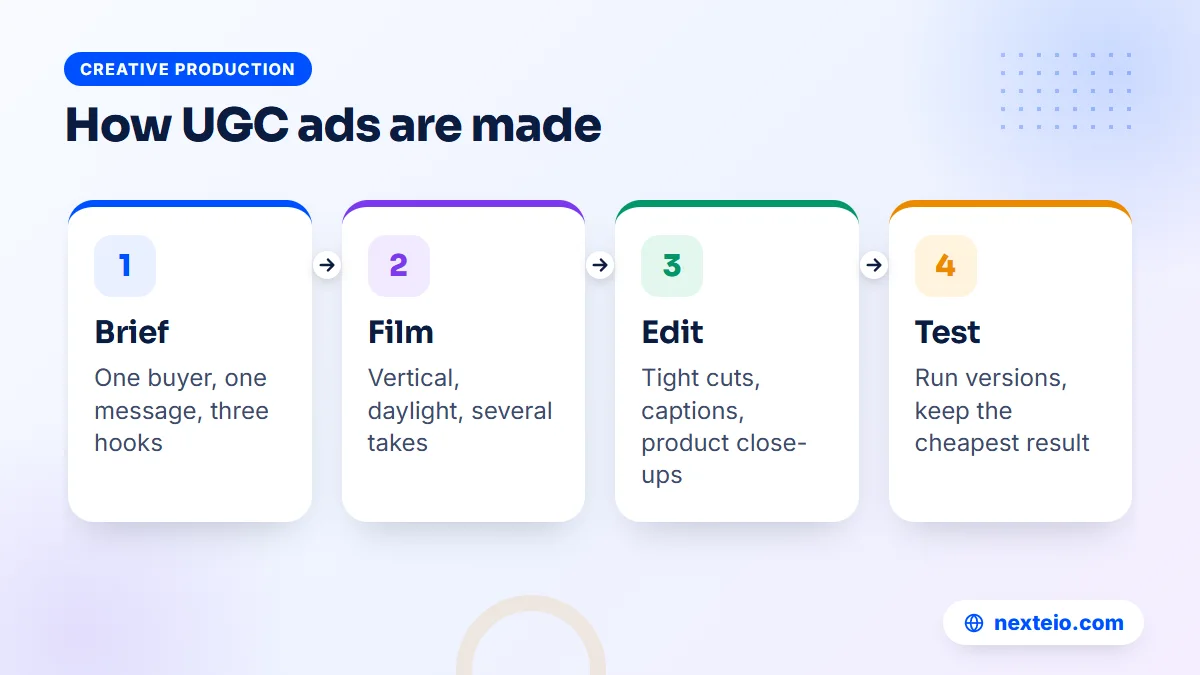
UGC ads are short videos that look and sound like they were made by a real customer, not by a brand. Someone holds the product in their hand, talks to the phone camera in their own words, and shows what happened when they used it. The ad runs on Facebook, Instagram, TikTok or YouTube with your budget behind it, but it feels like a post from a friend.
For many sellers in Bangladesh, this style now does more work than a studio shoot. A skincare page, a gadget shop, a coaching center or a home-food business can film ten honest clips for the cost of one polished brand film. Those clips can then be tested against each other until a clear winner appears.
The style is easy to copy badly, though. Plenty of businesses post shaky, rambling videos and call them UGC, then wonder why nobody buys.
This guide covers what the format really is, which businesses suit it, how to find people to film, how to brief and script them, how to edit the footage so it still feels real, the rights and disclosure rules you must follow, and how to judge which videos are worth more budget.
What UGC Ads Are (and What They Are Not)
UGC stands for user-generated content: photos, videos and reviews that customers create about a product. A UGC ad takes that kind of content, or content made to look and feel like it, and runs it as a paid advertisement. The key features are a real person on camera, a phone-shot look, natural speech, and a focus on personal experience instead of brand claims.
The term now covers three different sources, and it helps to keep them apart:
- Organic customer content: a buyer posts an unboxing or review on their own, and you ask permission to use it in ads.
- Commissioned creator content: you pay a creator to film a video in a customer style. They may or may not post it on their own account.
- In-house content in a UGC style: your staff, founder or delivery team film themselves talking about the product the way a customer would.
All three can work. What they share is the viewing experience: the video sits naturally between friends' posts in a feed and does not shout "advertisement" in the first second.
UGC is not an excuse for low effort. Good examples are planned, scripted in outline, filmed with care and edited tightly. They just hide that work well. UGC is also not the same as an influencer post. An influencer is paid mainly for their audience, while a UGC creator is paid mainly for the video itself, which you then show to your own chosen audience with your own budget.
Why UGC Ads Often Beat Polished Brand Videos
People scroll social feeds to see people, not commercials. A glossy video with studio lighting and background music signals "ad" instantly, and the thumb keeps moving. A person speaking straight to the camera in a normal room looks like content, so viewers give it a few seconds. Those few seconds are where every ad either wins or loses.
There are three more practical reasons the format performs well for small and mid-sized businesses:
- Trust from a peer: a customer saying "I was worried about the size, but it fit" answers a doubt better than the brand saying "perfect fit guaranteed".
- Volume for testing: one shoot day with a creator can produce many hooks and versions, so you can find what works instead of betting on one video.
- Lower cost per video: phone footage and simple editing cost far less than a crew, which matters when ad budgets are counted in thousands of taka, not lakhs.
That does not make brand films useless. A corporate group, a hospital or a university still needs polished video for its website and for building long-term reputation. The two styles do different jobs. Brand video builds the name; UGC ads persuade a specific person to take a specific action, such as ordering, booking or sending a message.
The best mix for most sellers is a small amount of polished content that explains who you are, plus a steady flow of customer-style videos that run as ads and get replaced as they tire. If you already have a video ads editing partner, ask them to keep both styles on separate tracks so the brand look does not creep into the UGC versions.
Which Businesses in Bangladesh Suit UGC Ads
The format works best when a purchase involves a personal doubt that another buyer can settle. Will this cream suit my skin? Is this bag really leather? Will my child actually like this tutor? If a real person can answer the doubt on camera, a UGC ad has a job to do. The table below gives examples by type of business.
| Business | The doubt to answer | A UGC angle that fits |
|---|---|---|
| Fashion and clothing page | Size, fabric, color in real light | Try-on in a normal room, before and after ironing |
| Skincare and beauty | Will it suit my skin type? | A two-week routine diary, with honest notes |
| Gadgets and accessories | Does it actually work? | Unboxing and a quick real-use test |
| Food and home kitchen | Taste, freshness, packaging | First bite reaction, delivery condition |
| Coaching center or online course | Is the teaching any good? | A student or parent explaining what changed |
| Clinic or diagnostic center | Is the process easy and clean? | A patient walking through booking and waiting |
Some businesses get less from it. A factory selling to foreign buyers, a law firm or a government office rarely needs customer-style clips, because their buyers decide through meetings and documents. Even there, a short staff-filmed walk through the production floor can work as a supporting ad.
Health and beauty need extra care. A patient or customer can describe their own experience, but the ad must not promise cures or guaranteed results. Ad platforms review these categories more strictly, and a single exaggerated line can get the whole ad rejected.
The Main UGC Ad Formats
Most successful customer-style ads follow one of a handful of formats. Knowing them makes briefing much easier, because you can ask a creator for "a problem-solution video" instead of "something nice about our product".
- Testimonial: the person talks about why they bought, what they worried about and what happened.
- Unboxing: opening the parcel on camera. Good for showing packaging, quality and safe delivery.
- Problem-solution: opens with a relatable problem ("my phone dies by afternoon"), then shows the product fixing it.
- Demo or tutorial: shows how to use the product step by step. Works well for kitchen tools, skincare routines and software.
- Comparison: puts your product beside the old way of doing things. Compare against a habit, not a named competitor.
- Answering a question: the creator replies to a real comment or common question, such as "does this fit a 15-inch laptop?"
- Day in the life: the product appears naturally inside a normal routine. Softer, better for awareness than for direct sales.
Each format answers a different buyer doubt, so choose by the question your buyers ask most often.
Start with two or three formats, not all seven. For a new product, problem-solution and unboxing usually give the clearest early signal. For a service, testimonial and answering-a-question tend to work better, because there is nothing to unbox.
Where to Find People to Film: Customers, Staff and Creators
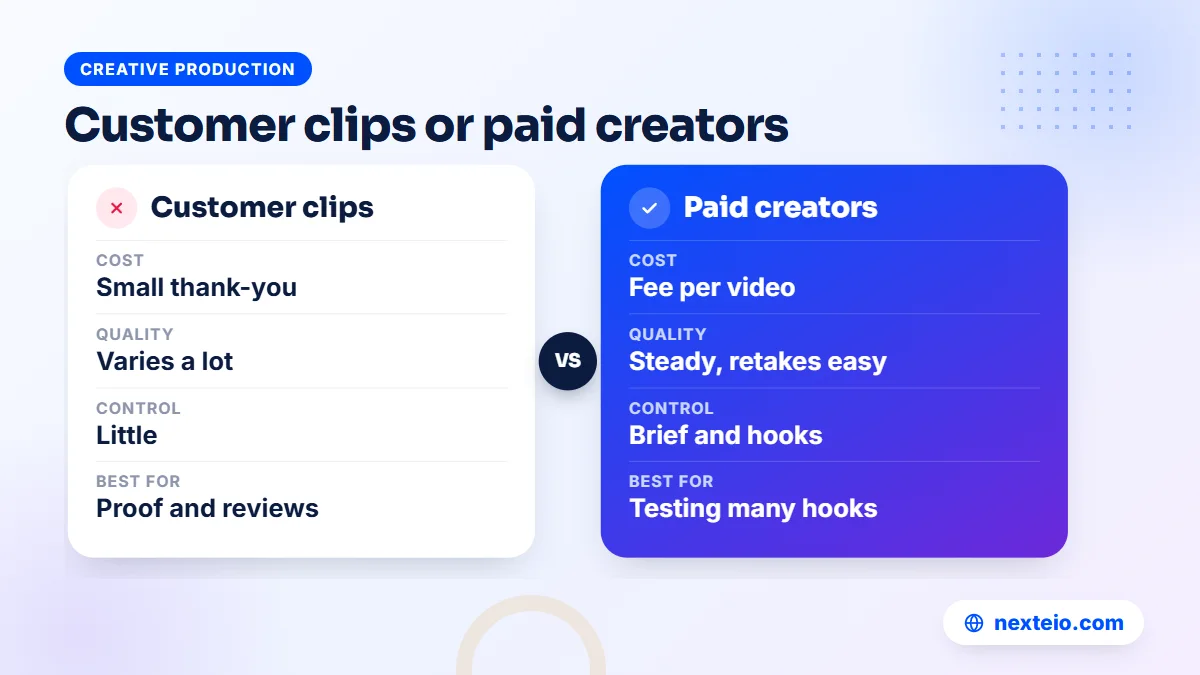
The cheapest source for UGC ads is your existing customers. Many happy buyers will record a short video if you ask politely and make it easy, for example by sending a few simple prompts on WhatsApp after delivery. A small thank-you, such as a discount on the next order, is common practice. Always get written permission before using their video in a paid ad.
Customer clips have limits. Quality varies, you cannot ask for retakes easily, and you get whatever angle the customer chose. That is why many sellers also commission creators. A UGC creator is someone who films customer-style videos for brands as paid work. They know how to light a face with a window, speak clearly, hit a hook in the first line and deliver several takes.
Your own team is the third option. A founder explaining why they started the business, a shop assistant showing three ways to wear a scarf, or a lab technician explaining how samples are handled can all feel honest. Staff videos work best when the person speaks as themselves, not as a fake customer. Never present an employee as an ordinary buyer; that crosses from marketing into misleading people.
When you choose creators, look at their past work on mute first. Many viewers in Bangladesh watch with the sound off on buses and in offices, so a creator whose face, gestures and product handling tell the story without audio is worth more than one with a nice voice. Then listen with sound to check that their Bangla, English or mix suits your buyers.
Writing a Creator Brief That Gets Usable Footage
Most disappointing UGC comes from a weak brief. "Make a video about our product" gives the creator nothing to aim at, and you receive a generic clip that could be about anything. A good brief is one or two pages, written in plain words, and answers the questions a creator would otherwise guess.
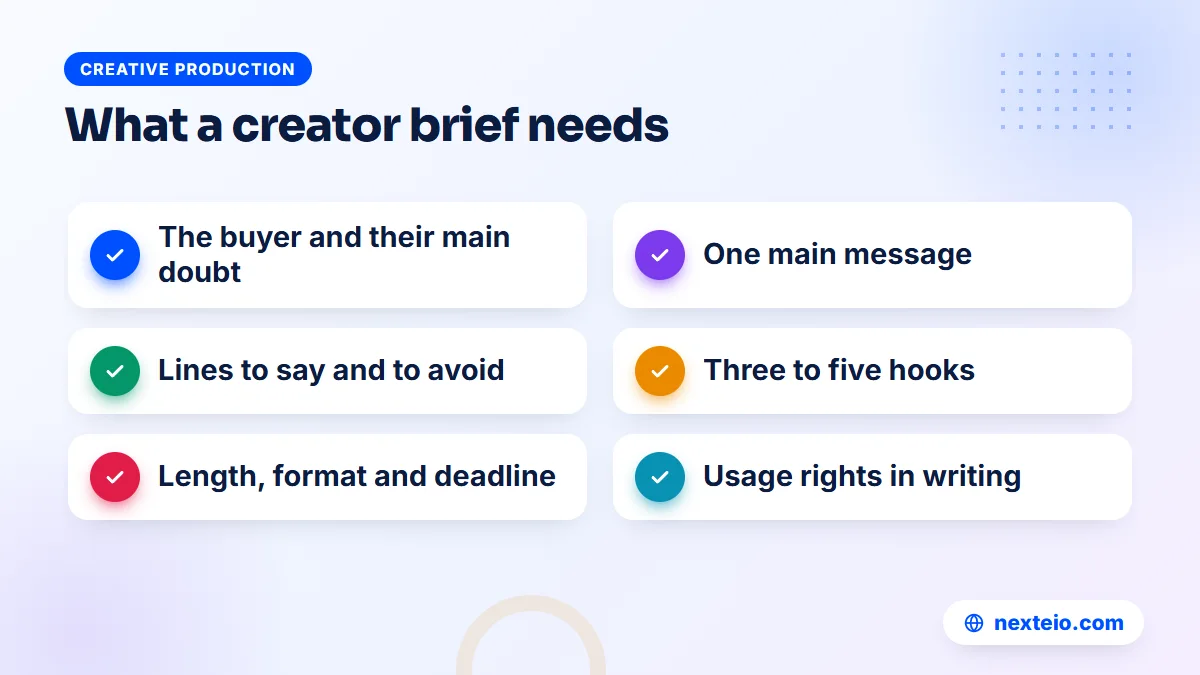
Include these points in every brief:
- Who the buyer is: age range, situation and the doubt they have before buying.
- The single main message: one benefit, not five. A video that tries to say everything says nothing.
- Must-say and must-not-say lines: the offer, delivery terms, and any claims the creator must avoid.
- Format and length: for example, a problem-solution video of 20 to 40 seconds, filmed vertically.
- Hooks to try: three to five different opening lines, each filmed as a separate take.
- Deliverables: number of videos, raw files, b-roll shots of the product, and the deadline.
- Usage rights: where you may run the footage, for how long, and whether the creator posts it too.
Keep the whole brief short enough to read on a phone, because that is where most creators will open it.
Send the product early enough that the creator can actually use it for a few days. A person who has really tried the cream or worn the shirt talks about it differently from someone who opened the box five minutes ago, and viewers can usually tell.
Scripts and Hooks: The First Three Seconds
A script for UGC ads should not be read word for word. Reading makes people sound stiff, which defeats the whole point. Instead, give the creator a beat sheet: the sequence of ideas, with suggested phrases they can say in their own way. A simple structure for a 30-second ad looks like this:
- Hook (0-3 seconds): a line or visual that makes the right viewer stop.
- Problem (3-8 seconds): the situation the viewer recognizes from their own life.
- Product in use (8-22 seconds): showing, not describing, what changes.
- Proof (22-26 seconds): a detail that makes it believable, such as packaging, a result or a reaction.
- Call to action (26-30 seconds): exactly what to do next, such as "tap Shop Now" or "send us a message".
The hook decides most of the result. Here are hook types that tend to work, with examples for a home-delivered lunch box service:
- A direct callout: "If you eat lunch at your office desk every day, watch this."
- A surprising visual: opening the lid to show the food still steaming at 1:30 pm.
- A confession: "I spent too much on food delivery last month, so I tried this."
- A question: "Why does office lunch always arrive cold?"
Ask the creator to film every hook as a separate take, then reuse the same middle and ending. One shoot can give you five versions that differ only in the first three seconds. That is the cheapest and fastest test you can run, and it often shows a large gap between the best and worst opening.
For written guidance on what each platform allows in a hook, read the policy pages before scripting. Our TikTok advertising policy guide lists the claims and before-and-after styles that most often get rejected.
Filming on a Phone: A Setup That Works
A recent mid-range phone is enough for this kind of video. The difference between amateur and usable footage comes from a few habits, not from equipment. Share this list with every creator and customer who films for you:
- Film vertically for Reels, TikTok and Shorts, and keep the face in the upper middle of the frame.
- Face a window for soft daylight; avoid a bright window behind the head.
- Use the back camera where possible, with a friend holding it, for sharper video.
- Record in a quiet room and turn off fans for the talking parts if the noise is loud.
- Clean the lens and wipe the product before filming. Fingerprints show on screen.
- Film close-up product shots separately, so the editor has b-roll to cut to.
- Keep a few seconds of silence before and after each take for clean cuts.
None of this needs a ring light or a microphone, although a cheap clip-on mic helps in noisy homes.
Load-shedding and heat can interrupt a shoot, so plan filming for the morning when daylight is good, and keep phones and power banks fully charged. Ask creators to send raw files through Google Drive or a similar link rather than through messaging apps, which compress video and lower quality.
Editing UGC Ads So They Still Feel Real
Editing is where raw clips become working ads. The aim is to keep the natural feel while removing everything that wastes the viewer's time. A good editor cuts pauses, filler words and repeated sentences, tightens the hook, and adds captions without making the video look like a TV commercial.
The editing jobs that matter most for UGC ads are:
- Captions: burned-in subtitles in the language the creator speaks, sized for a phone screen and placed away from the platform's buttons.
- Jump cuts: fast cuts that remove gaps between sentences and keep energy up.
- B-roll: short product close-ups placed over the talking parts, so the viewer sees what is being described.
- Light color and sound fixes: enough to make the face look natural and the voice clear, never so much that it looks like a studio.
- Versions: 9:16 for Reels, Stories, TikTok and Shorts; 4:5 or 1:1 for feed placements; a short cut and a longer cut.
- An end card: a plain frame with the offer, price or next step, held long enough to read.
Good editing on UGC ads should be close to invisible. Viewers should notice the person and the product, not the effects.
Keep platform screens in mind. On TikTok and Reels, usernames, captions and buttons cover the bottom and right side of the frame, so text placed there gets hidden. Your editor should keep important words in the safe central area.
If your team does not have time for this, our ad video editing service handles exactly this step: we take raw creator or customer footage and turn it into tested versions for each placement. For longer brand pieces and YouTube videos, we also offer general video editing, and our guide to what a good ad edit includes explains the work in detail.
Related guides worth reading next: choosing a video editing service in Bangladesh, building a TikTok audience profile and practical Meta ads tips for local sellers.
Rights, Permission and Honest Disclosure
Using someone's face and voice in a paid ad is a legal and ethical matter, not just a creative one. Before any video goes live, you should have written permission that says where it may run, for how long, and whether you may edit it. A short agreement in plain Bangla or English, signed or confirmed in writing, protects both sides.
Cover these points in the agreement:
- Usage: paid ads, organic posts, website, or all three.
- Duration: for example, six or twelve months, with an option to extend.
- Platforms: Facebook, Instagram, TikTok, YouTube or any other.
- Editing: whether you may cut, caption and combine their footage with other clips.
- Payment: the amount, the method, such as bKash or bank transfer, and when it is paid.
Disclosure matters too. When a creator is paid or given free products, viewers should be able to tell. TikTok's Branded Content Policy requires paid promotions to be disclosed, and YouTube explains its branded content disclosure rules for paid product placements. Meta has its own branded content tools for partnership posts.
Truthfulness is the other half. Google's misrepresentation policy and similar rules on other platforms prohibit misleading claims and hiding important information. A creator saying "I lost 10 kg in a week" or "this cured my acne" puts your ad account at risk, even if the creator believes it. Keep claims to personal, believable experience, and never script a fake review.
Running UGC Ads on Facebook, Instagram, TikTok and YouTube
Each platform offers a way to run UGC ads, and the options differ mainly in whose account the ad appears from. On TikTok, Spark Ads let you promote a post from a creator's own account using an authorization code, so the ad shows their name and keeps likes and comments on the original post. Meta's partnership ads work in a similar way on Facebook and Instagram, showing both your page and the creator's name.
You can also simply upload the video to your own ad account and run it from your brand page. This is easier to manage and avoids depending on the creator's account, but you lose the extra trust of their name on the ad. Many advertisers test both and keep whichever brings cheaper orders.
On YouTube, customer-style videos often work as short in-feed or Shorts ads. Google lists the available video ad formats, and the same vertical UGC cut usually fits Shorts placements with no extra editing.
Platform choice should follow your buyers, not trends. A clothing page whose orders come from Facebook should start its UGC testing there. A product aimed at students may find cheaper attention on TikTok, and our TikTok ads management covers that setup. For sellers who want UGC running across several platforms with one budget plan, our ads campaign service handles the split and the tracking.
Testing UGC Ads and Measuring What Works
The real advantage of the format is volume, so build a testing habit. Do not judge a video by likes or by how much the team enjoys it. Judge it by what happens after the click, and by how many people stopped scrolling in the first place.
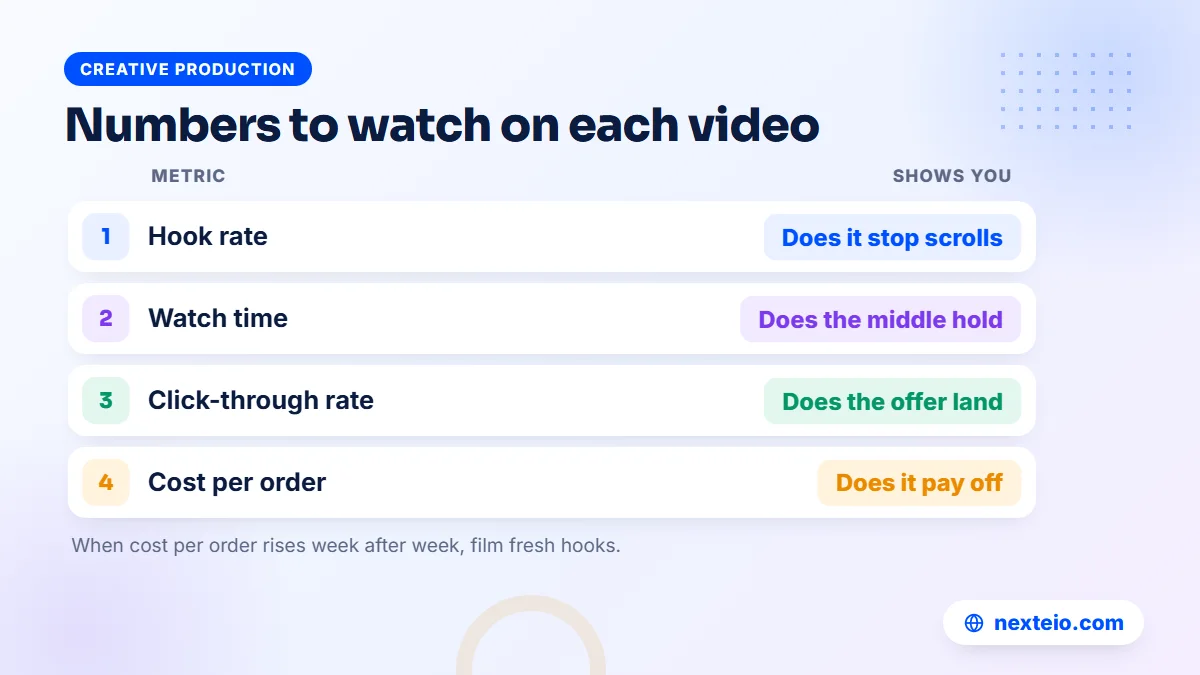
The table below shows the numbers worth watching, in the order you should look at them.
| Metric | What it tells you | What to change if it is weak |
|---|---|---|
| 3-second views divided by impressions (often called hook rate) | Whether the opening stops the scroll | Test new hooks with the same body |
| Average watch time or 50% views | Whether the middle holds attention | Cut slow parts, add b-roll, shorten |
| Click-through rate | Whether the offer and call to action land | Make the next step clearer, show the price |
| Cost per message, lead or order | Whether the ad makes business sense | Check the landing page, offer and audience |
Read the metrics as a chain. A low hook rate means the first seconds fail, so changing the ending will not help.
A simple test plan for a small seller looks like this: run three to five videos in one ad set with an equal starting budget for about a week, then pause the weakest, keep the best, and film new hooks for the winning video. Repeat every two to three weeks. If you need help reading results when spend rises and sales do not follow, our guide on why Meta ads stop performing walks through the usual causes.
Expect fatigue. A winning ad shown to the same audience for weeks gets more expensive as viewers start to ignore it. When cost per order climbs while the audience stays the same, it is time for fresh footage, not a bigger budget.
The page after the click
A strong video cannot rescue a weak landing page. If the ad promises a quick try-on and same-week delivery, the page must show sizes, the price, the delivery charge, cash on delivery or bKash options, and a clear order button. Any gap between what the video shows and what the page says loses buyers at the last step.
Keep the creator's face and the product shown in the video on the landing page too, for example as a short clip near the top or a photo with their quote. That continuity tells the visitor they are in the right place. Our article on building a high-converting landing page covers layout and form details, and if your store struggles on mobile, a proper e-commerce website may be the missing piece.
For sellers who take orders only through Messenger or WhatsApp, the chat is the landing page. Prepare quick replies with price, sizes and delivery details, so a viewer who saw the ad gets an answer within minutes, not hours.
Common Mistakes With UGC Ads
The same problems appear again and again when businesses try UGC ads for the first time. Most of them are cheap to fix once you see them:
- Starting with the logo: the first seconds go to the brand name instead of a reason to keep watching.
- Too much polish: heavy filters, studio music and fancy transitions make the video look like a normal ad again.
- Several messages in one video: price, quality, delivery and a discount all crammed into 20 seconds.
- No captions: most of the audience watches on mute and misses the whole point.
- Testing only one video: one result, good or bad, teaches you very little.
- No written permission: a customer asks you to remove their video after it has become your best ad.
- Exaggerated claims: the ad gets rejected, or it runs and damages trust.
- Ignoring comments: unanswered questions under an ad become public doubt.
Notice that only two of these mistakes are about the camera. The rest are planning, editing and follow-up problems.
Fixing these is usually faster than making new videos. Before you commission another shoot, review your current ads against this list and correct what you can in the edit. A fresh cut from a short-form ad editor often revives footage you already paid for. A broader checklist for Facebook campaigns is in our guide to what a Facebook ads service should deliver.
A First Month With UGC Ads: A Practical Plan
If you have never run UGC ads before, a four-week plan keeps the work manageable and gives you real data by the end:
- Week 1: pick one product with clear demand, collect existing customer clips, and brief one or two creators with three hooks each.
- Week 2: receive raw footage, edit five to eight versions with captions, and set up tracking on your site or chat.
- Week 3: run all versions with a small, equal budget per video. Do not change anything for at least five to seven days.
- Week 4: pause the weak versions, move budget to the best two, and order new hooks based on what the winner did.
By the end of the month you will know which format, which kind of person on camera and which opening line your buyers respond to. That knowledge carries into every future shoot and makes the next round cheaper and faster.
Keep a simple shared sheet for every video: the creator, format, hook, length, spend, cost per result and a note on why you think it worked or failed. After two or three rounds, that sheet becomes your most useful creative brief.
How Nexteio Can Help With UGC Ads
We work on the parts of this process that most businesses find hardest to do in-house. We help you choose the formats and hooks that fit your product, write the creator brief, and list the shots to capture. When the raw footage arrives, from customers, creators or your own team, our video ads editing team cuts it into short versions with captions, b-roll, clean sound and the right sizes for Reels, TikTok, Shorts and feed placements.
Because we also run campaigns through our Facebook ads management and TikTok services, we can set up the tests, track which videos bring messages or orders, and tell you which hooks to film next. You get the edited files, a clear record of what was tested, and plain advice on where to spend the next round of budget.
You can see examples of our work in our portfolio, read more about how we work, or send your product details and goals through our project brief form. If you prefer to talk first, our contact page has every way to reach us.
Keep reading: what to expect from a TikTok ads service and the full list of creative production guides. When you are ready for your first batch of UGC ads, start a project with us.
Frequently asked questions
What does UGC mean in advertising?
UGC means user-generated content, such as videos, photos and reviews made by customers rather than by the brand. In advertising, it usually refers to customer-style videos, either made by real buyers or by paid creators, that a business runs as paid ads. The appeal is that they look like normal posts and feel more believable than studio adverts.
Do I need permission to use a customer's video in an ad?
Yes. A customer posting a video on their own profile does not give you the right to run it as a paid advertisement. Ask for written permission that states where you will use it and for how long. A short message confirmation is better than nothing, but a simple signed agreement is safer for anything you plan to spend real budget on.
How long should a UGC ad be?
Most customer-style ads for direct sales work well at 15 to 45 seconds. Shorter versions suit Stories and quick offers, while a longer cut can work for a product that needs a demonstration. The safest approach is to edit two lengths from the same footage and let the results decide.
Can I make a UGC ad myself without hiring a creator?
Yes. Many small sellers film themselves or their staff with a phone, and it works well when the person speaks honestly as who they are. Do not pretend to be an ordinary customer if you are the owner or an employee. Use good daylight, film several hooks, and add captions before running it.
How many UGC videos should I test at once?
Three to five videos in one test is a practical number for a small budget. Fewer than three gives too little to compare, and too many spreads the budget so thin that no video gets enough views for a clear answer. Once a winner appears, test new hooks on it rather than starting from zero.
Why was my UGC ad rejected by Facebook or TikTok?
The most common reasons are exaggerated claims, before-and-after images for health or beauty products, missing disclosure of a paid partnership, or a landing page that does not match the ad. Read the rejection reason in Ads Manager, fix the specific line or image, and submit again. If you disagree with the decision, both platforms let you request a review.
Is UGC better than influencer marketing?
They do different jobs. An influencer post is mainly paid reach to that person's followers, while a UGC creator is paid for the video, which you then show to your own chosen audience through ads. Many brands start with UGC because it is easier to test and control, then work with influencers once they know which message sells.