Business Website Design for Manufacturers, Exporters and Factories
In this article 16 sections
- 1.What Buyers Look For Before They Contact a Factory
- 2.Business Website Design Starts With the Buyer's Questions
- 3.The Pages a Manufacturer's Website Needs
- 4.Showing Capacity, Machinery and Process Without Overclaiming
- 5.Certifications, Compliance and Audit Information
- 6.Photos, Video and the Factory Tour
- 7.Enquiry and RFQ Forms That Bring Serious Leads
- 8.Business Website Design for Mobile and Slow Connections
- 9.Writing for International Buyers and Local Audiences
- 10.SEO for Exporters: Being Found by Sourcing Teams
- 11.The Design Process: From Brief to Launch
- 12.What a Manufacturer's Website Usually Costs in Bangladesh
- 13.Keeping the Site Current After Launch
- 14.Mistakes Manufacturers Make With Their Websites
- 15.How Nexteio Can Help With Your Factory Website
- 16.Frequently asked questions
Good business website design for a manufacturer is not about looking expensive. It is about answering a buyer's questions before the first email: what you make, how much you can make, who you already supply, which audits you have passed and how to send an enquiry. A sourcing manager in Europe or a local corporate buyer will often decide whether to contact a garment factory, a plastics maker or a food processor in Bangladesh after a few minutes on its site.
Many factory websites fail that test. Some were built years ago and still show old machinery and a phone number nobody answers. Others look modern but say very little: a slider of stock photos, a mission statement and a contact form.
Buyers are practical people. They want evidence, specific numbers they can check and an easy way to start a conversation. Your website is often the first document in their supplier file.
The sections below follow the order a real project should take, from what buyers look for to pages, content, forms, speed, search, timeline and budget, with notes that apply to manufacturers, exporters and garment factories in Bangladesh.
What Buyers Look For Before They Contact a Factory
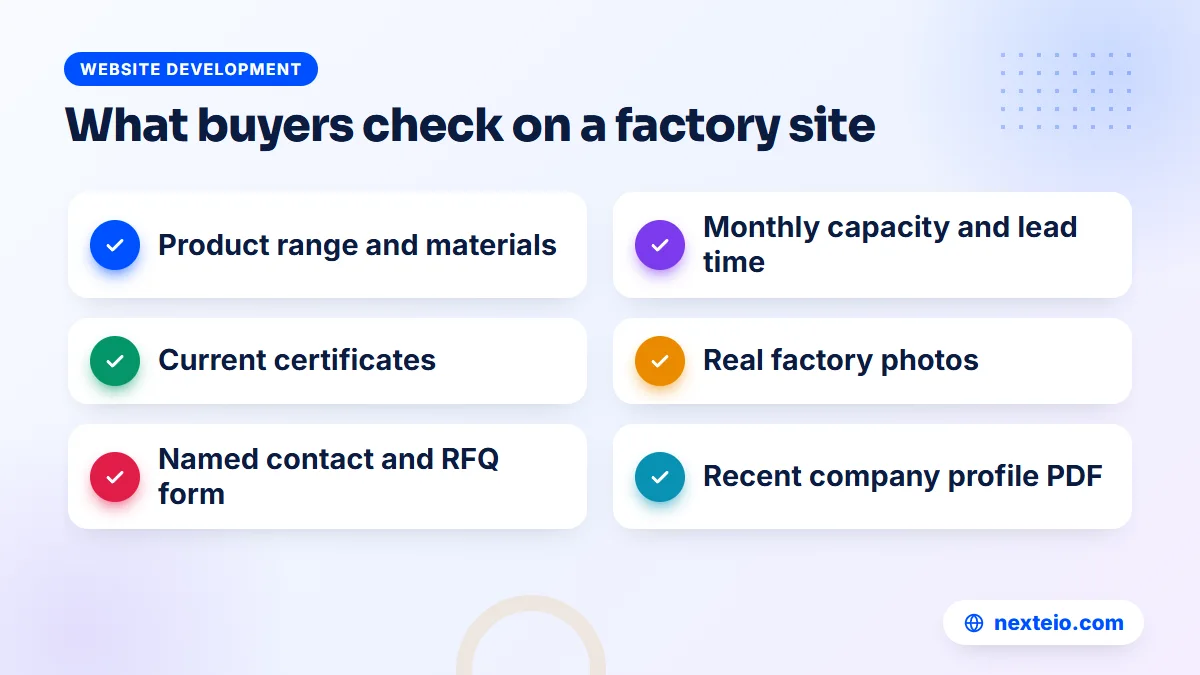
Before you plan a single page, think about who opens your site and why. For an export-oriented factory, the visitors usually fall into a few groups, each with a different question in mind.
- Sourcing and merchandising teams want product range, capacity, lead times and minimum order quantities.
- Compliance and quality teams want certifications, audit history and policies on safety, labor and environment.
- Existing buyers want a quick way to reach the right merchandiser or download an updated company profile.
- Local corporate clients want to see if you can handle uniform, packaging or component orders on time.
- Job seekers want vacancies, location and how to apply, often in Bangla.
A garment exporter preparing for a buyer meeting knows the pattern well. The buyer's team has often looked at the website the night before, compared it with two other suppliers and arrived with questions based on what they saw, or did not see.
If the site is thin, the factory starts the meeting on the back foot. If it is clear and specific, much of the trust-building has already happened. That is the job of the website: to make the first meeting shorter and more serious.
Business Website Design Starts With the Buyer's Questions
The most common mistake in a factory project is starting with colors and layout. Strong business website design starts with a list of questions and the evidence you have to answer them. Only then does it make sense to decide how pages look.
Sit down with the people who face buyers every day: the merchandising head, the compliance manager and the person who handles new enquiries. Ask them three things:
- What do new buyers ask in the first email or call?
- Which documents do we send again and again?
- What do buyers misunderstand about us, such as our product range or capacity?
The answers become your content plan. If buyers always ask for your monthly capacity by product type, that number belongs on the site. If your compliance team sends the same certificate list to every new buyer, it should be a clear page, not an attachment.
This step also shows which content you do not yet have. Many factories find they have no recent photos of the cutting section, no written description of their quality process and no up-to-date client list they are allowed to share. Collecting these takes longer than designing pages, so start early.
A custom website designed around these questions will usually perform better than a template filled in later, because every page has a reason to exist. Our general guide to building a professional business website covers the basics for any company; the rest of this article focuses on what changes for manufacturers.
The Pages a Manufacturer's Website Needs
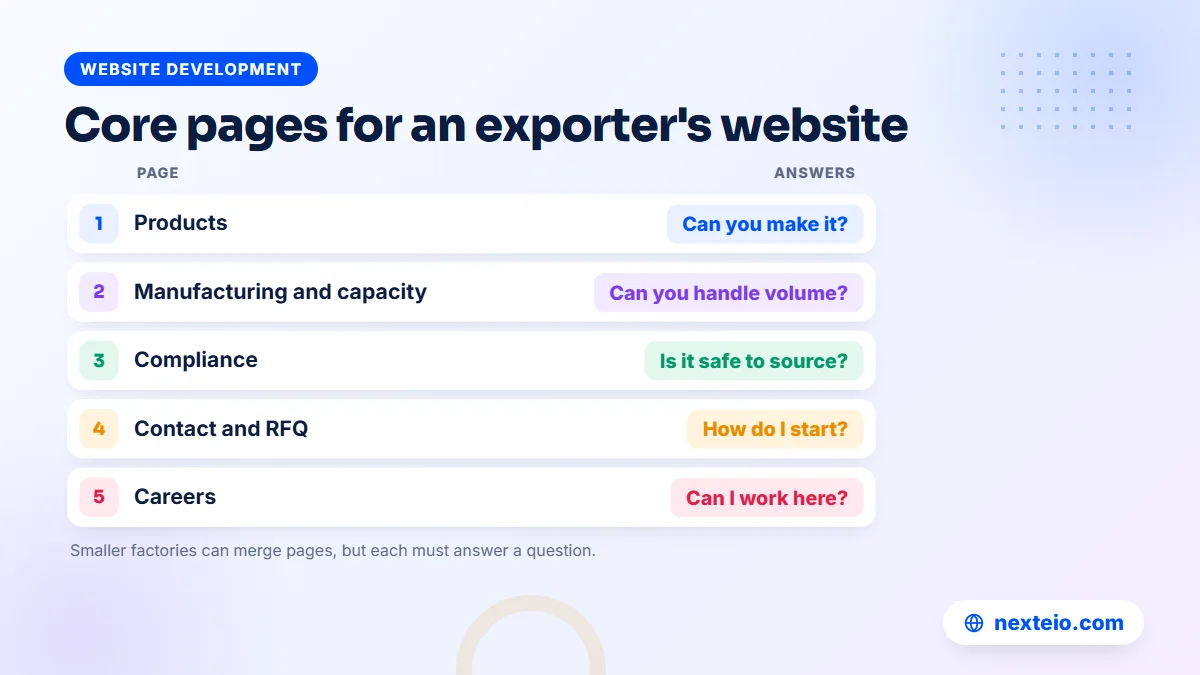
A factory website does not need dozens of pages. It needs the right ten to fifteen, each answering one clear question, and good business website design makes the path between them obvious. The table below shows a practical structure for an exporter.
| Page | What it answers | Key content |
|---|---|---|
| Home | Who are you and what do you make? | One clear line, main product groups, key numbers, one enquiry button |
| Products or capabilities | Can you make what I need? | Product categories, fabrics or materials, sample photos, typical MOQ |
| Manufacturing and capacity | Can you handle my volume? | Production lines, machinery, monthly capacity, lead times |
| Quality | Will the goods meet my standard? | Inspection stages, lab testing, quality team |
| Compliance and certifications | Is it safe to work with you? | Certificates with validity, audit programs, policies |
| Sustainability | What is your environmental practice? | Energy, water and waste work you can document |
| About and management | Who runs the company? | History, leadership, group companies, location |
| Contact and RFQ | How do I start? | Enquiry form, named contacts, address, map |
| Careers | Can I work here? | Vacancies, process, often in Bangla |
Not every factory needs all nine pages.
Smaller manufacturers can merge some of them. A packaging maker might combine quality and compliance into one page, while a group with several factories may need a page for each unit. The point is that each page answers a question a buyer genuinely has.
This is where a template often struggles. In a website designed from scratch for your factory, the page list follows your business rather than a theme's demo layout.
Keep one more page in mind: a downloadable company profile. Many buyers still want a PDF for their supplier file. Offer it on the site, keep it consistent with the pages, and update both together.
Showing Capacity, Machinery and Process Without Overclaiming
Capacity is where many factory sites either say too little or claim too much, and no amount of business website design can rescue numbers a buyer does not believe. "Large production capacity" tells a buyer nothing. A wildly inflated number is worse, because a buyer's audit team will check it on the floor.
Write capacity the way your planning team speaks about it. For a knit factory, that could be pieces per month by product type. For a printing and packaging unit, it might be sheets per shift or cartons per day. State the basis clearly, such as "based on a standard T-shirt" or "at two shifts", so the number means something.
Machinery lists work well in a simple table: machine type, brand, quantity and what it is used for. Buyers in technical categories often look for specific equipment, and a clear list saves them an email. Update it when you add or retire machines.
Process pages should walk through production in order. For a garment factory, that might be sampling, fabric inspection, cutting, sewing, finishing, final inspection and shipment. For each stage, two or three sentences and one real photo are enough. Explain where quality checks happen, because buyers care about that more than the machines themselves.
Lead times and minimum order quantities deserve honest ranges, not single numbers. "Usually 60 to 90 days from approved sample, depending on fabric" is more useful and more believable than "fast delivery".
Certifications, Compliance and Audit Information
For export buyers, compliance is often the first filter. A compliance manager may not look at your products at all until they have confirmed that your factory meets their standards for safety, labor practice and environment.
Show only certifications you currently hold, with the issuing body and validity date. Common examples in the garment and textile sector include OEKO-TEX, GOTS, WRAP, amfori BSCI, Sedex audits, ISO 9001 and ISO 14001, but the right list is whatever your factory actually has. Buyers can and do verify certificates with the issuing organizations, so expired or borrowed logos damage trust quickly.
A good compliance page includes:
- A list of current certificates with the scope, certificate number where appropriate, and expiry date.
- Audit programs you take part in, described accurately.
- Short summaries of your health and safety, fire safety and worker welfare policies.
- Your membership of trade bodies, such as BGMEA for garment exporters, if it applies.
- A named contact for compliance questions, or a dedicated email address.
Give each certificate a date of last review on your side. When a certificate is renewed, update the page the same week.
Sustainability pages need the same care. If your factory has invested in solar panels, a water treatment plant or a green building certification, describe it with specific, checkable facts. Avoid broad promises about being "eco-friendly". Buyers increasingly ask for data, and vague claims can invite tough questions in an audit.
Photos, Video and the Factory Tour
Images carry a lot of weight in business website design for manufacturers, because buyers cannot visit every supplier in person. They want to see a clean, organized floor, real workers in safety gear, the quality lab and the finished goods warehouse.
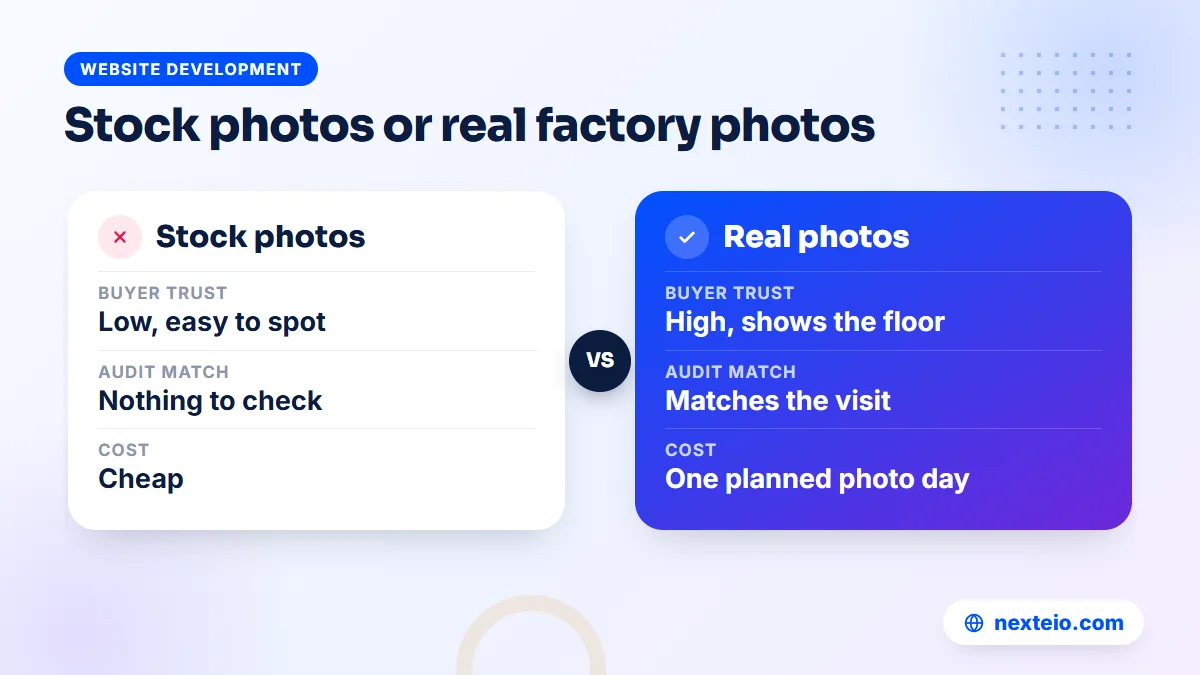
Stock photos of smiling models in a generic office do the opposite. A buyer recognizes them at once and wonders what you are hiding. Real photos taken on a normal working day, with good light and tidy surroundings, are far more convincing even if they are not perfect.
Plan a proper photo day. Brief each department in advance, clear walkways, make sure safety equipment is worn, and photograph every main process step. Take wide shots that show scale and close shots that show detail, such as stitching or print quality.
A short factory video, two or three minutes long, can act as a virtual tour for buyers who cannot travel. Keep it focused: arrival, main production areas, quality checks, warehouse and a short message from management. Our video editing service can turn raw footage into a clean tour with captions, and our article on business video editing in Bangladesh explains what a good edit includes.
Heavy media slows a site down, so design matters here. Compress every image, serve modern formats such as WebP, and load videos only when a visitor clicks play rather than when the page opens.
Related guides for factories planning their website content:
- How to write website content that people actually read
- WordPress or a custom website for a growing company
- What to check before hiring a WordPress developer
Enquiry and RFQ Forms That Bring Serious Leads
The enquiry form is where your website turns into business, and it deserves as much attention in your business website design brief as the home page. For manufacturers, a generic "name, email, message" form is not enough. Buyers who are serious want to share details, and your team needs those details to reply properly.
A useful request-for-quotation form asks for:
- Company name, country and the buyer's role.
- Product type and a short description.
- Estimated order quantity and target delivery date.
- Material, fabric or specification notes.
- A file upload for tech packs, drawings or reference images.
- How the buyer prefers to be contacted.
Keep the number of required fields small. Make only the essentials compulsory and let the rest be optional, so a buyer browsing on a phone can still send something useful.
Behind the form, the routing matters as much as the design. Enquiries should reach a shared mailbox that more than one person reads, not a single merchandiser's inbox. Many factories also log each enquiry in a simple system so nothing is forgotten when a staff member is away during a busy shipment week.
Reply speed is part of your brand. A buyer who sends the same RFQ to five suppliers will often work with the ones who answer first with a clear, specific reply. If your team needs help building a proper enquiry workflow with records and follow-ups, a Laravel web application can handle it alongside the public site.
Business Website Design for Mobile and Slow Connections
Buyers check supplier sites on phones more often than many factory owners expect: at trade fairs, between meetings, in a taxi on the way to a visit. Business website design for manufacturers has to work on a small screen first and a large monitor second.
On a phone, the most important things are the product groups, the key capacity numbers, the certifications and a visible way to make contact. Long tables should scroll sideways or turn into simple stacked lists. Buttons need to be large enough to tap. Phone numbers and WhatsApp links should open the right app directly.
Speed matters on two fronts. Your local visitors and job seekers may be on slow mobile data, while international buyers are loading your site from far away. Both groups suffer when pages are heavy. Google's guidance on improving Largest Contentful Paint explains how to make the main content appear quickly, and you can test your own pages free with PageSpeed Insights.
Hosting choice plays a part too. A reliable data-center server, with a content delivery network for images if your buyers are mainly abroad, keeps the site quick and available. A site hosted on a computer inside the factory office goes down with every power cut and internet problem. Our article on website speed and SEO explains how faster pages help both rankings and enquiries.
Writing for International Buyers and Local Audiences
Most export buyers read English, so the main site should be in clear, simple English. That does not mean formal or flowery language. Write the way a good merchandiser writes an email: short sentences, specific facts, no exaggeration.
Compare two lines. "We are a leading manufacturer committed to excellence" says nothing. "We make knit tops and bottoms for adult and kids' ranges, with two dyeing units and in-house printing" tells a buyer exactly what they need. Every page should lean toward the second style. Good business web page design gives these specific lines room to be read: short paragraphs, clear headings and numbers that stand out.
Bangla still has a place. Careers pages, notices for workers and information for local suppliers often work better in Bangla, and some manufacturers that sell mainly in Bangladesh may want a full Bangla version. If you add a second language, plan it properly, with each language on its own address. Google's guide to managing multilingual sites explains the setup.
Be careful with client names and logos. Many buyers do not allow suppliers to show their brand publicly. Ask permission in writing before you add any buyer's name or logo, and remove it if the relationship ends. A line such as "we supply mid-market fashion retailers in Europe" is often safer and still useful.
SEO for Exporters: Being Found by Sourcing Teams
Many sourcing teams search for suppliers directly, using phrases like a product type plus "manufacturer in Bangladesh". If your site has a clear page for each product category, written in plain language with specific details, it has a fair chance of showing up for those searches.
Each product or capability page should have its own title, a short description, real photos with descriptive alt text and a link to the enquiry form. Avoid one long page that lists every product in a single block. Our guide to on-page SEO for beginners walks through these basics step by step.
A few technical steps help search engines understand your company:
- Add Organization structured data with your legal name, logo, address and contact details.
- Set up Google Search Console to monitor how your pages appear in search.
- Create or claim a Google Business Profile for the factory address so local visitors and drivers can find it.
- Use a clean address structure, such as /products/knitwear rather than /page?id=27.
These steps support visibility, but they do not replace good content.
Search takes time. A new factory site will not appear for competitive product searches in the first month, and that is normal. Our article on what SEO means for a business explains how search brings customers over time, and our SEO service can take this work on if you want steady growth rather than a one-time setup. For faster results while SEO builds, a small, well-targeted Google Ads campaign for your main product terms can start bringing enquiries soon after launch.
The Design Process: From Brief to Launch
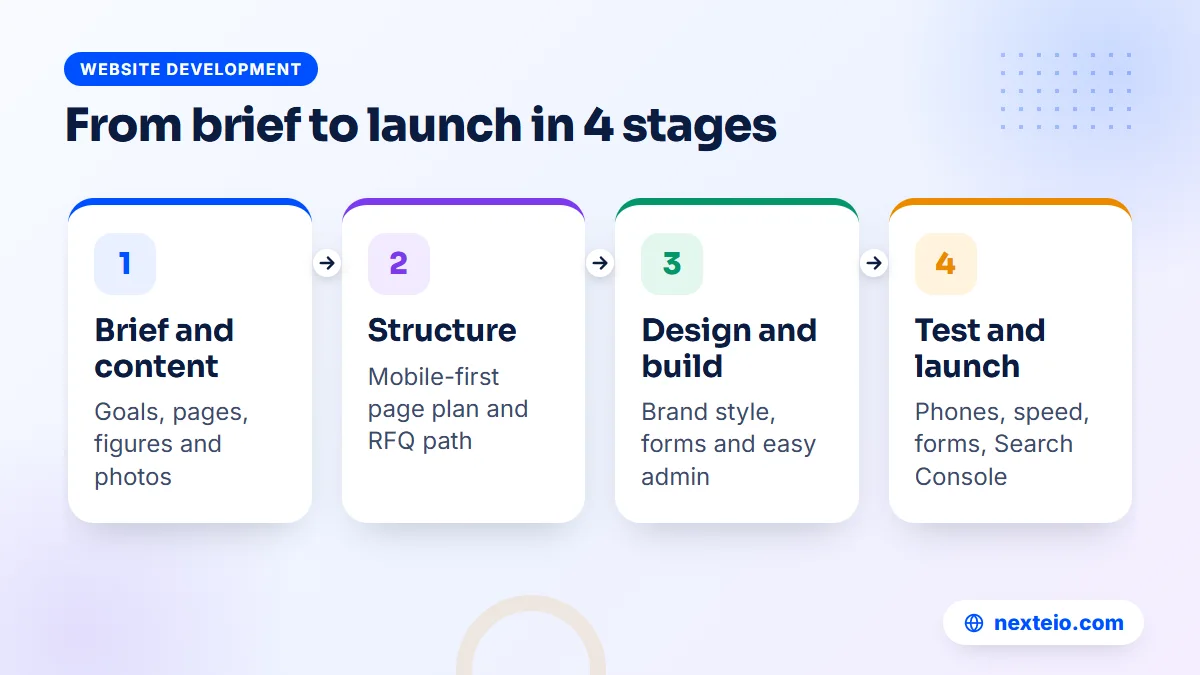
A well-run business website design project for a factory follows a clear sequence. Skipping steps, especially content collection, is the usual reason projects drag on for months.
- Brief and discovery: agree on goals, audiences, pages and who on your side approves each part.
- Content collection: gather capacity figures, certificates, machinery lists, product photos and text from each department.
- Structure and wireframes: plan the page layout and the path from home page to enquiry, on mobile first.
- Visual design: apply your brand colors, type and photography style to the key pages.
- Development: build the site, forms, downloads and admin area so your team can update it.
- Testing: check every page on phones and desktops, test forms and measure speed.
- Launch and handover: go live, connect Search Console, and train staff to update content.
The right length depends mostly on how fast content and approvals move.
For a typical manufacturer's site of ten to fifteen pages, the whole process often takes somewhere around four to ten weeks. Larger groups with several units, a Bangla version or a custom enquiry system take longer. In many factories, the longest wait is for approvals from the managing director or the board, so agree on one decision-maker early.
Plan the admin side as carefully as the public pages. Your team should be able to add a new certificate, update a vacancy or swap a product photo without calling a developer. A WordPress website with a clean editing setup suits many factories for this reason, while a custom build fits groups with more complex needs.
What a Manufacturer's Website Usually Costs in Bangladesh
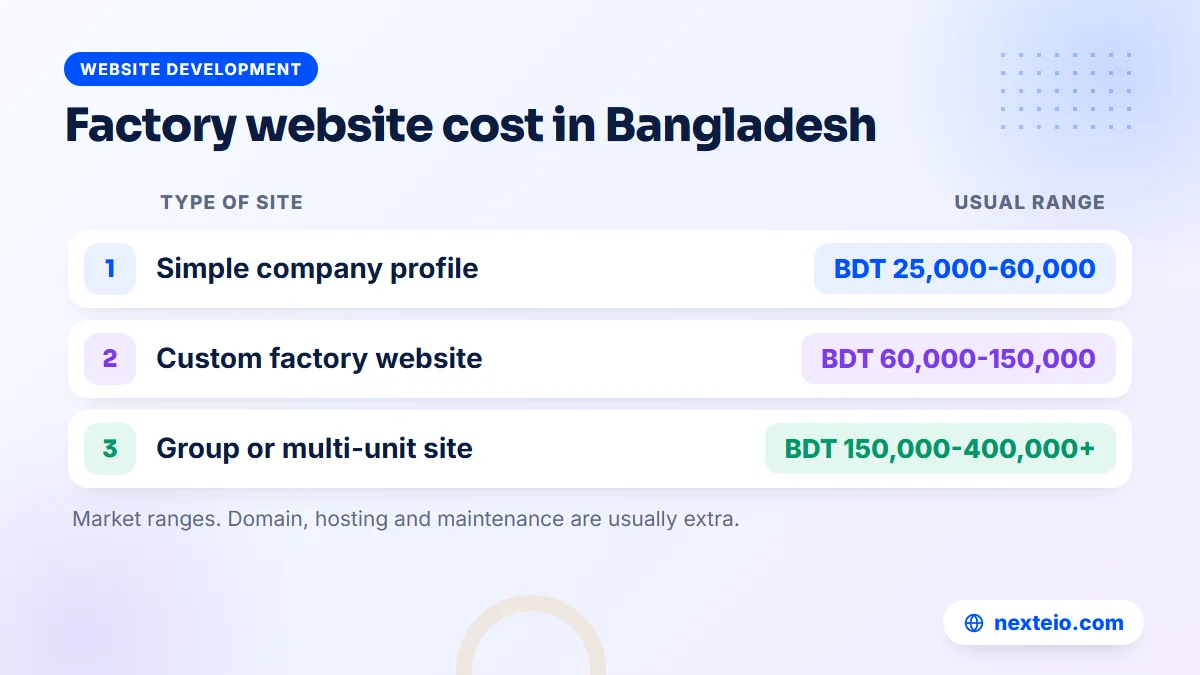
Business website design costs vary widely, and comparing quotes is hard when each one includes different work. These are broad market ranges, not fixed prices, and the final figure depends on the number of pages, the design work, languages, forms and integrations.
| Type of site | Usual range | Typically includes |
|---|---|---|
| Simple company profile | Around BDT 25,000 to 60,000 | A few pages, template-based design, contact form |
| Custom factory website | Around BDT 60,000 to 150,000 | Custom design, 10 to 15 pages, RFQ form, downloads, basic SEO setup |
| Group or multi-unit website | Around BDT 150,000 to 400,000 or more | Several units, two languages, enquiry system, careers module |
Domain, hosting and ongoing maintenance are usually separate. At Nexteio, for example, website maintenance is a separate monthly plan, roughly BDT 2,000 to 5,000 at the basic level and more for larger or busier sites, agreed in writing before work starts.
Photography and video are often extra, and they are worth budgeting for properly because they carry so much weight with buyers. Copywriting can also be a separate line if your team does not have time to write the content.
When you compare quotes, ask each provider what exactly is included: the number of pages, design rounds, who writes content, whether forms send to more than one person, what training you get and who owns the domain and hosting. Our checklist for choosing a web design company lists more questions. A cheaper quote that leaves out content and photos can end up costing more once you add them back in. For a clear figure based on your own pages and content, send us a short brief and we can explain what each part would include.
Keeping the Site Current After Launch
A factory website loses value quickly if nobody owns it. Certificates expire, capacity changes after a new line is added, and job notices stay online months after the posts are filled. Buyers notice these gaps, and they read them as a sign of how the factory is run.
Give the website a named owner inside the company, usually someone in marketing, merchandising or the MD's office. That person does not need technical skills. They need a simple calendar and the authority to ask departments for updates.
- Every month: check the contact form, remove filled vacancies and add any new product photos.
- Every quarter: review capacity, lead times and machinery, and refresh the company profile PDF if anything changed.
- When a certificate renews: update the compliance page and the expiry date the same week.
- Before a trade fair or buyer visit: read the site as a buyer would and fix anything out of date.
- Every year: look at which pages buyers visit most and which enquiries came from the site.
Technical upkeep, such as updates, backups and security checks, is separate work, and many factories hand it to an outside team while their own staff handle content.
Mistakes Manufacturers Make With Their Websites
The same business website design problems appear on factory sites across many sectors. Most are easy to fix once someone looks at the site through a buyer's eyes.
- Outdated information: certificates that expired, machinery that was sold, management who left.
- Generic claims: "best quality", "on-time delivery" and "industry leader" with no evidence behind them.
- Stock images: photos that clearly do not show your factory.
- Hidden contact details: no named contact, no direct email, only a form that may or may not work.
- Heavy home page: a large slider and autoplay video that take a long time to load on mobile.
- No owner inside the company: nobody responsible for keeping the site updated after launch.
- Personal email addresses: merchandisers listed with free email accounts instead of the company domain.
The last point needs action at a policy level.
Company email on your own domain looks more professional and stays with the business when people leave. Combined with a site that shows real, current information, it tells buyers that the factory is organized. If your current site has several of these problems, a focused redesign through our custom website design service can fix them in one project rather than piece by piece. Our article on why a website gets traffic but no customers covers other reasons enquiries stay low.
How Nexteio Can Help With Your Factory Website
We plan, design and build websites for manufacturers, exporters, garment factories and other businesses across Bangladesh. Our custom website design work starts from a blank page rather than a bought theme, so the structure follows your buyers' questions, your product range and the evidence you have.
In practice, that means helping you decide which pages you need, organizing the content your departments provide, designing for phones and slow connections first, and building enquiry forms that send the right details to the right people. We can set up the site on WordPress for easy updates, or build a Laravel system if you need a custom enquiry workflow, a careers module or a portal for buyers. After launch, Nexteio can also look after maintenance under a written agreement, once you give us access to the hosting and the website.
To start, share your project details on our brief form, including your product range and the buyers you want to reach. You can see examples of our work in our portfolio, look at our full list of services or reach us through the contact page.
Keep reading: technical SEO basics for website owners, or browse all our website development guides.
Frequently asked questions
What should a garment factory website include?
At minimum: your product range, manufacturing capacity and lead times, current certifications, real photos of the factory, management and company details, and a clear enquiry form with named contacts. A downloadable company profile and a careers page are also useful. Keep every number and certificate current, because buyers check.
How many pages does a manufacturer's website need?
Most factories do well with ten to fifteen pages. That is usually enough for products, capacity, quality, compliance, sustainability, company information, careers and contact. Larger groups with several units may need a page or a small section for each one.
Should we show our buyers' logos on our website?
Only with written permission. Many brands and retailers do not allow suppliers to display their names or logos publicly. A general description, such as the markets or types of retailers you supply, is safer and still helps a new buyer understand your experience.
Is WordPress good enough for a factory website?
For most factory sites, yes. WordPress handles product pages, downloads, forms and careers well, and staff can update content without a developer. If you need a buyer portal, a custom enquiry system with records or links to internal software, a custom build on a framework such as Laravel is often a better fit.
How long does it take to build a website for a manufacturer?
A typical site of ten to fifteen pages often takes around four to ten weeks. The biggest factor is usually content: capacity figures, certificates, photos and approvals from management. Having one person on your side who can make decisions speeds things up a lot.
Do export buyers really look at supplier websites?
Many do, especially before a first meeting or when they are comparing several suppliers. The website is often where a buyer checks your product range, certifications and scale before deciding whether to reply or visit. A clear, current site helps you get onto the shortlist.
Should our factory website be in English or Bangla?
For export buyers, clear English should be the main language. Bangla works well for careers pages, worker notices and local suppliers, and some companies that sell mainly in Bangladesh add a full Bangla version. If you use two languages, give each its own set of pages rather than mixing them on one page.