Free Domain and Hosting: Why It Is a Bad Idea for a Business Website

In this article 15 sections
- 1.What "Free Domain and Hosting" Usually Means
- 2.A Borrowed Address Tells Visitors You Are Not Settled
- 3.No Free Domain Hosting Setup Gives You Proper Business Email
- 4.Who Really Owns the Name
- 5.The Limits Free Hosting Does Not Advertise
- 6.Security, SSL and Bad Neighbors
- 7.How Free Domain and Hosting Holds Back Search and Ads
- 8.Reading a "Web Hosting With Free Domain" Offer
- 9.What Your Own Domain and Hosting Cost in Bangladesh
- 10.When a Free Setup Is Perfectly Fine
- 11.Moving From a Free Domain and Hosting Setup to Your Own
- 12.Questions to Ask About a "Free Domain and Hosting" Website Package
- 13.Setting Up Your Own Domain and Hosting the Right Way
- 14.How Nexteio Can Help
- 15.Frequently asked questions
Free domain and hosting offers look like an easy way to put a business online without spending anything. Type the phrase into Google and you will find site builders, blog platforms and hosting companies that promise a website at no cost. For a hobby project, that can be fine. For a company, a school, a clinic or an exporter that wants to be taken seriously, the free route usually costs more than it saves.
The problem is rarely obvious on day one. The site loads, the page looks decent and you have a link to share. The costs show up later: an address nobody remembers, no proper company email, a host that puts its own ads on your pages, or a name that turns out to belong to someone else.
Most owners only discover these limits when they try to grow. A buyer asks for an official email address. A tender form asks for the company website. Your Facebook ads send people to a page full of someone else's banners.
This guide explains what the different free offers really give you, where each one hides its cost, what a basic paid setup costs in Bangladesh, and how to move off a free platform without losing what you have built.
What "Free Domain and Hosting" Usually Means
The word "free" covers several very different deals. Before you judge any of them, it helps to know which one you are looking at. In practice, offers you find in Bangladesh fall into four groups.
| Type of offer | What you get | The usual catch |
|---|---|---|
| Free subdomain on a builder or blog platform | An address like yourname.platform.com and a hosted site | The platform's name in your address, limited control, ads or upgrade prompts |
| Free hosting account | Server space and often a free subdomain | Tight limits, forced ads, weak uptime, little or no support |
| Web hosting with free domain | A paid hosting plan with the domain free for the first year | Domain renewal at full price, often a long hosting contract |
| "Free" domain and hosting in a website package | The agency buys both and adds them to your project | The accounts may sit in the agency's name, not yours |
Only the first two are truly free. The last two are paid deals where the domain or hosting cost has simply been moved somewhere else. That is not dishonest in itself, but you should know where the cost went.
People search for this in many ways: "free domain free hosting", "free domain name hosting", "free website hosting and domain name". The words change, but the question is the same. Can a business get a proper web presence without paying for the two basics? The short answer is that it can get a web page, but not a business address it owns.
A Borrowed Address Tells Visitors You Are Not Settled
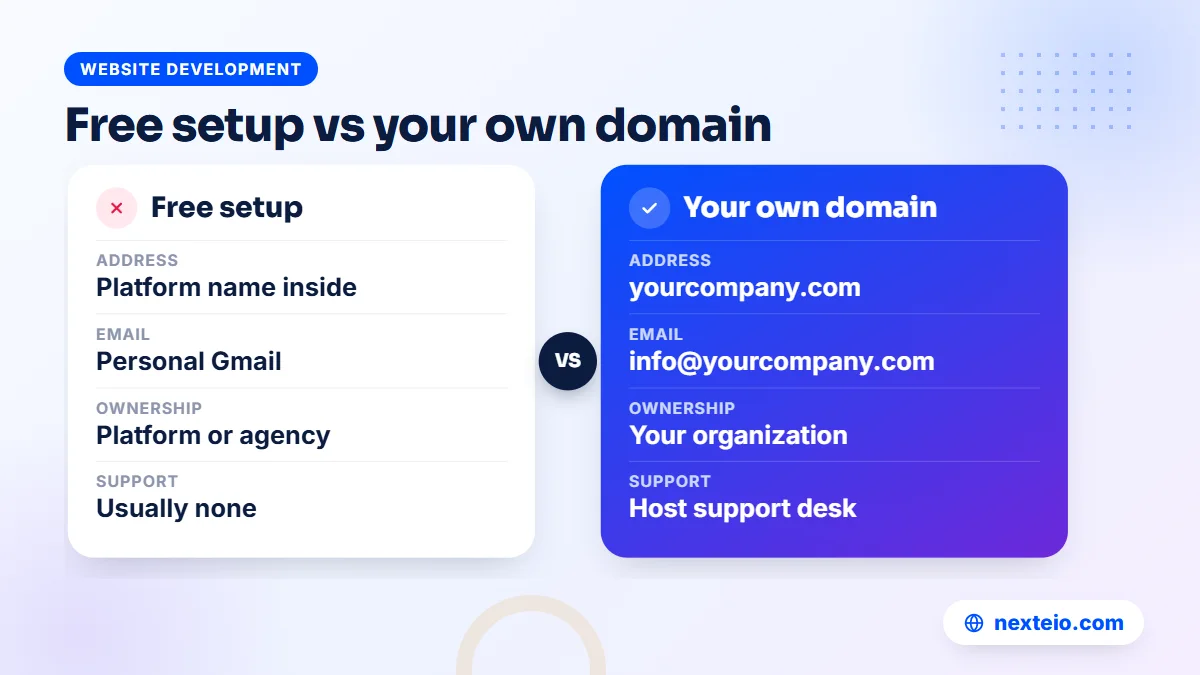
A free subdomain looks like this: yourcompany.someplatform.com. The platform's brand sits in the second half of your address, and it reads exactly like what it is: a page hosted on someone else's name.
For a personal blog, nobody minds. For a business, the address does real work. It goes on visiting cards, invoices, product packaging, factory signboards, school admission forms and email signatures. A long address with a platform's name inside it is hard to say over the phone and easy to mistype.
Think about a garment exporter preparing for a buyer meeting. The buyer's sourcing team searches the company name, then checks the website and the email domain. When both point to a free platform, the message is that this supplier has not invested in its own identity. Nobody will say that in the meeting. They simply rank you a little lower than the factory with a clean .com address.
The same is true for a coaching center printing leaflets or a clinic putting its address on prescription pads. A short domain like clinicname.com or schoolname.edu.bd is easy to remember. A borrowed address is not, and every printed copy you hand out keeps sending people to a name you do not control. When we plan a new business website, choosing the domain is one of the first decisions for exactly this reason.
No Free Domain Hosting Setup Gives You Proper Business Email
This is the cost most owners notice first. Company email such as info@yourcompany.com or admission@schoolname.edu.bd needs a domain that you own and whose DNS settings you can change. A free subdomain does not give you that, because the parent domain belongs to the platform.
So the business ends up using a personal Gmail or Yahoo address. That works for daily chat, but it creates three problems:
- Trust: buyers, government offices and corporate clients often treat free webmail addresses with suspicion, especially for invoices and payment details.
- Control: the mailbox belongs to whoever created it. When that staff member leaves, years of client conversations can leave with them.
- Delivery: with your own domain, you can set up SPF, DKIM and DMARC records so your messages are recognized as genuine. Without one, you cannot.
Some tender and procurement forms in Bangladesh may ask for an official email and website. A free address may not break any rule, but it rarely helps your case.
Once you own a domain, business email is not expensive. You can use the email that comes with most shared hosting plans, or a paid mailbox service for the people who send the most important messages. Our guide to building a professional business website covers how email, domain and site fit together from the start.
Who Really Owns the Name
The registrant record decides ownership
Every domain has a registrant, the person or organization recorded as its holder. Whoever is listed there controls the domain, can renew it, can move it to another provider and, in a dispute, is treated as the holder. It is not decided by who paid or who uses the website.
With a free subdomain, the registrant is the platform. You are a user on their name, under their terms, and those terms can change. With an agency package that includes a "free domain and hosting" line, the registrant might be you, or it might be the agency or one of its staff. Many organizations in Bangladesh only learn which one it is when they try to change providers.
ICANN's information for registrants explains the rights and duties of a domain holder in plain terms, including transfers and renewals. It is worth ten minutes of reading before you sign any website contract.
How to check your own domain
You can check the public record yourself. Use the ICANN Lookup tool for .com, .net and most other global domains. Then follow these steps:
- Enter your domain and look at the registrar name and the expiry date.
- Note whether the registrant organization is shown or hidden behind privacy protection.
- Ask your provider in writing for the registrar account login, or for a screenshot showing your organization as the registrant.
- Make sure the account email is an official address that your organization controls, not a staff member's personal inbox.
For .bd and .com.bd names, the registry is run inside Bangladesh by BTCL, and you can see the delegation record for the .bd extension on the IANA root zone database. Ask the provider for the registration documents in your organization's name.
The Limits Free Hosting Does Not Advertise
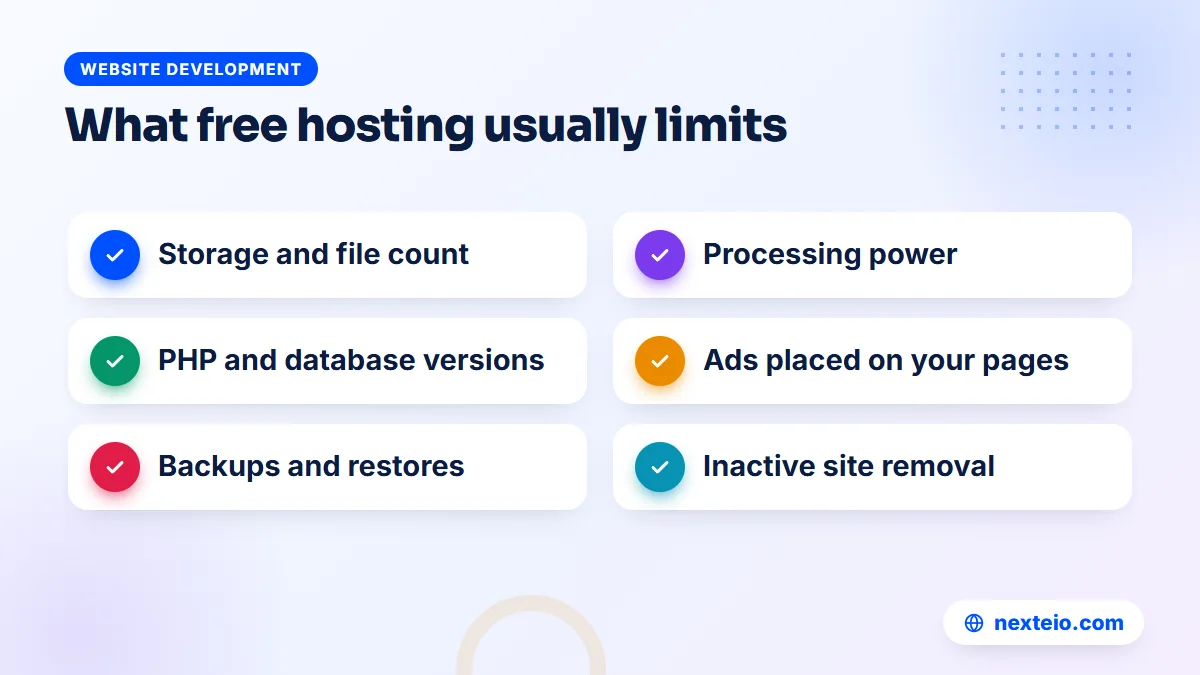
Every free domain and hosting offer is paid for somehow. Free hosting companies still pay for servers, electricity and staff. They cover those costs by limiting what each free account can use and by pushing you toward an upgrade. Here is what usually sits in the fine print:
- Storage and file limits: enough for a few pages, not for a product catalog or a photo gallery of school events.
- Processing limits: the site slows down or shows an error when several people visit at once.
- Old software: outdated PHP and database versions that modern WordPress plugins do not support.
- Forced ads or banners: the host places its own ads on your pages, and you choose none of them.
- No backups: if the account is deleted or infected, your content is gone.
- Inactive account removal: some hosts suspend or delete sites that get little traffic or that the owner does not log in to.
Any one of these might be acceptable for a test site. Together, they make free hosting a weak base for a business.
WordPress publishes its recommended server requirements, including the PHP and database versions it expects. Compare those with what a free host offers before you put anything important on it. A host that cannot meet them will give you errors, failed updates and security gaps.
Speed is a related problem. In Bangladesh, many visitors open your site on a phone using mobile data, often on a weak signal. A slow free server makes that worse, and visitors leave before the first image appears. A site that is designed and built for phones and mobile data on decent hosting avoids most of that wait.
Security, SSL and Bad Neighbors
On free hosting, your site shares a server, and often an IP address, with thousands of other free accounts. Some of those accounts are run by people who send spam or host phishing pages, because free hosting is attractive to them too. When a shared IP lands on a blocklist, email sent from that server can start bouncing or landing in spam, even if your own site has done nothing wrong.
Free hosts also tend to offer little security help. Nobody watches your account for malware, applies updates for you or cleans up after a hack. If something goes wrong, you are usually on your own.
Some offers present a "free SSL certificate" as a reason to choose them. SSL is what puts the padlock in the browser and loads your site over HTTPS. It matters, but it is no longer a special bonus. Let's Encrypt issues free certificates to anyone who controls a domain, and almost every paid hosting control panel can install one in a few clicks.
Paying for hosting does not make a site safe by itself. What it does give you is an account in your name, a support desk to contact, and the access you need to run backups and updates properly.
How Free Domain and Hosting Holds Back Search and Ads
Search visibility you cannot carry with you
Google can index pages on a subdomain, and a well-written free site can appear in search results. The trouble starts when you outgrow it. Every link that other sites, directories and social posts point at your free address helps that address, not your business. When you later buy your own domain, you need those links and rankings to follow you.
That only happens if the old address can permanently redirect visitors and search engines to the new one, usually with a 301 redirect. Many free hosts and builders do not let you set one up. You start again from zero on the new domain while the old pages sit there, sometimes still ranking, sometimes showing a "site not found" page to your customers.
If search is part of your plan, starting on your own domain saves this whole rebuild. Our guide to technical SEO basics explains redirects, indexing and the other foundations that are much easier to get right on a domain you control.
Paid ads and AdSense
When you run Google or Facebook ads, every click costs money. Sending that paid traffic to a slow page with a host's banners on it is like paying for a shop sign and then letting a neighbor put his poster over it. Ad platforms also look at the landing page experience, and a cluttered free page rarely helps.
If you want to earn from Google AdSense, the details matter too. AdSense works with an ads.txt file at the root of your domain, and you need enough control over the site to place ad code and keep the content in line with policy. Some free hosts do not allow third-party ads at all, because they want the ad space for themselves. If AdSense is in your plans, our Google AdSense help starts by checking that the site and domain setup can support it.
Related guides for this stage:
- Simple SEO tips for small business websites in Bangladesh
- How to build a landing page that turns ad clicks into enquiries
- WordPress or a custom website: which suits your business
Reading a "Web Hosting With Free Domain" Offer
Many paid hosting plans include a free domain for the first year. This is the most useful of the "free" deals, because you get a real domain and a real hosting account. It still needs a careful read, because the free part ends and the rest of the deal stays.
Before you accept, find the answers to these questions:
- What is the domain renewal price from the second year?
- What is the hosting renewal price, as opposed to the first-term discount?
- Is the free domain only available with a long contract, such as two or three years paid upfront?
- Will the domain be registered with your organization as the registrant?
- If you cancel the hosting, do you keep the domain, and is there a fee to transfer it out?
- Which domain extensions are included? Some offers cover .com but not .com.bd.
Note that most registrars do not allow a newly registered domain to move to another registrar within its first 60 days. That is normal and not a reason to worry, but it means you should be sure about the provider before you register.
The best version of this deal is simple: a fair renewal price, the domain in your name and the freedom to move it whenever you want. If any of those three is missing, the free year is not worth it.
What Your Own Domain and Hosting Cost in Bangladesh
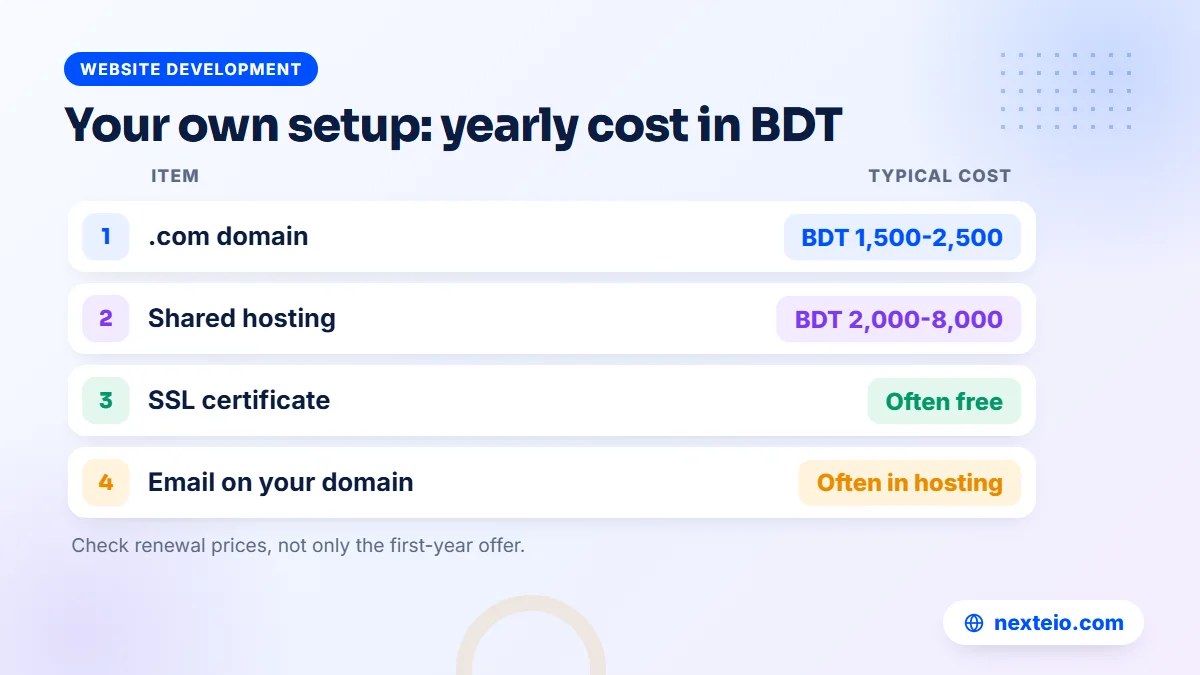
The good news is that the paid version is not expensive. In Bangladesh, a .com domain usually costs about BDT 1,500 to 2,500 a year, and shared hosting that suits a normal company or school website usually costs about BDT 2,000 to 8,000 a year. Prices depend on the provider, the plan and whether you pay in taka through a local reseller or in dollars to a foreign company.
| Item | Typical yearly cost | Notes |
|---|---|---|
| .com domain | BDT 1,500 to 2,500 | Check the renewal price, not only the first year |
| .com.bd or .edu.bd domain | Set by BTCL and its resellers | Needs organization documents; renews every year or two |
| Shared hosting | BDT 2,000 to 8,000 | Enough for most company, school and clinic sites |
| SSL certificate | Often free | Let's Encrypt through the hosting control panel |
| Email on your domain | Often included with hosting | Paid mailboxes cost extra if you need more |
Over three years, a .com domain and a reasonable shared hosting plan together come to roughly BDT 10,500 to 31,500. That is about BDT 300 to 900 a month for an address you own, email that looks professional and a server that meets current software requirements.
Compare that with the hidden costs of free domain and hosting: lost enquiries from an address nobody remembers, a rebuild when you move, and staff time spent fixing problems with no support desk to call. For most organizations the paid setup is the cheaper option within the first year. Our article on why a website gets traffic but no customers shows how small trust problems quietly turn visitors away.
When a Free Setup Is Perfectly Fine
Free domain and hosting offers are not useless. They suit situations where trust, email and ownership do not matter yet. These are reasonable uses:
- Learning how websites, WordPress or HTML work before you spend money.
- A student portfolio or a class project that only needs to live for a term.
- A personal blog where you write for interest, not for sales.
- Testing a design or layout before the real build.
- A short internal demo to show a manager or committee what a site could look like.
Blogger is a good example of a free platform that grows with you. You can start on a free blogspot.com address and later connect your own domain. Google's guide to setting up a custom domain on Blogger notes that the old blogspot address then redirects to the new one. If writing is your main goal, our Blogger website service sets this up with a clean theme and your own domain from the beginning.
The line is simple. If the site will carry your company name, take enquiries or payments, or appear on printed material, it should sit on a domain you own.
Moving From a Free Domain and Hosting Setup to Your Own
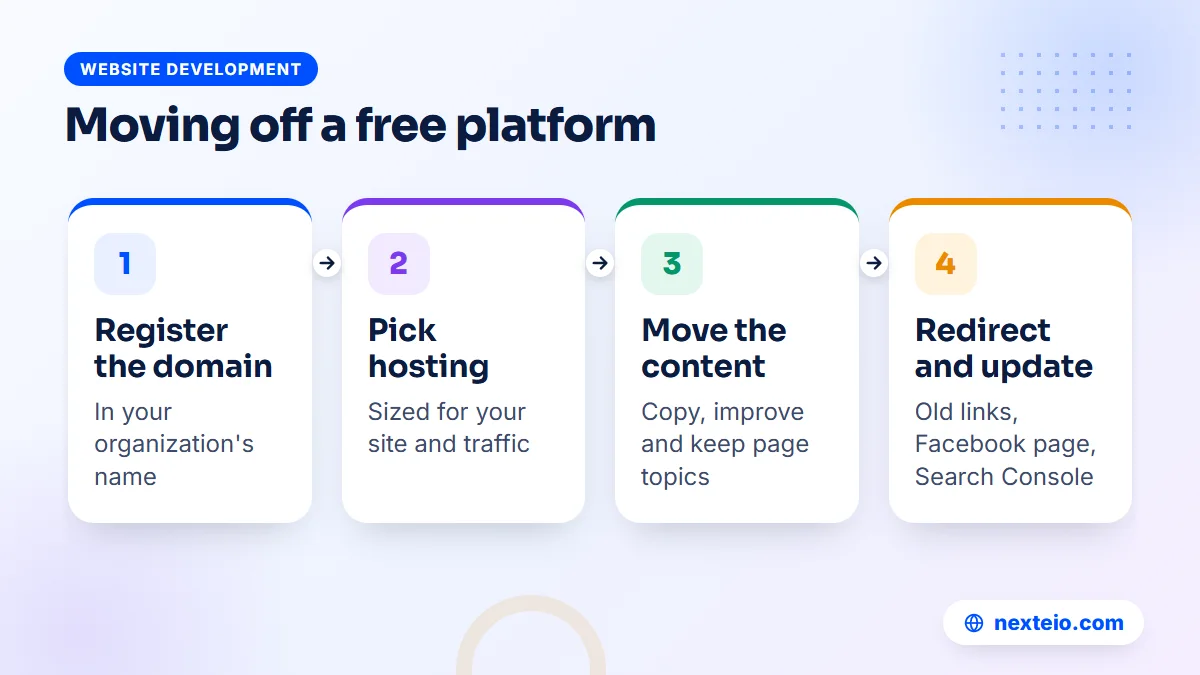
If your business already runs on a free address, you do not need to throw everything away. A careful move keeps most of your content and protects as much search traffic as the old platform allows. Work through it in this order.
Step 1: Secure the name first
Register your domain in your organization's name, using an official email address as the account contact. Do this before anything else, even if the new site is weeks away, so nobody else takes the name in the meantime.
Step 2: Choose hosting that fits the site
A company profile, a school notice board or a clinic site usually runs well on shared hosting. An online store or a portal with many logins may need more. If you sell online, our e-commerce website development work includes choosing hosting that can handle orders, stock and payment pages.
Step 3: Copy and improve the content
Export what you can from the free platform: text, images and blog posts. Use the move as a chance to fix weak pages, add missing contact details and update old notices. Keep the same page topics where possible so the move does not change what each page is about.
Step 4: Redirect, then update every link
If the old platform allows redirects, point each old page to its new address. Then update the links you control: your Facebook page, Google Business Profile, email signatures, visiting cards and any directory listings.
Step 5: Tell Google about the new site
Add the new domain to Google Search Console, submit a sitemap and watch the coverage reports for a few weeks. Old pages may keep showing in search for a while, which is normal while Google catches up.
If you want help with the move, our custom website design team can plan the new structure, rebuild the pages and handle the technical steps, so the business keeps running while the site changes underneath it.
Questions to Ask About a "Free Domain and Hosting" Website Package
Some web design offers in Bangladesh advertise a website "with free domain and free hosting for one year". There is nothing wrong with a bundled price, but the word "free" can hide the questions that matter most. Ask these before you pay any advance:
- In whose name will the domain be registered, and can we see the record after registration?
- Will we get the hosting control panel login, or only the website admin?
- What will the domain and hosting cost from the second year, and who sends the renewal reminder?
- Which hosting company is it, and can we pay them directly later if we want to?
- Are backups included, where are they stored and can we download a copy?
- If we part ways, how will you hand over the domain, hosting and files?
Good providers answer these quickly and put the answers in writing. If a provider avoids the ownership question, treat that as the answer.
Watch the renewal date even when the first year is covered. Many organizations lose their website and email together because the renewal notice went to someone who left, or because accounts approval took longer than the grace period allowed. Put the date in a shared calendar and give the finance team notice a month ahead.
If you are comparing several agencies, our buyer's checklist for choosing a web design company covers the rest of the questions, from portfolio checks to payment terms. You can also browse more website development guides on planning, platforms and budgets.
Setting Up Your Own Domain and Hosting the Right Way
Once you decide to leave the free route, set things up so you never have to untangle them later. These habits cost nothing extra and save a lot of trouble:
- Register the domain and hosting in the organization's legal name.
- Use a shared official address, such as it@ or admin@, as the account email.
- Turn on auto-renewal where possible, and keep a payment method that does not expire with one person's card.
- Keep an access sheet with registrar, hosting, website and email logins, known to at least two senior people.
- Give your web developer their own login instead of sharing the owner account.
Small organizations often skip this because the setup feels too simple to need rules. It is exactly the small setups that get lost when one person changes jobs.
Platform choice comes next. Most company and institution sites run well on WordPress, because staff can post notices and news without a developer. Our WordPress website service builds sites that stay simple to update. When the site must handle admissions, bookings or internal records, a Laravel web application gives you a system built around that process.
Finally, plan for search from the start. Once the domain is yours, every page you publish and every link you earn builds value you keep. Our SEO service can help once the site is live and you want more people to find it on Google.
How Nexteio Can Help
We build websites for companies, schools, clinics, factories and NGOs across Bangladesh, and we care a lot about getting the basics into the right hands. If you do not have a domain yet, we can help you choose one and register it in your organization's name. If you already have one, we can help you check who holds it and what needs to change if it points to the wrong person.
Through our custom website design service, we plan and build the site from a blank page, design it for phones and mobile data, and set it up on hosting that meets current software requirements. The domain, hosting and website admin accounts stay with your organization.
If you are moving off a free platform, we can bring your existing content across, improve the pages that need it, set up redirects where the old platform allows them, and connect Google Search Console to the new domain. Instead of a "free domain and hosting" line, we prefer to show domain and hosting at their real cost, so you know what renews and when.
You can see examples of our work in the portfolio, read more about Nexteio, or send us a short brief about your organization and the site you need. If you prefer to talk first, reach us through the contact page, or start a project when you are ready.
Keep reading: what to check before hiring a WordPress developer and common SEO mistakes that hurt business websites.
Frequently asked questions
Is free web hosting and domain name registration safe for a small business?
It is safe enough for testing or learning, but not for a site that carries your company name. Free hosts give little or no security help, rarely keep backups and may remove inactive accounts. The bigger risk is ownership: on a free subdomain, the platform holds the name, not you.
Can I get a free domain name and hosting for a school or madrasa website?
You can put a basic page on a free platform, but it will not give you an .edu.bd address or official admission email. Guardians and education offices expect a stable address that will still work next year. A proper domain and shared hosting usually cost only a few thousand taka a year, which most institutions can budget for.
Is a free domain with a hosting plan a good deal?
It can be, if the domain is registered in your name and the renewal prices are fair. The free part usually covers only the first year, and some offers require a long hosting contract. Check what the domain and hosting will cost from the second year and whether you can move the domain away later.
Will Google rank a website on a free subdomain?
Google can index and rank pages on a subdomain, so a free site is not invisible. The problem is what happens when you move to your own domain. If the free platform does not allow redirects, the search visibility you built stays behind and the new domain starts from the beginning.
Can I use company email with free website hosting and domain offers?
Not with a free subdomain, because you cannot change the DNS records of a domain you do not own. To get addresses like info@yourcompany.com, you need your own domain. Many shared hosting plans include email, so the extra cost is often small once you have the domain.
What happens if a free hosting company shuts down or deletes my site?
Your pages go offline, and unless you kept your own copy, the content may be lost. Free services can change their terms, close accounts they see as inactive or stop operating altogether. Keep a local backup of your text and images, and move important sites to hosting you pay for and control.
Should our web designer register the domain for us?
It is fine for a designer to handle the registration, as long as your organization is recorded as the registrant and you receive the account login. Ask for this in writing before the project starts. A domain registered in a staff member's or agency's name is the most common cause of handover disputes.