Web Page Design Cost: What Changes the Price of Each Page

In this article 15 sections
- 1.Why Price Per Page Misleads Most Buyers
- 2.Unique, Template and Repeat Pages
- 3.What Goes Into Designing One Web Page
- 4.Page by Page: Where the Effort Goes
- 5.8 Factors That Change Web Page Design Cost
- 6.Typical Web Page Design Cost in Bangladesh
- 7.A Worked Example: Pricing a Clinic Website Page by Page
- 8.Landing Pages and Single-Page Jobs
- 9.How to Read a Page-Based Quote
- 10.Ways to Lower Web Page Design Cost Without Hurting Results
- 11.Mistakes That Make Pages Cost More Later
- 12.The Cost of a Page After Launch
- 13.Questions to Ask Before You Approve a Web Page Design Cost
- 14.How Nexteio Can Help With Web Page Design
- 15.Frequently asked questions
Web page design cost is hard to pin down because no two pages take the same amount of work. A contact page with a map and a form might take a few hours. A homepage that has to explain a corporate group's five businesses, show certifications and guide buyers to the right division can take days of planning before anyone opens a design tool.
That is why two quotes for "a 10-page website" can be far apart. One designer counted ten copies of the same layout. The other counted ten different pages, each planned, written and designed on its own.
If you are budgeting for a new site or a redesign, it helps to see a website the way a designer prices it: as a set of page types, each with its own effort, plus the features and content that sit behind them.
This guide breaks down what goes into one page, which pages cost the most and why, the factors that move the price up or down, typical market ranges in Bangladesh, and how to read a quote so you can compare offers fairly.
Why Price Per Page Misleads Most Buyers
Many buyers ask, "How much per page?" It is a natural question, and some providers answer it with a flat rate. The trouble is that a flat rate hides the real work. A page is not a fixed unit like a printed leaflet. It is a mix of planning, writing, design, development and testing, and the mix changes from page to page.
Consider a school website. The homepage needs a clear structure for parents, students and teachers, with notices, admission dates and a principal's message. Each teacher profile, on the other hand, follows the same layout as every other profile. Once the first one is designed, the next twenty are mostly data entry.
If you pay the same rate for the homepage and for each profile, one of two things happens. Either the homepage is underpriced and gets rushed, or the profiles are overpriced and you pay for design work that was never done. Neither is good for you.
A better question is: "How many different page designs does my site need, and what has to happen on each one?" That question leads to an honest estimate, and it is the one experienced designers ask before they quote.
Unique, Template and Repeat Pages
Almost every page on a business website falls into one of three groups. Knowing which group each page belongs to is the fastest way to understand where your budget goes.
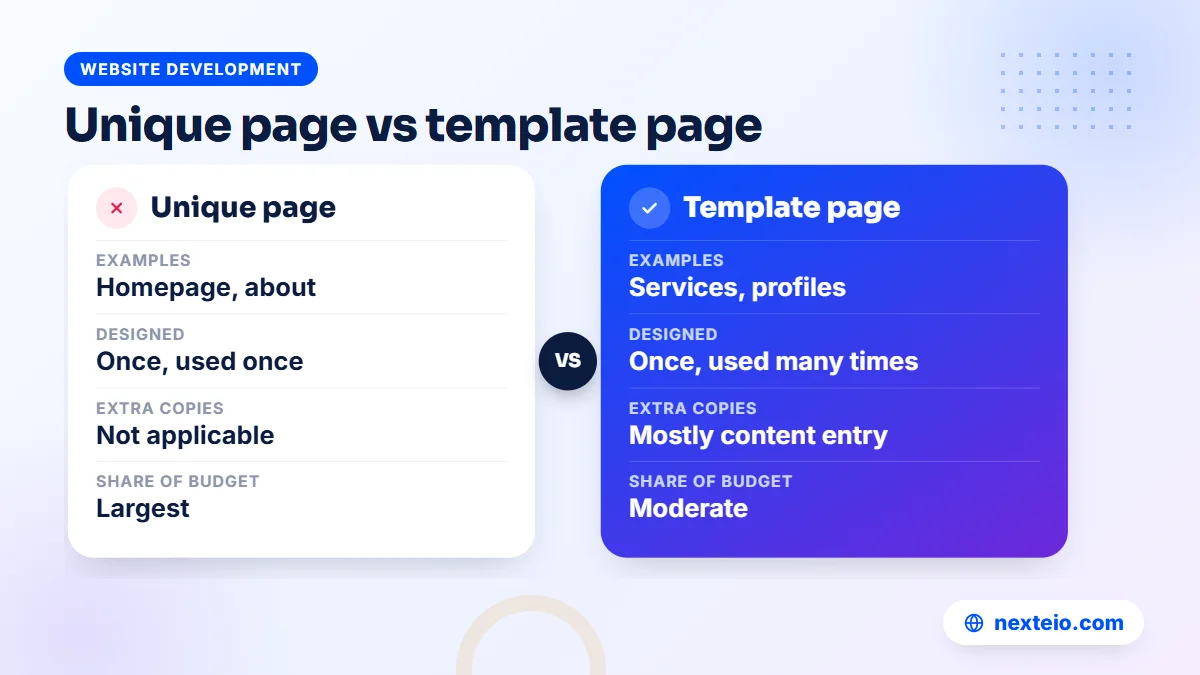
- Unique pages are designed once and used once. The homepage, the about page and a main landing page are typical examples. Each needs its own planning and layout.
- Template pages are designed once and used many times with different content. Service pages, product pages, blog posts, doctor profiles and news items usually work this way.
- Repeat pages are simple pages built from existing parts, such as privacy policy, terms, a thank-you page or a 404 error page. They need little design work.
A 15-page company site might really contain four unique designs, two templates and a handful of simple pages. That is a very different project from 15 unique designs, even though both are "15 pages".
| Page | Usual group | Why |
|---|---|---|
| Homepage | Unique | Sets the structure and style for the whole site |
| About or company profile | Unique | Story, team, history and proof differ for every business |
| Service or product page | Template | One layout, filled with different content for each item |
| Blog post or notice | Template | Staff publish new ones without design work |
| Contact page | Unique but simple | Form, map, numbers and office hours |
| Privacy, terms, 404 | Repeat | Text inside the standard page layout |
When you request a quote, ask the provider to sort your pages into these groups. It shows you exactly what you are paying for and makes it easy to compare two offers.
What Goes Into Designing One Web Page
Owners often picture page design as choosing colors and placing a photo. That is only one stage. A properly built page goes through several steps, and each one adds to the time and the web page design cost.
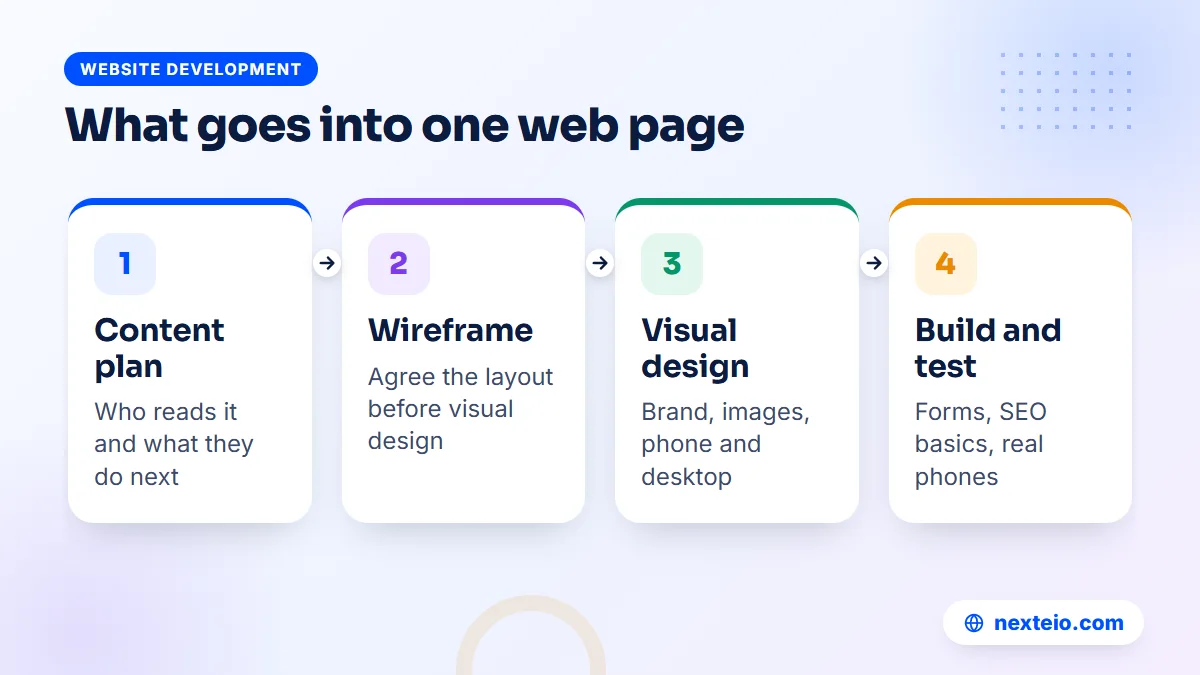
1. Purpose and content plan
Who is this page for, and what should they do next? A garment factory's compliance page is read by buyers' audit teams, who want certificates and facts. A coaching center's course page is read by students and parents, who want fees, timings and a phone number. The content plan lists the sections, the order and the action the page should lead to.
2. Wireframe
A wireframe is a simple sketch of the layout with boxes for text, images and buttons. It lets you agree on structure before any visual design starts, which saves expensive changes later.
3. Visual design for desktop and phone
The designer applies your brand colors, type, images and spacing. Because most visitors in Bangladesh arrive on a phone, the mobile layout needs as much care as the desktop one. Google's guide to responsive web design basics explains why a layout has to adapt to each screen rather than shrink.
4. Build, content entry and checks
The approved design is built in the website platform, the content is added, forms are connected and the page is tested on real devices and slow connections. Basic SEO is set at this stage: page title, description, headings and image alt text.
A provider who skips steps one and two can quote less, but you will often pay the difference in revision rounds once you see a design that does not match what you had in mind. In a proper custom website design project, the plan and wireframe come before any colors are chosen.
Page by Page: Where the Effort Goes
The homepage
The homepage usually carries the largest share of design time. It has to introduce the business in a few seconds, guide different visitors to the right sections and set the visual style that every other page follows. For a corporate group or a university, deciding what goes on the homepage can involve several departments and a long approval chain.
Service and product pages
These pages persuade. Each one needs a clear explanation, proof such as photos or certifications, answers to common questions and a strong call to action. The first service page takes real design effort; the rest follow its template, but each still needs its own content. Our guide to writing SEO-friendly website content shows how to write these pages so they work for both visitors and search engines.
About and team pages
An about page is where buyers, donors and parents decide whether to trust you. It needs real history, real people and real photos. The design is usually moderate. The time goes into collecting and writing honest content, which many organizations underestimate.
Contact and enquiry pages
A contact page looks simple, but it must work perfectly. Forms need to deliver email reliably, phone numbers should be tappable on a phone, and a map should show the right location. A hospital or clinic may also want separate numbers for emergency, appointments and billing.
Landing pages for ads
A landing page for a Google or Facebook campaign has one job: turn a paid click into an enquiry or an order. It needs focused copy, fast loading and a short form, and it is often tested in two versions. Our article on building a high-converting landing page explains what that page should include.
Listing and detail templates
Shops, news sections, notice boards and doctor directories need two templates: a listing page that shows many items, and a detail page for each one. Filters, search and pagination add work to the listing template. Once built, though, adding a hundred more items costs almost nothing in design.
The table below gives a rough sense of the relative effort for common page types on a typical business site.
| Page type | Relative design effort | What drives the effort |
|---|---|---|
| Homepage | High | Structure, many sections, sets the style |
| Landing page for ads | Medium to high | Persuasive copy, speed, testing versions |
| Service or product template | Medium | Layout reused across many items |
| About or company profile | Medium | Content gathering and photos |
| Listing with filters | Medium to high | Search, filters and data setup |
| Contact page | Low to medium | Forms, map, email delivery |
| Legal and utility pages | Low | Text in an existing layout |
Use this as a planning aid, not a price list for web page design cost. A complex contact page with booking slots can easily take more time than a simple homepage.
8 Factors That Change Web Page Design Cost
Beyond page type, eight factors decide most of the difference in web page design cost between quotes. Look at each one for your own project.
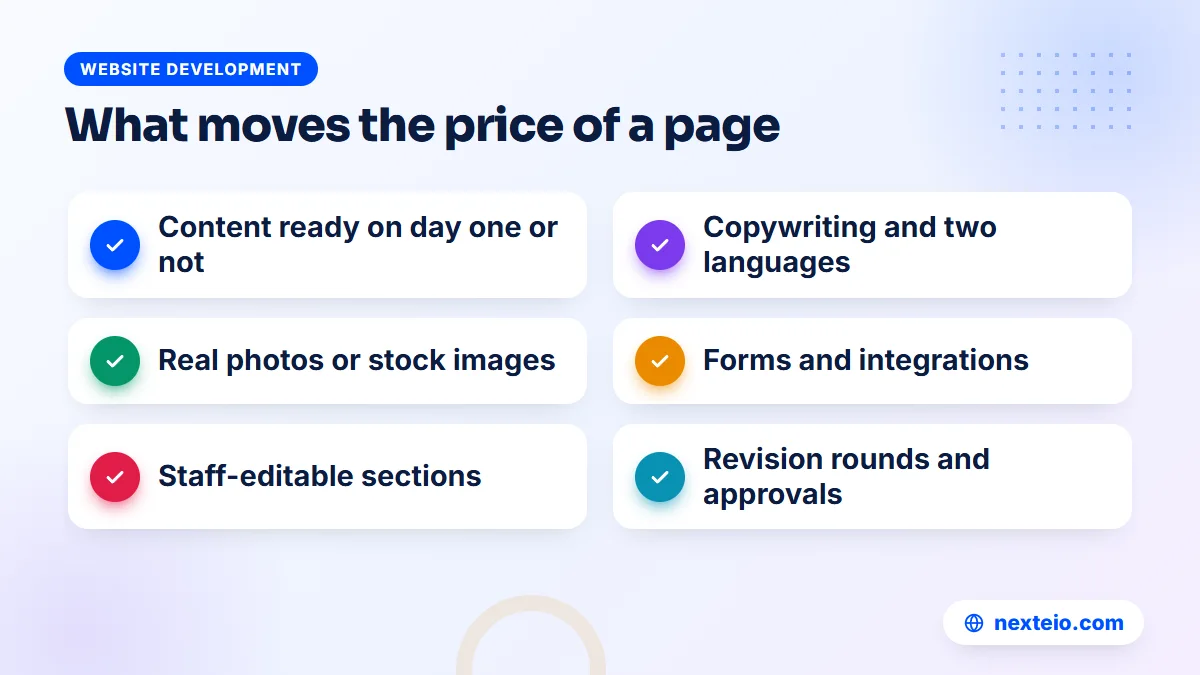
1. Whether the content is ready
If you hand over final text, logos and photos on day one, the designer can work directly. If the content arrives in pieces over two months, the designer redesigns sections as the content changes. Late content is one of the most common reasons projects run over budget.
2. Who writes the copy
Writing good page text takes skill and time. If the provider writes it, the cost goes up, but so does the quality of what visitors read. A middle path is to write rough notes yourself and pay for editing.
3. Bangla, English or both
Two language versions mean more than translation. Layouts must handle different text lengths and Bangla fonts, and both versions need to stay in step. For many schools, NGOs and government-facing organizations, both are necessary, so plan the budget for them.
4. Images and photography
Stock photos are quick, but buyers and parents can tell. Real photos of your factory floor, classrooms or clinic build more trust. A photo shoot, image editing and compression all add to the cost of the pages that use them.
5. Custom graphics and animation
Icons, illustrations, infographics and scroll animations all take extra design time. Used well, they help explain things. Used heavily, they slow the page down on mobile data.
6. Forms and integrations
A simple contact form is cheap. An admission form with file uploads, a quote form linked to a CRM, an appointment system or a bKash payment link is development work, and it should be priced as such.
7. How editable the page must be
Pages your staff will update every week, such as notices or product listings, need an easy admin area. Building that editability takes more time than a fixed page. It pays back quickly, because you stop paying a developer for small text changes.
8. Revisions and approvals
Two rounds of revisions per page is a common standard. A design that must pass a managing director, a board and a marketing head can easily need five. Agree on the number of rounds and on one person who gives final approval.
Typical Web Page Design Cost in Bangladesh
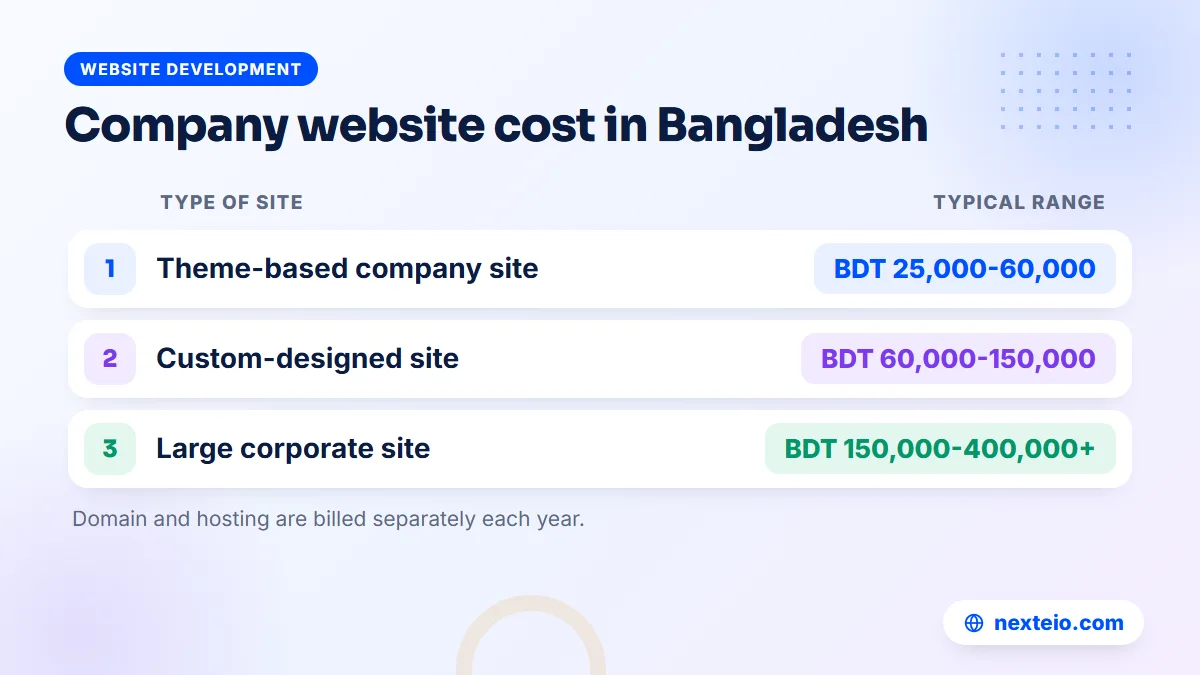
Most providers in Bangladesh quote for the whole website rather than per page, because the pages depend on each other. The ranges below are typical market ranges for a company or business website. They are not fixed prices, and a specific project can sit anywhere within them depending on the factors above.
| Type of site | Typical market range | What usually fits |
|---|---|---|
| Theme-based company website | BDT 25,000 to 60,000 | A ready design adjusted to your brand, standard pages and a contact form |
| Custom-designed company website | BDT 60,000 to 150,000 | Unique homepage and templates, planned around your content |
| Large corporate site with integrations | BDT 150,000 to 400,000 or more | Many sections, several languages, CRM, ERP or portal links |
For institutions, typical ranges are different: a school or madrasa site usually falls around BDT 20,000 to 60,000, a college site around BDT 50,000 to 120,000 and a university site around BDT 150,000 to 400,000 or more. Online stores and custom portals follow their own pricing.
Where a site lands within its band depends mostly on how many unique designs it needs and how much content and integration work sits behind them. A theme-based site with eight pages and ready content stays near the lower end. A custom design with a long homepage, two languages and an enquiry system moves toward the top. Our custom website design service covers the second kind of project, where the page layouts are planned around your content rather than taken from a ready theme.
Domain and hosting are separate. A .com domain usually costs about BDT 1,500 to 2,500 a year, and shared hosting about BDT 2,000 to 8,000 a year.
Related guides that help with budgeting:
- WordPress or a custom website: how each choice affects cost
- What a professional business website needs to get results
- A buyer's checklist for choosing a web design company
A Worked Example: Pricing a Clinic Website Page by Page
Let us look at how a provider might break down a website for a mid-sized clinic with eight doctors and four departments. The clinic wants appointment requests online, a notice section and pages in English and Bangla.
First, the page inventory. Listed simply, the clinic thinks it needs 22 pages. Sorted into groups, the picture changes:
| Page or template | Count on the site | Group | Designs needed |
|---|---|---|---|
| Homepage | 1 | Unique | 1 |
| About the clinic | 1 | Unique | 1 |
| Department pages | 4 | Template | 1 |
| Doctor profiles | 8 | Template | 1 |
| Notices and health tips | 4 at launch | Template | 1 |
| Appointment request page | 1 | Unique with form | 1 |
| Contact, privacy, 404 | 3 | Simple | 0 to 1 |
So 22 pages need about six or seven designs, not 22. The heavy work is the homepage, the appointment form and its email alerts, the doctor profile template with schedules, and the Bangla version.
A fair quote for this clinic would list those designs, the appointment system as a separate line, the Bangla layout work, and content entry for the 22 pages. With that breakdown, the clinic can see that adding four more doctors later costs very little, while adding online payment would be a new piece of development.
This is also where platform choice matters. Built on WordPress, the clinic's staff can add notices and update doctor schedules themselves. Our WordPress website service sets up templates like these so the office team can manage content without a developer.
Landing Pages and Single-Page Jobs
Not every project is a full website. Many businesses need one page: a campaign landing page, a new homepage on an existing site, or a product launch page. These are priced as small projects, and the web page design price depends on the same factors as above, concentrated in one place.
A landing page for ads usually needs more care than its size suggests. It must load quickly on mobile data, match the ad's message, and make the next step obvious. If you are spending money on Google Ads campaigns, a weak landing page wastes part of every click you pay for, so it is often the best place in the whole budget to spend on design.
A single-page redesign on an existing site has its own catch. The new page must fit the old site's fonts, menus and code. If the old site is outdated, the designer may spend extra time making the new page work inside it. Sometimes that cost is a sign the whole site needs attention.
If you run an online shop, the most valuable single pages are usually the product template and the checkout. Our e-commerce website development work starts from those two, because small improvements there affect every order.
How to Read a Page-Based Quote
A good quote makes the work visible. When you receive one, check that it covers these points:
- A list of pages or templates, with the unique designs named.
- Whether mobile layouts are designed, not just "responsive".
- Who provides the text and images, and what happens if they arrive late.
- The number of revision rounds included for each design.
- Forms, integrations and admin features as separate lines.
- Language versions, if you need Bangla and English.
- Basic SEO setup, speed checks and testing on real phones.
- Payment schedule and what you receive at handover.
A quote missing half of these is not necessarily dishonest. It may simply be vague, and vague quotes lead to disputes about what was included.
Be careful with offers of "unlimited pages" at a low price. Usually that means unlimited copies of one template with your content pasted in. That can be fine for a simple site, but it is not design work on each page. Also be wary of a per-page rate with no definition of what a page includes. Ask whether it covers mobile design, content entry and revisions.
When comparing two quotes, line them up against the same page inventory. Our list of what to check before hiring a WordPress developer has more questions for this step.
Ways to Lower Web Page Design Cost Without Hurting Results
You can bring the cost down in ways that do not weaken the website. These are the most effective:
- Prepare content early. Final text and photos before design starts save more money than any discount.
- Use templates wisely. Let service, product and profile pages share one well-designed layout.
- Launch in phases. Build the pages that bring enquiries first, and add the rest later.
- Name one approver. One decision-maker means fewer revision rounds.
- Skip decoration that does not help. Heavy animations and sliders add cost and slow the page.
- Reuse what works. If your brand guide and logo files are ready, the designer does not need to recreate them.
Phasing works especially well for organizations with long approval chains. The first phase can go live with the homepage, core service pages and contact page, while the board reviews the rest.
Avoid cutting the things that make pages work: mobile design, speed, clear calls to action and basic SEO. These are cheap to do during the build and expensive to add later.
Mistakes That Make Pages Cost More Later
Some savings at the start turn into bigger bills a year later. Watch for these patterns.
No mobile design. A layout designed only for desktop and left to "shrink" on phones usually looks broken on small screens. Fixing it later means redesigning every page.
Pages nobody can edit. If each text change needs a developer, a cheap build becomes an expensive site to run. Notices, prices and staff lists should be editable by your own team.
Slow pages. Oversized images and heavy scripts make pages slow on mobile data. Google's guide to Largest Contentful Paint explains one of the main measures of how quickly a page shows its main content. Our article on website speed and SEO covers the practical fixes.
Missing SEO basics. Page titles, headings, descriptions and image alt text cost almost nothing to set during the build. Google's SEO starter guide lists the basics every page should have. Adding them later means revisiting every page, which is why our SEO service often starts by fixing exactly these gaps.
Ignoring accessibility. Low color contrast, tiny text and images without descriptions make pages hard to use for many people, including older visitors. The MDN accessibility guide is a good reference for what to ask your designer about.
The Cost of a Page After Launch
The web page design cost you approve covers building the page. It does not cover keeping it accurate and working for the next three years. Many owners forget this part, then feel surprised when the first small change request comes with a bill.
After launch, a page needs three kinds of care. Its content changes: new prices, new staff, new admission dates. Its software changes: the platform, plugins and server receive updates that can affect layouts and forms. And its purpose changes: a page that worked for last year's campaign may need a new section, a new form field or a new photo.
Organizations usually handle this in one of two ways. Some train a staff member to edit content through the admin panel and call a developer only for technical work. Others sign a maintenance plan that covers updates, backups and a set number of content changes each month. Maintenance plans in Bangladesh typically run from about BDT 2,000 to 5,000 a month for a basic plan, BDT 5,000 to 12,000 for a standard plan and BDT 12,000 to 30,000 or more for an advanced one.
When you compare quotes, ask how each provider charges for changes after launch. A low build price paired with expensive small edits can cost more over three years than a slightly higher web page design cost with an easy admin area and fair support rates.
Questions to Ask Before You Approve a Web Page Design Cost
Before you sign, ask the provider these questions and note the answers in the agreement:
- How many unique designs and templates are in this quote?
- Will I see a wireframe or layout plan before the visual design?
- How many revision rounds are included, and what does an extra round cost?
- Will my staff be able to edit text, images and new items without help?
- How will you test the pages on phones and slow connections?
- What happens to the price if we add pages halfway through?
- What do we receive at handover: logins, files, a short guide?
Clear answers to these questions protect both sides. They also tell you a lot about how the provider works. Someone who can explain their process in plain words usually has one.
If your site needs logins, records or a workflow such as admissions or order tracking, it may be more than a set of pages. In that case, a Laravel web application built around the process is often the better fit, and it is quoted after a requirements review.
How Nexteio Can Help With Web Page Design
We design and build websites for businesses and organizations across Bangladesh, and we look at a project the way this guide describes: as a set of unique designs, templates and simple pages, plus the forms, languages and features behind them. If you send us your page list, we can show you how it splits into those groups and where the real work sits.
Through our custom website design work, we plan and design your site from a blank page rather than a bought theme, so the layouts fit your content and your visitors. Pages are designed for phones and mobile data, built so your staff can update the parts that change often, and set up with the basic SEO every page needs.
We are happy to explain our quote line by line, so you can compare it with other offers and decide which pages belong in a first phase and which can wait.
You can see examples in our portfolio, look at all our services, or send us your page list for a breakdown. If you would rather discuss your project first, use our contact page, and when you are ready, start your project here. For a page-by-page plan of a full site, our website design team is the right place to begin.
Keep reading: content strategy for each stage of the customer journey, on-page SEO for beginners, or browse more website development guides.
Frequently asked questions
How much does it cost to design one web page in Bangladesh?
Most providers do not price a single page in isolation, because the cost depends on whether it is a unique design, a template or a simple text page. A landing page for ads or a new homepage is usually quoted as a small project. Ask for a quote that explains the design, content and testing work behind the page, not just a number.
Why is the homepage the most expensive page to design?
The homepage sets the structure and visual style for the whole site, and it has to serve several kinds of visitors at once. It also tends to have the most sections and the most people involved in approving it. Once it is done, many other pages reuse its parts.
Does adding more pages always increase the price?
Not by the same amount each time. A new page that uses an existing template, such as another service or doctor profile, mainly needs content entry. A new page with its own layout, form or feature needs fresh design and development work, so it adds more to the cost.
Is it cheaper to write the website content ourselves?
It can be, if the text is ready and clear before design starts. Late or unfinished content often costs more than paying for copywriting, because the designer has to rework layouts as the text changes. A good middle path is to write rough notes and pay for editing.
Should a web design quote include mobile design?
Yes. Most visitors in Bangladesh use phones, so each layout should be designed and tested for small screens, not just left to shrink. Ask the provider to confirm that mobile layouts are part of the design work and that pages are tested on real devices.
How many revision rounds are normal for each page?
Two rounds per design is a common arrangement, with extra rounds charged separately. Organizations with long approval chains should agree on one final approver and collect feedback from everyone before sending it to the designer. That keeps rounds focused and avoids paying for repeated changes.
Is a theme-based website enough for a small business?
Often it is, especially for a company profile with standard pages and a contact form. Theme-based sites usually sit around BDT 25,000 to 60,000 in Bangladesh. A custom design makes more sense when your content, audience or features do not fit a ready layout.