Blogging and SEO: How a Business Blog Brings Search Traffic
In this article 17 sections
- 1.How Blogging and SEO Work Together
- 2.Which Organizations Gain Most From a Blog
- 3.Finding Topics People Actually Search For
- 4.Matching Search Intent: One Post, One Question
- 5.Planning Topic Clusters Around Your Services
- 6.Writing a Post That Ranks and Gets Read
- 7.On-Page Basics for Every SEO Blog Post
- 8.Linking Blog Posts to Your Service Pages
- 9.Technical Settings That Decide Whether Posts Get Found
- 10.A Worked Example: A Coaching Centre's First Ten Posts
- 11.How Often to Publish and How Long Results Take
- 12.Updating and Pruning Old Posts
- 13.Measuring What Your Blog Brings
- 14.Blogging and SEO Mistakes That Waste Months
- 15.Who Should Write Your Business Blog
- 16.How Nexteio Can Help With Your Blog and SEO
- 17.Frequently asked questions
Blogging and SEO work together in a simple way: people type questions into Google long before they are ready to buy, and a good blog post is often the page that answers them. A parent asks which documents a school admission needs. A factory manager asks how long a website takes to build. If your post gives the clearest answer, your business is the first one they meet.
Service pages rarely catch those early questions. A page titled "Our Services" answers "who can do this for me", not "how does this work" or "what should I check first". A blog fills that gap and gives search engines many more useful pages to show.
That does not mean every blog brings traffic. Most business blogs in Bangladesh get very few visitors, usually because the posts answer questions nobody searches for, repeat what a hundred other sites already say, or never link to the pages that turn readers into enquiries.
This guide to blogging and SEO walks through how to choose topics, write posts that rank, connect them to your services, handle the technical side and measure what the blog actually brings. It is written for business owners and office teams who want results, not for people who blog as a hobby.
How Blogging and SEO Work Together
Search engines show pages that answer the searcher's question. Your homepage and service pages can answer a few questions well, such as "web design company in Bangladesh" or "school management software". But people search for thousands of related questions, and each one needs its own page to rank.
A blog is the natural home for those pages. Each post targets one question, which gives Google a clear reason to show it. Over months, a blog with useful posts becomes a large set of entry points into your site, each one bringing a slightly different reader.
The posts also help your main pages. When a post links to a related service page, it sends readers there and tells search engines which page matters most for that topic. Our guide to internal linking for SEO explains this in detail.
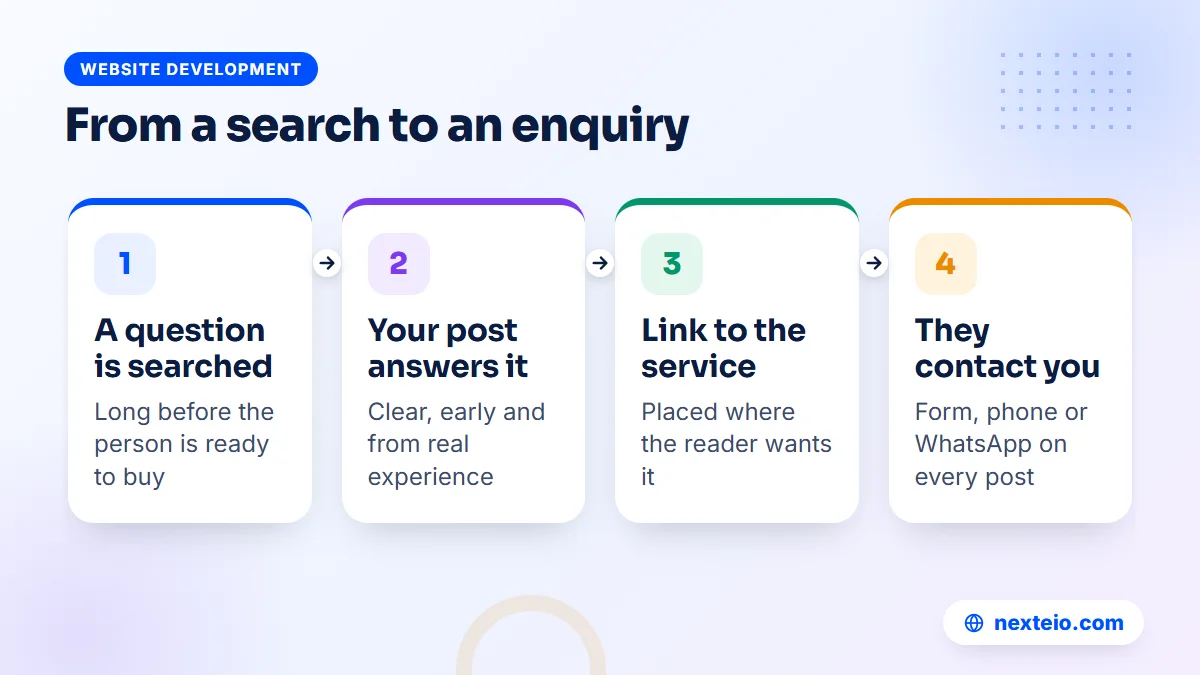
The chain looks like this: a person searches a question, finds your post, trusts the answer, clicks through to the service page and contacts you. Every link in that chain has to work. A post that ranks but never leads anywhere is a cost, not an asset.
Which Organizations Gain Most From a Blog
A blog helps most when your buyers research before they decide, and when the decision is large enough that they want to understand it first. That covers many of the businesses and institutions in Bangladesh that rely on a website.
- Service companies such as IT firms, consultants, travel agents and logistics providers, whose buyers compare options and costs.
- Schools, colleges and coaching centres, where guardians search about admissions, results, syllabus changes and study tips.
- Clinics and hospitals, whose patients search symptoms, tests and treatment questions before choosing a doctor.
- Manufacturers and exporters, whose foreign buyers search for materials, compliance and capability.
- Online shops, where buying guides and comparison posts support product and category pages.
- News pages and niche publishers, for whom the blog is the whole site and a Blogger site on your own domain keeps running costs low.
A blog helps less when nobody searches for your topic, for example a highly local business with only walk-in customers, or a company selling to a handful of known buyers. In those cases, a strong Google Business Profile and a clear website may matter more than regular posts.
Finding Topics People Actually Search For
The biggest reason business blogs fail is topic choice, and it is the first decision in blogging and SEO. "Our team attended a seminar" or "We celebrated our anniversary" are fine for a news page, but nobody searches for them. A blog meant for SEO needs posts built around real searches.
Start with your own customers
Your best topic list is already in your phone, inbox and WhatsApp chats. Write down every question customers, guardians or patients ask before they buy. Ask your sales and front-desk staff too. If a question comes up every week, it deserves a post.
Check what Google shows
Type a topic into Google and look at the suggestions in the search box and the "People also ask" questions. They show how people really phrase their searches. Google Trends helps you compare two phrasings and see seasonal patterns, such as admission searches rising at the start of the year.
Use data you already own
If your site is in Search Console, the Performance report lists the searches that already show your pages. Queries where you appear on page two are often the quickest wins for a new post or an improved one. The Google Ads Keyword Planner gives rough search volumes, and our guide on finding high-intent keywords shows how to read them.
Decide on Bangla, English or both
Many people in Bangladesh search in Bangla, in English or in Banglish, depending on the topic. Guardians searching about local admissions may use Bangla. Foreign buyers of a garment factory will search in English. Write each post in the language your reader actually searches in, rather than translating everything by habit.
Matching Search Intent: One Post, One Question
Search intent is what the person really wants when they type a query. Two searches with similar words can want very different pages. Someone searching "website cost" wants numbers. Someone searching "how to plan a website" wants steps. A post that gets the intent wrong will not rank well, however well it is written. Matching intent is the part of blogging and SEO that new writers skip most often.
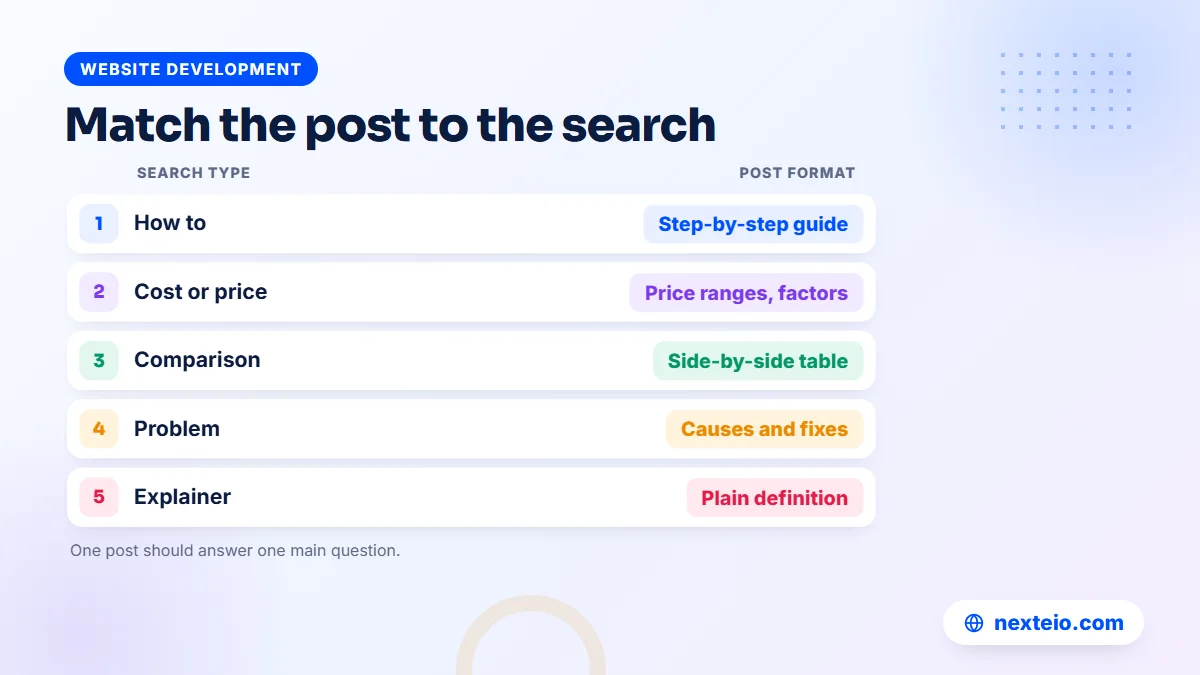
| Search type | Example query | Best post format |
|---|---|---|
| How to | how to apply for a trade licence | Step-by-step guide with a short checklist |
| Cost or price | school website cost in Bangladesh | Price ranges with what changes the price |
| Comparison | WordPress or custom website | Side-by-side table and a clear recommendation |
| Problem | website not showing on Google | Causes in order of likelihood, with fixes |
| Explainer | what is a domain name | Plain definition, examples and next steps |
Before writing, search your target phrase and look at the first page. If every result is a step-by-step guide, write a better step-by-step guide.
Give each post one main question. If you find yourself answering two very different questions in one post, split it. Two focused posts usually rank better than one post that tries to do everything.
Planning Topic Clusters Around Your Services
Random posts on unrelated topics rarely build much. A stronger approach is the topic cluster: one main page on a subject, surrounded by several posts that answer narrower questions and link back to it.
For most businesses, the main pages are your service pages. Here is how a cluster might look for a clinic that offers diagnostic tests:
- Main page: the clinic's diagnostic services page.
- Supporting posts: how to prepare for a fasting blood test, what a thyroid test shows, how long common test reports take, and which tests a yearly check-up usually includes.
- Links: every supporting post links to the services page, and the services page links to the most useful posts.
A software company could build a similar cluster around school management software, with posts on attendance tracking, online fee collection with bKash and Nagad, and how to move old student records into a new system.
Clusters are where the effort you put into blogging and SEO starts to add up. They also make your blog easier to plan. Instead of asking "what should we post this month", you ask "which questions around this service have we not answered yet". On top of that, they make it clearer to search engines that your site covers a subject in depth.
Related guides for planning your blog:
- What SEO is for a business and how it brings customers
- On-page SEO for beginners, step by step
- Content strategy for every stage of the customer journey
Each of these goes deeper into one part of the plan above.
Writing a Post That Ranks and Gets Read
Google's guidance on helpful, reliable, people-first content is the best single reference here. It asks whether a post shows real experience, adds something beyond what is already out there, and leaves the reader satisfied. Those questions are a better writing guide than any word count.
Answer early
Put the direct answer in the first few paragraphs. If someone searches "how long does a website take to build", tell them the usual range near the top, then explain what changes it. Readers who get their answer quickly trust the rest of the post.
Show what you know from practice
Your experience is the one thing competitors cannot copy. A logistics company can explain which documents customs usually asks for, and which mistakes cause delays. A school can explain how its own admission test works. Real examples, common mistakes and honest limits make a post worth reading.
Make it easy to scan
Most readers in Bangladesh open posts on a phone. Use short paragraphs, clear subheadings, lists for steps and tables for comparisons. Add images only when they explain something, such as a screenshot of a form or a simple diagram, and compress them so the page loads on mobile data.
Say who wrote it
Show the author's name and role, especially for health, money or legal topics. A post on diabetes tests signed by a named doctor carries more weight with readers than an anonymous one. Our guide on writing SEO-friendly content people read has more practical tips on structure and tone.
On-Page Basics for Every SEO Blog Post
Good writing needs a few technical touches so search engines understand it. None of these are tricks. They simply label the post clearly. Run through this list before you publish each SEO blog post:
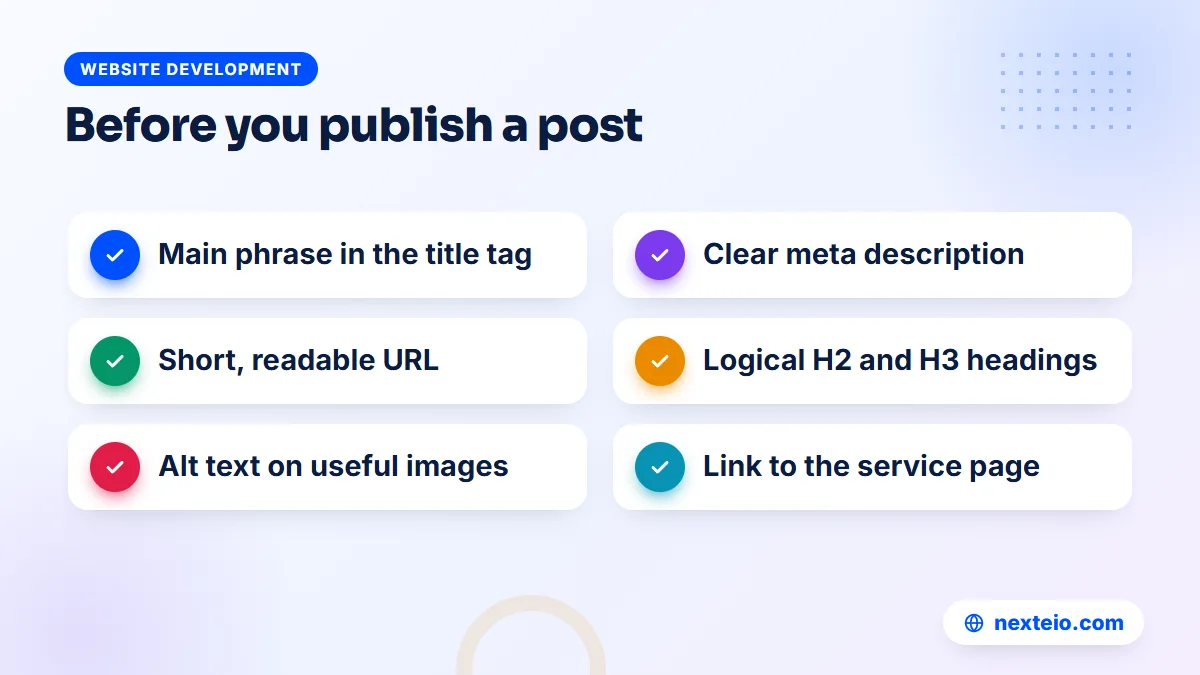
- Title tag: includes the main phrase near the start and stays around 50 to 60 characters.
- Meta description: one or two sentences that tell the searcher what they will get.
- URL: short and readable, such as /blog/school-website-cost, not a string of numbers.
- Headings: one H1 for the title, then H2 and H3 headings in a logical order.
- Images: descriptive file names and alt text that explains the image.
- Internal links: at least two or three links to related posts and one to the matching service page.
- External links: a link to an official source where you cite a rule or a figure.
Google's own SEO starter guide covers each of these in more depth.
Most blog platforms handle the basics if you fill in the fields. WordPress uses an SEO plugin for titles and descriptions. Blogger has a search description field for each post once you switch it on in the settings. If you are setting up a new blog, our Blogger website service includes turning these settings on correctly from the start.
Linking Blog Posts to Your Service Pages
This is where blogging and SEO turn into actual business. A post that brings 500 visitors a month and sends none of them to your services has done half its job.
Link to the matching service page from inside the post, where the reader would naturally want it. If a post explains how to choose a school website, a sentence such as "if you would rather have this handled for you, see our school website service" is helpful, not pushy. A large banner shouting "Hire us now" after every paragraph is the opposite.
Good places for a service link include:
- After you explain a task that is hard to do alone.
- In a section about costs or choosing a provider.
- Near the end, with a short, plain call to contact you.
Link between related posts too. A reader who finished a post on website costs may want the one on choosing a developer next. Each extra page a reader views is another chance for them to trust you.
Finally, make contact easy from every post. A phone number, a WhatsApp link and a short form in the footer or sidebar turn interest into enquiries. If posts get traffic but no calls, the problem is often the path after the post, which our guide on traffic without customers explains.
Technical Settings That Decide Whether Posts Get Found
A post that Google cannot crawl or index will never rank, however good it is. Most blog platforms are fine out of the box, but a few settings break visibility more often than people expect.
- Search Console: add your site to Google Search Console, submit the sitemap, and check the Pages report for posts that are "discovered but not indexed".
- Noindex tags: a setting left on from the build stage can hide the whole blog. Check it after launch and after redesigns.
- Thin tag and archive pages: dozens of tag pages with one post each add little. Keep categories few and meaningful.
- Mobile speed: heavy themes, large images and too many scripts slow pages down on mobile data.
- Duplicate posts: the same post published twice under different URLs splits its value. Use one address per topic.
Our article on technical SEO basics explains each of these in plain terms.
The platform matters less than the setup. A blog on Blogger, WordPress or a custom Laravel site can all rank well when these basics are right. Blogger is the cheapest to run, and a properly configured Blogger site on your own domain covers most needs for a small publisher. Larger organizations usually prefer the blog inside their main WordPress website, so posts and service pages share one domain and one design.
A Worked Example: A Coaching Centre's First Ten Posts
Here is how the ideas above fit together for one realistic case. A coaching centre prepares students for university admission tests. Its website has a homepage, a course page for each program and a contact page. Almost all its visitors come from Facebook, and search brings very little.
The centre's staff list the questions guardians and students ask at the front desk every season. From that list, they choose ten topics that match real searches and link naturally to the course pages:
- How the admission test for each type of university is structured.
- A study plan for the three months before the test.
- How to manage time in a multiple-choice exam.
- Common mistakes students make in the English section.
- How to choose between online and offline coaching.
- What a full mock test should include.
- How guardians can track a student's progress.
- Which documents students need on the test day.
- How to recover after a weak mock test result.
- What the centre's fee covers, and the payment options, including bKash.
Each post links to the matching course page and ends with a WhatsApp number. The team publishes two posts a month, written by teachers and edited by one coordinator. After each admission season, they update dates and details instead of writing new posts from scratch. That plan is small, but it is specific, steady and tied to what the centre sells.
How Often to Publish and How Long Results Take
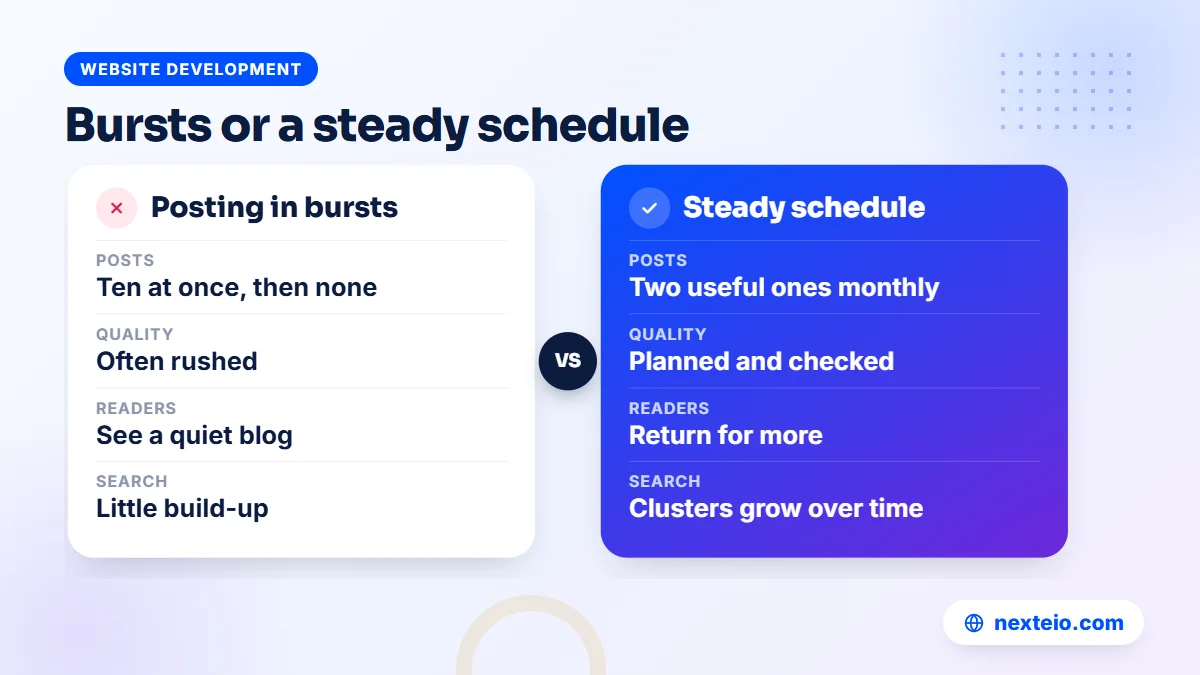
There is no magic number of posts per week. Consistency matters more than volume. Two useful posts a month, every month, usually beat ten rushed posts in January followed by silence.
Results take time. A new post needs to be found, crawled and indexed, and then it slowly earns its place against older pages. For a new blog on a new domain, the first months often bring very little search traffic. Visits usually start to grow once you have a solid set of posts around a few topics and some other sites begin to mention you. Our guide on how long SEO takes explains the realistic timeline.
| Stage | What usually happens | What to focus on |
|---|---|---|
| First few months | Posts get indexed, a handful of visits | Publishing steadily, fixing technical errors |
| Middle of the first year | Some posts reach page one for narrow questions | Linking posts to services, improving near-misses |
| After a year of steady work | Several posts bring regular visitors and enquiries | Updating winners, filling gaps in clusters |
These stages are a general pattern, not a promise. Competition in your topic changes the pace a lot.
If you need visitors this month, a blog alone will not do it. Paid search can bring traffic while the blog grows, and our comparison of SEO and Google Ads shows how the two fit together.
Updating and Pruning Old Posts
An SEO blog is never finished. Old posts go stale: prices change, rules change, screenshots show old menus. A post that ranked well two years ago can slip because newer pages answer the same question better.
Once or twice a year, review your posts in Search Console. Sort them into three groups:
- Winners: posts that bring steady traffic. Update facts, refresh examples, add a missing section and keep the same URL.
- Near-misses: posts with many impressions but few clicks. Improve the title and description, and strengthen the content where competitors do better.
- Dead weight: posts with no visits and no purpose, such as old event notices. Merge them into a better post with a redirect, or remove them.
Updating a strong existing post is often faster than writing a new one, and it keeps the links and history the post has already earned. Change the date only when you have made real changes, not to make the post look fresh.
Measuring What Your Blog Brings
Visits are only the first number. What a business needs to know is whether the blog brings enquiries, admissions, orders or calls, because that is the real point of blogging and SEO. Measure in three layers.
- Visibility: impressions, clicks and average position per post in Search Console.
- Engagement: how long people read and whether they view a second page, from Google Analytics.
- Results: form submissions, phone or WhatsApp clicks and orders that started on a blog post, tracked as conversions in Analytics.
Set up the third layer before you judge the blog. Many organizations decide "the blog does not work" while it is actually sending visitors who call the office directly, which nobody tracks. Ask new customers how they found you and note the answer in a simple sheet.
Review the numbers monthly, but judge the blog over a longer period. A single month can swing because of holidays such as Eid, exam seasons or an algorithm update. Look at the direction over a quarter.
Blogging and SEO Mistakes That Waste Months
Most failed business blogs fail for the same few reasons. Avoiding these saves more time than any advanced tactic.
- Writing about yourself instead of the reader's question. Company news has its place, but it rarely ranks.
- Publishing mass-produced posts. Google's spam policies cover pages made at scale mainly to rank, with little value for readers. These can hurt the whole site.
- Copying or lightly rewriting other sites. It adds nothing new, so it rarely ranks, and it damages trust.
The next group of mistakes is about strategy rather than writing:
- Stuffing the keyword. Repeating a phrase in every sentence makes posts hard to read and does not help rankings.
- Targeting impossible phrases. A new blog will not rank for one-word topics. Start with specific questions.
- No links to services. Traffic that never reaches a service page or a contact option brings no business.
- Giving up too early. Many blogs stop after three months, just before posts would have started to rank.
Our list of common SEO mistakes on business websites covers more problems that affect the site as a whole, not only the blog.
Who Should Write Your Business Blog
There are three common ways to staff blogging and SEO work, and each has a place.
Your own staff know the subject best. A doctor, a merchandiser or a teacher can explain things no outside writer can. The problem is time: blog posts slip down the list when real work piles up. This works best when one person owns the schedule and experts give short interviews or notes.
Freelance writers are flexible and can write in Bangla or English. They need a clear brief and access to your experts, or their posts will be general and thin. Always check that the work is original.
An agency can handle the plan, writing, on-page setup and reporting together. This costs more but removes the coordination work. If you go this way, ask to see the topic plan and how results will be reported. Our guide to choosing an SEO service in Bangladesh lists the questions to ask.
Many organizations mix the three: staff supply the knowledge, a writer or agency shapes it into posts, and someone technical keeps the site healthy.
How Nexteio Can Help With Your Blog and SEO
We help organizations across Bangladesh build blogs that bring search visitors and send them to the right service pages. For writers and small publishers, our Blogger website service sets up a clean, mobile-friendly blog on your own domain, with search descriptions, indexing settings and Search Console connected from day one.
For companies, schools and clinics that want the blog inside their main website, we build it into a WordPress or custom site so posts and services share one address. Through our SEO service, we can also plan topic clusters around your services, check the technical issues that stop posts from being indexed, and improve the posts you already have.
We start by asking what the blog needs to achieve and who it is for, then suggest the simplest setup that fits. You can see our work in the portfolio, learn more about Nexteio, send us a short project brief or reach us through the contact page. If you are not sure where to start, a quick brief about your blog is enough for us to suggest a first step.
Keep reading: simple SEO tips for small business websites, or browse all our website development guides.
Frequently asked questions
Does blogging really help SEO for a small business?
It can, when posts answer questions your customers actually search for and link to your service pages. A blog gives search engines more useful pages to show and gives you a way to meet buyers early. A blog of company news or copied posts usually brings very little.
How many blog posts do I need before I see results?
There is no fixed number. A focused set of useful posts around a few related topics tends to do better than many scattered ones. Many business blogs start to see steady search visits after several months of regular publishing, depending on competition.
How long should a blog post be for SEO?
Long enough to answer the question fully, and no longer. A simple explainer may need a few hundred words, while a cost guide or comparison may need a few thousand. Look at what already ranks for your phrase and aim to be more useful, not just longer.
Should our business blog be on Blogger or inside our main website?
A publisher or writer can run well on Blogger with a custom domain at very low cost. A company, school or clinic usually does better with the blog inside the main website, so posts and service pages share one domain, one design and one set of contact options.
Can we write blog posts in Bangla for SEO?
Yes. Google shows Bangla pages for Bangla searches. Write in the language your readers search in, keep the Bangla font clear on phones, and avoid publishing the same post in two languages without telling search engines how the versions relate.
Is it fine to use writing tools to produce many posts quickly?
Producing large numbers of pages mainly to rank, with little original value, goes against Google's spam policies whatever tool is used. Posts should be checked and improved by someone who knows the subject, with real examples and accurate facts.
How do I know if blogging and SEO are bringing us customers?
Track conversions, not just visits. Set up form submissions, phone clicks and WhatsApp clicks as conversions in Google Analytics, check which posts they start from, and ask new customers how they found you.