Website for Small Business: What You Actually Need
In this article 15 sections
- 1.Facebook Page or Website: Why You Need Both
- 2.The Five Jobs a Website for Small Business Must Do
- 3.Match the Site to the Way Your Customers Buy
- 4.The Pages You Need and the Ones You Can Skip
- 5.Features Worth Paying For and Features to Skip
- 6.Website Design for Small Business: What Works on a Phone
- 7.Prepare Your Content Before You Hire Anyone
- 8.Choosing a Platform: Builder, Blogger, WordPress or Custom
- 9.What a Website for Small Business Costs in Bangladesh
- 10.How to Choose Website Designers for Small Business
- 11.Getting Found on Google and Maps
- 12.Launch Week and the First Three Months
- 13.Common Mistakes Small Business Owners Make
- 14.How Nexteio Can Help With Your Website for Small Business
- 15.Frequently asked questions
A website for small business owners in Bangladesh does not need to be big or expensive. It needs to answer the questions customers already ask on the phone, show that the business is real, and make it easy to call, message or visit. Most small firms need five to seven well-made pages, not fifty.
Think of a tailoring shop that gets the same five questions on WhatsApp every day, an interior design studio whose clients want to see past work before a site visit, or a small diagnostic center where patients look up test prices late at night. Each one needs something slightly different. Each one also wastes money if the site is planned like a corporate portal.
Many owners start with a Facebook page and wonder whether a website adds anything. It does, but only when it is planned around the jobs it has to do for that particular business.
This guide covers what to build and what to skip, how to prepare your content, which platform suits which kind of business, typical costs in Bangladesh, how to choose the people who build it, and how to keep the site useful with about an hour of your time each month.
Facebook Page or Website: Why You Need Both
A Facebook page is good for daily posts, offers and conversations. But you are renting space on someone else's platform. Facebook decides who sees your posts, your page looks like every competitor's page, and last month's price list gets buried under new posts within days.
A website is the part you own. Your domain stays yours as long as you renew it, the pages stay in the order you choose, and you can put prices, service details and directions exactly where people look for them. It also matters when you send a quote to a corporate buyer, an NGO procurement desk or a school office, because the person approving the purchase often checks your website before signing.
The two work best together, along with a free map listing. Each one has a different job:
- Facebook page: daily updates, comments and messages, boosted offers, and a feel for the people behind the business.
- Website: appearing in Google search, full service and price details, a permanent address online, enquiry forms you can track, and credibility with formal buyers.
- Google Business Profile: your pin on Google Maps, reviews, opening hours and the call button that appears in local results.
If you only have time for one task this week, claim your free profile on Google Business Profile first. Then build the website, because the profile works better when it points to a real site with real details.
The Five Jobs a Website for Small Business Must Do
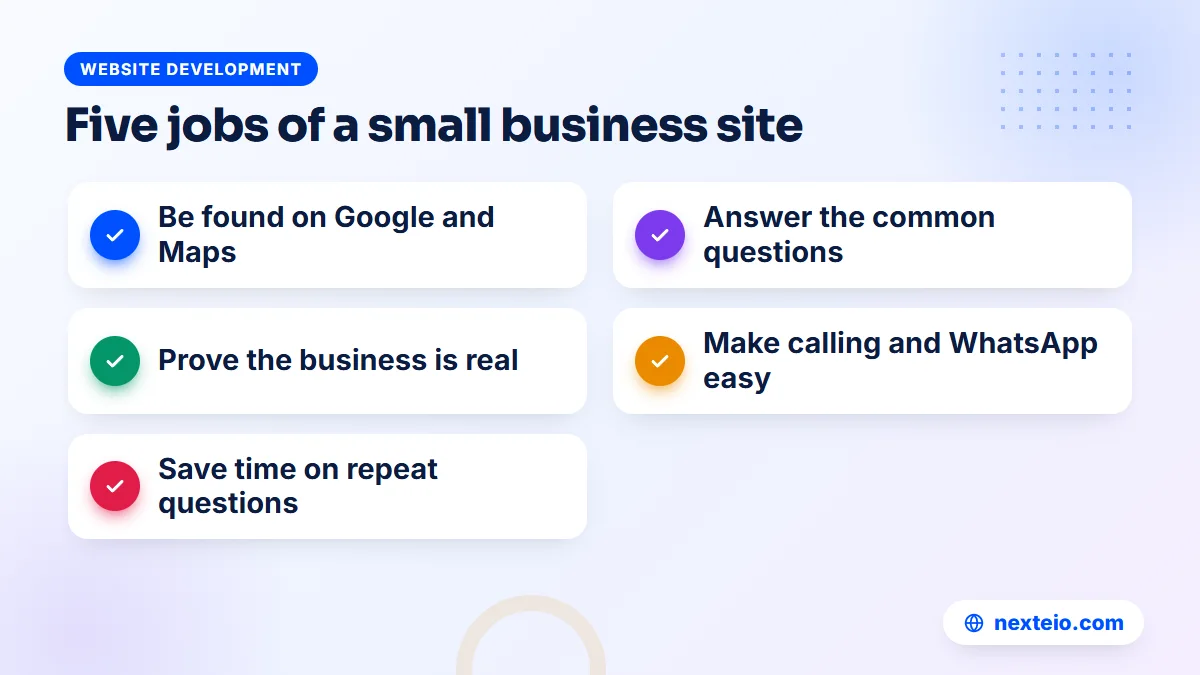
Before you choose colors or a template, agree on what the site is for. Almost every small business site has the same five jobs. If a page or feature does not help with at least one of them, it can wait.
- Be found. Show up when people search for what you offer, both in Google results and on the map.
- Answer the basic questions. What you do, who it is for, where you are, when you are open and roughly what it costs.
- Prove you are real. Real photos, a full address, registration details where they matter, reviews from actual customers and examples of past work.
- Make contact easy. A phone number that dials when tapped, a WhatsApp button, a short form and clear directions.
- Save your time. Answer repeated questions once, on the page, so you and your staff spend fewer hours repeating them.
A website for small business that does these five jobs well will beat a bigger, prettier site that does not.
The fifth job is the one owners forget. A caterer that lists its menu packages with a starting price per head gets fewer "how much?" messages and more serious ones. A computer repair shop that explains its checking fee and usual turnaround stops having the same debate at the counter.
Match the Site to the Way Your Customers Buy
Small businesses are not all alike, so good web design for small businesses starts from how your customers decide. Someone booking a wedding caterer behaves very differently from someone who needs an electrician within the hour. The table shows common types and what the website should put first.
| Type of business | What the visitor wants | Put this first |
|---|---|---|
| Repair and home services (AC, plumbing, electrical, computers) | Someone who can come soon | Tap-to-call number, areas covered, service charges |
| Restaurant, cafe or caterer | Menu, prices and location | Menu with prices, opening hours, map, order number |
| Shop or showroom with a small range | To see products before visiting | Product photos with prices, stock note, directions |
| Professional office (law, accounts, consulting, architecture) | Trust and expertise | Profiles, practice areas, past work, appointment form |
| Small clinic, dental chamber or diagnostic center | Doctor timings and test details | Doctor schedule, test list, appointment number |
| Training center or private tutor | Course details and fees | Course outline, batch dates, fee, enrolment form |
| Travel agent or event planner | Ideas and packages | Package pages, photo galleries, quick enquiry form |
Use the table as a starting point, not a rule.
Most businesses fit one row clearly. If yours sits between two, pick the action that brings the most money and design around that first. A furniture showroom that also takes custom orders should lead with product photos and keep the custom order form one tap away.
The Pages You Need and the Ones You Can Skip
A website for small business usually needs five to seven pages. Every extra page means more writing, more photos and more to keep up to date. An empty or outdated page hurts more than a missing one, because it makes the business look closed.
Pages almost every small business needs
- Home: one clear line about what you do and for whom, three or four main services, some proof, and the call and WhatsApp buttons.
- Services or products: a section or page for each main service, with what is included, who it suits and a starting price where possible.
- About: the owner or team, how the business started, registration details where buyers care, and real photos of the place.
- Work or gallery: past projects, before-and-after photos or a menu, depending on the business.
- Contact: phone, WhatsApp, email, full address with a landmark, an embedded map, opening hours and a short form.
- FAQ: the ten questions you answer most often, written the way customers actually ask them.
If one of these pages has nothing real to show yet, leave it out until it does.
Pages that can wait
- A blog, unless someone will write at least one useful post a month.
- A news page, which looks abandoned when the newest item is a year old.
- Careers, until you hire often enough to need it.
- A separate page for every small service, which spreads your content too thin.
- A members' area or login, unless customers really need accounts.
When you are ready to grow the site, add pages that answer specific searches. A dental chamber might later add a page on root canal treatment written with the dentist, because patients search for that exact service. That kind of page earns its place. A generic "Our Vision" page rarely does.
Features Worth Paying For and Features to Skip
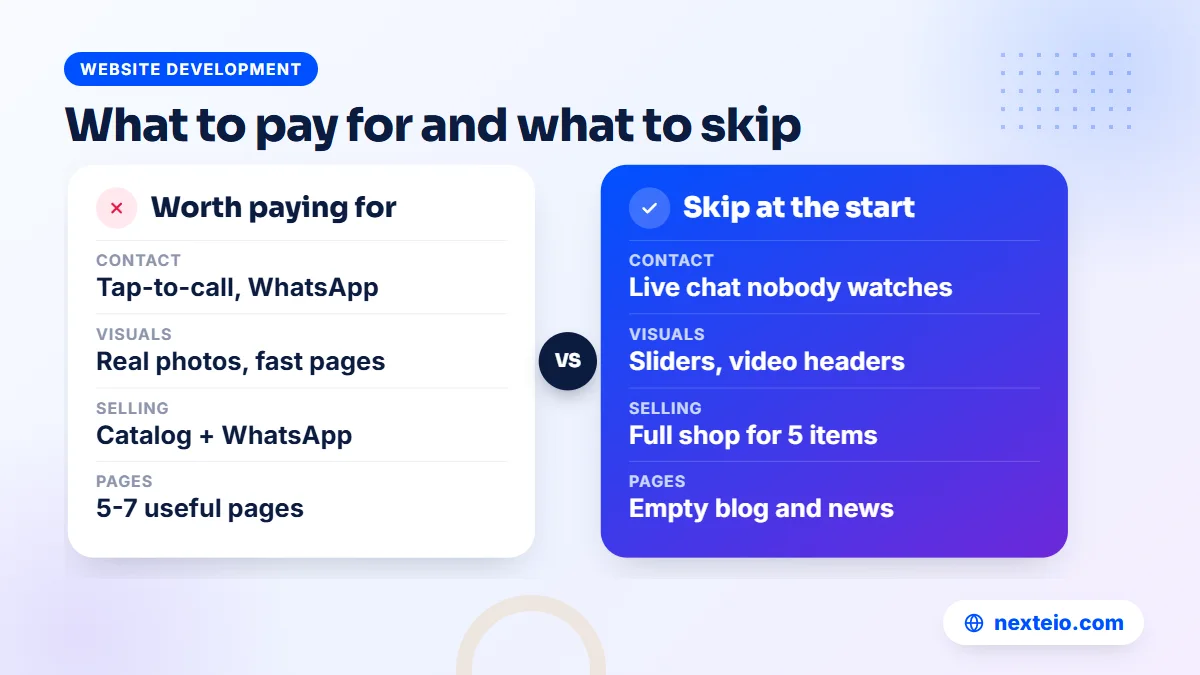
Quotes for a website for small business often grow because of features that sound useful in a meeting but do little in practice. Here is what usually pays back.
- Tap-to-call and WhatsApp buttons that stay within reach on a phone screen.
- A short enquiry or booking form (name, phone, what they need) that reaches an inbox someone checks every day.
- A Google Map embed plus written directions with a landmark.
- Fast loading on mobile data, with compressed images.
- Basic search setup done properly: page titles, descriptions, headings, a sitemap and Search Console.
- Bangla and English text where your customers use both.
- A simple admin panel, so you can change prices, photos and hours yourself.
And here is what you can usually skip at the start:
- Large image sliders that hide your message and slow the page.
- Pop-ups that cover the screen before the visitor has read anything.
- Heavy animations and background videos.
- Live chat that nobody watches.
- A full online shop when you sell a handful of items, mostly by phone.
The online shop point needs care. If you sell physical products and get orders every day, an online store with cash on delivery and bKash or Nagad can be the right choice, and our e-commerce website team builds stores for exactly that. If orders arrive a few times a week and each needs a conversation, a product catalog with an "Order on WhatsApp" button is cheaper and often works just as well.
Website Design for Small Business: What Works on a Phone
Most visitors will open your site on a phone, often on mobile data, sometimes during load-shedding when the office Wi-Fi is down. Good website design for small business starts with that small screen and then grows to the desktop, not the other way round. Use this list to judge any design you are shown:
- Your business name and what you do are visible without scrolling.
- The phone number sits in the header or a bar at the bottom, and it dials when tapped.
- Body text is at least 16 pixels, dark on a light background.
- Buttons are big enough for a thumb, with space between them.
- Photos show your real shop, team and work. Stock photos of smiling strangers make a small business look less real, not more.
- Images are compressed and saved in modern formats such as WebP, so pages load on a weak signal.
- Nothing scrolls sideways, and nothing important hides behind a tiny menu.
You can test speed yourself with Google's free PageSpeed Insights. Paste your address, look at the mobile result, and note how long the main content takes to appear.
Google explains the measures behind that report, known as Core Web Vitals, on its web.dev site. You do not need a perfect score. But a page that takes many seconds to show anything on a phone loses people before they ever see your number.
Color and decoration matter less than clarity. A simple layout with one brand color, a readable font and plenty of white space looks more professional than a crowded page full of effects. This is how we approach every custom website design project at Nexteio: the phone layout is drawn first, and the desktop version follows from it.
Prepare Your Content Before You Hire Anyone
The biggest delay in website creation for small business projects is rarely the design or the code. It is waiting for the owner to send text and photos. Gathering these before you speak to a designer saves weeks and makes every quote you receive more accurate.
Your content kit
- Business basics: legal name, trading name, address with a landmark, phone, WhatsApp, email, opening hours and the areas you serve.
- Services list: two or three lines per service on what is included and who it is for, plus a starting price or price range.
- Photos: 15 to 30 real photos taken in daylight on a good phone: the shopfront, the inside, the team at work and finished jobs. Hold the phone sideways for most shots.
- Proof: customer reviews you have permission to use, logos of business clients (also with permission), certificates and registration details that buyers ask about.
- Common questions: the questions customers ask most, each with your usual answer.
- Logo: the original file if you have one. If not, decide whether you need a simple logo made before design starts.
Put everything in one shared folder and send the link once.
Write in the language your customers use. Many small businesses in Bangladesh do well with English menus and headings and Bangla service descriptions, or with both languages side by side on key pages. Decide early, because Bangla text often needs more space and a different font.
Keep the writing plain and specific. "We repair home AC units and visit within one working day" tells a visitor far more than "We provide quality solutions". The Google SEO Starter Guide makes the same point: write useful text for people, using the words they would search with.
Related guides: see how to build a professional business website that gets results, learn to write SEO-friendly website content that people actually read, and find out how faster pages help you rank and sell.
Choosing a Platform: Builder, Blogger, WordPress or Custom
There are four common ways to build a website for small business use. The right one depends on how much you want to change yourself, how much the site needs to do, and how long you plan to keep it.
| Option | Good for | Watch out for |
|---|---|---|
| Online site builder | Very simple sites the owner builds alone | Monthly fees in US dollars on an international card, limited speed control, hard to move elsewhere |
| Blogger with your own domain | Simple information sites and writers on a tiny budget | Limited design and features, weak fit for booking or detailed service pages |
| WordPress | Most small businesses that want to edit content themselves | Needs regular updates, backups and care with plugins |
| Custom-built site | Special workflows, bookings or a strong brand | Higher upfront cost, so pick a developer who documents the work |
Each option can work. The mistake is picking one that does not match how you will run the site.
For most owners, WordPress hits the right balance between cost and control. Your staff can change a price or add photos without calling anyone, and many developers in Bangladesh know it well. Our WordPress website service is built around that: a fast site your team can update. If you are torn between the two main routes, our comparison of WordPress and custom websites lays out the trade-offs.
Blogger suits a writer or a very small information site, and we also set up Blogger sites with your own domain for that kind of need. Small business website design services that start from a blank page make sense when your brand needs a distinct look or your process does not fit a template, which is where a custom-designed website earns its higher cost.
Whichever route you take, the domain and hosting should be registered in the business's name, with you holding the main login.
What a Website for Small Business Costs in Bangladesh
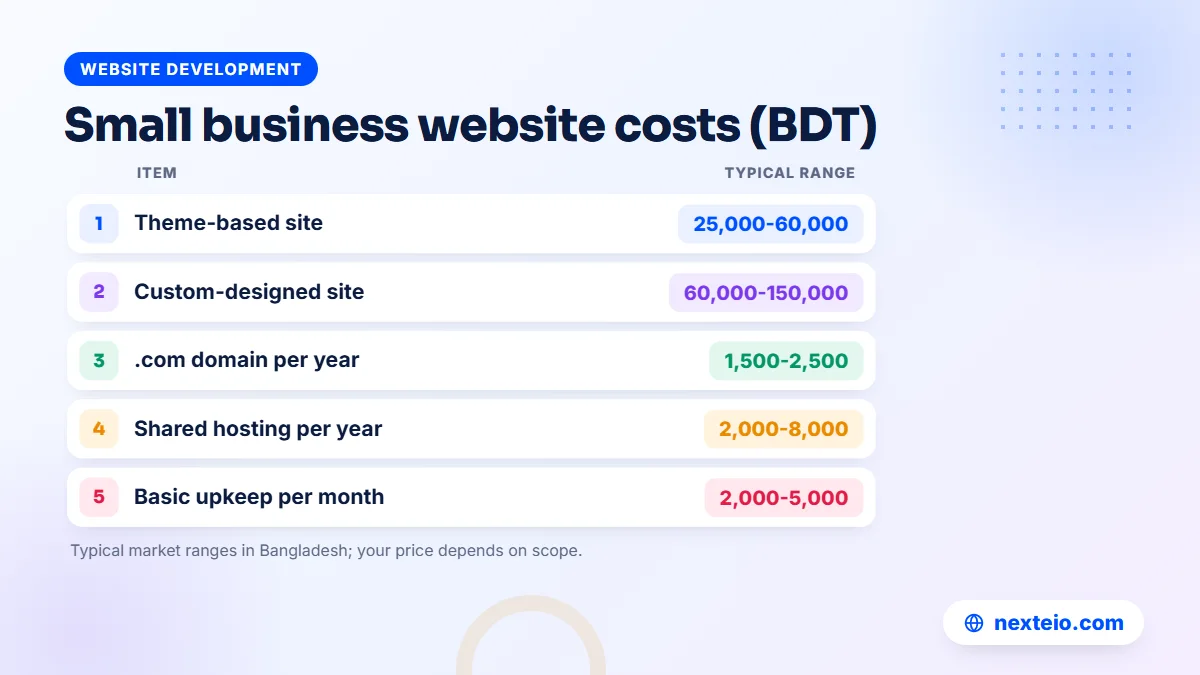
The price of a website for small business varies widely, because "a website" can mean one page or a full online shop. The figures below are typical market ranges in Bangladesh, not fixed quotes. The final price depends on the number of pages, how much writing the designer must do, and any special features.
| Item | Typical market range (BDT) | Notes |
|---|---|---|
| Theme-based business website | 25,000-60,000 | Fits most small firms with five to seven pages |
| Custom-designed business website | 60,000-150,000 | Own layout, stronger brand, more planning |
| Online store on a ready theme | 25,000-60,000 | Cash on delivery and bKash or Nagad setup |
| Online store with custom design | 60,000-150,000 | Custom product and category layouts |
| .com domain | About 1,500-2,500 a year | Register it in the business's name |
| Shared hosting | About 2,000-8,000 a year | Choose a host with backups and support |
| Basic maintenance | About 2,000-5,000 a month | Updates, backups and small edits |
A worked example makes this clearer. A small interior design studio wants six pages, a project gallery and an enquiry form on WordPress, using a ready theme adjusted to its brand. Year one might be about BDT 40,000 for the build, around BDT 2,000 for the domain and about BDT 5,000 for hosting.
If the studio adds a basic maintenance plan, that is roughly BDT 24,000 to 60,000 more across the year. Many owners skip this line and pay more later, when an outdated plugin breaks the site or the domain lapses.
How to Choose Website Designers for Small Business
Search for "web design services small business" and you will get hundreds of names, from solo freelancers to large agencies. Price alone tells you little. Ask every shortlisted provider these questions and compare the answers side by side.
- Can I see three live small business sites you built, and may I speak to one of the owners?
- Will the domain, hosting and admin login be registered in my business's name?
- What exactly is included: number of pages, writing, photos, revisions and search setup?
- How will I change prices, photos and opening hours after launch, and will you show me?
- How fast does the finished site load on a phone, and how do you test it?
- After launch, who updates the software, who keeps backups, and what does that cost?
- Who owns the design and code once the project is paid for?
Write the answers down, so you can compare providers fairly.
It also helps to know the difference between website designers for small business and website developers for small business. A designer plans how the site looks and how visitors move through it. A developer builds it and makes the forms, speed and security work. On a small project one person may do both, so ask who handles each part.
Red flags
- The domain is registered in the designer's name "for convenience".
- There is no written scope, only a price in a chat message.
- Full payment is demanded upfront, with no stages.
- The portfolio shows templates, not live client sites.
- Someone promises the first position on Google within a month.
A beautiful design that nobody tested on a cheap Android phone still fails. For a longer list of checks, read our guide to choosing the best web design company in Bangladesh.
Getting Found on Google and Maps
A website for small business does not get visitors just by existing. For a small business, most useful search traffic comes from people looking for a service in their area, or for your business by name. Three basic steps cover most of it:
- Complete your Google Business Profile with the same name, address and phone as the website, choose the right category, add photos and link to your site.
- Give every page a clear title and description that says what it offers, and use the service words people search for in your headings and text, naturally.
- Add the site to Google Search Console so you can see which searches show your pages and whether Google has trouble reading them.
After that, ask happy customers to leave reviews on your profile, and keep your name, address and phone number identical everywhere they appear. Two different phone numbers or two spellings of the same road confuse customers more than anything else.
For more steps you can take yourself, read our simple SEO tips for small business websites. If you would rather hand it over, our SEO service covers the technical, content and structure fixes. Search results take time to build, so some owners also run Google Ads campaigns to appear for chosen searches while the site gains ground.
Launch Week and the First Three Months
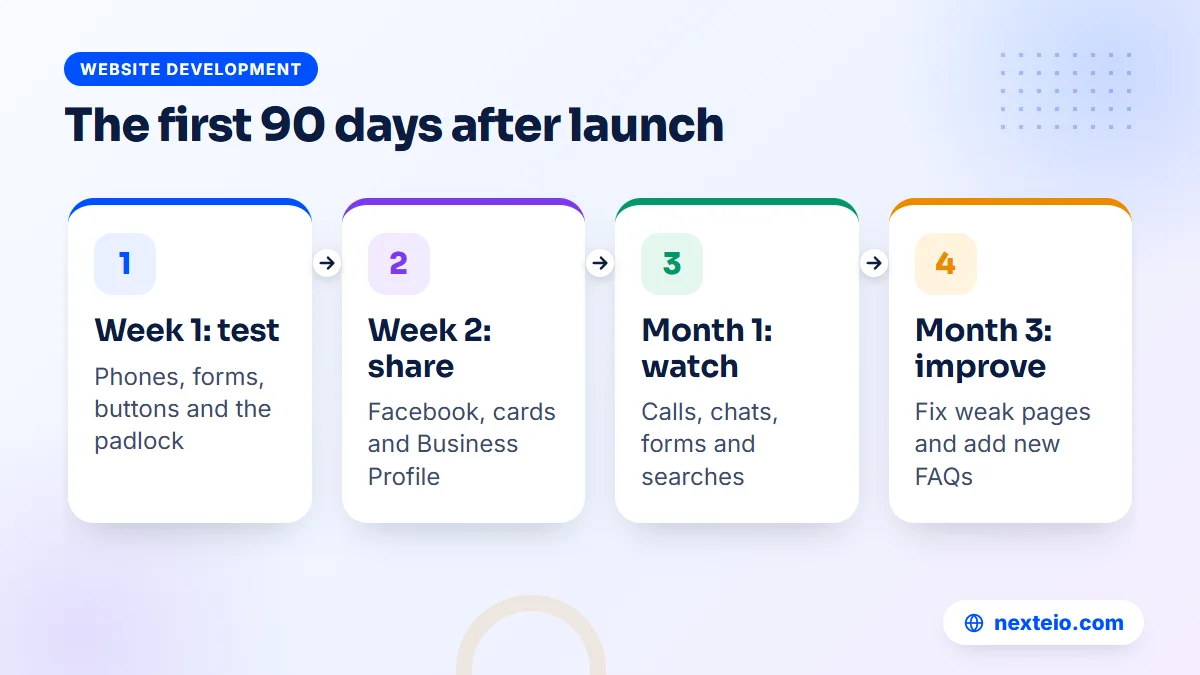
Launching is a short checklist. Before you share the link, test the site the way a customer would:
- Open every page on two phones, one of them a low-cost Android, using mobile data.
- Tap every phone number and WhatsApp button.
- Submit the form and confirm the message arrives, including on a staff phone.
- Check the spelling of the business name, address, prices and hours.
- Check that the padlock shows and the site opens with and without "www".
Then put the address everywhere: the Facebook page, Google Business Profile, visiting cards, invoices, the shop signboard, email signatures and your WhatsApp Business profile.
What to measure
Visitor numbers alone say little about whether a website for small business is working. Count what brings money: calls that mention the website, WhatsApp chats started from the button, forms received and direction requests on your profile. For one month, ask every new customer how they found you and write it down.
If the site gets visits but few enquiries, our guide on why a website gets traffic but no customers walks through the usual causes, from weak headlines to forms that never reach anyone.
Keeping it current with little time
Set a short monthly routine. Update prices and hours, add a few new photos or one new project, answer one more question in the FAQ, and test the form. That takes about an hour.
The technical side, such as software updates, backups and security, is better left to whoever built or maintains the site. Agree on it in writing before launch, so nobody assumes someone else is doing it.
Common Mistakes Small Business Owners Make
These mistakes come up again and again, and each one is cheap to avoid when a website for small business is first planned:
- Building the site around the owner's taste instead of the questions customers ask.
- Showing the phone number only on the contact page.
- Copying text from a competitor's site, which helps nobody and gives Google no reason to show your page.
- Showing no prices at all, which pushes away people who are comparing options.
- Letting the domain expire because the renewal reminder went to the designer's email.
- Paying for features such as sliders, chat widgets and member logins that nobody uses.
- Launching the site and never touching it again.
Fixing any of these later usually costs more time and money than doing it right the first time.
How Nexteio Can Help With Your Website for Small Business
Our web design services for small business in Bangladesh start from how your customers actually buy. You tell us about your business through the project brief form or a short call, and we suggest the pages and features that fit, along with the ones you can safely leave out.
Our custom website design service plans and builds the site from a blank page rather than a bought theme, so it fits your brand, loads quickly on mobile data and makes calling or messaging you easy. If your team wants to update content often, we can build on WordPress instead. If you sell online, we set up cash on delivery and bKash payment through our e-commerce work.
Domain, hosting and logins stay in your business's name. After launch, we can look after updates and backups under a written maintenance agreement, and our SEO and Facebook ads teams can help bring visitors once the site is ready. You can see examples of our work in the portfolio, read more about Nexteio, or browse more website development articles.
When you are ready, send us your project details or contact our team with questions about your small business website.
Keep reading: how much Google Ads costs for a small business in Bangladesh and what a Facebook ads service should give you for your money.
Frequently asked questions
How many pages does a small business website need?
Most small businesses do well with five to seven pages: home, services or products, about, a work or gallery page, contact and an FAQ. Add more only when you have something specific to say, such as a page for a popular service that people search for by name. A small site that is complete and current beats a large one with empty sections.
Can I build a small business website myself?
Yes, with an online builder or WordPress, if you have time to learn and to write the content. The hard parts are usually clear writing, good photos, mobile speed and basic search setup, not dragging blocks around. Many owners build a first version themselves and hire help later when the site starts bringing enquiries.
How long does it take to build a website for a small business?
A theme-based site with five to seven pages usually takes two to four weeks once the content is ready. Custom designs take longer because of planning and design approval. In practice, the biggest delay is waiting for text, photos and prices from the business, so preparing a content kit first shortens the whole project.
Should my small business website be in Bangla or English?
Use the language your customers use when they search and message you. Many businesses in Bangladesh mix the two: English menus and headings with Bangla descriptions, or full pages in both. If you serve corporate or foreign buyers, English matters more. If you serve local families, Bangla service details often bring more calls.
Do I still need a website if I get orders through Facebook?
A website gives you a place you control, appears in Google search and builds trust with buyers who check before paying or signing. Facebook stays useful for posts, messages and ads. Many small businesses use Facebook to start conversations and the website to answer detailed questions and collect enquiries.
What should I ask for when my website is handed over?
Ask for the domain and hosting logins in your business's name, an administrator account for the website, a recent full backup, and a short guide or video showing how to change text, prices and photos. For custom-built sites, also ask for the source code and notes on how it is set up.
Is a free website good enough for a small business?
A free site on a platform subdomain can work for a test, but it looks less trustworthy than your own domain and gives you less control. A .com domain costs only about BDT 1,500 to 2,500 a year in Bangladesh, so most businesses are better off paying for their own address from the start.