Startup Websites: What to Build First and What Can Wait
In this article 16 sections
- 1.Why Startup Websites Should Be Built in Phases
- 2.Three Questions to Answer Before You Build Anything
- 3.Phase One: The Pages to Build First
- 4.Features That Must Work From the First Day
- 5.Trust Signals for a Company Nobody Knows Yet
- 6.What Startup Websites Can Leave for Later
- 7.Choosing a Platform for Startup Websites
- 8.Domain, Email and Hosting: Set Them Up Correctly Once
- 9.Writing the First Version of Your Copy
- 10.Landing Pages for Ads and Launches
- 11.Measuring What Works in the First 90 Days
- 12.What Startup Websites Cost in Bangladesh
- 13.Common Mistakes Founders Make With Startup Websites
- 14.A First-Year Website Roadmap
- 15.How Nexteio Can Help
- 16.Frequently asked questions
Startup websites fail in two opposite ways. Some founders launch with a single page, a stock photo and a Gmail address, and lose the trust of the first serious buyer who checks them. Others spend six months and most of their early budget on a site with every feature they can imagine, before a single customer has told them what they actually need.
The better path sits between the two. Build a small, solid first version that answers the questions your first customers, partners and investors will ask. Make sure every part of it works properly on a phone. Then add pages and features only when real demand shows you they are worth the money.
This guide is for founders and small teams in Bangladesh launching a new product, service or company. It shows what to build first, what can safely wait, and what should trigger each new addition. It also covers platform choice, domain and email setup, the first version of your copy, landing pages for ads, how to measure early results and what startup websites typically cost here.
Why Startup Websites Should Be Built in Phases
A startup changes quickly in its first year. The target customer shifts, the pricing changes, a product line gets dropped and a new one appears. A website planned around your first guess will need rework once the business finds its real shape. Building everything at once means paying twice for many pages.
Phased building also protects cash. Early money is better spent on the product, the team and getting customers. A small website that works well costs far less than a large one, and it leaves budget for the changes you will certainly need after launch.
There is a quality argument too. A five-page site where every page is clear, fast and correct makes a better impression than a thirty-page site where half the pages are thin, outdated or say "coming soon". Visitors judge you by the weakest page they find, not the strongest.
The best startup websites treat the first version as a working tool, not a finished brochure. It goes live quickly, collects enquiries, shows what visitors care about and gets improved in planned steps. The rest of this guide is about deciding what goes into each step.
Three Questions to Answer Before You Build Anything
Before you choose a designer, a theme or a platform, answer three questions in writing. They will decide the shape of your first version far more than any design trend.
Who must trust you first?
Name the first group whose trust you need. For a software startup selling to corporate groups, it is an IT head or a procurement officer. For a food delivery idea, it is a parent ordering lunch on a phone. For an export services company, it is a foreign buyer who has never heard of you. Each group looks for different proof and reads the site differently.
What is the one action you want?
Pick the single most important thing a visitor should do: book a demo, request a quote, call, send a WhatsApp message, place an order or join a waiting list. Every page in the first version should make that action easy. A site that asks for five different actions usually gets none of them.
What proof can you honestly show today?
Startups rarely have a long client list, so be clear about what you do have. That might be founder experience, a pilot project, a registered company, a working product demo, partner organizations or early customer feedback. Honest, specific proof beats vague claims every time, and it tells you which sections your first version needs.
Phase One: The Pages to Build First
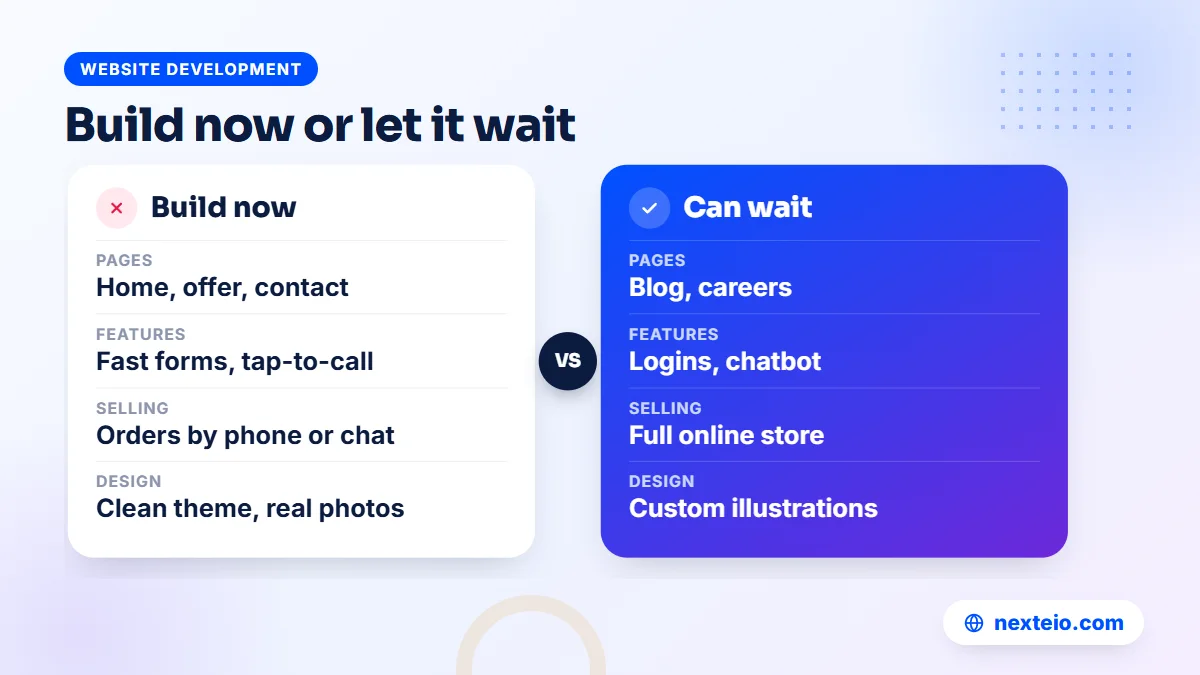
For most new businesses, five or six pages are enough to launch. Each one has a clear job, and together they answer the questions a careful visitor will ask before contacting you.
- Home: what you offer, who it is for and the one action you want, visible on a phone.
- Product or service page: what the customer gets, how it works, how pricing works and common questions.
- About: the founders, why the company exists and the registered business name.
- Proof: a pilot story, early feedback or a short demo, at first as a home page section.
- Contact: a short form, tap-to-call, WhatsApp if you use it, an email on your domain and your address.
- Privacy policy: good practice whenever forms collect personal data, and often asked for by ad platforms and payment providers.
Keep every page short enough to read comfortably on a phone.
Notice what is not on this list: a blog, a careers page, a news section and a full team directory. These all have value later, but none of them helps a first customer decide to contact you.
If you sell several distinct services, give each its own page rather than squeezing them onto one. A customer searching for one service should land on a page about exactly that. Our guide to building a professional business website explains how to structure these core pages in more detail.
Features That Must Work From the First Day
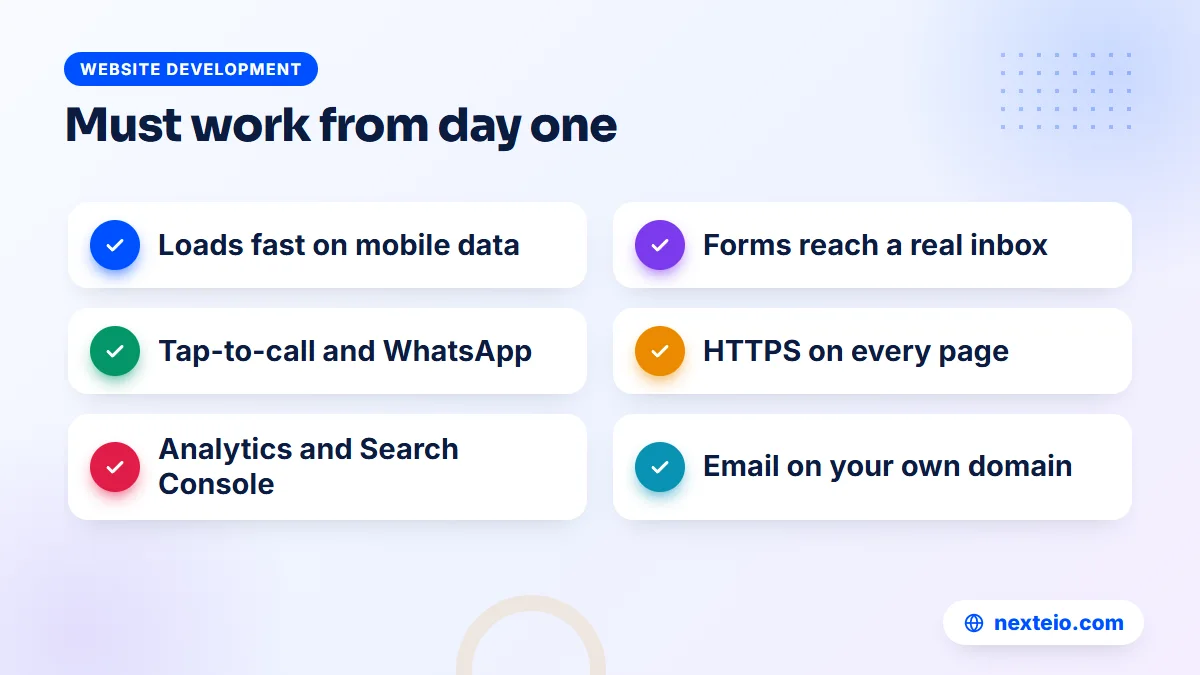
Small does not mean rough. A few things must work properly on launch day, because they decide whether visitors trust you and whether you hear from them at all. Most of them cost little extra if they are planned from the start.
- Speed on mobile data: most of your visitors in Bangladesh will open the site on a phone, often away from Wi-Fi. Compressed images and a light theme matter more than animations.
- Forms that reach a real inbox: test every form, check the spam folder and make sure someone is responsible for replying.
- Tap-to-call and WhatsApp: many customers here prefer a quick call or message to filling in a form.
- HTTPS on every page: a free certificate is fine, as long as it renews automatically.
- Analytics and Search Console: without them, you cannot learn anything from your first months.
- Email on your own domain: an address like hello@yourcompany.com looks far more established than a free webmail address.
These six items are cheap to get right at the start and expensive to fix after launch.
For analytics, set up a free Google Analytics property following Google's official setup guide, and verify the site in Google Search Console so you can see which searches bring visitors. If you plan to run ads, set up conversion tracking before the first campaign. Our beginner's guide to Google Ads conversion tracking walks through it.
Trust Signals for a Company Nobody Knows Yet
A new company faces a specific doubt: visitors have no reason yet to believe it is a real, working business. Startup websites have to answer that doubt quietly, through small concrete details rather than slogans. Each detail on its own seems minor, but together they decide whether a cautious buyer picks up the phone.
The signals that carry the most weight are usually simple:
- The registered company name, shown the same way on every page and document.
- A physical address, even if it is a shared or small office.
- Named founders with real photos and one line on their background.
- A phone number that a person answers during office hours.
- Real photos of the product, the team or the workspace.
- Clear policies on privacy, delivery or refunds, where they apply.
None of these costs much, and all of them are easy to check.
For startups selling to other businesses, a short company profile that visitors can download often helps. Procurement teams and foreign buyers like to share a PDF inside their organization before a meeting. For startups serving local customers, a free Google Business Profile helps people find your address, hours and phone number in Search and Maps, and it links back to your site.
Be careful with borrowed trust. Do not show client or partner logos without permission, and do not describe a pilot as a long-term contract. Strong startup websites are honest about being new and specific about what the team has already done. That combination reads as confidence, not weakness.
What Startup Websites Can Leave for Later
The list of things that can wait is longer than most founders expect. The trick is to write down each idea along with the signal that would make it worth building. That way nothing is forgotten, and nothing gets built on a hunch.
| Feature or page | Why it can wait | Build it when |
|---|---|---|
| Blog or resources | Needs a steady writing habit to pay off | You can publish useful posts at least twice a month |
| Careers page | Early hiring often happens through networks | You are hiring regularly or for several roles |
| Second language | Doubles the writing and updating work | A clear share of customers prefers the other language |
| Customer login or portal | Expensive to build and secure | Customers repeatedly ask for self-service access |
| Full online store | Needs stock, delivery and payment processes first | Orders by phone or message become hard to handle |
| Chatbot or live chat | Needs someone to answer quickly | You have staff to respond during business hours |
| Custom illustrations and animation | Adds cost and often slows pages | The brand is settled and the budget allows it |
Treat the right-hand column as a set of triggers, not dates.
The second-language point needs care in Bangladesh. If your customers are local consumers, Bangla may belong in the first version, not later. If you sell to foreign buyers or corporate IT teams, English first is usually enough. Choose the language your first customers actually read, and add the other when the data says it is worth the work.
The online store point also deserves a note. Many startups here sell through Facebook pages and messages at first, taking cash on delivery or bKash. That is a reasonable way to test demand. A full store makes sense once order volume makes manual handling slow and error-prone.
Choosing a Platform for Startup Websites
The platform decision shapes your costs for years. Founders often pick based on what a friend used, which works out only by luck. Look instead at who will update the site, what it must do, and how likely it is to grow into something more complex.
| Option | Suits | Watch out for |
|---|---|---|
| Hosted website builder | A very simple first site, built by the founder in days | Monthly fees in foreign currency, limited control and harder migration later |
| WordPress | Most service startups, content-led businesses and simple stores | Needs updates, backups and a careful choice of plugins |
| Custom build or Laravel | Products with logins, dashboards, bookings or unusual workflows | Higher upfront cost and the need for a developer for every change |
None of these is right for everyone, and many startup websites move from one option to another as the business grows.
For most service-based startups, a well-built WordPress website is a sensible middle ground. Your team can edit pages and add posts without a developer, and the site can grow with landing pages, a blog and even a store later. Our comparison of WordPress and custom websites explains the long-term trade-offs.
If your startup is itself a web product, such as a booking platform or a business dashboard, your marketing site and your application are two different things. Keep the marketing site simple and separate. The application can be built in a framework such as Laravel through a custom web application project, on its own schedule and budget.
Avoid building your first marketing site entirely on custom code unless you have a strong reason. It makes every small text change depend on a developer, which is exactly what a fast-changing startup does not need.
Domain, Email and Hosting: Set Them Up Correctly Once
Ownership problems in startup websites usually start on day one, when a co-founder or a freelancer registers the domain under a personal email. Two years later, that person has left, and nobody can renew the domain or reach the hosting account. Avoid this from the start.
- Register the domain in the company's name, with a shared company email as the contact.
- Choose a short name that is easy to say on the phone and spell from hearing it.
- Buy hosting under a company account, and give developers their own access rather than the main login.
- Set up email on your domain from day one, even if you only have two staff.
- Keep a simple access record that at least two founders can open.
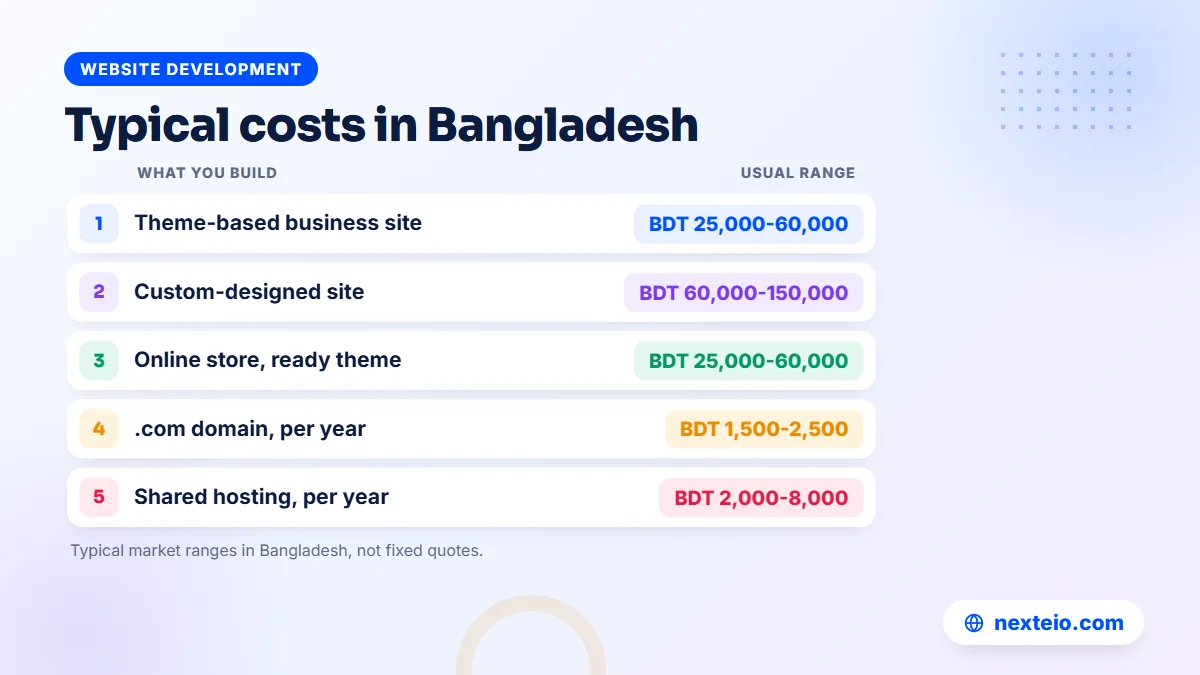
Costs here are modest. A .com domain usually costs about BDT 1,500 to 2,500 a year, and shared hosting about BDT 2,000 to 8,000 a year, depending on the plan. A .com.bd domain is an option if you serve local customers and want a Bangladeshi address, though it takes a little more paperwork.
Pick hosting with a data-center server, automatic backups and free SSL that renews by itself. A site hosted on a cheap, overloaded server will feel slow to customers on mobile data, no matter how well it is designed.
Writing the First Version of Your Copy
Founders know their product so well that they often describe it in terms customers do not use. "An integrated workflow solution for SMEs" means little to a factory manager. "Track every order from cutting to shipping on one screen" means a lot. Write the way your customers talk about their problem.
A simple structure works for most first versions:
- State the problem your customer has, in their own words.
- Say what you offer and who it is for in one sentence.
- Show how it works in three or four short steps.
- Give honest proof, such as a pilot result, founder experience or a demo.
- Answer the questions people ask before they buy, including price.
- Ask for the one action you chose, clearly and more than once.
Keep each page focused on this order, and cut anything that does not serve it.
Google's guidance on creating helpful, reliable content is a useful check. It asks whether your content is written for people first, shows real experience and answers the visitor's question fully. Copy written that way tends to persuade customers and help search visibility at the same time.
Avoid inflated claims, especially as a new company. Words like "leading" or "number one" make an unknown startup look less credible, not more. Specific facts, such as who founded the company, what you have built and who you have worked with, carry far more weight.
Related guides for a new business site:
- Simple SEO tips for small business websites
- Why a website gets traffic but no customers
- How long SEO takes to show results
Read them alongside this guide when you plan your first round of content.
Landing Pages for Ads and Launches
Many startups get their first customers through paid ads on Facebook, Google or TikTok. Sending that paid traffic to your home page wastes money, because the home page speaks to everyone. A landing page speaks to one audience about one offer, and asks for one action.
A good landing page for a startup usually has a headline that matches the ad, a short explanation, two or three points of proof, a simple form or call button and nothing that leads visitors away. It loads fast on a phone and keeps the form short. Our guide to creating a high-converting landing page covers the details.
Plan for landing pages in your first version, even if you build only one at launch. Most startup websites that run ads end up needing several. A platform that lets you create new pages quickly, without a developer for every change, will save money each time you test a new offer. When you are ready to run campaigns, the planning behind Google Ads campaigns and Facebook and Instagram ads works best when the landing page and the ad are designed together.
Keep each campaign's results separate. If one landing page brings enquiries at half the cost of another, that tells you something about your customers, and it often shapes the next version of your main site.
Measuring What Works in the First 90 Days
The first three months after launch are when your website teaches you the most. You do not need complex reports. You need a few numbers, checked regularly, and a habit of changing the site based on what they show.
Track these every week or two:
- Visitors, and where they came from: search, ads, social media or direct.
- Enquiries, calls and WhatsApp messages that started on the site.
- Which pages people visit before they contact you.
- Which searches show your site in Google, from Search Console.
- Pages where many visitors leave quickly.
Simple counts are enough at this stage, as long as you record them consistently.
Ask every new customer how they found you, and note the answer. In Bangladesh, a lot of business still starts with a phone call, and analytics alone will miss it. Combining the call log with website data gives you a much clearer picture.
Then act on the numbers. If visitors read the pricing page and leave, the pricing may be unclear. If most enquiries come from one service page, give that service more space. Startup websites that change every month based on this kind of evidence improve far faster than sites that wait for an annual redesign.
Search takes time to build, usually several months for a new domain. Do not judge your site's search potential in the first few weeks. Google's SEO starter guide explains the basics, and steady improvements from the start will pay off later.
What Startup Websites Cost in Bangladesh
Budgets for startup websites vary widely, mostly because founders compare very different things. A theme-based five-page site and a custom-designed site with a store are separate projects, even if both are called "a website". These are typical market ranges in Bangladesh, not fixed prices:
| What you are building | Typical market range |
|---|---|
| Theme-based company or business website | BDT 25,000 to 60,000 |
| Custom-designed business website | BDT 60,000 to 150,000 |
| Large site with integrations | BDT 150,000 to 400,000 or more |
| Online store with a ready theme | BDT 25,000 to 60,000 |
| Online store with custom design | BDT 60,000 to 150,000 |
| Custom web application or portal | Quoted after a requirements review |
Domain and hosting are usually billed separately, as covered above.
Custom software and portals are normally quoted after a requirements review, because the cost depends on modules and users. If a rough figure is needed, they often range from about BDT 150,000 to 1,200,000 or more.
A phased plan spreads these costs. Many startups launch with a theme-based site in the lower range, then move to a custom website design once the brand, offer and customer are clear. Others start custom because their first customers are corporate buyers who expect a polished presence. Both paths are reasonable if the decision is deliberate.
Budget for the costs after launch as well: content updates, new landing pages, maintenance, photography and ad spend. A site that cost little to build but never gets updated loses value quickly. If you plan to sell online, our e-commerce website service page explains how stores here handle cash on delivery and mobile payments.
Common Mistakes Founders Make With Startup Websites
Most of the mistakes below come from good intentions: wanting to look big, wanting to save money or wanting to launch everything at once. Each one is easy to avoid once you know it.
- Copying a large company's site: big brands can afford vague slogans because people already know them. A new company needs to explain itself plainly.
- Launching with "coming soon" pages: empty sections look abandoned. Leave them out until they are ready.
- Using only stock photos: real photos of founders, the office and the product build far more trust.
- Hiding the price completely: even a "from" price or a clear explanation of how pricing works keeps serious buyers reading.
- No owner for enquiries: a form that nobody checks daily is worse than no form at all.
- Letting a freelancer own the accounts: domain, hosting and analytics should always belong to the company.
- Redesigning instead of improving: a new design every year rarely fixes what a few clear page changes would.
Fixing even two or three of these usually improves enquiries more than any redesign would.
The last mistake is worth a closer look. Founders often feel their site "looks old" after a year and want a fresh design. Before spending on a redesign, check the numbers. If enquiries are steady and visitors find what they need, small improvements to copy, proof and speed usually do more than a new look.
A First-Year Website Roadmap
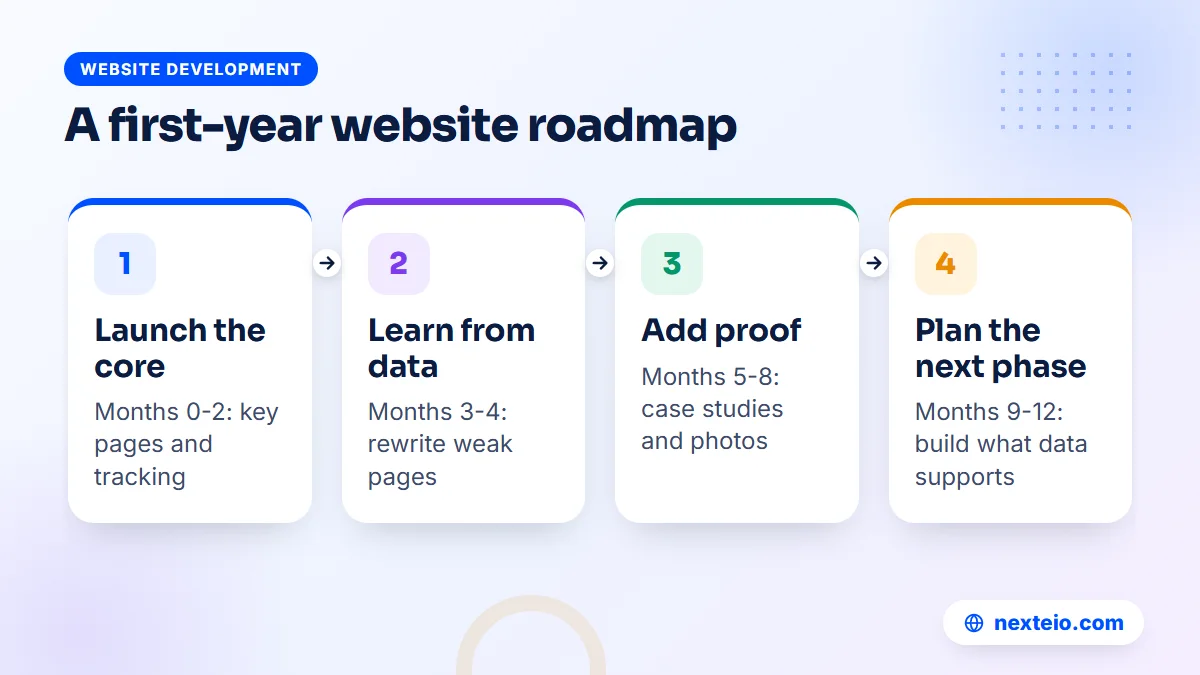
Here is a simple roadmap that suits many service and product startups. Adjust the timing to your own launch and budget, but keep the order: launch small, learn, add proof, then grow.
- Months 0 to 2: launch the core pages, set up analytics, Search Console and form testing, and put the domain and hosting in the company's name.
- Months 3 to 4: review enquiries and search data, rewrite weak pages, and build one or two landing pages for ads or launches.
- Months 5 to 8: add proof as it arrives, such as short case studies, client feedback and photos from real work.
- Months 9 to 12: decide on the next phase, such as a blog, a second language, a store, a client portal or a custom redesign, based on what the first months showed.
Review the roadmap every quarter with whoever owns the website on your team.
Keep a running list of ideas through the year, each with the trigger that would justify it. When budget becomes available, you can pick the next step from evidence rather than guesswork. This is how strong startup websites grow: in small, measured steps that follow the business.
If you are choosing someone to build with, look at their past work and ask how they handle small, phased projects. A provider who pushes every feature into the first version may not be the right partner for a business that is still finding its shape.
How Nexteio Can Help
We build websites for new and growing businesses across Bangladesh, and we are happy to plan a site in phases rather than all at once. Through our custom website design service, we start by understanding your first customer, the one action you want and the proof you can show. Then we plan a first version that launches quickly and leaves room to grow.
For the first phase, that usually means the core pages, fast mobile performance, working forms, tap-to-call and WhatsApp, analytics and Search Console, with the domain and hosting set up in your company's name. Later phases can add landing pages, a blog, a second language, an online store or a fully custom design once your brand and offer are settled. If your product needs logins or dashboards, we can plan that as a separate web application.
You can see the kind of sites we build in our portfolio, read more about Nexteio, or send us a short brief about your startup. If you would rather talk first, use our contact page. When you are ready, start a project and we will suggest a phased plan for your startup's site.
Keep reading: how to write website content people actually read, a buyer's checklist for choosing a web design company, or more website development guides.
Frequently asked questions
How many pages should a startup website have at launch?
Five or six pages are enough for most new businesses: home, a product or service page, about, contact, a privacy policy and a proof section. Add a separate page for each distinct service you sell. More pages can follow once you know what visitors look for.
Is a Facebook page enough instead of a website for a new business?
A Facebook page is a good place to start conversations, but it does not replace a website. Buyers, partners and investors often check for a proper site before they trust a new company, and a website shows up in Google searches. You also own your website, while a social page depends on the platform's rules.
How long does it take to build a first startup website?
A small, theme-based first version can often go live in a few weeks once the content is ready. Custom design usually takes longer because of planning, design rounds and testing. Waiting for content, such as photos and approved text, is the most common cause of delay.
Should a startup choose WordPress or a custom-built website?
For most service startups, WordPress is a sensible first choice because the team can update pages without a developer. A custom build makes more sense when the website needs logins, dashboards or workflows that a normal content site cannot handle. If your product itself is a web app, keep the marketing site separate from it.
Can we redesign later without losing our search rankings?
Yes, if the move is planned. Keep the same domain, keep important page addresses where you can, set up redirects for any that change and check Search Console after launch. Problems usually happen when a redesign changes every address without redirects.
Do startup websites in Bangladesh need online payment from the start?
Not always. Many new businesses start with cash on delivery, bank transfer or a mobile payment number shared after an order is confirmed. A payment gateway makes sense once order volume grows, and providers usually ask for business documents such as a trade license before approval.
Who should own the domain and hosting for a startup?
The company should, not a founder personally and not a freelancer. Register both with a shared company email address and give developers their own access. This avoids the common problem of losing the domain when one person leaves.