Local SEO for Business: How to Get Found by Nearby Customers
In this article 16 sections
- 1.What Local SEO for Business Means
- 2.How Google Decides Which Local Businesses to Show
- 3.Find the Searches Your Nearby Customers Use
- 4.Google Business Profile: The Signals Inside It
- 5.Build Local Pages on Your Website
- 6.Keep Your Name, Address and Phone Consistent
- 7.Reviews: Earning Them and Replying Well
- 8.Local Structured Data and Technical Basics
- 9.Local Content and Links That Build Prominence
- 10.Local SEO for Business With Branches or a Service Area
- 11.Measuring Local SEO for Business Results
- 12.A 90-Day Local SEO Plan
- 13.Local SEO Mistakes That Hold Businesses Back
- 14.Doing It Yourself or Hiring Local SEO Services
- 15.How Nexteio Can Help With Local SEO
- 16.Frequently asked questions
Local SEO for business is the work that helps nearby customers find you when they search on Google for what you sell, often with "near me" or an area name in the search. A patient looking for a dental clinic, a parent comparing coaching centers or a family hunting for a furniture showroom rarely scrolls far. They pick from the few businesses Google shows on the map and the first results below it.
Those few spots bring calls, direction requests and walk-in visitors every day. Yet many businesses in Bangladesh still rely on a Facebook Page alone, have no verified Google profile, or have a profile with the wrong phone number and hours from three years ago. A competitor with a tidier presence wins the customer before your shop is even considered.
This guide explains how Google chooses local results, then walks through local SEO for business owners in a practical order: finding the searches your customers use, strengthening your Google Business Profile, building local pages on your website, keeping your details consistent, earning reviews, adding the right technical signals and measuring what changes.
It also covers businesses with several branches, service businesses that visit customers, and a 90-day plan you can follow or hand to your team. No setting or trick guarantees a top spot, because Google decides the order. What you can do is give it every honest reason to show you.
What Local SEO for Business Means
When someone searches for a product or service with local intent, Google often shows a map with a short list of businesses, sometimes called the local pack. Below it come normal web results, which also lean toward pages connected to the searcher's area. Local SEO covers both: your place on the map and your website's place in the results.
Local intent does not always need an area name. A search for "diagnostic center" or "AC servicing" on a phone usually returns nearby results, because Google understands that most people want a place they can reach. The words "near me" make that intent even clearer.
This matters most for businesses that serve people in person or within a set area:
- Clinics, hospitals, diagnostic centers and pharmacies.
- Schools, colleges, madrasas, coaching centers and training institutes.
- Restaurants, cafes, sweet shops and bakeries.
- Showrooms for furniture, electronics, tiles, cars and motorbikes.
- Service businesses: repair, cleaning, interior work, pest control, car rental.
- Offices people visit, such as law firms, travel agents and consultants.
A garment exporter or a software company selling abroad needs local SEO less. Even then, a correct profile helps buyers, visitors and new staff find the office or factory gate.
How Google Decides Which Local Businesses to Show
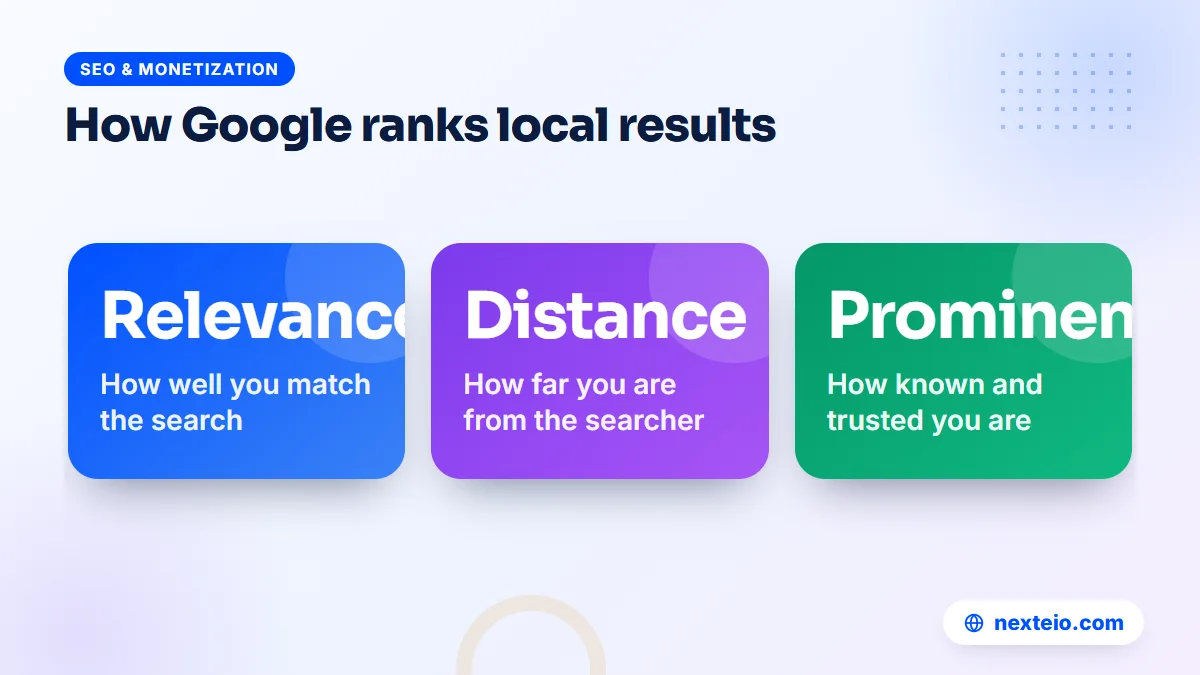
Google explains that local results are based mainly on three things: relevance, distance and prominence. Its own page on improving your local ranking describes each one. Understanding them tells you where your effort will count.
Relevance is how well your profile and website match the search. A profile with the right category, a clear list of services and a website that describes them in plain words is easier to match.
Distance is how far you are from the searcher, or from the area named in the search. You cannot change it, which is why a business does not rank everywhere in a large area, however good its SEO is.
Prominence is how well known and trusted the business is. Google looks at reviews, mentions and links across the web, and your position in normal web results. Long-established businesses with many genuine reviews often rank well for this reason.
| Factor | What you control | What you cannot control |
|---|---|---|
| Relevance | Categories, services, website content, page titles | How Google interprets a search |
| Distance | Correct address, pin and service areas | Where the searcher is standing |
| Prominence | Reviews, mentions, links, website quality | How long competitors have existed |
Every step in this guide feeds one of these three factors.
Find the Searches Your Nearby Customers Use
Good local SEO for business starts with words, not settings. Local keyword research is simpler than national research, but it needs local thinking. People search in English, in Bangla and in Bangla written with English letters. They use brand names, problem words and area names. A hospital may be searched by its full name, a short name, a department or a doctor's specialty.
Start with these sources, all free:
- Your Google Business Profile performance report: it lists searches that showed your profile.
- Google Search Console: the queries that already bring impressions to your website.
- Google's autocomplete: type your service and watch the suggestions, on a phone, from your area.
- Your own staff: ask reception and sales what customers say on the phone.
- Competitors' profiles: note the categories and services they list.
Group what you find by service, not by single phrases.
For each main service, write down the core phrase, the area version and the "near me" version. A coaching center might list "admission coaching", "admission coaching [area name]" and "admission coaching near me", plus the Bangla equivalents. Those groups become the services on your profile and the headings on your website pages. Our guide to on-page SEO for beginners shows how to use them in titles and headings without stuffing. This kind of research is also the first step in our SEO work for local businesses.
Google Business Profile: The Signals Inside It
Your Google Business Profile is the single most important asset for map results. Setting it up and verifying it is the first step, but a verified profile with thin details still loses to a complete one. Follow Google's guidelines for representing your business, because breaking them can get a profile suspended.
Name and categories
Use your real business name exactly as it appears on your signboard and documents. Adding keywords or area names to the name breaks the guidelines, even if you see competitors doing it. Choose the primary category that describes your main business as precisely as possible, such as "Dental clinic" rather than "Medical clinic", and add a few accurate secondary categories.
Services, products and description
List each service in the services section, with a short plain description. Restaurants can add menus; shops can add products with photos and prices. Write a business description that says what you do, who you serve and what makes you different, in plain words rather than a list of keywords.
Hours, contact and attributes
Keep hours correct, including special hours for Eid, Puja, national holidays and the changed timings many businesses keep during Ramadan. Add a phone number that is answered, a website link and attributes such as wheelchair access or online appointments where they apply.
Photos and updates
Add real photos: the front of the building from the street so people recognize it, the inside, your team and your products. Post updates for offers, events, admission dates or new services. Active, complete profiles give customers more reasons to choose you, even if the ranking effect of each single action is small.
Build Local Pages on Your Website
Your website supports the profile and ranks on its own in the results below the map. Google's profile links to your website, and Google reads the website to judge relevance and prominence. A profile pointing to a slow, thin site wastes much of its value.
In local SEO for business websites, the service and contact pages do most of the work. At minimum, a local business website needs:
- A page for each main service, written for customers, with prices or price ranges where you can share them.
- Your full name, address and phone number in the footer of every page.
- A contact page with an embedded map, directions from a known landmark and opening hours.
- Click-to-call and WhatsApp buttons that work on phones.
- Real photos, staff names where appropriate, and reviews or case examples.
Write page titles that combine the service and your area naturally.
If you have branches, create one page per branch with its own address, phone, hours, map, photos, staff and directions. Do not create dozens of near-identical pages that only swap the area name. Google treats these as doorway pages under its spam policies, and they rarely help.
Many local businesses do not need a large site. A clear, fast site of eight to fifteen pages built through our custom website design service, or a WordPress website your staff can update, often does more for local SEO than a big site full of generic text. For typical market ranges in Bangladesh, a company or business website usually costs about BDT 25,000-60,000 with a theme, or BDT 60,000-150,000 with a custom design.
Keep Your Name, Address and Phone Consistent
Name, address and phone number, often shortened to NAP, should match everywhere your business appears: your profile, website, Facebook Page, directories, association member lists and supplier sites. It is the least exciting part of local SEO for business, and one of the most neglected. Inconsistent details make it harder for Google to be sure that all those mentions are the same business, and they confuse customers.
Addresses in Bangladesh cause special trouble. The same place may be written as House 12, Road 5, Block C in one listing and Plot 12, Lane 5 in another, with or without the area, thana and postcode. Pick one standard English format and one Bangla format, write them down, and use them every time.
- Write your official name, address in English and Bangla, main phone number and website address.
- Search Google for your business name and old phone numbers to find existing listings.
- Correct or claim each listing you find, starting with the most visible ones.
- Update your Facebook Page, any association listings and supplier or partner pages.
- Note every listing in a sheet with its login, so the next change takes minutes.
Do this again whenever you move or change numbers.
When the address is hard to find
Many places here are easier to find by landmark than by house number. Add a short direction line on your website and profile, such as the floor, the gate or a well-known building nearby. Google Maps also shows a Plus Code for any location, a short code that points to an exact spot, which you can share with customers and delivery riders when the street address is unclear.
Check the map pin itself on a phone. Open directions from a few nearby roads and confirm that Google sends people to your real entrance, not to the back of the building or the wrong side of a main road.
Old numbers are a common leak. If a clinic changed its phone number two years ago but an old directory still shows the old one, patients call a dead line and assume the clinic has closed.
Reviews: Earning Them and Replying Well
Reviews are where local SEO for business meets customer service. They feed prominence and, just as importantly, they persuade the person reading them. A profile with a steady stream of recent, detailed reviews usually wins clicks over one with a handful of old ones, even when the ratings are similar.
How to get more genuine reviews
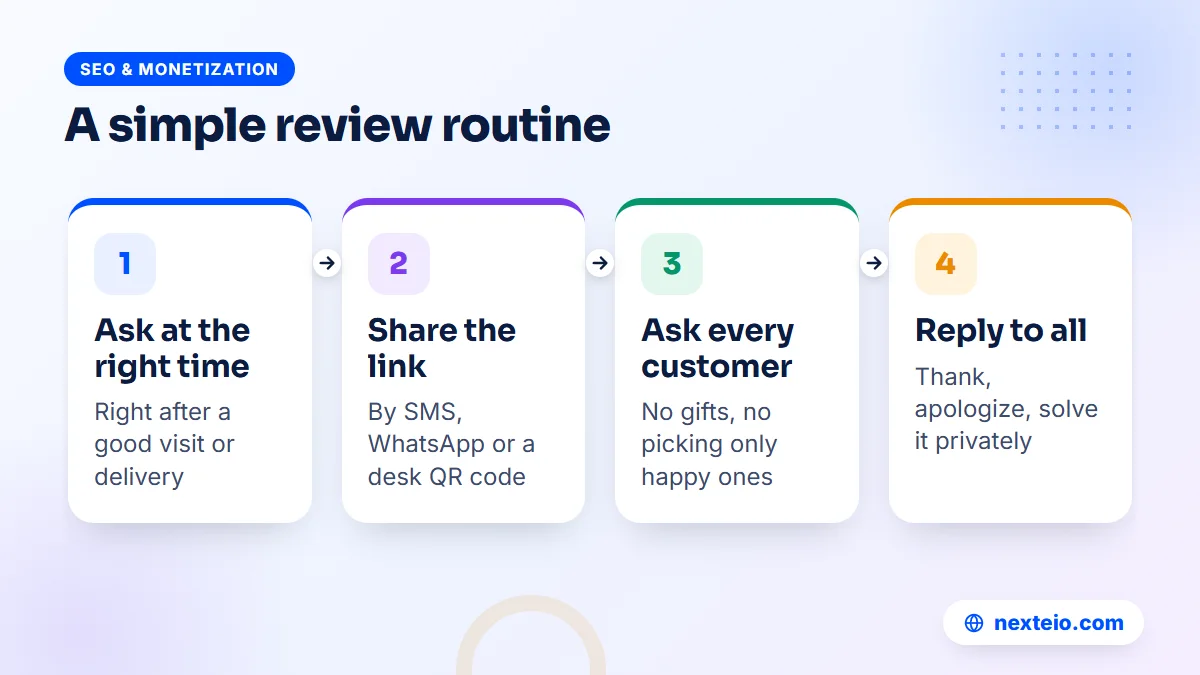
Ask at the moment a customer is happy: after a successful treatment, when a student gets results, after a smooth delivery or installation. Make it easy by sharing the direct review link by SMS or WhatsApp, or by printing a QR code at the reception desk. Ask every customer, not only the happy ones you pick.
Google's policies forbid offering discounts or gifts in exchange for reviews, asking only satisfied customers while steering others away, and posting reviews written by staff or bought from sellers. Fake reviews can be removed and can lead to restrictions on the profile, so the shortcut is not worth it.
How to answer reviews
Reply to every review, good and bad, in the language the customer used. Thank people by name for positive reviews and mention the service they used. For negative reviews, stay calm, apologize for the experience without arguing in public, and give a phone number or name so the problem can be solved privately.
Future customers read your replies as closely as the reviews. A polite, specific answer to a complaint often builds more trust than ten five-star reviews with no reply.
Related guides for strengthening your local presence:
- Ten simple SEO tips for small business websites in Bangladesh
- How to write website content that people actually read
- How internal links connect your website pages
Local Structured Data and Technical Basics
Structured data is code on your website that tells search engines facts about your business in a fixed format: name, address, phone, hours, geographic coordinates and type of business. For local SEO, the LocalBusiness type and its more specific types, such as Dentist or MedicalClinic, are the relevant ones. Google's documentation on local business structured data lists the properties it reads.
Structured data does not guarantee any special display, and it must match what visitors see on the page. Treat it as a way to remove doubt, not as a ranking trick. A developer can add it in an hour, and on WordPress many SEO plugins can generate it once your details are entered correctly.
The other technical basics matter just as much for local visitors, who are nearly all on phones:
- The site loads quickly on mobile data, with compressed images.
- The phone number is a tap-to-call link, not an image.
- The site uses HTTPS, with no security warnings.
- Google can crawl and index the service and contact pages.
Our guides to technical SEO basics and website speed and SEO explain how to check each of these.
Local Content and Links That Build Prominence
Your standing in local results grows when other people talk about you. For a local business, the most useful mentions come from the community around you, not from link packages sold online. Paid link schemes break Google's spam policies and can do lasting harm.
Practical sources of local mentions and links include:
- Trade associations and chambers of commerce that list members.
- Suppliers and brands you stock, which often list authorized dealers.
- Local events, sports teams or school programs you sponsor.
- Local news coverage of something genuinely newsworthy, such as a new facility or free health camp.
- Partner businesses, such as a clinic and a nearby diagnostic center that refer patients to each other.
Quality matters more than numbers here.
Content on your own site can also earn attention. A clinic can publish clear guides on common local health questions, a school can post admission timelines and results, and a showroom can explain how to choose the right product for local conditions, such as furniture that handles humidity. Content written for real local questions is more likely to be shared and linked than generic articles. Planning this content around real customer questions is part of how we run SEO campaigns for clients.
Local SEO for Business With Branches or a Service Area
Businesses with more than one location, or with no location customers visit, need a slightly different setup. Getting it right early avoids duplicate profiles and lost reviews later.
Several branches
Each branch that serves customers in person and has its own staff and hours can have its own profile. Each profile should link to that branch's page on your website, not to the homepage. Keep names consistent across branches, such as the brand name followed by nothing extra, and let the address and page content show which branch is which.
Service-area businesses
Plumbers, cleaners, caterers, mobile repair services and home tutors often visit customers instead of receiving them. Google lets these businesses hide their address and set the areas they serve. Do this honestly: list the areas you really cover. A service-area business still competes on relevance and prominence, so reviews and a strong website matter even more.
Large organizations, such as hospital groups and school networks, should also decide who manages each profile. Give each branch manager a limited role, keep ownership with head office, and use one standard for photos, hours and replies.
Measuring Local SEO for Business Results
Rankings on the map change with where the searcher stands, so a single ranking check from your office tells you little. Measure the actions that bring revenue instead.
| Where to look | What to track | How often |
|---|---|---|
| Business Profile performance | Calls, direction requests, website clicks, searches | Monthly |
| Google Search Console | Clicks and queries for service and branch pages | Monthly |
| Google Analytics | Visits from the profile link, form and call clicks | Monthly |
| Front desk or sales | "How did you find us?" answers | Every enquiry |
Compare each month with the same month last year where you can.
Add campaign tags to the website link in your profile, so visits from it show separately in Analytics rather than mixed with other Google traffic. Also train reception staff to ask new customers how they found you and to note the answer. It takes seconds and gives you evidence no tool can.
Checking map positions fairly
If you want to check where you appear on the map, search from a phone at several points around your area, not just from your desk. Results from a spot two kilometers away can look very different from results at your front door. Note the positions for your three or four main services once a month, and treat them as a rough guide next to calls and enquiries.
Expect gradual change. Fixing a broken profile can show results within weeks, while building prominence through reviews and mentions takes months. Our article on how long SEO takes explains realistic timelines.
A 90-Day Local SEO Plan
Here is a simple local SEO for business plan that an owner, office manager or provider can follow. Adjust the pace to your team's time, but keep the order, since later steps depend on earlier ones.
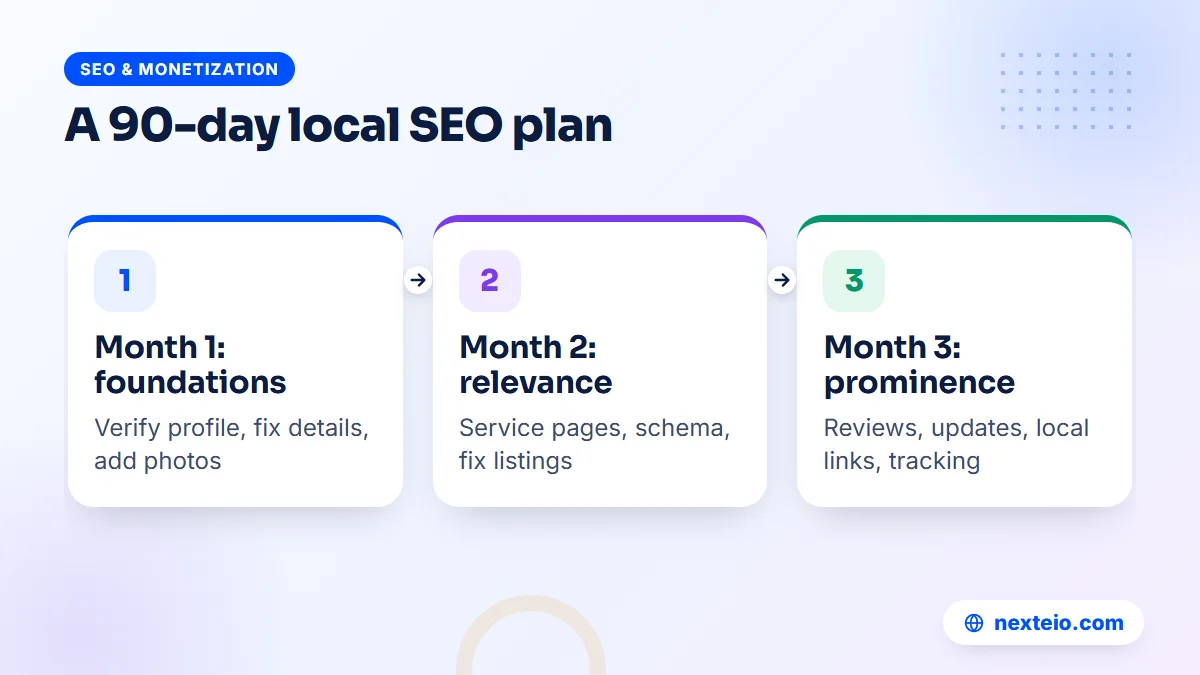
Month 1: fix the foundations
Claim and verify your profile, correct the name, categories, hours and phone, and add services and real photos. Write down your standard name, address and phone in English and Bangla. Check that your website has a contact page with a map, tap-to-call and the same details.
Month 2: build relevance
Create or improve one page for each main service and each branch. Add local business structured data. Fix old directory listings and update your Facebook Page and association listings. Start a simple review request routine at the front desk or after delivery.
Month 3: build prominence and measure
Reply to every review, post profile updates every week or two, and reach out to suppliers, associations and partners for listings. Publish one or two pieces of useful local content. Set up the monthly measurement table and record your first full month of data.
After 90 days, the work becomes a routine: reviews, replies, updates, content and a monthly check. A local small business SEO routine like this costs a few hours a month once the foundations are right.
Local SEO Mistakes That Hold Businesses Back
Most local SEO for business problems come from a short list of mistakes. Check your own presence against it.
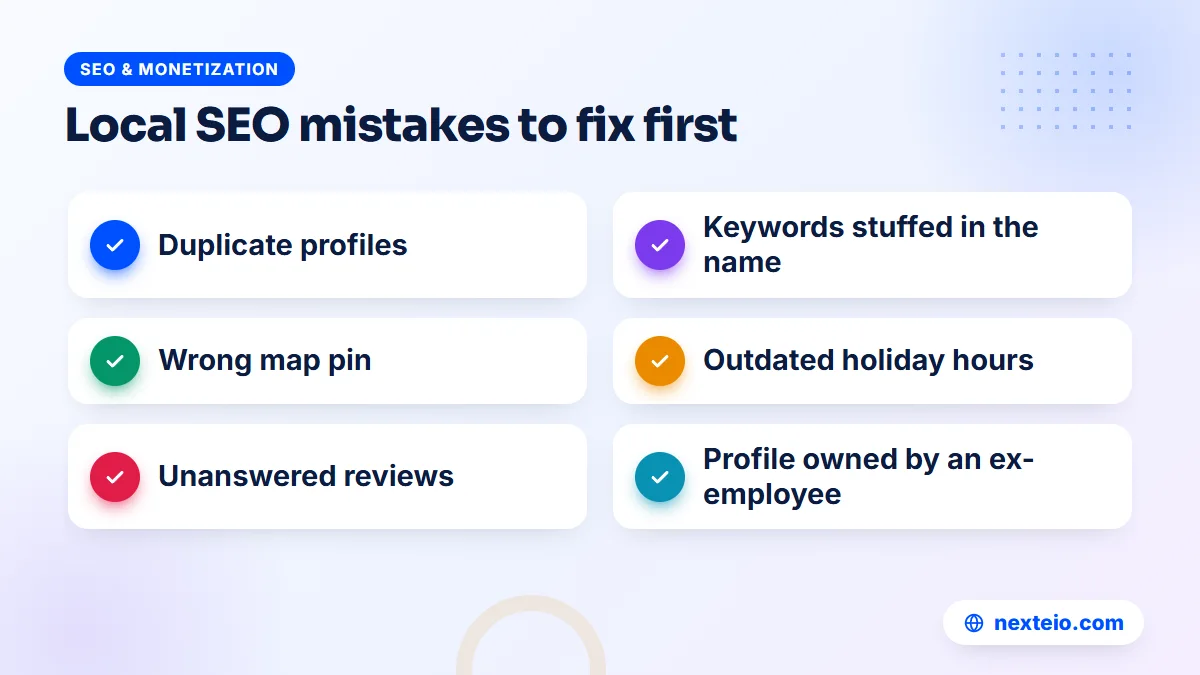
- Duplicate profiles created by different staff over the years, splitting reviews and confusing Google.
- Keyword-stuffed names such as adding "best" or an area name to the business name.
- Wrong pin location, so directions send people to the wrong street.
- Outdated hours, especially over holidays, which bring angry reviews.
- No replies to reviews, or defensive public arguments with customers.
- A profile owned by a former employee or an old agency, with nobody able to edit it.
- A website with no address or phone, or only an image of them.
Fixing these is often the fastest win available.
Ownership deserves special care. The profile should be owned by an account controlled by the business, with staff or providers added as managers. If someone else holds it, recovering it can take weeks. Our article on common SEO mistakes covers the website side of the same problems.
Doing It Yourself or Hiring Local SEO Services
Many small businesses can handle the basics themselves: the profile, photos, hours, review requests and replies. Local SEO for small businesses with one location is mostly steady attention, and an organized staff member can do much of it with an hour or two a week.
Outside help pays off when the website needs work, when you have several branches, when profiles are suspended or duplicated, or when competitors are strong and the extra prominence work matters. The kind of generic SEO local business owners are often sold, with long keyword lists and monthly reports full of rankings, misses most of this. Good local SEO services should talk about calls, direction requests and enquiries, and should leave every account in your name.
Before you hire anyone, ask what they will do in the first 90 days, how they will measure results and who will own the profile and website accounts. Our guide to choosing an SEO service in Bangladesh lists more questions. Search engine optimization for local business sites should also work alongside paid ads when you need results faster; our comparison of SEO and Google Ads explains how they fit together.
How Nexteio Can Help With Local SEO
We handle local business search engine optimization as part of our SEO service for businesses and organizations across Bangladesh. We start with a review of your Google Business Profile, website, listings and reviews, then list the problems in order of impact: duplicates, wrong details, missing services, weak pages and technical errors.
From there, we fix the profile within Google's guidelines, write or improve service and branch pages, add structured data, correct listings and set up a review routine your staff can keep. We set up measurement for calls, directions and website enquiries, and explain each month's changes in plain words. If your site is too slow or thin to support the work, our web team can rebuild it, and for faster results we can run Google Ads or Facebook ads for your area alongside the local search work.
Online shops with a physical store can combine this with our e-commerce SEO. You can see our work in the portfolio, read more about Nexteio, share your business details for a starting plan, or reach us through the contact page. When you are ready, send a project brief and we will reply with next steps.
Keep reading: how SEO brings customers to a business, or browse all our SEO and monetization guides.
Frequently asked questions
Do I need a website for local SEO, or is a Google profile enough?
A profile alone can bring calls and visits, especially for a small shop with few competitors. A website makes the profile stronger, because Google reads it to judge relevance and prominence, and it gives customers prices, services and directions in more detail. In competitive categories, businesses with both usually do better than those with only a profile.
Can I rank on Google Maps in areas where I have no office?
Distance is one of Google's main local factors, so ranking on the map far from your address is hard. Service-area businesses can list the areas they really serve, which helps. For areas far from any branch, normal web results, useful website pages and ads are more realistic ways to reach people.
Should I write my profile and website in Bangla or English?
Use the language your customers search in, which for many local businesses means both. Keep the official name and address consistent in each language, add Bangla service descriptions where customers use Bangla, and reply to reviews in the language the reviewer used.
Is it allowed to offer a discount for a Google review?
No. Google's policies do not allow offering incentives for reviews, and they also forbid asking only happy customers while discouraging others. Ask every customer politely, make the review link easy to reach, and let the reviews come naturally.
How do I remove a fake or unfair review?
You can flag a review that breaks Google's policies, such as spam, hate speech or a review from someone who was never a customer, and Google decides whether to remove it. A review that is simply negative will usually stay. In that case, a calm, helpful public reply is the best response, because future customers read it.
What should I do if there are two Google profiles for my business?
Find out who owns each profile, then keep the one with the correct details and the most reviews. Google lets you report duplicates so they can be merged or removed. Make sure the remaining profile is owned by an account the business controls, with staff added as managers.
How long does local SEO take to show results?
Fixing obvious problems, such as a wrong phone number, missing categories or an unverified profile, can show results within weeks. Building prominence through reviews, mentions and better website pages takes several months. Measure calls, direction requests and enquiries each month rather than checking rankings every day.