Link Building for Beginners: How to Earn Quality Backlinks
In this article 16 sections
- 1.What Link Building Means and Why Google Still Counts Links
- 2.What Makes a Backlink Worth Having
- 3.Dofollow, Nofollow, Sponsored and UGC Links Explained
- 4.Link Building Practices Google Treats as Spam
- 5.Start With a Site That Deserves Links
- 6.Link Building Tactics for Beginners: Start With People You Know
- 7.Create Content Other Sites Want to Link To
- 8.Outreach That Gets Replies
- 9.Broken Links, Unlinked Mentions and Other Quick Wins
- 10.Link Building Ideas by Type of Organization
- 11.How to Track Your Backlinks
- 12.Anchor Text: What the Link Says Matters
- 13.Bad Links, Negative SEO and the Disavow Tool
- 14.How Long Link Building Takes and What It Really Costs
- 15.How Nexteio Can Help With Link Building
- 16.Frequently asked questions
Link building is the work of getting other websites to link to yours, so that people and search engines can find your pages and trust them. A link from a respected site works like a reference: it tells Google that someone else found your page worth pointing to. For a business, school or clinic in Bangladesh, a handful of the right links can do more than hundreds of random ones.
Most beginners meet link building through offers like "1,000 backlinks for a few dollars" on freelance marketplaces or in Facebook groups. Those offers are cheap for a reason. Google's spam policies name almost every tactic they use, and links like that either get ignored or put the site at risk.
The good news is that real links are not reserved for big brands. A garment supplier listed by its buyers, a school mentioned by its alumni association, a clinic featured in a health awareness campaign: these are ordinary links that any organization can earn with steady effort.
This guide explains what makes a link valuable, which practices to avoid, practical ways to earn links as a beginner, ideas for different kinds of organizations, and how to track results without paying for expensive tools.
What Link Building Means and Why Google Still Counts Links
When another site adds a clickable link to one of your pages, that is a backlink for your site. Google uses links in two main ways. First, its crawler follows links to discover new pages. Second, links are one of many signals Google uses to judge which pages are useful and trustworthy on a topic.
Links are not the only signal, and they are not even the first thing to fix on most small sites. Content that answers real questions, a technically sound website and a clear structure come first. But once those are in place, links often decide which of several decent pages ranks higher, especially for competitive searches.
People search for this topic in many ways, such as "backlinks for website", "back links SEO" or "SEO backlinks". They all mean the same thing. SEO and backlinks are connected because a link is a public vote that you cannot give yourself, which is exactly why Google pays attention to it and why it tries hard to ignore votes that were bought or faked.
Links pointing between your own pages matter too, though they are a separate job. Our guide to internal linking for SEO covers that side. In a full SEO campaign, internal links, content and link building are planned together, because each one makes the others work better.
What Makes a Backlink Worth Having
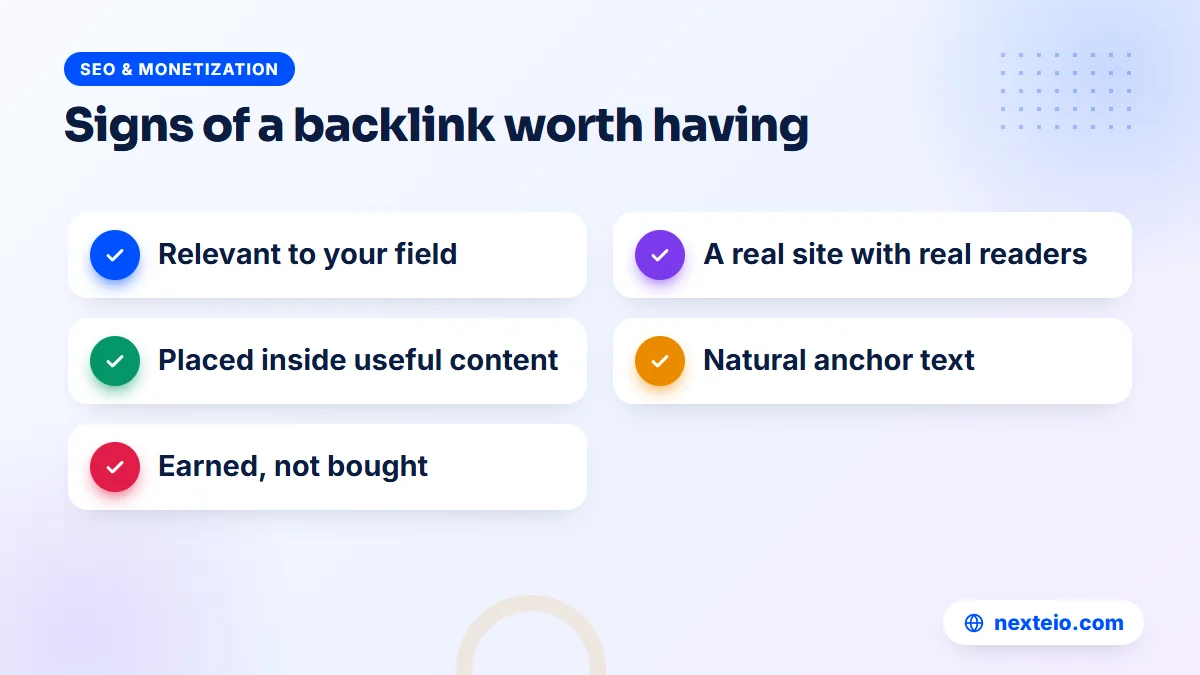
Not all links are equal. One link from a relevant, respected website can be worth more than hundreds from directories nobody visits. When you judge a possible link, ask these questions:
- Is the site relevant? A link to a textile dyeing company from a fashion supply blog makes sense. A link from a casino review site does not.
- Is it a real site with real readers? Look for regular, useful content and signs that people actually visit and comment.
- Is the link placed in useful content? A link inside a helpful article counts for more than one buried in a footer list of 200 names.
- Would you want it even without Google? If the link could send you customers, partners or students, it is probably a good one.
- Is the anchor text natural? Your brand name or a plain description is normal. Exact-match keywords on every link look manipulated.
The last question is the best filter. If a link only exists to move rankings, it is the kind Google tries to discount.
Dofollow, Nofollow, Sponsored and UGC Links Explained
A link's HTML can carry a rel attribute that tells search engines about the relationship between the two sites. Google explains these values in its guide to qualifying outbound links.
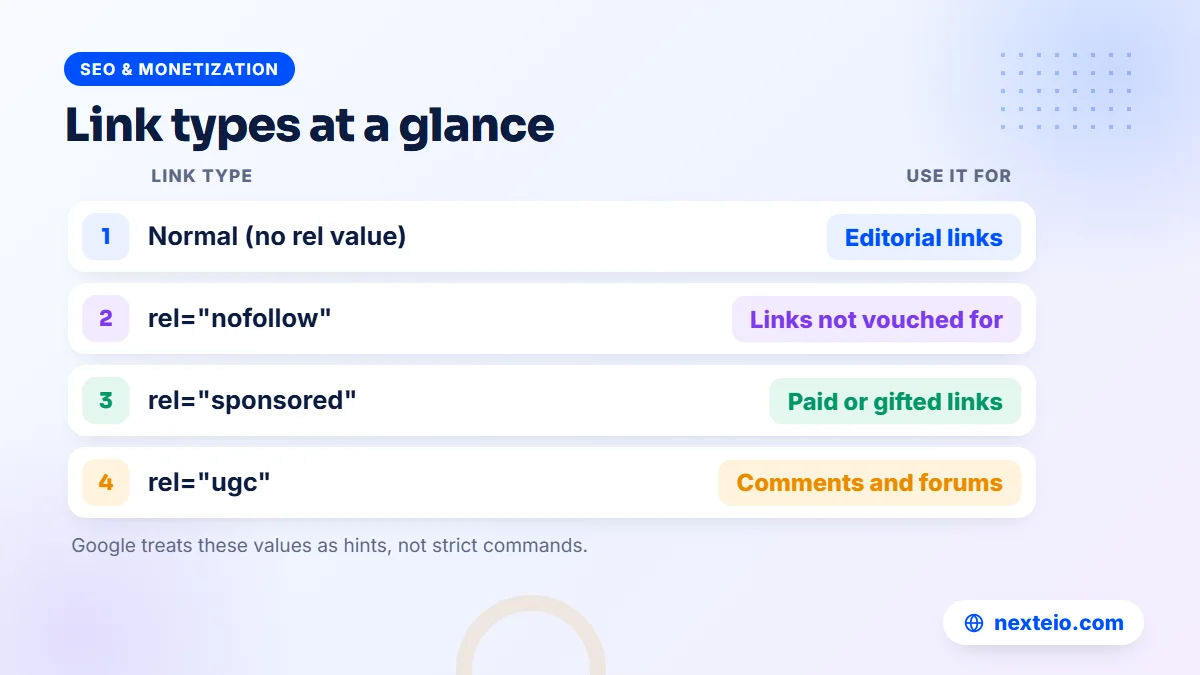
| Link type | How it looks in HTML | When it is used |
|---|---|---|
| Normal ("dofollow") | No rel value | Editorial links the site owner chose to give |
| Nofollow | rel="nofollow" | Links the site does not want to vouch for |
| Sponsored | rel="sponsored" | Ads, paid placements and sponsorships |
| UGC | rel="ugc" | Comments, forum posts and other user content |
There is no such thing as a "dofollow" attribute in HTML.
A dofollow link is simply a normal link without nofollow, sponsored or ugc. Sellers who promise "high DA dofollow links" are usually selling exactly what Google's rules forbid: paid links disguised as editorial ones.
Google treats nofollow, sponsored and ugc as hints rather than strict commands. Nofollow links are still worth having when they bring real visitors, such as a link from a busy forum thread or a news article. A healthy backlink profile naturally contains a mix of both.
If you pay for a placement, sponsor an event or send a product for review, the link should carry rel="sponsored" or rel="nofollow". That keeps you within the rules while still giving you the exposure and the visitors.
Link Building Practices Google Treats as Spam
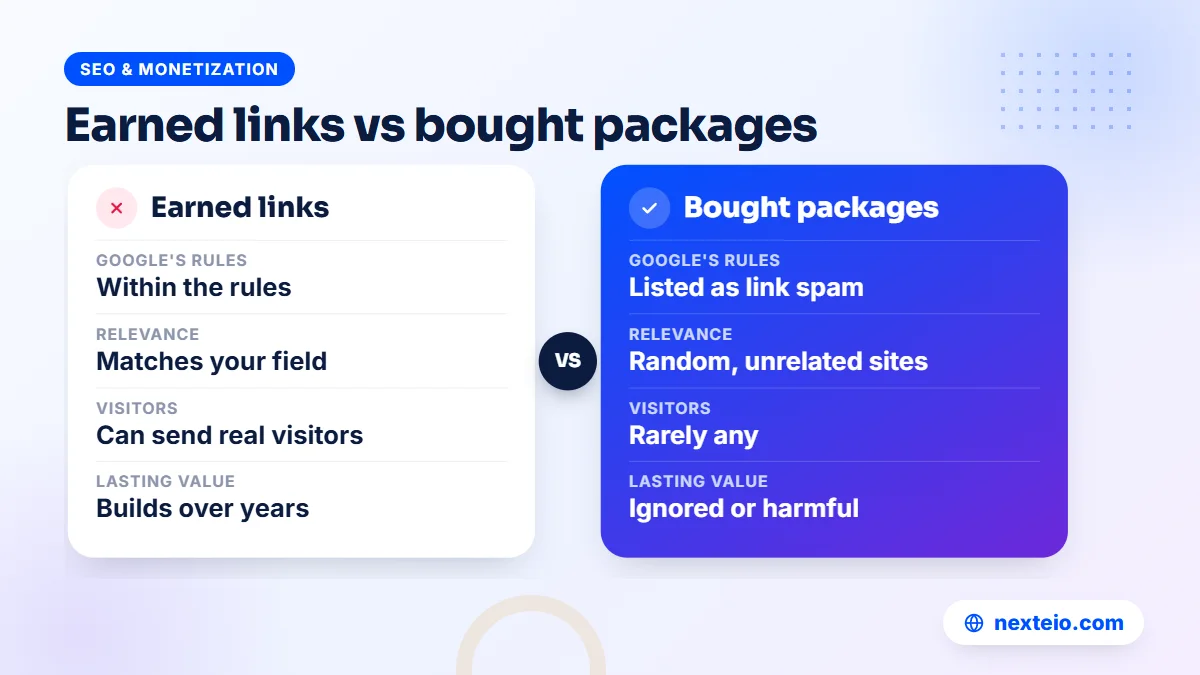
Google's spam policies describe link spam as creating links mainly to manipulate rankings. The examples are worth knowing, because many cheap SEO packages are built from them:
- Buying or selling links that pass ranking credit, including paying with goods or services.
- Excessive link exchanges, or partner pages that exist only for cross-linking.
- Using automated programs or services to create links.
- Low-quality directory or bookmark site links.
- Keyword-rich or hidden links in widgets, footers and templates spread across many sites.
- Forum comments and signatures stuffed with optimized links.
Google can ignore such links or take manual action against a site.
The usual outcome is that the links simply do nothing. You pay, a report arrives with a long list of URLs, and rankings do not move. In worse cases, a manual action appears in Search Console and the site loses visibility until the problem is cleaned up.
Private blog networks (PBNs) deserve a special warning. These are groups of sites, often built on expired domains, that exist only to link to clients. They can look convincing in a report, but they break the rules and can disappear overnight. Our list of common SEO mistakes covers more traps that hurt business websites.
Start With a Site That Deserves Links
No outreach email can make people link to a weak page. Before you ask anyone for a link, make sure the page you want them to link to is worth it. That means content that answers a real question better than the alternatives, loads quickly on a phone and looks trustworthy.
Check these basics first:
- Clear service, product or department pages, each focused on one topic.
- An about page with real names, address, registration details and photos.
- At least a few genuinely useful guides, notices or resources.
- Fast loading and no broken pages, which our guide to technical SEO basics explains.
- Pages written for people, using the approach in our article on SEO-friendly website content.
If the site itself is outdated, slow or hard to use on mobile, fixing it may give a better return than any link building campaign. A rebuild through a custom website design project or a well-built WordPress website gives your future links a page that turns visitors into inquiries.
Link Building Tactics for Beginners: Start With People You Know
The easiest links to earn come from organizations that already know you. These are relationships you have built offline, and many of them have websites that could mention you but do not yet. Make a list and work through it:
- Suppliers and partners: many list their clients, dealers or stockists. Ask to be included with a link.
- Clients and buyers: a B2B customer may have a supplier or partner page.
- Associations and chambers: trade bodies often keep member directories. Check your listing has your website address.
- Alumni and staff: former students or employees who write online may mention you.
- Event organizers: if you speak at or take part in an event, the event page can link to you.
- Software and service providers: some feature client case studies with a link.
These links are relevant by nature, which is exactly what makes them valuable.
The approach is simple. Send a short, polite message to the person you already deal with, mention the specific page where your listing could appear, and give them the exact URL and the name you want shown. Most people say yes when it costs them two minutes.
Local and industry directories can help too, but only the ones people genuinely use. A listing on a well-known industry directory or your trade association's site is fine. Paying to appear on fifty unknown directories is the low-quality pattern Google warns about.
Related guides for getting the foundations right:
- On-page SEO for beginners, step by step
- What SEO means for a business and how it brings customers
- Simple SEO tips for small business websites
Each one covers work that makes your pages easier to rank once links start arriving.
Create Content Other Sites Want to Link To
Writers, teachers, journalists and bloggers link to pages that help their own readers. If your site has something they cannot easily find elsewhere, links arrive with less effort. These are often called linkable assets. Here are types that work for organizations in Bangladesh:
- Practical guides: a clear explanation of a process you know well, such as export documentation steps or how to prepare for an admission test.
- Checklists and templates: a printable checklist or a sample form that saves people time.
- Your own data: honest figures from your own work, explained carefully, such as what customers ask most.
- Original photos and diagrams: real images of your factory, campus or products that others can credit.
- Bangla resources: good Bangla content on specialist topics is still scarce, which makes it linkable.
- Free tools: a simple calculator, such as a fabric weight converter or a fee estimator.
Create fewer, better assets rather than many thin ones.
A video can be a linkable asset too. A clear factory tour or a short explainer gets embedded and shared, and the page that hosts it earns the links. Our video editing service can turn raw footage into that kind of resource.
Promotion matters as much as creation. A great guide that nobody sees earns nothing. Share it with the people and sites who would find it useful, which is where outreach comes in.
Outreach That Gets Replies
Outreach means contacting site owners or writers and showing them something useful. It works when it feels personal and relevant, and fails when it looks like mass email. Follow these steps:
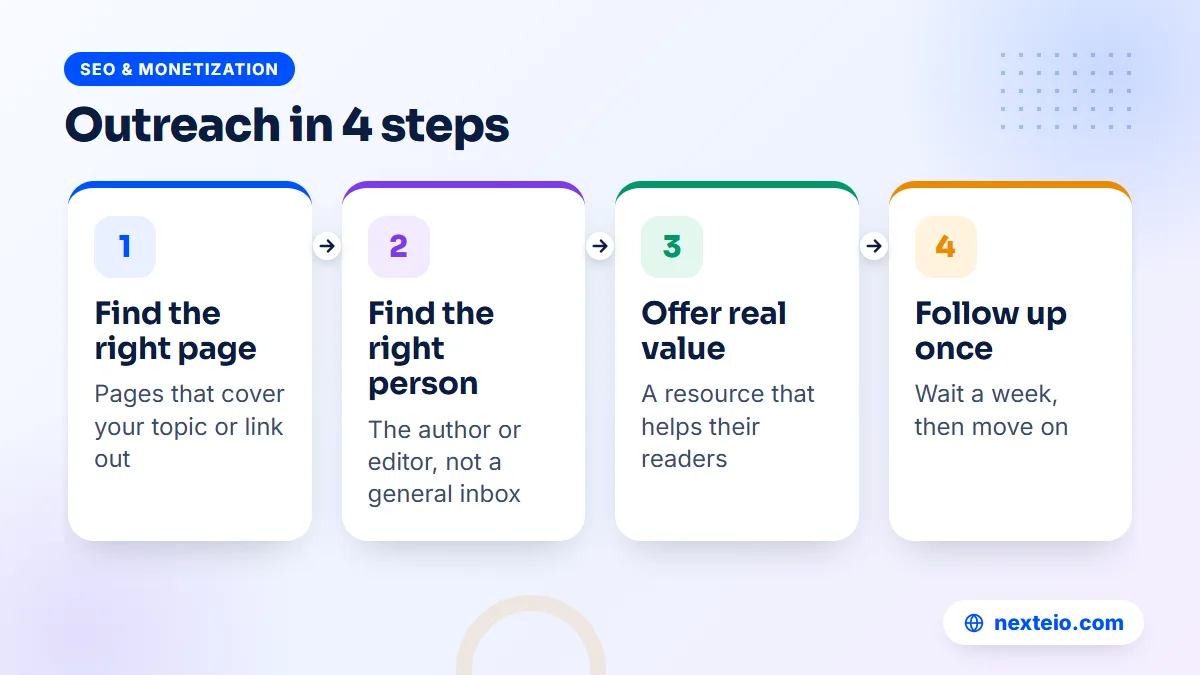
- Find pages that already link to similar resources, or that cover your topic but miss something you provide.
- Find the right person, usually the author or the site's editor, rather than a general inbox.
- Read their page, so your message shows you know what they wrote.
- Write a short message: who you are, what you noticed, and why your resource helps their readers.
- Include the exact URL and a one-line description they can use.
- Follow up once after a week if there is no reply, then move on.
Keep each message under 120 words. Nobody wants to read a long pitch from a stranger.
Never offer money, gifts or a link swap in exchange for a followed link, since that crosses into the link schemes Google prohibits. Track every contact in a simple spreadsheet so you never email the same person twice by mistake.
Expect a low reply rate. That is normal, even for good outreach. The aim is a few links from strong, relevant sites, not a long list from weak ones.
Broken Links, Unlinked Mentions and Other Quick Wins
Unlinked mentions
Search for your organization's name in Google, in both English and Bangla. You may find news stories, event pages or blog posts that mention you without a link. A short, friendly message asking the writer to add a link to your site is one of the easiest requests in link building, because they already chose to talk about you.
Broken link replacement
Resource pages often link to sites that have since closed. If you find a broken link on a relevant page and you have a page covering the same topic, tell the owner about the broken link and suggest yours as a replacement. You are helping them fix their page, which makes a yes more likely.
Reclaiming your own lost links
If your site was redesigned and old URLs were removed without redirects, any links to those URLs now land on error pages. Find those old addresses in Search Console and redirect each one to the closest current page. This recovers link value you already earned.
Local news and community stories
Newspapers and online portals in Bangladesh cover school results, factory milestones, health camps, charity drives and new openings. If your organization does something newsworthy, send a short press note with photos and a contact person to the relevant reporter. Online versions of these stories often link to the organization's website, and even when they do not, the mention is worth asking about later.
Keep it genuine. A free health camp, a scholarship for local students or a new export certification is news. A discount offer is an ad, and editors treat it that way.
Guest articles, carefully
Writing a genuinely useful article for a respected site in your field can bring visitors and credibility. Do it for the audience, not just the link, and avoid sites that publish anything for a fee. Large-scale guest posting with keyword-rich links is listed by Google as a link scheme.
Link Building Ideas by Type of Organization
The best opportunities depend on who you are. These are starting points we often suggest:
| Organization | Natural link sources |
|---|---|
| School, college or madrasa | Alumni associations, education portals, event and competition pages, local news |
| Garment or textile factory | Buyer supplier lists, trade associations, certification bodies, trade fair pages |
| Hospital or clinic | Health awareness campaigns, partner labs, insurance and corporate health partner lists |
| Online shop | Brand stockist pages, product reviews with sponsored links, gift guides |
| NGO | Donor and partner pages, project reports, research citations |
| Software or service company | Client case studies, technology partner directories, conference pages |
Start with the first two sources in your row; they are usually the quickest wins.
Two short examples
Take a private school that has just rebuilt its website. Its first link building list might include the alumni association's page, the sports federation that lists its inter-school tournament results, a local news story about its science fair, and the websites of partner coaching programs. None of these needs a payment, and every one is relevant to parents searching for schools.
Now take a knitwear factory that exports to Europe. Its natural sources are the certification bodies that publish lists of certified factories, the trade fair where it exhibited, its trade association's member directory and a buyer's supplier sustainability page. A few links like these tell Google, and visiting buyers, that the factory is real and established.
In both cases the work is mostly asking politely and keeping details up to date. The effort is small, but someone has to own it.
Online shops face extra competition because many sellers chase the same product searches. Product reviews by bloggers or creators are fine as long as gifted or paid reviews use sponsored or nofollow links. For stores that want search traffic beyond ads, our e-commerce SEO service combines category page work with links that fit the rules.
How to Track Your Backlinks
You do not need paid tools to start. Google Search Console has a free Links report that shows your top linking sites, your most linked pages and the most common link text. It is the closest view you have of what Google itself sees.
Keep a simple spreadsheet for your google link building work with these columns:
- Target site and page
- Contact person and date contacted
- Status: no reply, declined, agreed or published
- URL of the page with your link, and its anchor text
- Link type: normal, nofollow or sponsored
- Date last checked
Check live links every few months, because pages get redesigned and links disappear.
Judge results by outcomes, not link counts. Over a few months, watch whether the pages that earned links climb for their target searches, whether referral visits arrive from linking sites, and whether inquiries grow. Third-party scores such as "domain authority" are estimates made by tool companies, not numbers Google uses.
Website back links from real, relevant sites also bring visitors directly. If a supplier's partner page sends you two serious buyer inquiries a month, that link has paid for itself regardless of rankings.
Anchor Text: What the Link Says Matters
Anchor text is the clickable wording of a link. It tells readers and Google what to expect on the other side. In natural link building, most anchors are your organization's name, your web address, or plain phrases such as "this guide" or "their admission page".
Problems start when too many links use the exact keyword you want to rank for. If fifty sites all link to a clinic with the words "best diagnostic center in Bangladesh", that pattern does not happen naturally. Google's spam policies mention keyword-rich anchor text in large-scale guest posting and in widgets for this reason.
A healthy mix usually looks like this:
- Brand anchors: your organization's name, usually the most common type.
- URL anchors: the bare web address, common in directories and lists.
- Descriptive anchors: a natural phrase about the page, such as "their guide to export documents".
- Generic anchors: "here", "website" or "read more".
You rarely control the anchor text on links you earn, and that is fine.
When someone asks how to link to you, suggest your organization's name or a short description of the page rather than a keyword phrase. Google's link best practices recommend anchor text that is descriptive and reasonably concise, which is good advice for both sides of a link.
Bad Links, Negative SEO and the Disavow Tool
Every site collects some junk links over time from scraper sites and spam directories. Google says it generally ignores these, and most site owners never need to act on them.
The disavow tool in Search Console lets you ask Google to ignore specific links or domains. Google advises using it only if you have a large number of spammy, artificial or low-quality links pointing to your site and they have caused, or are likely to cause, a manual action. Used carelessly, it can remove credit from good links too.
The common case in Bangladesh is a site that bought a cheap backlink package years ago. If Search Console shows a manual action for unnatural links, document the paid links, try to get them removed, disavow what you cannot remove, and then file a reconsideration request. If there is no manual action, focus on earning good links rather than chasing old ones.
How Long Link Building Takes and What It Really Costs
Link building is slow by nature. Relationship links may take a few weeks. Content-led links can take months, because a resource needs time to be found, shared and cited. After links go live, Google needs time to crawl them and reflect them in rankings. Our guide on how long SEO takes sets realistic expectations for the whole process.
The main cost is time: writing good content, researching sites, sending messages and following up. When you hire help, you are mostly paying for that time and the skill behind it. That is why link building usually sits inside a broader SEO service plan rather than being sold as a separate package of links. A fair proposal explains which methods will be used, which sites are targeted and how links will be reported.
Watch for these warning signs in any link building offer:
- A guaranteed number of links per month at a fixed low price.
- Promises of "high DA dofollow" links without naming real sites.
- A sample report full of directories, bookmark sites and foreign blogs unrelated to your field.
- Guaranteed first-page rankings within weeks.
Any one of these is a reason to ask hard questions before you pay.
Links also work best alongside other channels. While your search visibility grows, Google Ads can bring inquiries for your most important services, and our article on choosing an SEO service in Bangladesh explains what a balanced plan should include.
How Nexteio Can Help With Link Building
Link building works best as part of complete SEO, so we handle it inside our SEO service. We start by finding the technical, content and structure problems that stop Google from showing your pages, and fix them in order of impact. That way, the pages you want links for are worth linking to before any outreach begins.
From there, we look for link opportunities that fit your organization: partners, associations, mentions you already have, resources worth creating and sites your audience actually reads. Links we help earn are the kind you would want even if search engines did not exist.
If your site needs work first, we can help with that too, from a new build to on-page fixes. You can see examples of our work in our portfolio, read more about Nexteio, or share your website and goals through our project form. For a quick question, reach us through the contact page. Our search engine optimization service page explains how a project runs, and the project form is the quickest way to start.
Keep reading: how to choose an SEO expert in Bangladesh, what e-commerce SEO includes, or browse all our SEO and monetization guides.
Frequently asked questions
Is link building still important for SEO?
Yes, but it is not the first job on most small sites. Google still uses links to discover pages and as one signal of trust, so good links often decide which of several useful pages ranks higher. Fix content and technical problems first, then earn links to the pages that matter most.
How many backlinks does a new website need?
There is no fixed number. A local business in a quiet market may rank well with a few relevant links, while a competitive online store needs many more. Focus on quality and relevance rather than a target count, and compare yourself with the sites that already rank for your main searches.
Is it safe to buy backlinks?
Buying links that pass ranking credit breaks Google's spam policies. At best, Google ignores them and your money is wasted. At worst, your site receives a manual action and loses visibility. Paid placements are fine only when they are marked with rel="sponsored" or rel="nofollow", and then you are buying exposure, not rankings.
What is a dofollow link?
A dofollow link is simply a normal link with no nofollow, sponsored or ugc value in its rel attribute. There is no actual dofollow attribute in HTML. Editorial links that a site owner chooses to give are normally of this kind, and they are the ones that can pass ranking signals.
Are nofollow links useless?
No. Google treats nofollow as a hint, and nofollow links from busy, relevant sites can still bring visitors, inquiries and brand awareness. A natural backlink profile contains a mix of followed and nofollow links, so there is no need to reject a useful mention because of its rel value.
Do social media links count as backlinks?
Links in social media posts are usually nofollow and do not pass much ranking value directly. They still help people discover your content, and content that spreads on social media is more likely to be noticed by writers and site owners who may link to it from their own pages.
Can I do link building myself without an agency?
Yes. Most beginner link building is relationship work: asking partners, suppliers, associations and event organizers to list you, and creating a few useful resources worth sharing. It takes steady time rather than special tools. Hiring help makes sense when you lack the hours, or when a competitive market needs content and outreach at a larger scale.
How long does it take for backlinks to affect rankings?
Google first has to crawl the linking page, which can take days to weeks, and the effect on rankings usually builds over months. Links rarely cause an instant jump. Keep earning links steadily and judge results over three to six months rather than week by week.