Keyword Research How To: A Simple 7-Step Method for SEO
In this article 17 sections
- 1.What Keyword Research Is and Why It Comes First
- 2.The Keyword Research How To in Seven Steps
- 3.Step 1: Start With Your Customers, Not a Tool
- 4.Step 2: Expand the List With Free Sources
- 5.Step 3: Work Out the Search Intent
- 6.Step 4: Judge Volume and Competition Honestly
- 7.Step 5: Group Keywords That Share One Intent
- 8.Step 6: Map Each Group to One Page
- 9.Step 7: Use the Keywords Naturally and Track Results
- 10.Keyword Research How To for Different Types of Organization
- 11.A Worked Example: Keyword Research for a School Website
- 12.Bangla, English and Banglish Keywords
- 13.Common Keyword Research Mistakes
- 14.How to Tell Whether Your Keyword Plan Is Working
- 15.Free Tools or Paid Tools
- 16.How Nexteio Can Help With Keyword Research
- 17.Frequently asked questions
This keyword research how to guide gives you a simple, repeatable method for choosing the searches your website should target. Keyword research means finding the words real people type into Google when they need what you offer, then deciding which of those searches each page should answer. Done well, it tells you what to write, what to call your pages and which pages to build next.
Most websites in Bangladesh skip this step. A company writes its service pages in the language of its brochure, a school names its pages after internal office terms, and an online shop copies product titles from the supplier. Then everyone wonders why Google sends so few visitors.
The problem is rarely the quality of the business. It is a mismatch between the words on the site and the words customers search. A garment buyer searches "knitwear manufacturer Bangladesh", not "our esteemed production facility". A parent searches "class 6 admission", not "academic intake procedure".
Unlike many keyword research how to articles written for large English-speaking markets, the method below needs no paid tools. It works for a company site, an institution, a clinic or an online store, and it fits into a few focused afternoons.
What Keyword Research Is and Why It Comes First
A keyword is simply a search query: the words someone types or speaks into a search engine. Some are short and broad, such as "web design". Others are longer and more specific, such as "school website design price in Bangladesh". Your SEO keywords are the queries you decide your pages should rank for.
Keyword research comes before writing because it changes what you write. If you learn that people search "ERP software for garment factory" far more than "enterprise resource planning", the page title, headings and examples all change. If you learn that parents search for admission circulars every November, the school's notice page needs to be ready in October, not after the rush.
It also prevents wasted work. Many business blogs publish dozens of posts that nobody searches for, while the questions customers actually ask stay unanswered. Good search keyword research starts with your customers, uses free data from Google, and ends with a plan that links each keyword group to one page.
Keyword research is one part of SEO, not all of it. Technical health, page quality and links matter too. A full SEO service covers those parts alongside the keyword plan.
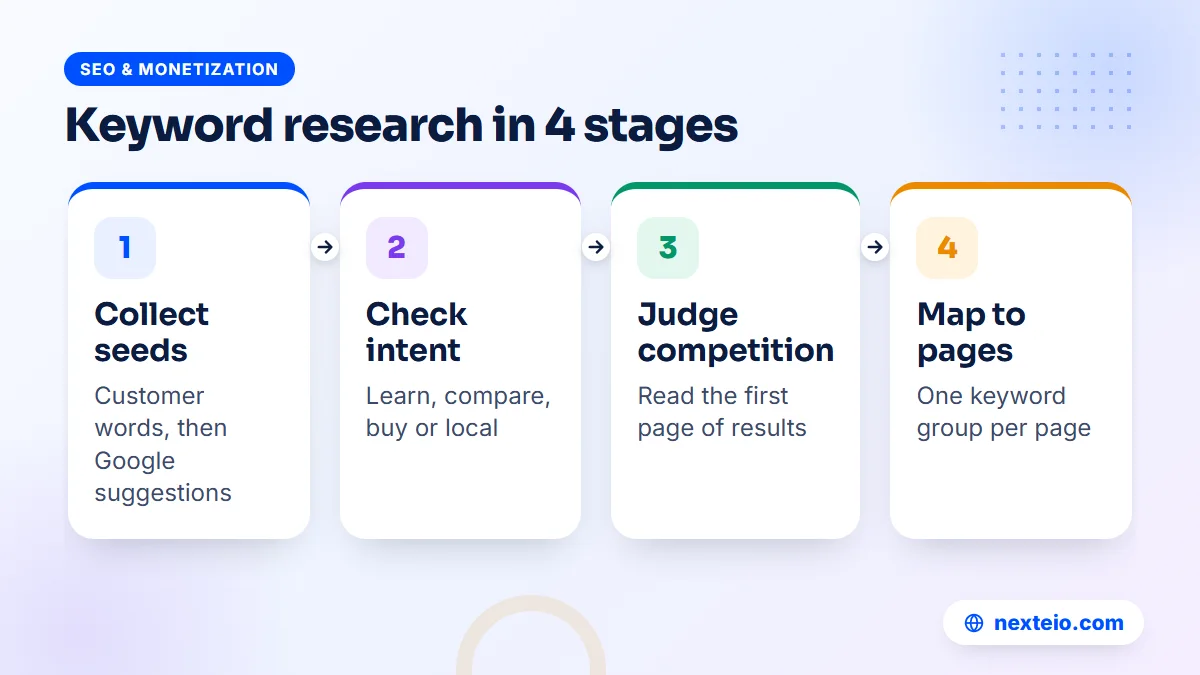
The Keyword Research How To in Seven Steps
Here is the full method at a glance. Each step gets its own section below, with examples you can copy.
- List seed topics from what you sell and what customers ask.
- Expand the list with free sources such as Google suggestions and Search Console.
- Work out the intent behind each search.
- Judge volume and competition honestly for your site's strength.
- Group keywords that share the same intent.
- Map each group to one page, existing or new.
- Use the keywords naturally on the page and track the results.
Plan on one afternoon for steps 1 to 3 and another for steps 4 to 6. Step 7 is ongoing.
Step 1: Start With Your Customers, Not a Tool
Every keyword research how to rests on one rule: tools only expand ideas you feed them. The best seed ideas come from people who talk to your customers every day: the sales team, the front desk, the admission office, the person who answers the Facebook page and WhatsApp messages.
Ask them three questions and write down the exact words customers use:
- What do people ask about most before they buy, enrol or book?
- What words do they use for our products or services, including slang and Banglish?
- What problem were they trying to solve when they found us?
Write the answers as they were spoken, not in polished office language.
Then add your own list: every product, service, location you serve and customer type. A clinic might write "dental clinic", "root canal", "teeth whitening", "child dentist" and "dental checkup cost". A factory might write "knit garments", "private label T-shirts", "BSCI certified factory" and "minimum order quantity".
Aim for 20 to 40 seed terms. Do not judge them yet. At this stage, a phrase that sounds too obvious is often the one customers search most.
Step 2: Expand the List With Free Sources
Now turn each seed into a longer list of real searches. Free sources from Google itself are enough for most business sites:
- Google autocomplete: type a seed into Google and note the suggestions. Add a letter after it ("dental clinic a", "dental clinic b") to see more.
- People also ask: the question boxes in the results show what searchers want to know next.
- Related searches: the list at the bottom of the results page gives variations and neighbouring topics.
- Search Console: if your site is live, the queries report shows searches that already bring impressions.
- Keyword Planner: Google's planner inside Google Ads suggests related keywords with rough monthly search ranges.
- Google Trends: shows whether interest in a topic is rising, falling or seasonal.
Use a private browser window so your own history does not shape the suggestions.
Your own site data is often the richest source. Google Search Console lists the exact queries where your pages already appear, including ones you never targeted on purpose. A page sitting at position 15 for a useful query is an opportunity hiding in plain sight.
The Google Keyword Planner needs a Google Ads account, but you do not have to run ads to use it. Accounts with little or no spend see search volumes as broad ranges rather than exact figures, which is still enough to compare options. Google Trends is useful for seasonal businesses: set the region to Bangladesh and you can see when interest in "school admission" or "Eid collection" starts to climb.
Paste everything into one spreadsheet. A list of 100 to 300 raw keywords is normal for a small business site at this stage.
Step 3: Work Out the Search Intent
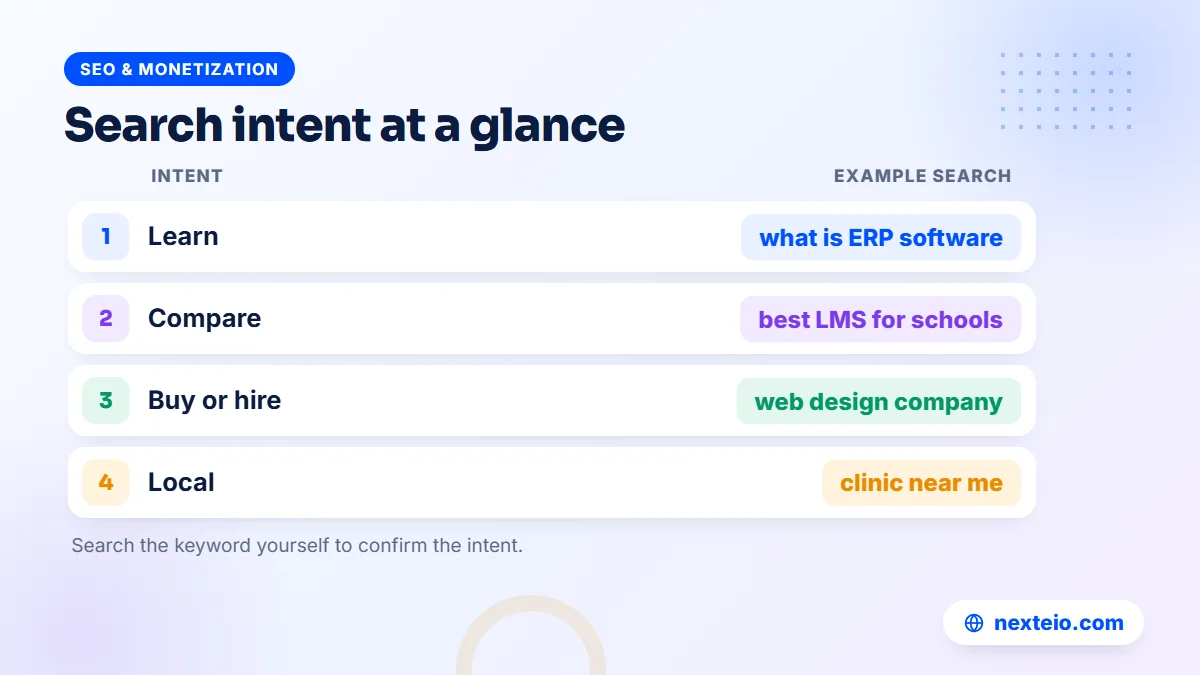
Search intent is the reason behind a search. Two queries can share most of their words and still want completely different pages. "Web design" might come from a student who wants to learn it or a company that wants to hire someone. The intent decides what kind of page can rank.
| Intent | What the searcher wants | Example search | Page that fits |
|---|---|---|---|
| Learn | Information or an answer | how to choose school management software | Guide or blog post |
| Compare | Options before deciding | best LMS for schools | Comparison or buyer's guide |
| Buy or hire | A product or provider now | web design company in Bangladesh | Service or product page |
| Local | A place nearby | dental clinic near me | Location page and Business Profile |
| Brand | A specific company | your company name | Homepage or contact page |
Mark each keyword in your sheet with one of these intents.
The quickest way to check intent is to search the keyword yourself and look at the first page of results. If the top results are all blog guides, Google has decided people want to learn, and a sales page will struggle there. If the results are service pages and directories, a long blog post will struggle instead. Match what already ranks, then do it better.
Step 4: Judge Volume and Competition Honestly
This is the step most keyword research how to guides rush. Volume is how many people search a term. Competition is how hard it is to reach the first page. A good target has enough searches to matter and competition your site can realistically beat.
Keep volume in perspective. Search volumes in Bangladesh are often smaller than in large English-speaking markets, and very specific business terms may show "0-10" in Keyword Planner. That does not make them useless. A search like "corrugated carton manufacturer Bangladesh" might come from only a handful of buyers a month, but each one could be worth a large order.
For competition, the first results page tells you more than any score from a paid tool. Look for these signs:
- Hard: the top results are large marketplaces, national newspapers, government portals or international brands with thousands of pages.
- Possible: a mix of small business sites, thin directory listings and old forum posts.
- Easier: results that do not really answer the query, are years out of date or are not from Bangladesh at all.
A new or small site should start with the possible and easier groups.
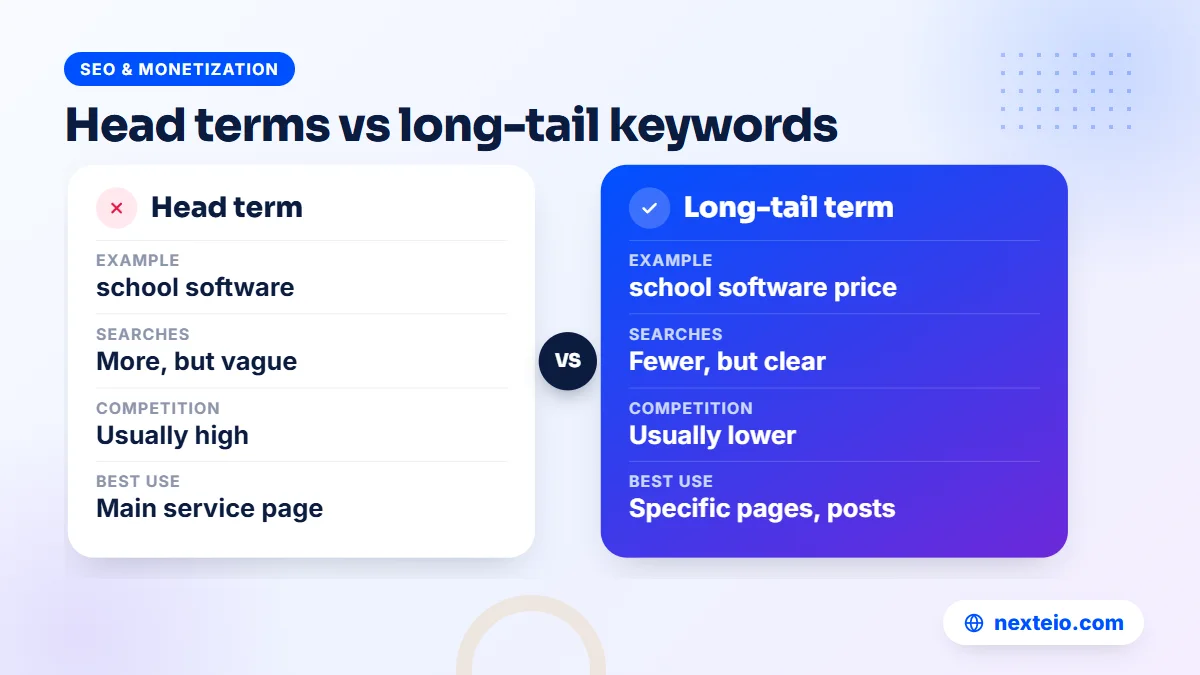
Broad terms like "web design" or "school software" are worth targeting with your main service pages over time, but they rarely bring early results. Longer, more specific searches usually convert better and rank sooner. Our article on how long SEO takes explains why patience matters here.
Step 5: Group Keywords That Share One Intent
Your spreadsheet now holds many keywords that are really the same search said in different ways. "Website design price", "web design cost Bangladesh" and "how much does a website cost" all want the same answer. One strong page can rank for all of them.
Group keywords when the same page would satisfy every search in the group. A quick test: search two keywords and compare the top results. If several of the same pages rank for both, Google treats them as one topic, and they belong in one group.
Keep groups apart when the intent differs, even if the words are close:
- "school management software" (buy) and "what is school management software" (learn) need different pages.
- "dental clinic near me" (local) and "dental implant cost" (compare) need different pages.
- "WordPress developer" (hire) and "WordPress tutorial" (learn) need different pages.
Name each group after its strongest keyword, which becomes the group's main target.
Grouping protects you from a common problem called keyword cannibalization, where two of your own pages target the same search and pull each other down. It happens often on business blogs that publish a new post on the same topic every few months instead of improving the first one.
Step 6: Map Each Group to One Page
A keyword map is the plan that comes out of the research. It is a simple sheet with one row per keyword group and these columns:
- Main keyword and supporting keywords.
- Search intent.
- Rough volume range and competition notes.
- The page that will target the group, with its URL.
- Status: existing page to improve, or new page to create.
- Priority, based on business value and how quickly it could rank.
Start by matching groups to pages you already have.
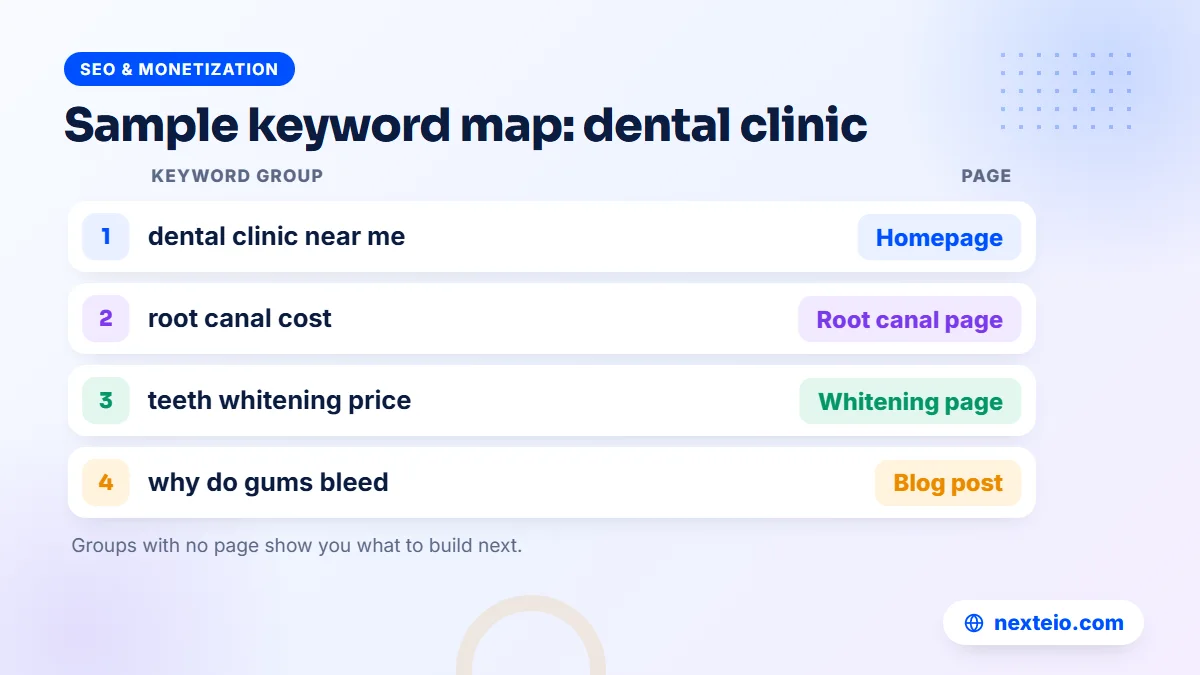
Here is a small example for a dental clinic:
| Keyword group | Intent | Page | Status |
|---|---|---|---|
| dental clinic near me, dentist in your area | Local | Homepage and Business Profile | Improve |
| root canal cost, root canal treatment price | Compare | Root canal service page | Improve |
| teeth whitening price, whitening at a clinic | Compare | Teeth whitening page | Create |
| why do gums bleed, gum bleeding treatment | Learn | Blog post linking to the gum care page | Create |
The map turns research into a work plan. If you want a second opinion on yours, share it with us through the project form.
Groups with no matching page show you exactly which pages to build next. Groups that match two pages show where to merge content or change one page's focus. On an online shop, the same exercise maps groups to category and product pages, which is where our e-commerce SEO service spends much of its effort. On a service business site, it usually shows that the core service pages need more depth before any blog post will help.
Related guides that build on a keyword map:
- Content strategy for every stage of the customer journey
- Simple SEO tips for small business websites
- Internal linking to connect your pages
Each one shows how to turn mapped keywords into pages that rank and convert.
Step 7: Use the Keywords Naturally and Track Results
Once a page has its keyword group, place the main keyword where it carries the most weight, in a way that still reads naturally:
- The page title tag, ideally near the start.
- The main heading (H1) and one or two subheadings.
- The first paragraph.
- The URL, kept short.
- Image alt text where it honestly describes the image.
Use the supporting keywords in headings, examples and FAQ answers where they fit.
Never force a keyword into every sentence. Pages written for a phrase count read badly, and Google's SEO starter guide is clear that you should write for people first. A page that fully answers the search, with clear headings and real detail, will naturally include the words and their variations. Our on-page SEO guide for beginners covers the rest of the page-level work, and our guide to SEO-friendly website content shows how to keep it readable.
Then track. After a page is published or updated, watch its queries in Search Console for the following weeks. You will often find it ranks for searches you never listed, which feed straight back into your next round of research. Repeat the full keyword research how to every six to twelve months, because searches, products and competitors change.
Keyword Research How To for Different Types of Organization
The same method gives very different results depending on who searches for you. A few examples show how the keyword list changes with the buyer.
Garment and manufacturing exporters. Buyers search in English, often from abroad, with product, material and certification words: "organic cotton T-shirt manufacturer", "denim factory Bangladesh", "WRAP certified garment factory". Volumes are low and buyer value is high, so each product category deserves its own detailed page.
Schools, colleges and madrasas. Parents search in Bangla and English around fixed seasons: admission dates, results, fees and routines. Intent is mostly informational and local, so the keyword plan is really a calendar of notices and pages that must be ready before each season.
Clinics and hospitals. Patients search by treatment, by doctor name and by location, often with "near me" or "cost". Local intent dominates, so the website and the Google Business Profile have to agree on names, addresses and phone numbers.
Online shops. Shoppers search product names, brands, sizes and prices, often with words like "price in BD" or "online". Category pages carry the broad terms and product pages carry the specific ones.
Service companies and agencies. Buyers search "service + Bangladesh" and comparison terms like "best" or "cost". These pages need clear pricing context and proof of work, which is where most of the conversion happens. Choosing keywords for website pages in this group means thinking about the decision-maker who will approve the purchase, not only the person searching.
A Worked Example: Keyword Research for a School Website
Here is how the seven steps play out for a private school that wants more admission enquiries through its website. The details will differ for your school, but the pattern holds.
Seeds. The admission office says parents ask about class 1 admission, admission test dates, monthly fees, transport, the English version curriculum and results. Those become the first seed terms, written the way parents say them.
Expansion. Google suggestions add variations such as admission circulars by year, admission test questions and fee lists. Search Console shows the school already gets impressions for its own name with words like "result" and "admission".
Intent and competition. General searches for admission circulars are dominated by national education portals and newspapers, and a single school will struggle there. Searches that combine the school's name, its area or its school type with "admission" or "fees" are realistic targets, and they come from parents who are already interested.
Groups and map. The keyword map ends up with five main pages:
- An admission page for class-wise dates, eligibility and the process.
- A fees page with a clear table and payment options such as bKash or bank deposit.
- A notice and results page that is updated through the year.
- A campus and facilities page covering transport, labs and safety.
- A few guide posts for parents, such as how to prepare a child for an admission test.
One rule makes the biggest difference here.
Keep the admission page at the same address every year and update its content, rather than creating a new page each session. The page then builds up history and links over the years instead of starting from zero every November.
Bangla, English and Banglish Keywords
Bangladeshi searchers mix languages more than most. The same need can appear in English ("laptop price"), in Bangla script, and in Bangla written with English letters. Spelling also varies: someone may type "keywords for search engine optimisation" with British spelling or "optimization" with American, and Google usually treats such variants as the same search.
A few practical rules help:
- Check what language the top results use for each important query. That shows what Google thinks searchers want.
- If many valuable searches are in Bangla script, create real Bangla pages rather than adding a few Bangla words to an English page.
- Banglish queries usually return results in either language. You rarely need separate pages for them.
- Keep each page in one main language so its title, headings and content agree.
Language choices also depend on your buyers. An exporter's site can stay in English, while a school or local clinic often needs both languages.
For organizations that need both, a website built with proper language versions makes this much easier to manage. Our custom website design work plans Bangla and English pages from the start, and our WordPress websites can do the same with a multilingual setup.
Common Keyword Research Mistakes
Most failed keyword plans share the same few errors. Watch for these:
- Chasing volume only: a huge broad term that brings visitors who never buy is worth less than a small, specific one that brings enquiries.
- Ignoring intent: trying to rank a sales page for a "how to" search, or a blog post for a "hire" search.
- One page per keyword variation: separate pages for "web design price" and "website design cost" compete with each other.
- Copying competitors blindly: their keyword list fits their business, not necessarily yours.
- Never revisiting the list: searches change with seasons, new products and new competitors.
- Keyword stuffing: repeating a phrase until the page reads like a robot wrote it.
Each of these is easy to avoid once you know to look for it.
One more mistake is common in organizations: the keyword plan lives in one person's head or laptop. Keep the keyword map in a shared sheet that the marketing team, the web developer and whoever writes content can all see. When a new page is proposed, check the map first.
How to Tell Whether Your Keyword Plan Is Working
Research only pays off if you check the results against the map. Give each improved or new page a few weeks to be crawled, then watch these signals in Search Console and your analytics:
- Impressions for the mapped keywords: the first sign that Google connects the page with the right searches.
- Average position for the main keyword: expect it to move in steps over months, not days.
- Clicks and CTR: if impressions rise but clicks do not, rewrite the title and description.
- Enquiries, calls and orders: the measure that matters most, tracked through form submissions or call records.
Note the date of each change so you can link results to the work that caused them.
If a page gains impressions for searches you did not plan, look at them closely. Sometimes they reveal a better main keyword than the one you chose. If a page gets no impressions at all after two or three months, check that it is indexed, that the intent matches what ranks, and that other pages on your site link to it.
Free Tools or Paid Tools
For a small or medium business site, the free sources in step 2 are enough to build a solid first keyword map. Paid tools add estimated volumes for many countries, competitor keyword lists, difficulty scores and rank tracking. They save time for agencies and large sites, but their numbers are estimates, and their Bangladesh data is often thin.
A sensible approach is to start free. Build the map, publish or improve the main pages and watch Search Console for three to six months. If you then need deeper competitor research or many more keywords, a paid tool, or an SEO specialist who already pays for one, becomes worth it.
If you also run Google Ads, the search terms report in your ad account is another free source. It shows the exact searches that triggered your ads and which ones led to enquiries. Our guide to keyword research for Google Ads covers that side, and our Google Ads management team uses the same data to decide which searches are worth paying for and which to win through SEO.
How Nexteio Can Help With Keyword Research
If you would rather not follow this keyword research how to alone, keyword research is also the first stage of our SEO service. We start with your business: what you sell, who decides to buy, and what your sales or admission team hears every day. Then we collect searches from Google's own sources and your Search Console data, check the intent and competition behind each one, and group them into a clear keyword map.
You get a plan you can read and use: which existing pages to improve, which new pages to create, the main and supporting keywords for each page, and the order to do them in. We can write and optimize the pages ourselves, or hand the map to your team with notes on how to use it. Because we also build websites, we can fix structure problems, such as missing service pages or confusing URLs, as part of the same search optimization work.
To learn more about how we work, read about Nexteio or see our portfolio. When you are ready, send us your website and goals through the project form, or use the contact page for a quick question.
Keep reading: how to choose an SEO expert in Bangladesh, what SEO does for a business, or browse all our SEO and monetization guides.
Frequently asked questions
How long does it take for new keywords to start bringing visitors?
A new or updated page usually starts showing impressions within a few weeks once Google crawls it. Moving into the top results for a competitive search often takes several months and depends on the strength of your site and the competition. Specific, low-competition searches tend to move first.
Is this keyword research how to suitable for a brand-new website?
Yes. A new site has no Search Console data yet, so lean more on customer questions, Google suggestions and Keyword Planner ranges. Focus on specific, lower-competition searches first, since broad terms are hard for a new domain to win in the early months.
How many keywords should one page target?
One main keyword group per page, which can include several close variations and supporting phrases. If two keywords need different pages to answer them well, they belong to different groups. A page that tries to rank for unrelated searches usually ranks well for none of them.
What if Keyword Planner shows zero searches for a keyword?
Low or zero estimates are common for specific business terms in Bangladesh, and the tool's ranges are rough. If customers really use the phrase and it fits a page you need anyway, it can still be worth targeting. Check Search Console after publishing to see the real impressions.
Should I target Bangla or English keywords?
Target the language your buyers search in, which you can check by looking at the language of the top results for your main queries. Exporters and B2B firms usually need English, while schools, clinics and local shops often need both. Keep each page in one main language rather than mixing them.
How often should keyword research be repeated?
Review your keyword map every six to twelve months, and sooner if you launch new products or services. Seasonal businesses such as schools and retailers should also check before each busy season. Search Console data from the months in between makes each review faster.
Are SEO keywords and Google Ads keywords the same?
They often overlap, but they are chosen differently. For ads, you pay per click, so you favour searches with clear buying intent and exclude wasteful ones. For SEO, you also target learning and comparison searches that build trust over time, because clicks from organic results have no per-click cost.
Can I do keyword research without any paid tool?
Yes. Google autocomplete, People also ask, related searches, Search Console, Google Trends and Keyword Planner together cover what most small and medium business sites need. Paid tools mainly add competitor data and save time on large sites.