Digital Marketing for Healthcare: A Guide for Hospitals and Clinics
In this article 17 sections
- 1.What Digital Marketing for Healthcare Means in Practice
- 2.How Patients in Bangladesh Choose a Doctor or Hospital
- 3.Start With Google Business Profile and Maps
- 4.A Website Patients Can Actually Use
- 5.Search Ads for Services Patients Look For
- 6.Facebook and Instagram: Page, Content and Ads
- 7.Video: Doctors Explaining, Not Selling
- 8.Health Content That Earns Trust
- 9.Digital Marketing for Healthcare: Rules and Ethics to Follow
- 10.The Call Desk Is Part of Your Marketing
- 11.Measuring Results Without Touching Patient Data
- 12.Channel Priorities by Type of Facility
- 13.Campaign Ideas That Suit Hospitals and Clinics
- 14.A 90-Day Starting Plan for a Clinic or Hospital
- 15.Choosing a Healthcare Digital Marketing Agency
- 16.How Nexteio Can Help
- 17.Frequently asked questions
Digital marketing for healthcare is the work of helping patients find, trust and contact a hospital, clinic or diagnostic center online, while following the stricter rules that apply to medical services. In Bangladesh, that usually means a correct Google Maps listing, a website with doctor schedules, a well-run Facebook page, carefully written ads and a phone desk that answers. Done well, it fills appointment slots with the right patients. Done carelessly, it damages trust that took years to build.
Healthcare is not like selling clothes or electronics. A patient searching at night for a child specialist is worried, not browsing. A family comparing hospitals for a surgery is weighing safety and cost, not a discount. The marketing that works here is calm, accurate and useful, and it never promises outcomes.
This guide is for owners, administrators and marketing staff at private hospitals, clinics, diagnostic centers and specialist practices. It covers how patients choose a provider, which channels matter most, what advertising rules apply, how to measure results without touching patient data, and how to choose outside help.
The advice applies to a single-doctor chamber as much as to a multi-specialty hospital. Only the scale changes.
What Digital Marketing for Healthcare Means in Practice
For a hospital or clinic, digital marketing is less about clever campaigns and more about being present, correct and reachable at the moment a patient needs you. It has five working parts, and each one supports the others.
- Being found: your Google Business Profile, Maps listing and search visibility for the services you offer.
- Being trusted: a clear website, doctor profiles, real photos, honest reviews and accurate health information.
- Being chosen: paid ads on Google, Facebook and YouTube for specific services, such as health check packages or a new department.
- Being reachable: phone lines, WhatsApp and Messenger that someone actually answers, with clear appointment steps.
- Being measured: knowing which channel brought each call or booking, so money goes where it works.
Most facilities are strong in one or two of these and weak in the rest.
A common pattern is a hospital that spends heavily on Facebook boosts while its Google Maps listing shows an old phone number. Another is a clinic with a beautiful website and nobody answering the phone after 8 pm. Digital marketing for healthcare works when all five parts are in order, roughly in the sequence above. Paid ads should come after the basics, not instead of them.
How Patients in Bangladesh Choose a Doctor or Hospital
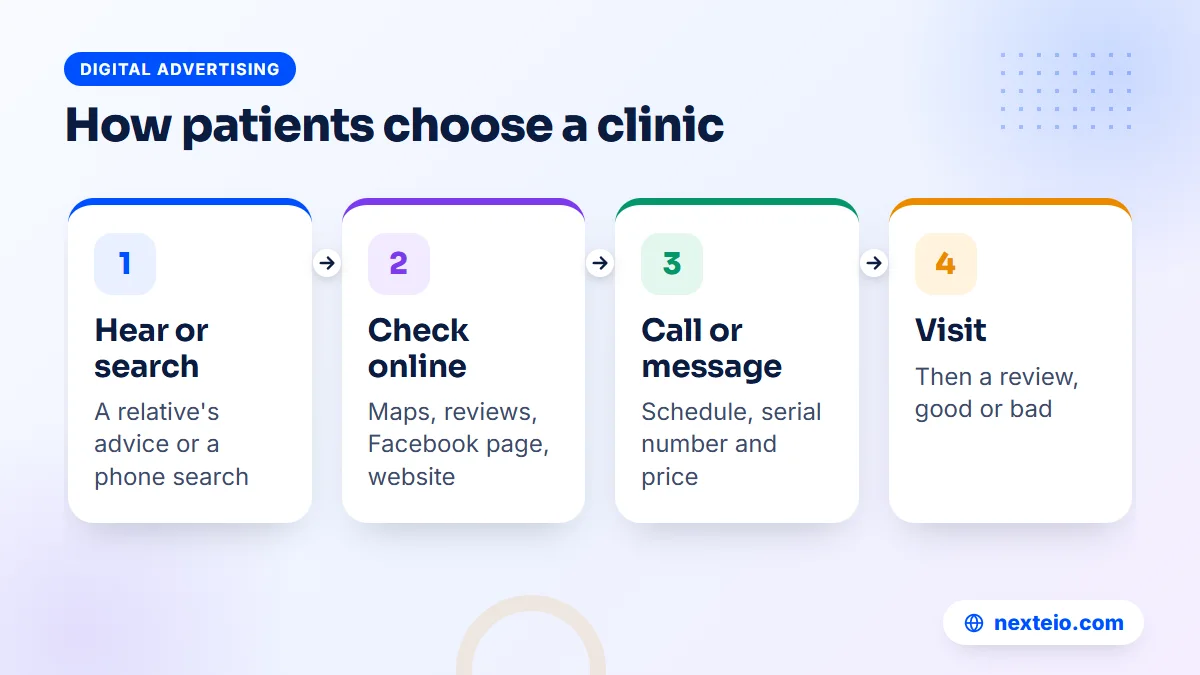
Patients rarely follow a straight line. A typical journey starts with a recommendation from a relative or a colleague: "go to this doctor at that hospital". The next step is almost always a phone search. They look up the doctor's name or the hospital, check the Facebook page, look at Google reviews and photos, and search for the chamber schedule and serial number.
Others start with a problem rather than a name. They search for "gynecologist near me", "MRI cost" or "dialysis center" in English, Bangla or a mix of both. Here the facility that shows up clearly on Maps, with good reviews and a working phone number, has a strong advantage over a better-known hospital with a messy listing.
Several things are typical of Bangladesh and shape what works:
- Most searches happen on phones, often on mobile data.
- Many patients want to call or message, not fill in a form.
- Doctor schedules and serial booking matter as much as the hospital's name.
- Families often decide together, and one person may search on behalf of a parent.
- Prices for tests and packages are a common question, and clear answers build trust.
Plan every channel around these habits.
The practical lesson is that every channel leads back to a phone call or a message. Your marketing should make that next step obvious, whether the patient arrives from an ad, a review or a search result.
Start With Google Business Profile and Maps
For most clinics and hospitals, the Google Business Profile is the most valuable free marketing asset they have. It controls what appears on Google Maps and in the panel beside search results: your name, address, phone, hours, photos and reviews. Many patients make their decision from this panel alone, without ever opening your website.
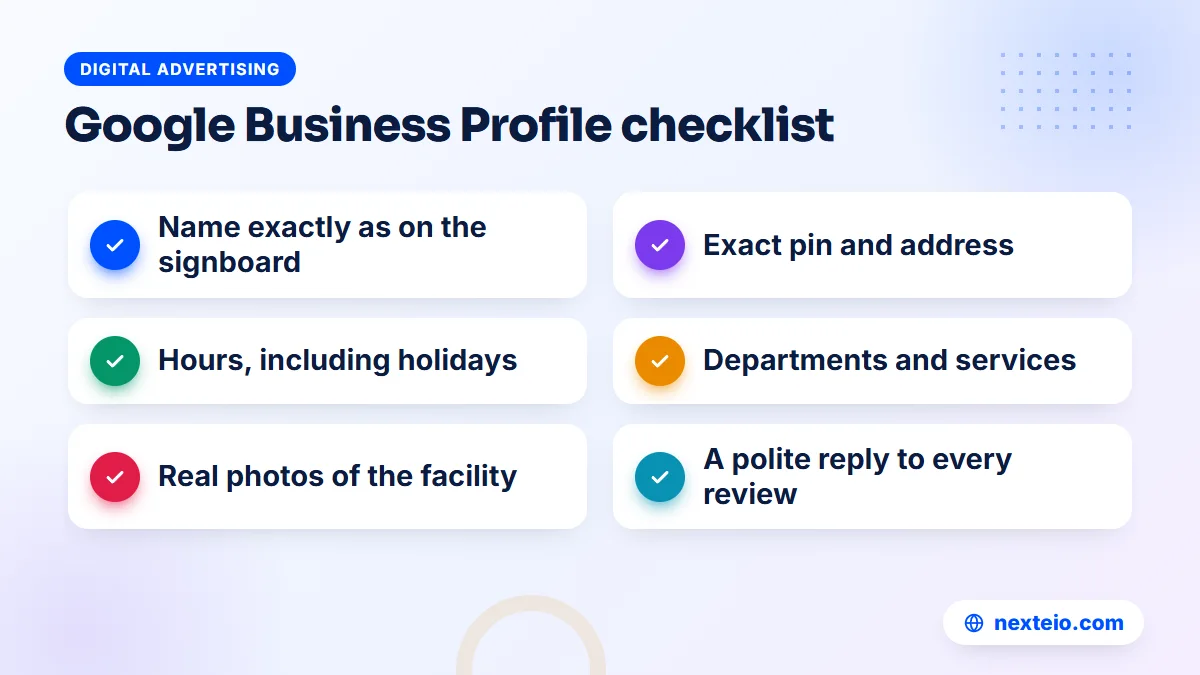
Start by claiming and verifying the profile, then fix the basics. The name should match your real signboard, without extra keywords added. The address and pin location should be exact, because patients use Maps to get there. Hours should include special hours for Eid and other holidays. Google's guidelines for representing your business explain what is allowed, including how individual doctors can be listed.
Then build it out. Add the departments and main services, upload real photos of the reception, wards, equipment and entrance, and post updates about new doctors, health camps or changed schedules. A diagnostic center with several branches needs a separate, verified profile for each location.
Reviews deserve daily attention. Reply to every review politely, including negative ones, and never discuss a patient's medical details in a public reply. Ask satisfied patients for reviews in a simple way, such as a small card at the discharge desk, but never offer discounts or gifts in exchange, which Google's policies do not allow.
A Website Patients Can Actually Use
Social pages come and go, but your website is the one place you fully control. For a healthcare provider, it needs to answer practical questions quickly, on a phone, in the language the patient prefers.
The pages patients look for most are simple: a list of doctors with their specialty, qualifications and chamber days; department pages that explain what each one treats; a test and package price list where you can share it; directions; and a contact page with tappable phone numbers. A hospital should also show emergency contact details on every page.
Doctor schedule pages are often the most visited part of a hospital site and the most often out of date. Assign one person to update them whenever a schedule changes. An old schedule sends a patient on a wasted trip and loses their trust for good.
Technical details matter more than design flourishes. Pages should load quickly on mobile data, text should be readable without zooming, and Bangla should display correctly. Structured data from schema.org's MedicalClinic type can help search engines understand that the site belongs to a clinic, its address and its opening hours.
If your site cannot be updated easily or does not work well on phones, a rebuild through our custom website design service may be the right first step before spending on ads. Our guide to building a high-converting landing page also applies to service pages for health packages.
Search Ads for Services Patients Look For
Google Ads puts your facility at the top of search results when someone looks for a specific service. For healthcare, this works best for services people actively search for and compare: diagnostic tests, health check packages, specific surgeries, dental treatment, physiotherapy, fertility services or a new specialist clinic.
Good healthcare search campaigns are narrow. Instead of one broad campaign for "hospital", build separate campaigns or ad groups for each service, each pointing to its own page with prices, doctors and the booking number. Our guide to Google Ads keyword research explains how to find the searches that show real intent.
Use call ads and call assets. Many patients want to talk before they book, and a tappable number in the ad removes a step. Restrict the location to the area your patients realistically travel from, and schedule ads for the hours when your phone desk is staffed.
Healthcare also has its own advertising rules on Google. The healthcare and medicines policy restricts ads for prescription medicines, online pharmacies and certain treatments, and the details vary by country. Google also limits personalized advertising based on health conditions, so remarketing to people based on the condition they read about is generally not allowed. Read the policy before planning a campaign, not after an ad is disapproved.
Our Google Ads service handles this setup, and our article on Google Ads conversion tracking shows how to count calls and form requests properly.
Facebook and Instagram: Page, Content and Ads
In Bangladesh, a hospital's Facebook page is often checked before its website. Patients look for recent posts, doctor announcements, replies to comments and how the page handles complaints. An inactive page with unanswered messages sends a worse signal than having no page at all.
Keep the page useful. Post doctor joining announcements, schedule changes, health camp dates, simple health awareness posts reviewed by a doctor, and clear package information. Use real photos of your facility and staff. Avoid stock images of smiling models in white coats, which patients recognize immediately.
Facebook and Instagram ads can reach people in your area by location, age and general interests. They work well for awareness of a new service, health check packages, vaccination drives and events. They need care, though. Meta's advertising standards do not allow ads that assert or imply a person's medical condition, so "Suffering from diabetes?" is not acceptable ad copy, while "Diabetes care clinic, Saturday to Thursday" is fine. Meta has also removed many detailed targeting options linked to health topics.
Messages from ads must be answered fast. Many patients reply to an ad on Messenger and expect a response within minutes. Our guide to Meta ads targeting in Bangladesh covers audience setup, and our Facebook ads service handles campaigns, tracking and creative work.
Related guides for healthcare advertisers:
- Google Ads vs Meta Ads: which is more profitable
- Meta ads conversion tracking with Pixel and CAPI
- How an ads campaign service works for small businesses
Video: Doctors Explaining, Not Selling
Short video is one of the most useful formats in digital marketing for healthcare, because it lets patients see and hear a doctor before they meet them. A two-minute video of a cardiologist explaining when chest pain needs urgent attention builds more trust than any banner ad. So does a calm walkthrough of the new dialysis unit or a nurse explaining how to prepare for a test.
Good healthcare video follows a few simple rules:
- One topic per video, explained in plain language.
- Bangla subtitles or captions, since many people watch with the sound off.
- A real doctor or staff member, with their name and specialty on screen.
- No promises of cure and no patient faces without written consent.
- A clear next step at the end: the department phone number or booking page.
Short clips can be posted as Facebook reels and YouTube Shorts.
Longer explainers suit YouTube, where they can be found by search for months. A small YouTube campaign can then show your best videos to people in your area. Our video ads editing service turns raw phone or camera footage into ready-to-post clips, and our YouTube ads service handles the campaign side.
Health Content That Earns Trust
Articles and posts about health topics can bring steady search traffic, but they carry more responsibility than most content. Wrong advice about medicine dosage, symptoms or treatment can harm someone. Search engines also hold health content to a higher standard, and Google's guidance on creating helpful, reliable content stresses clear authorship and expertise.
A safe content process for a hospital or clinic looks like this:
- Pick topics from real patient questions at the reception and in Messenger.
- Have a writer draft the article in plain language.
- Have a qualified doctor review and correct it.
- Show the reviewing doctor's name and the date of review on the page.
- Recheck articles at least once a year and update anything that has changed.
Never skip the doctor review step.
Write for the patient, not for other doctors. "When should a fever in a child worry you?" is a better article than a technical summary of fever types. Link each article to the relevant department and doctor, so a reader who needs help knows exactly who to call. Our guide to writing SEO-friendly website content covers the writing side, and our SEO service can plan topics and fix technical issues.
Digital Marketing for Healthcare: Rules and Ethics to Follow
Medical marketing carries legal, professional and ethical limits that ordinary businesses do not face. Doctors in Bangladesh follow professional conduct rules set by the Bangladesh Medical and Dental Council, and private hospitals and clinics are licensed through the Directorate General of Health Services. Check current requirements with these bodies and your own legal adviser before any major campaign.
Beyond formal rules, a few principles keep digital marketing for healthcare honest:
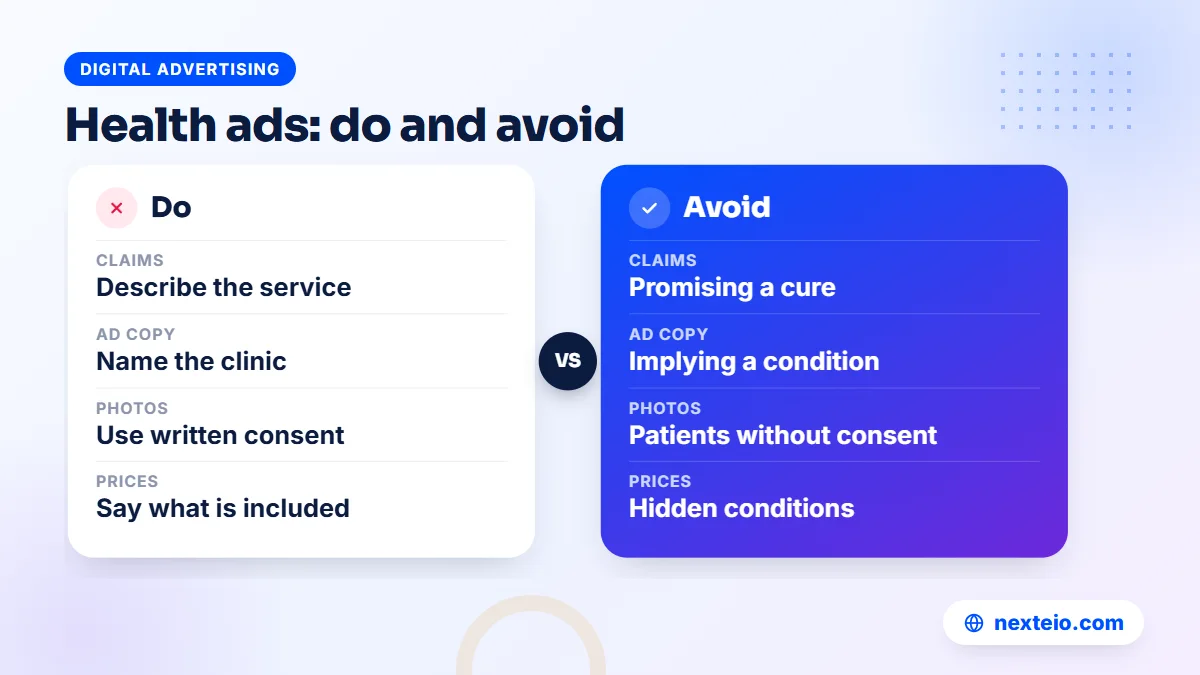
- No guarantees. Never promise a cure, a success rate or a result. Describe the service, the doctors and the equipment instead.
- No fear tactics. Scaring people into booking a test is unethical and often against platform rules.
- Consent first. Get written consent before using any patient's photo, video or story, and let them withdraw it.
- Patient privacy. Never upload patient names, phone numbers or medical details to an ad platform or a public post.
- Clear prices. If you advertise a package price, say what it includes and any conditions.
- Accurate credentials. List qualifications exactly as they are, without inflating titles.
These principles protect patients and your reputation.
One mistake can undo years of goodwill. A misleading ad or a leaked patient photo spreads quickly on social media, and the reputational damage far outweighs anything a campaign could bring in.
The Call Desk Is Part of Your Marketing
Many healthcare campaigns fail at the phone, not in the ad. The ad works, people call, and nobody picks up, or the person who answers cannot give the doctor's schedule or the test price. Every missed or badly handled call is money spent on ads that turned into nothing.
Treat the call desk as part of the campaign. Before any ad goes live, check that:
- Enough phone lines are staffed during the hours the ads run.
- Staff have an up-to-date sheet of doctor schedules, test prices and package details.
- Someone answers WhatsApp and Messenger within minutes during working hours.
- Missed calls are returned the same day.
- Staff ask "How did you hear about us?" and record the answer.
Run a test call before every new campaign.
A small investment here often does more than doubling the ad budget. A diagnostic center that answers within a few rings and gives a clear price will turn far more callers into visits than one with a larger campaign and a voicemail. If you are getting calls but few bookings, our guide to getting more leads from Google Ads covers the follow-up side.
Measuring Results Without Touching Patient Data
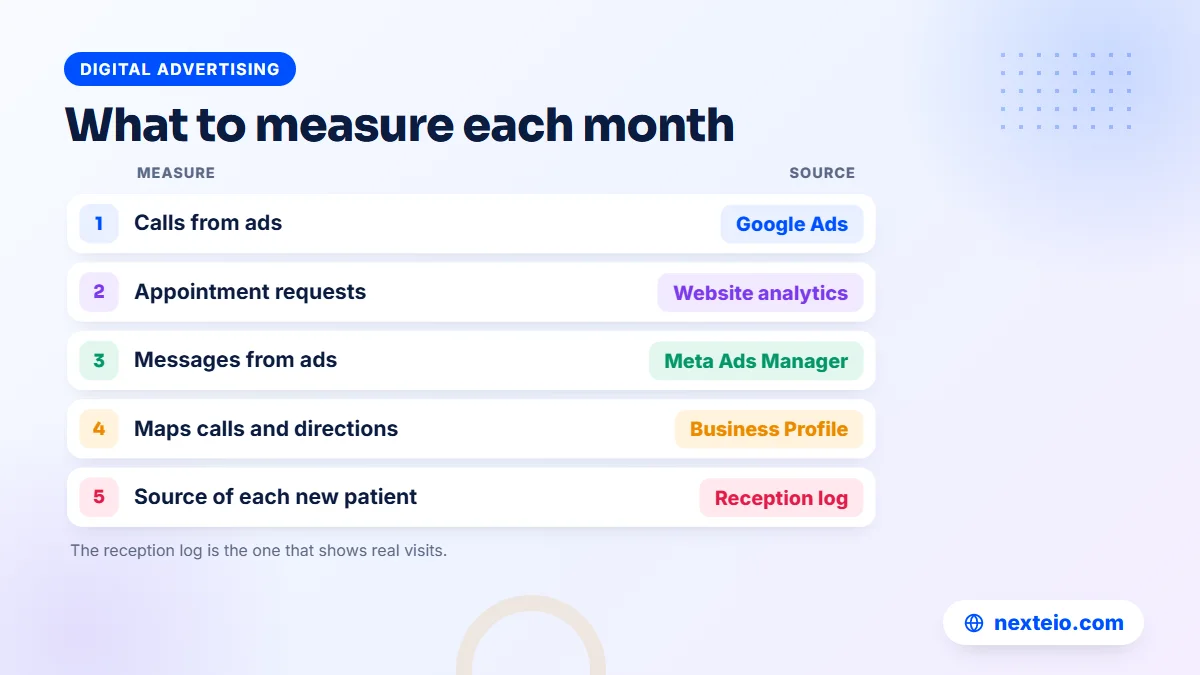
You can measure digital marketing for healthcare properly without ever sending patient information to an ad platform. The goal is to count actions, such as calls, messages and appointment requests, by channel, not to track individuals or their conditions.
| What to measure | Where it comes from | What it tells you |
|---|---|---|
| Calls from ads | Call tracking in Google Ads | Which campaigns make the phone ring |
| Website appointment requests | Form tracking in analytics | Which pages bring bookings |
| Messages from ads | Meta Ads Manager | Which posts start conversations |
| Maps calls and direction requests | Google Business Profile insights | How visible you are locally |
| Source of each new patient | Reception or call desk log | What actually brings visits |
Review these numbers every month.
The last row is the most important and the most often skipped. Ad platforms count clicks and calls, but only your reception knows who actually came in. A simple weekly sheet with the source of each new patient, kept without any medical details, turns guesses into decisions. Compare cost per call and cost per visit across channels, and move budget to what works.
Channel Priorities by Type of Facility
Not every facility needs every channel at the same strength. The right mix depends on what you offer, how far patients travel to reach you and how many people can handle enquiries. The table below shows common priorities. It is a starting point, not a fixed formula.
| Type of facility | Start with | Add next |
|---|---|---|
| Single doctor chamber | Google Business Profile, Facebook page | A simple website with schedule |
| Diagnostic center | Maps listings per branch, package prices | Google search ads for tests |
| Specialist clinic | Website with service pages, reviews | Search ads and doctor videos |
| Multi-specialty hospital | Website, Maps, active Facebook page | Campaigns per department, YouTube |
Budgets should follow the same order.
Spend on the basics first, because they cost little and support every paid channel. Then test paid campaigns one service at a time, starting with the services that have capacity and clear demand. There is no point advertising a department that already has a three-week waiting list. Our ads campaign service starts with exactly this kind of review before any budget is spent.
Campaign Ideas That Suit Hospitals and Clinics
Healthcare campaigns work best when they are tied to a real service, a real date or a real need, not a general message about being "the best hospital". Here are ideas that fit the rules and tend to interest patients:
- Health check packages: a clear list of tests, the price and who the package suits, such as adults over 40 or people with a family history of diabetes.
- New doctor or department: an announcement with the doctor's specialty, chamber days and how to book a serial.
- Health awareness days: free screening camps or advice sessions on dates such as World Diabetes Day or World Heart Day.
- Seasonal needs: dengue testing during the monsoon months, or vaccination drives for children.
- Women's health: antenatal care, maternity packages and female doctors' schedules, which many families search for specifically.
Each idea needs its own landing page.
A campaign for a maternity package should send people to a page about that package, not to the homepage. That page should show what is included, the doctors involved, the price or a price range where you can share it, and a large call button. Keep the ad and the page saying the same thing, so the patient never feels misled.
Plan the year in advance. A simple calendar of awareness days, seasonal health issues and your own events makes digital marketing for healthcare far easier to manage than deciding each campaign the week before.
A 90-Day Starting Plan for a Clinic or Hospital
If your online presence is patchy, trying to fix everything at once usually leads to nothing being finished. A three-month plan keeps the work in order and makes progress visible to management.
Month one: the basics. Claim and complete the Google Business Profile for every branch. Update the Facebook page, its contact details and its pinned post. Correct the doctor schedules on the website, and set up a simple log at reception to record how new patients heard about you.
Month two: content and tracking. Publish service pages for your two or three most important departments. Set up call and form tracking. Record two or three short doctor videos, and start replying to every review and message within the same day.
Month three: the first paid campaign. Choose one service with spare capacity and clear demand, and run a small, focused campaign on Google or Facebook. Compare its cost per call and cost per visit with your reception log at the end of the month, then decide whether to expand, adjust or stop.
This order matters because each step makes the next one work better. Ads sent to an outdated Maps listing or an unanswered phone waste money, however good the ad itself is.
Choosing a Healthcare Digital Marketing Agency
Many hospitals and clinics hire outside help because their own staff are busy with patients. A good healthcare digital marketing agency understands that medical marketing has different rules and a different tone. A bad one runs the same aggressive campaigns it uses for fashion brands, and the results show it.
Ask any agency these questions before you sign:
- Do you know the healthcare ad policies on Google and Meta, and how do you handle disapprovals?
- Who writes health-related content, and will a doctor from our side review it before it goes live?
- How will you track calls and appointment requests without handling patient data?
- Will the ad accounts, page access and tracking be set up in our name?
- What will you report each month, and in what format?
- How do you handle negative reviews and complaints online?
Listen for specific, practical answers.
Be wary of any agency that promises a fixed number of patients, guarantees first position on Google, or suggests buying fake reviews. These are signs of shortcuts that can get your accounts suspended. Make sure your hospital owns its ad accounts, Business Profile and page, with the agency added as a partner, so you keep everything if you change providers. Our page on campaign management across ad platforms explains how we plan and track campaigns, and you can read more about Nexteio.
How Nexteio Can Help
We help hospitals, clinics and diagnostic centers across Bangladesh put the pieces of digital marketing for healthcare in order. Through our ads campaign service, we decide which ad platforms suit your services, split the budget between them and track every campaign in one place, so you can see which departments and packages bring calls and bookings. On Google, that means keywords and ads for the specific services patients search for, with conversion tracking. On Facebook and Instagram, it means audiences, creatives and Pixel tracking set up within the health ad rules described above.
Where the basics are missing, we can also help with the pieces around the ads: a website that works on phones for your campaigns to point to, and short doctor videos and clips cut from your own footage, with captions, for Facebook and YouTube. Nobody can honestly promise a number of patients, and we do not. The aim is a clear plan, tracking you can read, and advertising that represents your facility accurately.
You can see examples of our work in our portfolio. To start, tell us about your facility through our project form, including your departments and the services you most want to grow, and we will suggest a starting plan for your healthcare ad campaigns. You can also reach us on our contact page.
Keep reading: what a good video ad edit includes, or browse all our digital advertising guides. When you are ready, share your project details and we will take it from there.
Frequently asked questions
Can hospitals and clinics in Bangladesh advertise on Facebook and Google?
Yes. Hospitals, clinics and diagnostic centers can run ads for their services on both platforms, but health ads face stricter rules. Prescription medicines, some treatments and copy that implies a person's medical condition are restricted. Read each platform's healthcare policy before you plan a campaign.
Which channel should a small clinic start with?
Start with a complete, verified Google Business Profile and an active Facebook page, because they cost nothing but time and many patients check them first. Make sure the phone is answered and doctor schedules are current. Paid ads make sense after those basics are working.
How should we respond to a negative review from a patient?
Reply politely and briefly, thank them for the feedback and invite them to contact a named person or the patient relations desk. Never discuss their diagnosis, treatment or any personal details in public, even if the review does. Then fix the problem they raised if it is real.
Can we use patient photos or testimonials in our marketing?
Only with the patient's clear written consent, given freely and without pressure, and with the right to withdraw it later. Avoid photos that reveal medical details, and never present one patient's result as typical. Many facilities choose to show staff, equipment and facilities instead.
How do we know whether our ads bring real patients?
Track calls, messages and appointment requests in each ad platform, then ask every new patient how they heard about you and record the answer at reception. Comparing the two each month shows which channels bring visits rather than just clicks. No medical details are needed for this.
Should doctors have their own social media pages?
Many patients search for a doctor by name, so a professional presence can help, as long as it follows the doctor's professional conduct rules and avoids promises about outcomes. The hospital should agree with its doctors how schedules and announcements are shared, so information stays consistent.
Is it better to hire an agency or manage marketing in-house?
An in-house person knows the doctors, schedules and patients, while an agency brings ad platform skills and experience with tracking. Many hospitals combine both: staff handle daily posts, messages and reviews, and an agency runs paid campaigns and reporting. Either way, the hospital should own every account.