Best Ecommerce Websites: Examples and Lessons for Your Own Store
In this article 15 sections
- 1.What Makes the Best Ecommerce Websites Work
- 2.Lessons From Well-Known Global Stores
- 3.Lessons From Online Stores in Bangladesh
- 4.Brand Stores: Story, Photography and Consistency
- 5.Product Photos and Descriptions: The Details Shoppers Judge
- 6.Checkout Patterns the Best Ecommerce Websites Share
- 7.After the Order: Delivery, Returns and Repeat Customers
- 8.Mobile and Speed: Where Great Ecommerce Websites Start
- 9.How the Best Ecommerce Websites Get Found on Google
- 10.Advertising That Matches the Store
- 11.What Not to Copy From Big Stores
- 12.How to Audit Your Store Against the Best Ecommerce Websites
- 13.What a Store With These Features Typically Costs
- 14.How Nexteio Can Help Build Your Store
- 15.Frequently asked questions
The best ecommerce websites are not always the prettiest ones. They are the stores where a shopper finds the right product quickly, trusts the price and the seller, and finishes the order without confusion. Look closely at any store you buy from again and again, and you will find the same habits behind it.
That matters for a business in Bangladesh planning its own online shop. You cannot copy Amazon's budget or Daraz's seller network, and you should not try. What you can copy is the thinking: how a product page answers questions, how a category page helps people choose, and how checkout fits the way your customers actually pay.
This guide looks at well-known stores, global and local, and pulls out one practical lesson from each. It then covers the checkout, mobile, search and trust patterns these stores share, what not to copy, how to audit your own store against them, and what building a store with these features typically costs.
Large stores test and change their pages often, so the features described here are the ones visible at the time of writing. Open each site yourself and look at what it does today.
What Makes the Best Ecommerce Websites Work
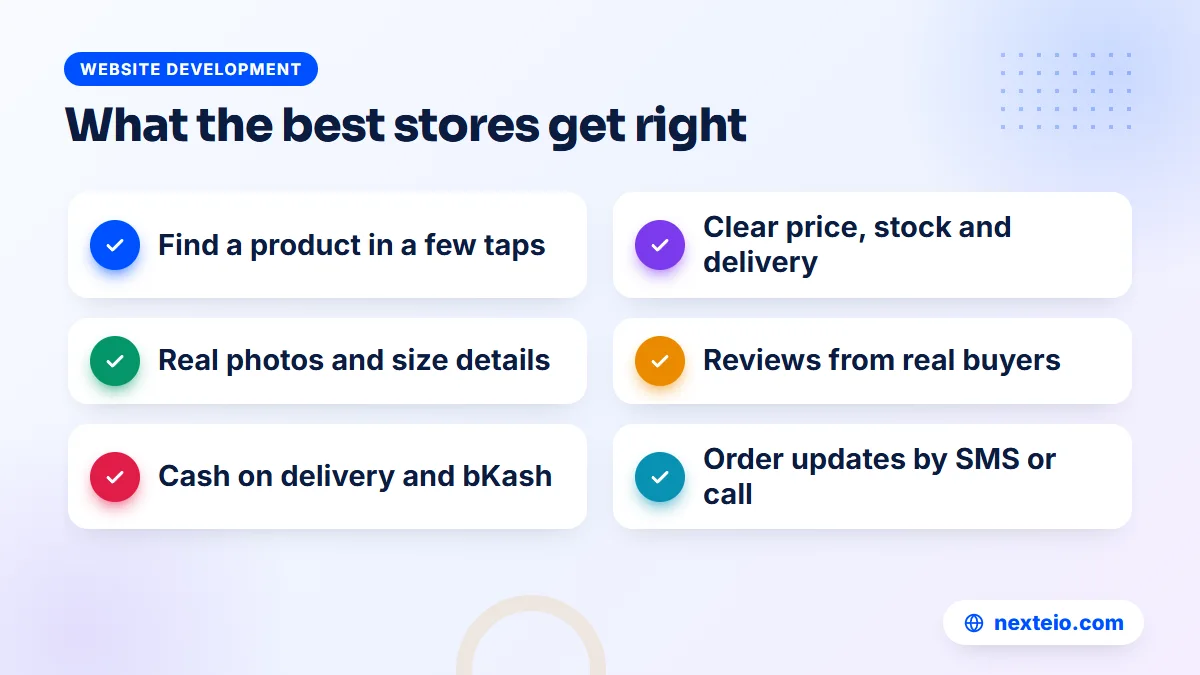
Before looking at examples, it helps to agree on what "best" means. A store can win design awards and still lose sales if people cannot find the size chart. For a store selling to customers in Bangladesh, a good ecommerce website does six jobs well:
- Finding: shoppers reach the right product in a few taps through clear categories, filters and search.
- Understanding: each product page explains the price, size, material, stock and delivery without a phone call.
- Trusting: real photos, reviews, a physical address and clear return terms make a stranger willing to order.
- Paying: checkout offers the methods people use, such as cash on delivery, bKash, Nagad and cards.
- Following up: the customer gets a confirmation and knows when the parcel will arrive.
- Loading fast: all of this works on a mid-range phone on mobile data.
Every example below is strong in at least one of these jobs. None of them is a template to copy whole.
Lessons From Well-Known Global Stores
Three global stores show how much a product page, a comparison and a few honest details can do. Each sells at a scale no local shop will match, but the habits behind them cost very little to borrow.
Amazon: product pages that answer questions before they are asked
Amazon's product pages are long, and that is deliberate. A typical page shows several photos, a list of key features, a detailed specification section, a delivery estimate before checkout, and customer ratings with a breakdown of how many people gave each star. Written reviews, often with buyers' own photos, sit further down the page.
The lesson for a smaller store is not to copy the layout. It is to collect every question your customers ask by phone, Messenger or WhatsApp, and answer them on the page. If people keep asking whether a kurti is cotton, whether a blender works on 220 volts or how long delivery takes outside your area, the product page is missing information.
Amazon also shows related products, such as items frequently bought together. A small store can do a simple version by hand: a phone cover next to a screen protector, or a school bag next to a water bottle. It raises the order value without feeling like a hard sell.
One habit worth borrowing directly is honest reviews. Showing only five-star reviews looks fake. A mix of ratings, with replies from the store to the critical ones, builds more trust than a wall of perfect scores.
IKEA: showing size, context and what happens after delivery
Furniture is hard to sell online because people worry about size and assembly. IKEA's product pages deal with both. They list measurements clearly, show the product in room settings as well as on a plain background, and offer assembly instructions and other documents for download.
This lesson travels well. A furniture shop in Bangladesh can show a sofa beside a standard door for scale, list dimensions in both inches and centimetres, and add a short video of the assembly. A clothing store can do the same with a size chart measured from real garments rather than a generic chart copied from elsewhere. An electronics shop can share a manual or a warranty card as a PDF.
The common idea is reducing worry about what happens after the order. Each worry you answer on the page is one less reason to abandon the cart, and one less return when the product arrives.
Apple: making comparison and choice easy
Apple's online store is a good example of guiding a choice. It offers a page to compare models side by side, and when you configure a product such as a laptop, the price updates as you change the options. The shopper always knows what they are choosing and what it costs.
Many stores in Bangladesh sell products with variants: phones with different storage, packages with different quantities, courses with different durations, or service plans at several levels. Too often the variants hide in a drop-down menu and the price only changes after a reload, or not at all.
The lesson is simple. If your customers often hesitate between two or three options, give them a small comparison table on the product or category page. Show the price for each variant clearly and keep the differences to the points that matter, such as capacity, warranty or delivery time. Our guide on building a high-converting landing page uses the same principle of reducing choice to what matters.
Lessons From Online Stores in Bangladesh
Local stores deal with the same conditions your store will: cash on delivery, mobile data, Bangla and English search, and customers who want to talk to someone before they pay. Three of them show different answers to those conditions.
Daraz: trust signals in a marketplace
Daraz, one of the best-known online marketplaces in Bangladesh, has a trust problem to solve that a single-brand store does not: thousands of sellers of very different quality. Its answer is a layer of signals. Seller ratings, product reviews, a separate DarazMall section for brand and official stores, and campaign events such as its 11.11 sale all help shoppers decide whom to buy from and when.
Your own store has an easier job, since there is only one seller. But the lesson still holds: shoppers look for proof that someone real stands behind the order. On a single-brand site, that proof is a physical address, a working phone number, a clear return policy, real photos rather than supplier images, and reviews from real customers.
Campaigns are the other lesson. Big sale events work because they are planned well ahead, with banners, landing pages and ads ready on time. A small store can plan its own calendar around Eid, Pohela Boishakh, winter and the start of the school year, rather than reacting a few days before.
Marketplaces also have limits for brands. The platform owns the customer relationship and charges a commission, and your products sit beside competitors. Many brands sell on a marketplace and run their own website at the same time, using the site to build repeat customers. If you are weighing that choice, our guide to ecommerce website development in Bangladesh explains what to plan and budget.
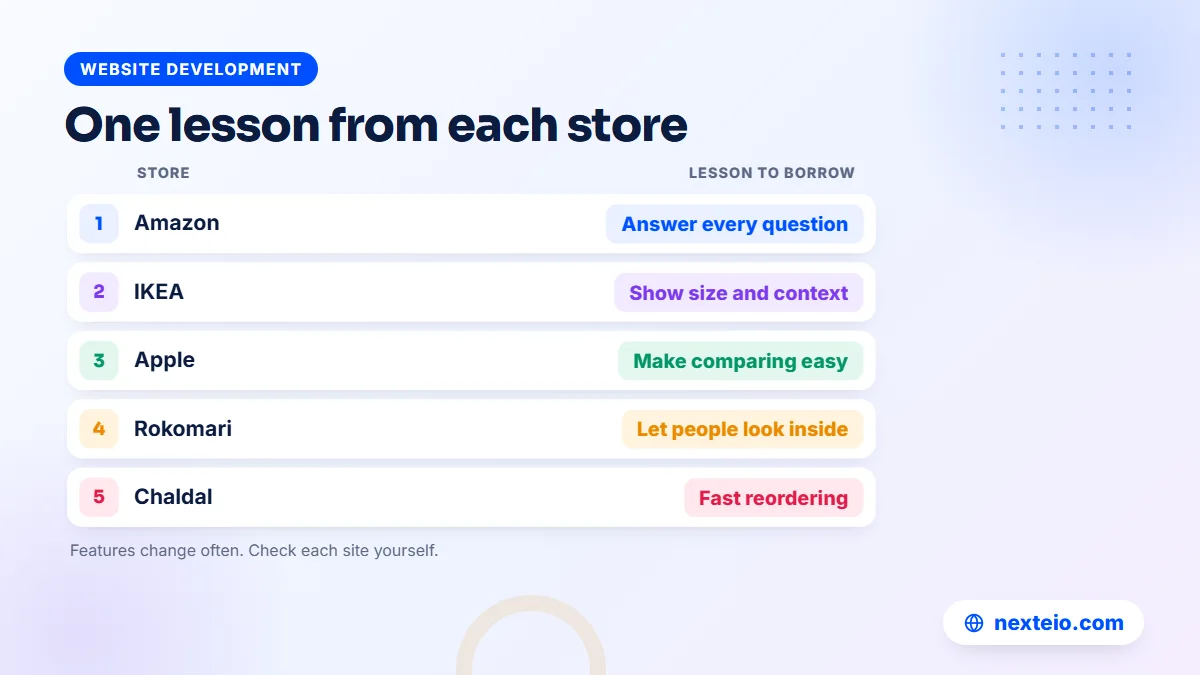
Rokomari: letting shoppers look inside
Rokomari began as an online bookstore and is widely known in Bangladesh for books. One helpful feature is that many books let shoppers read a few sample pages before ordering. For a buyer unsure whether a book suits them or their child, that preview answers the question a bookshop shelf would answer.
The broader lesson is to let people sample before they commit. Different products allow different kinds of sampling:
- A clothing brand can show close-up photos of the fabric and a short video of the garment being worn.
- A cosmetics store can show the color on different skin tones.
- An online course can offer a free first lesson.
- A food business can show the packaging, the weight and what the portion looks like on a plate.
Another lesson from book and grocery stores is search that understands both languages. Many shoppers type in English, some type in Bangla and some type Bangla words in English letters. If your products have Bangla names, test your search with all three and add the common spellings as keywords.
Chaldal: speed for everyday repeat shopping
Grocery is a different kind of shopping. People buy the same things again and again, and they want to finish fast. Chaldal, an online grocery store in Bangladesh, lets shoppers add items to the bag straight from the product grid, without opening every product page.
Stores that sell repeat items, such as groceries, baby products, health products, stationery or pet food, can learn from this. Useful features include quick-add buttons on category pages, a clear running total, a "buy again" list for returning customers and sensible default quantities.
The lesson is to match the store to the buying pattern. A fashion store needs rich product pages because each item is a considered choice. A grocery store needs speed because each item is not. Many shops sit between the two and need both: fast lists for common items and detail where the decision is harder.
Related guides for store owners: why a website gets traffic but no customers, what ecommerce SEO includes and costs and WordPress or a custom website for your store.
Brand Stores: Story, Photography and Consistency
Many of the cool ecommerce websites people share and talk about belong to fashion, lifestyle and craft brands rather than giant retailers. They sell fewer products, but each one is presented with care. What they share is consistency: the same style of photography across the catalog, product descriptions written in one voice, and a short story about who makes the products and how.
For a small brand in Bangladesh, this is the most realistic example to follow. You do not need a large catalog. You need a clear brand, honest photos taken in good light against a consistent background, and product descriptions that say more than the product name. A clothing brand can name the fabric, the fit and the care instructions. A handicraft seller can name the region and the technique.
Video helps here too. Short clips of a product being made, worn or used work on the product page, on Facebook and on TikTok. Our video ads editing service turns raw footage into short clips sized for each platform.
Product Photos and Descriptions: The Details Shoppers Judge
Across all of these examples, one thing stays the same: the product page carries the sale. Shoppers cannot touch the item, so photos and words have to do the work a shop assistant would do. This is where many small stores in Bangladesh fall furthest behind the best ecommerce websites, and also where they can catch up fastest.
Photos that answer questions
A good set of product photos usually includes the front, the back or side, a close-up of the material or detail, the product in use, and something that shows scale. Take them in daylight or under steady lighting, on a plain background, with the same setup for every product. Supplier photos with another brand's watermark, or images that look nothing like the parcel that arrives, cause returns and bad reviews.
Descriptions written for buyers
A product description should answer the questions people ask before buying. Useful details depend on the product, but a simple structure works for most stores:
- What it is and who it suits, in one or two plain sentences.
- Key specifications: size, material, weight, capacity or ingredients.
- What is in the box, and what is not.
- Care, usage or warranty information.
- Delivery time and return terms for this item.
Write in the language your customers search in. Many stores keep product names in English and add a short Bangla line for key details, which helps shoppers who are more comfortable reading Bangla.
Checkout Patterns the Best Ecommerce Websites Share
Checkout is where browsing turns into revenue, and where many stores lose orders. The best ecommerce websites keep it short and predictable. For stores selling in Bangladesh, a few patterns matter more than any design detail.
| Checkout pattern | Why it matters in Bangladesh |
|---|---|
| Cash on delivery clearly offered | Many first-time buyers will not prepay a store they do not know |
| bKash, Nagad and card options | Regular customers prefer to pay quickly and skip handling cash |
| Guest checkout | Forcing an account before the first order loses impatient buyers |
| Delivery charge shown early | A surprise charge at the last step is a common reason to leave |
| Short address form | Typing long addresses on a phone is slow and error-prone |
| Confirmation by SMS or call | Reduces fake orders and refused parcels for cash on delivery |
Few of these cost much to build. Most are decisions.
Form details matter as well. Correct field types bring up the number keypad for phone numbers, and the browser can fill in saved details when fields are labelled properly. MDN's reference on the autocomplete attribute lists the values a developer should use. On the store side, a clear order workflow keeps confirmations, packing and courier handover in step. WooCommerce's documentation on managing orders shows what a standard order status flow looks like.
Checkout and payment setup is the core of e-commerce website development for this market, because a store that does not match how people pay will lose orders however good it looks.
After the Order: Delivery, Returns and Repeat Customers
The sale is not finished when the order is placed. The best ecommerce websites treat delivery and after-sales care as part of the store, because that is where a first order turns into a second one.
Start with clear expectations. Show estimated delivery times for inside and outside your main delivery area on the product page and again at checkout. Once the order is confirmed, tell the customer which courier is carrying it and how to check its progress. A short SMS when the parcel ships prevents many "where is my order" calls.
Returns need the same clarity. Write a return and exchange policy in plain language: which items can be returned, within how many days, who pays the delivery charge and how refunds are made. Link it from every product page and the checkout. A fair, visible policy often reduces returns, because customers order with fewer doubts.
Finally, give customers a reason to come back. That might be a thank-you note in the parcel, a small discount on the next order, a message when a favorite item is back in stock, or simply excellent packaging. Repeat customers usually cost much less to win than new ones from ads, and the stores that last are usually the ones that look after them.
Mobile and Speed: Where Great Ecommerce Websites Start
Many online shoppers in Bangladesh browse and buy on a phone, often after tapping an ad on Facebook. Great ecommerce websites are designed for that screen first. The menu, filters, product photos and the order button all need to work with a thumb, and pages need to load on an ordinary mobile connection.
Speed problems in stores usually come from the same places: large product photos uploaded straight from a camera, too many apps or plugins, heavy sliders and several tracking scripts loading at once. Google's Core Web Vitals measure loading, responsiveness and visual stability, and they are a useful way to check product and category pages on a real phone.
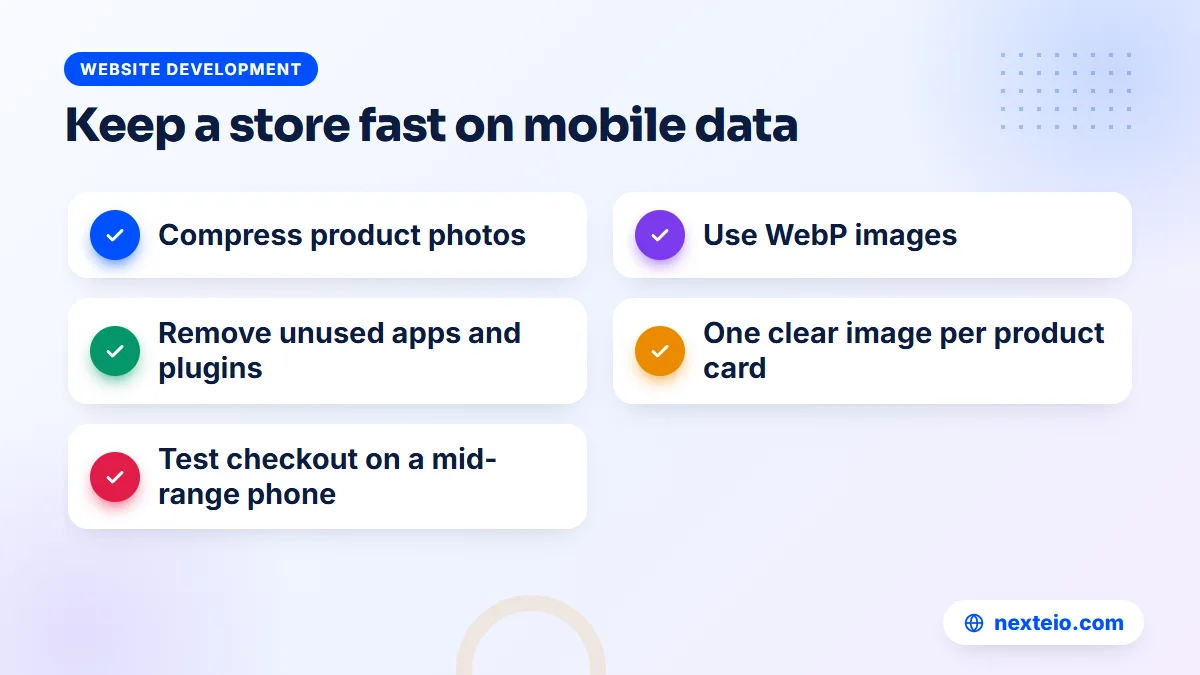
A few habits keep a store fast:
- Resize and compress product photos before upload, and use modern formats such as WebP.
- Show one clear image first on category pages instead of hover galleries.
- Remove apps and plugins you no longer use.
- Test the checkout on a mid-range Android phone, not only on a new iPhone.
Our guide on website speed and SEO explains how faster pages help both rankings and sales.
How the Best Ecommerce Websites Get Found on Google
Many shops in Bangladesh rely almost entirely on paid ads for orders. The best ecommerce websites also earn free visits from search, because their category and product pages are built to be understood by Google.
Google's own guide to ecommerce sites in Search covers the basics: clear URL structure, crawlable category links and unique product information. Adding product structured data, described in Google's documentation for product snippets, can make price, availability and review details eligible to appear in results.
The practical steps for a small store are:
- Write a short, useful introduction for each main category page.
- Write your own product descriptions instead of copying the supplier's text.
- Give every product a clear title that matches how people search.
- Handle out-of-stock products carefully instead of deleting pages that rank.
- Link related categories and products to each other.
Done steadily, these steps let part of your sales come from search without a cost per click. Our ecommerce SEO service handles this work for stores that want help.
Advertising That Matches the Store
Big stores combine search, social media and email. A small store in Bangladesh usually starts with Facebook and Instagram, then adds Google for people who already know what they want. Either way, the ad and the landing page must agree: the product, price and offer in the ad should be exactly what the visitor sees after the tap.
Tracking is what turns ad spend into decisions. When the Pixel and conversion events are set up correctly, you can see which ads bring orders rather than just clicks. Our guide to Meta ads conversion tracking explains the setup. If you want help running campaigns, our Facebook ads and Google Ads services cover targeting, creatives and tracking, and our article on what a Facebook ads service should include helps you judge any provider.
What Not to Copy From Big Stores
Studying the best ecommerce websites can also lead a small store in the wrong direction. Some features only make sense at scale, and copying them adds cost and slows the site.
- Endless features: wish lists, loyalty points, live chat, comparison tools and spin-the-wheel pop-ups all at once.
- Pop-ups on arrival: a full-screen offer before the visitor sees a product, which is especially annoying on a phone.
- Huge catalogs on day one: hundreds of thin product pages with supplier photos and no descriptions.
- A mobile app too early: a separate app costs much more to build and maintain, and a fast mobile site usually serves a small store better.
- Complex accounts: forcing registration and long profiles before the first order.
Start with the basics done well, then add features when customers ask for them. A sensible ecommerce development partner will tell you which features can wait.
How to Audit Your Store Against the Best Ecommerce Websites
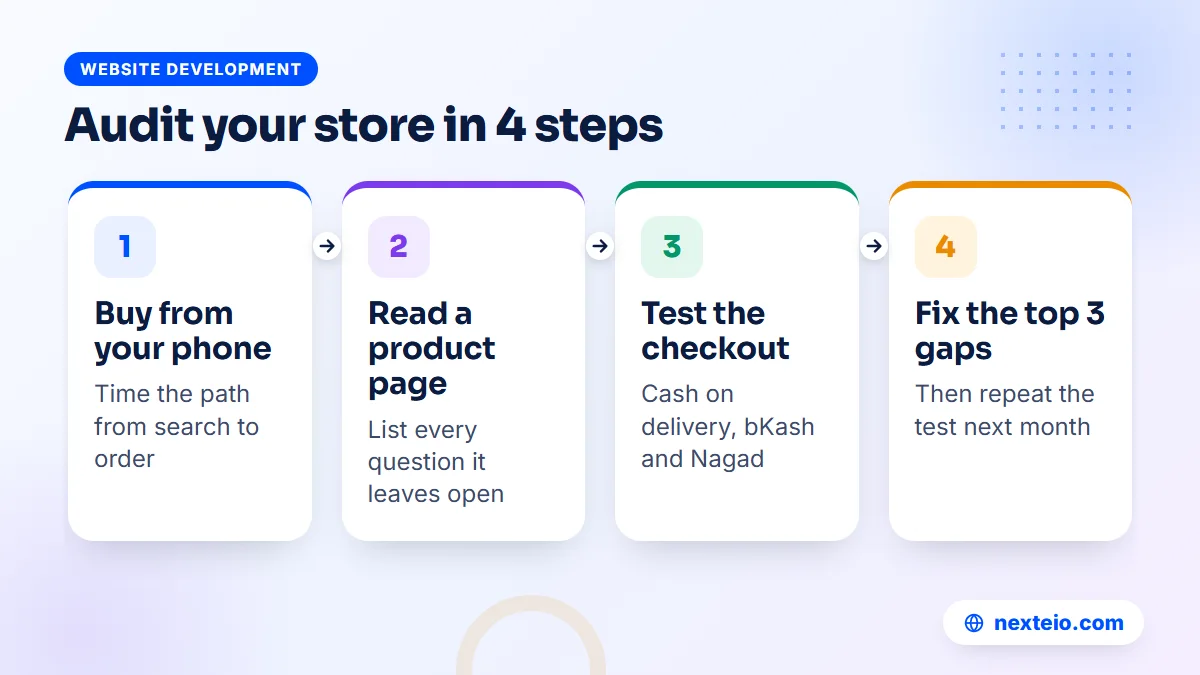
You can test your own store in an afternoon. Use your phone, on mobile data, and act like a first-time customer who has never heard of you.
- Search Google for one of your products by name and see whether your store appears.
- Open your homepage and time how long it takes to reach a specific product.
- Read one product page and list every question it leaves unanswered.
- Add the product to the cart and check that the delivery charge is clear before the last step.
- Complete an order with cash on delivery, then another with bKash or Nagad.
- Note whether you receive a confirmation, and how quickly someone contacts you.
- Look for the return policy, address and phone number without using search.
Then compare each step with the examples above. Pick the three biggest gaps and fix them first, then repeat the test next month.
What a Store With These Features Typically Costs
A store does not need to match Amazon to borrow its best habits, and most of the patterns in this guide fit a modest budget. Typical market ranges in Bangladesh for building an online store are shown below. They are not Nexteio quotes, and your price depends on the number of products, the features and the integrations.
| Store type | Typical market range (BDT) | Usually suits |
|---|---|---|
| Ready theme | 25,000 to 60,000 | New stores with a modest catalog and standard checkout |
| Custom design | 60,000 to 150,000 | Brands that need their own look and a tuned product page |
| Custom-built with integrations | 150,000+ | Stores linked to stock, accounting, courier or ERP systems |
A .com domain is usually about BDT 1,500 to 2,500 a year, and shared hosting about BDT 2,000 to 8,000 a year, although busy stores often need stronger hosting.
Many small stores start on a ready theme, often a WordPress and WooCommerce build, and move to custom work once sales justify it. If you want a realistic figure for your own catalog, send us your product count and the features you need.
How Nexteio Can Help Build Your Store
We build online stores for businesses across Bangladesh through our e-commerce website service, designed around the way people here buy: on a phone, often with cash on delivery or bKash, and with a quick confirmation before the parcel ships. The lessons in this guide are the kind of decisions we work through with you before the build: what each product page must answer, how categories should be organized, which payment methods to offer and how orders reach your team.
If you already have a store, we can review it against the audit steps above and suggest which gaps to fix first. If you are starting from scratch, we can help you choose between a ready theme and a custom build based on your catalog and budget. After launch, we can support you with search visibility and ad campaigns, so the store has steady traffic as well as a good checkout.
See the kind of work we do in our portfolio, read more about Nexteio, or tell us about your store through the project form. You can also reach us on the contact page or read more about our online store development work.
Keep reading: Google Ads or Meta ads for your store, or browse all our website development guides.
Frequently asked questions
What makes an ecommerce website one of the best?
The best stores make finding, understanding, trusting and buying easy, especially on a phone. They answer buyers' questions on the product page, show real photos and reviews, offer the payment methods customers actually use and confirm orders quickly. Design matters, but only when it serves those jobs.
Should a small store copy Amazon or Daraz?
Copy their habits, not their size. Detailed product pages, honest reviews and clear delivery information work for any store. Features built for millions of products, such as complex recommendation systems or a separate mobile app, usually add cost without helping a small catalog.
Is it better to sell on a marketplace or build my own website?
Many businesses do both. A marketplace brings ready traffic but takes a commission, controls the customer relationship and places you beside competitors. Your own website takes more effort to promote, but you keep customer data, build your brand and can grow repeat sales over time.
Which payment methods should an online store in Bangladesh offer?
Cash on delivery is still expected by many first-time buyers. Add bKash and Nagad for customers who prefer mobile payments, and cards through a local payment gateway if your customers use them. Show the delivery charge early so there are no surprises at checkout.
How much does it cost to build a good ecommerce website in Bangladesh?
Typical market ranges are about BDT 25,000 to 60,000 for a store on a ready theme, BDT 60,000 to 150,000 for a custom-designed store and BDT 150,000 or more for a custom-built store with integrations. Domain, hosting and payment gateway fees are separate.
Do I need a mobile app for my online store?
Most small and mid-sized stores do not need one at the start. A fast, well-designed mobile website serves new and returning customers without the cost of building and updating separate apps. Consider an app later if you have many loyal customers who order often.
How can my online store get orders without paying for ads?
Search is the main free source. Write useful category introductions and original product descriptions, use clear product titles that match how people search and add product structured data. Social media posts, repeat customers and word of mouth also help, but results from search usually take months to build.
How often should I review my online store?
Run a short audit on your phone at least once a month: search for a product, read a product page, complete a test order and check the confirmation. Also review your store before big sales seasons such as Eid, so stock, banners and delivery capacity are ready in time.