Questions to Ask a Website Development Company Before You Hire Them
In this article 16 sections
- 1.Prepare Before You Speak to Any Provider
- 2.Questions About the Website Development Company Itself
- 3.Questions About Past Work and References
- 4.Questions About Scope and the Proposal
- 5.Questions About Design, Content and Bangla Support
- 6.Questions About the Platform and Technology
- 7.Questions About Speed, Mobile and Accessibility
- 8.Questions About SEO and Moving From an Old Site
- 9.Questions About Hosting, Security and Ownership
- 10.Questions About Price, Payment and Timeline
- 11.Questions About Launch, Training and Support After Handover
- 12.Extra Questions for Your Type of Organization
- 13.Answers That Should Make You Pause
- 14.Comparing Answers From More Than One Website Development Company
- 15.How Nexteio Can Help With Your Website Project
- 16.Frequently asked questions
Hiring a website development company is much easier when you walk in with the right questions. Most providers sound confident in the first meeting, and their proposals look similar at a glance. The real differences show up in how they answer specific questions about people, scope, ownership, price and support.
This matters more for an organization than for a small shop. A corporate group, a hospital or a university usually needs approval from several managers, a vendor file for the accounts team, and a website that will still be looked after once the person who hired the provider has moved on. One weak answer missed at the start can turn into a year of problems.
The questions below are grouped by topic, with notes on what a good answer sounds like and which answers should worry you. Take them into every meeting and write down what each provider says. Comparing written answers side by side is far easier than comparing three sales pitches from memory.
Prepare Before You Speak to Any Provider
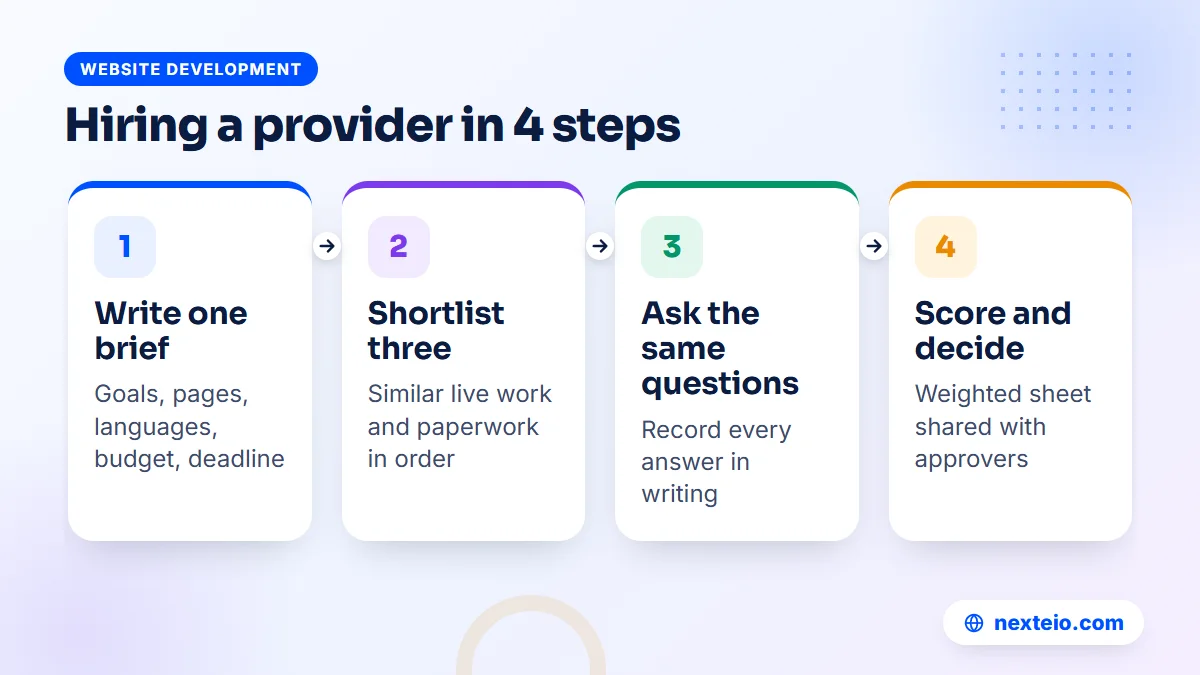
Before you contact any website development company, do a little groundwork on your side. If you cannot say what the site is for, every provider will fill the gap with their own idea, and you will end up comparing quotes for three different projects.
Write down short answers to these points:
- What the website must achieve: enquiries, admissions, appointments, tenders, sales or simply trust.
- Who the main visitors are: buyers abroad, parents, patients, job seekers or local customers.
- A rough page list and any special features, such as booking, payment, search or a staff login.
- The languages you need, usually Bangla, English or both.
- Who inside your organization will supply the text, photos and approvals.
- Your budget range and the date you need the site live, with the reason for that date.
- Which domain, hosting and email accounts already exist, and who holds them.
One or two pages is enough. Send the same brief to every provider so the quotes are comparable. If you want a model to follow, the questions on our project brief form cover the same ground.
Also decide who will sit in the meetings. In many organizations the person who meets the provider is not the person who signs off. Bring the decision maker, or at least agree on the must-haves in advance, so a good provider is not rejected later for reasons nobody mentioned.
Questions About the Website Development Company Itself
Start with who you are dealing with. People search for this kind of partner in many ways, such as a web development company, a website agency, a web dev agency or a web design & development company, and the labels cover everything from a large team to one person with a logo. These questions tell you which one is in front of you.
What kinds of organizations do you usually build for?
A good answer names sectors close to yours and gives examples. A website development firm that mostly builds online shops can still build a hospital site, but it should be honest about what will be new to it. Be wary of "we do everything for everyone".
Who will actually work on our project?
Ask for names and roles: project manager, designer, developer and whoever tests the site. Ask whether they are full-time staff. A provider that cannot name the people, or that changes the subject, may be planning to pass your project to someone outside.
Do you subcontract any part of the work?
Subcontracting is not automatically bad. Many teams use outside specialists for photography or translation. What matters is that you know about it, that the provider stays responsible, and that the subcontractor never holds your accounts.
How do you run a project from start to finish?
Ask the provider to walk you through the stages: brief, sitemap, design, build, testing, launch and handover. A good answer names who approves each stage and how you will review progress, ideally on a private staging copy of the site. If the answer is "send us the content and we will do the rest", expect surprises at the end.
Can you meet our vendor and paperwork requirements?
Many organizations need a trade licence, TIN, a formal quotation, a signed agreement and proper invoices before any payment. Ask early. A very good small provider that cannot supply these papers may be impossible for your accounts team to pay.
Questions About Past Work and References
A portfolio page shows what a website development company wants you to see. Your job is to look at the work as a visitor would, then hear from the people who paid for it.
- Can we see live sites similar to ours? Live links, not screenshots. Open them on a phone with mobile data and see how they feel.
- What exactly did you do on each one? The full build, the design only, or a later redesign? Some portfolios include work where the provider played a small part.
- Which of these clients do you still support? A provider whose clients stay after launch is usually doing something right.
- Can we speak to two of them? A confident team will arrange it without fuss.
Note which sites match your size and sector before you move on.
When you call a reference, keep it short and specific. Ask whether the project finished close to the agreed date, how the provider handled changes and disagreements, whether the domain and hosting are in the client's own name, and how quickly problems are fixed now. Those four answers tell you more than any testimonial on the provider's site.
You can see examples of the organization sites Nexteio builds in our portfolio, and our buyer's checklist for web design companies covers more ways to judge past work.
Questions About Scope and the Proposal
Most disputes begin with a proposal that said too little. "Corporate website, fully responsive, SEO friendly" fits almost any project and promises almost nothing. Ask every website development company on your list to put the scope in writing, then check it against the table below.
| The proposal should state | Why it matters | Watch out for |
|---|---|---|
| Page list and page templates | Sets the real size of the job | "Unlimited pages" with no detail |
| Features, such as forms, booking or search | Features drive cost and time | Features named but not described |
| Languages and who translates | Bangla and English can double content work | Silence on the second language |
| Content entry and image editing | Uploading text and photos takes days | Content left entirely to you without saying so |
| Design revision rounds | Prevents endless changes or rushed approvals | No number at all |
| Training, handover and support period | Defines life after launch | "Support available" with no terms |
Keep the table open while you read each proposal and mark every row as clear, vague or missing.
Then ask two follow-up questions. First, what is not included? Common exclusions are content writing, photography, paid plugins, hosting and the domain. Second, how are changes handled after the scope is signed? A good answer describes a simple change request: you ask, they estimate time and cost, you approve, then they do it. That small step prevents most arguments about money.
Finally, ask whether you will see a sitemap or wireframe before any design work starts. Agreeing on structure first is much cheaper than rearranging a finished design, and any team that builds custom websites for organizations should treat this step as normal.
Questions About Design, Content and Bangla Support
Is the design custom, or based on a theme?
Both can be right. A theme-based site is quicker and cheaper, while a custom-designed website fits your brand and content more closely. What matters is that the provider tells you plainly, and that any theme is properly licensed in your organization's name rather than a pirated copy.
Who writes and prepares the content?
Content is the most common cause of delay. Ask whether the provider writes copy, edits what you supply, or only uploads it. If you need Bangla, ask how they handle Unicode fonts, line height and mixed Bangla and English on the same page. Poorly set Bangla text is hard to read on a phone and is a quick sign of an inexperienced team.
How many design revisions are included?
Two or three rounds on the main pages are common. Unlimited revisions sound generous but often mean the provider has not thought about scope, and the project drifts.
How will you check the design on a cheap phone?
Your visitors are not all using a flagship handset. A good answer mentions testing on a range of real devices and screen sizes. A weak answer is "it is responsive", with no detail on how that was checked.
Questions About the Platform and Technology
You do not need to be technical to ask about technology. You only need the provider to explain its choice in plain words.
Which platform do you recommend for us, and why?
A sensible answer links the platform to your needs. For a content-led company or institution site, a WordPress website is often the practical choice because staff can update it easily. When the site has to run a process, such as an admission portal, a dealer system or a booking workflow, a Laravel web application may fit better. Be careful with any provider that recommends the same tool for every client.
Our comparison of WordPress and custom websites explains the trade-offs if you want to understand the answer before the meeting.
Could another developer take over this site later?
This is one of the most revealing questions you can ask. A good web development company builds on well-known tools, writes notes on custom work and hands over the code. If the answer suggests that only this provider could ever maintain your site, you are being locked in.
Which plugins, packages or paid tools will you use?
Ask for a list, and ask who pays for any yearly licences. A site built on fifteen plugins is harder to keep safe than one built on five, and expired licences stop security updates.
Questions About Speed, Mobile and Accessibility
Most visitors in Bangladesh open websites on phones, often on mobile data that can slow down at busy times. A site that looks fine on office Wi-Fi can feel heavy on a weak 4G signal. Ask these questions:
- How do you measure page speed, and what targets do you aim for?
- How do you handle large images, sliders and video on the homepage?
- Which devices and browsers will you test on before launch?
- Do you follow basic accessibility practice, such as readable text, color contrast and image descriptions?
A good answer mentions Google's Core Web Vitals or similar measures, image compression, caching and testing on real phones. On accessibility, MDN's accessibility documentation is a fair benchmark. Public bodies, universities and NGOs especially should expect a provider to know the basics, because their visitors include older people and people with disabilities.
Speed also affects search. Our guide on website speed and SEO explains how faster pages help both rankings and enquiries.
Questions About SEO and Moving From an Old Site
Very few organizations start from nothing. If you already have a website, the new one must not throw away the search visibility the old one built up. Ask:
- What SEO setup is included at launch? Page titles, meta descriptions, headings, a sitemap, clean URLs and structured data where it fits.
- How will you handle the old URLs? Every important old page should redirect to its new equivalent. Google's guidance on site moves with URL changes describes the process.
- Will Search Console and Analytics be set up under our account? They should belong to your organization, with the provider added as a user.
- What happens after launch? Will someone check for crawl errors and broken links in the first few weeks?
If the provider cannot explain how old pages will be redirected, you risk losing search traffic after launch.
Be clear about the difference between SEO setup and ongoing SEO. Setup is a one-time job that belongs in the build. Growing traffic month after month is separate work, which our SEO service handles. Our article on technical SEO basics lists what a sound launch should include.
Related guides before your meetings:
- How to build a professional business website that gets results
- Planning content for every stage of the customer journey
- How to write SEO-friendly website content people actually read
Questions About Hosting, Security and Ownership
These questions protect you if the relationship ever ends. They are also where a weak website development company gives its vaguest answers, so listen carefully.
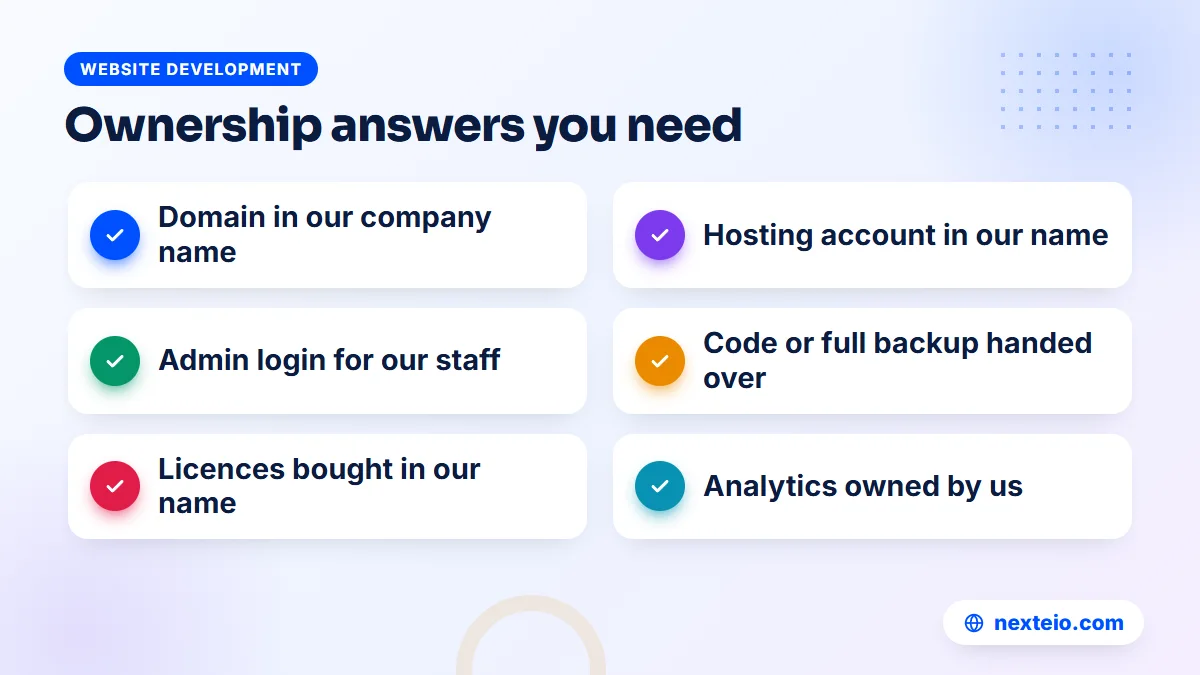
In whose name will the domain and hosting be registered?
The only good answer is: your organization's, with an official email as the contact. Some providers register everything in their own account "to make things easier". That makes leaving them very difficult.
Where will the site be hosted, and how are backups handled?
Ask which hosting company, which plan and where the server sits. Then ask how often backups run, where copies are stored and when a restore was last tested. WordPress's own guide to WordPress backups shows what a complete backup includes. Backups kept only on the same server are not enough.
What security steps are part of the build?
Expect SSL, limited login attempts, strong admin passwords, two-step login for administrators where possible, and no unused plugins or test pages left online. For sites with user accounts or payments, ask how personal data is protected.
What happens if the site goes down or gets hacked?
Ask who notices first, who fixes it and how long a restore from backup usually takes. A provider with a real process will mention uptime alerts, clean backups and a named person to call. If the answer is "that rarely happens", ask again, because sooner or later it happens to most sites.
Will we receive the code and full admin access?
Yes should be the answer, at handover at the latest. For custom-built systems, ask for the source code in a repository your organization controls.
Questions About Price, Payment and Timeline
Price questions are easy to ask and easy to answer badly. Ask for the total project cost, then ask what is billed separately, such as hosting, the domain, paid plugins, content writing and future changes.
For reference, these are typical market ranges in Bangladesh. Your own quote depends on scope, content and features, so treat them as a sense check rather than a price list.
| Project type | Typical market range |
|---|---|
| Company or business site, theme-based | BDT 25,000-60,000 |
| Company or business site, custom design | BDT 60,000-150,000 |
| Large corporate site with integrations | BDT 150,000-400,000+ |
| E-commerce store on a ready theme | BDT 25,000-60,000 |
| E-commerce store with custom design | BDT 60,000-150,000 |
| Custom software, portals or management systems | Quoted after a requirements review, often BDT 150,000-1,200,000+ |
| .com domain, per year | About BDT 1,500-2,500 |
| Shared hosting, per year | About BDT 2,000-8,000 |
A quote from a website development company far below these ranges usually means something is missing. A quote far above them should come with a clear reason, such as integrations, a large page count or a custom portal. Online stores have extra moving parts, so if you are planning one, read about e-commerce website development before comparing quotes.
Next, ask how payment is split. Milestones tied to visible progress, such as an advance, design approval, a finished staging site and launch, protect both sides. Then ask for a timeline with dates, and ask what usually delays projects. An honest provider will say that late content and slow approvals cause most delays, and will ask you to name one person who can approve work quickly.
Questions About Launch, Training and Support After Handover
A website is not finished on launch day. Ask what the website development company will do in the weeks and months after the site goes live.
- What is on your launch checklist? Forms tested, redirects in place, SSL active, analytics working, and the site checked on phones.
- Will you train our staff? A short session, recorded if possible, on adding notices, news and pages.
Then move to the longer term:
- How long is the free support period, and what does it cover? Bug fixes are normal. New features usually are not.
- What does ongoing maintenance cost, and what is included? Updates, backups, security checks and a number of content changes each month.
- How do we report a problem, and how fast will you respond? A named contact and a phone number beat a generic form.
- What happens if we part ways? The provider should hand over accounts, code and backups and remove its own access.
Pay attention to holiday cover too. Many teams close for a week or more during Eid. If your site takes admissions or orders during that period, ask who will be on call.
Extra Questions for Your Type of Organization
The questions so far apply to almost any project. Each sector also has its own pressure points, and a website development company that has worked in your sector should raise them before you do. If it does not, ask.
Schools, colleges, madrasas and universities
Ask how notices, exam routines and results will be published, and whether office staff can do it without calling the developer. Ask how the site will cope with traffic spikes on result day or during admission season. If online admission or fee payment is planned, ask how forms connect to your office records and how bKash, Nagad or bank payments will be confirmed.
Hospitals, clinics and diagnostic centres
Doctor schedules and phone numbers change often, so ask how quickly staff can update them. If patients will book appointments online, ask where their personal details are stored, who can see them and how the data is protected. A clinic site with outdated chamber times does more harm than no site at all.
Factories and garment exporters
Buyers abroad check compliance, certifications and capacity before meetings. Ask how the provider will present audits and certificates without overclaiming, how large photo galleries will load on slow connections, and how enquiry forms will reach the merchandising team rather than a forgotten inbox.
NGOs, offices and government bodies
Ask about reports and document downloads, Bangla content, and accessibility for older visitors. Many of these organizations have long approval chains, so ask how the web development agency handles feedback from several reviewers without the project stalling. Also ask how the site will be handed over when the staff member who managed the project moves to another post.
A sector-specific answer is often the clearest sign of real experience. A website development company that has built for hospitals will talk about chamber schedules before you mention them. One that has not will talk about colors and sliders.
Answers That Should Make You Pause
Every provider has strengths and gaps, and one imperfect answer is not a reason to walk away. Patterns are different. If you hear several of the answers below from the same website development company, treat it as a warning.
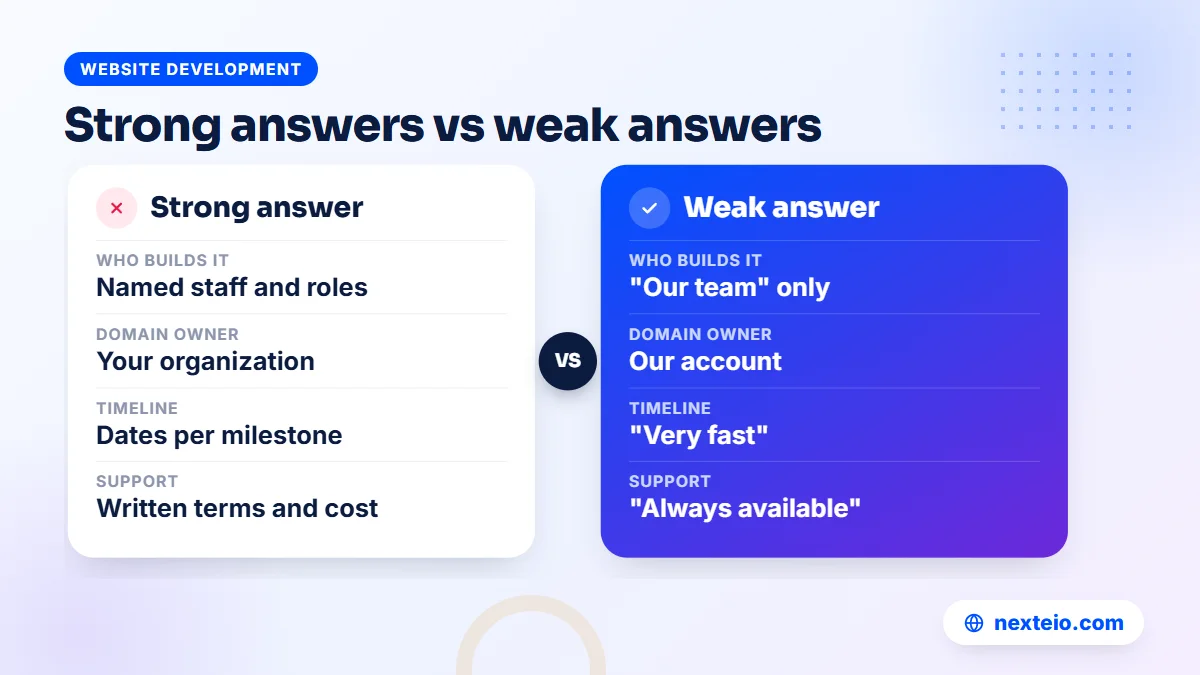
- "Don't worry about the domain, we will keep it in our account."
- "Our team handles everything", with no names or roles when you ask.
- "We can launch in a week", for a site that needs content you have not written yet.
- "SEO is included", with no description of what that means.
- "Unlimited revisions" and "unlimited pages" on a low fixed price.
- A request for full payment before any work starts.
- Reluctance to give you admin access or the code at handover.
The opposite is also telling. A provider that raises ownership, backups and content planning before you ask is usually one that has seen projects go wrong and built its process to prevent it. That is the kind of website design and development company worth a second meeting.
Comparing Answers From More Than One Website Development Company
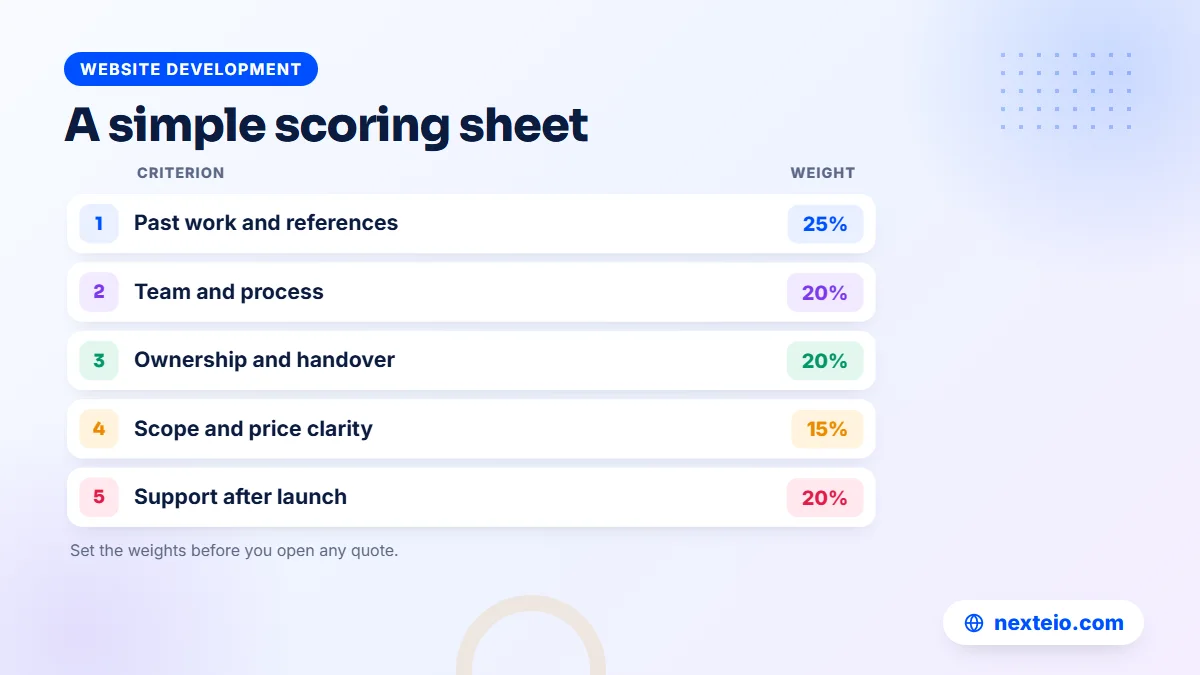
Meet at least three website development agencies or firms, ask each the same questions and record the answers in one sheet. A simple weighted score turns gut feeling into something you can show your managing director or board.
| Criterion | Suggested weight | What earns full marks |
|---|---|---|
| Relevant past work and references | 25% | Live sites like yours and clients who confirm the experience |
| Team and process | 20% | Named people, a written plan, a staging site and a launch checklist |
| Ownership and handover | 20% | Accounts, code and admin access in your name without conditions |
| Clarity of scope and price | 15% | Itemized proposal, exclusions listed and a change process |
| Support after launch | 20% | Written terms, a named contact and a fair maintenance price |
Adjust the weights to your situation. A hospital with appointment booking may weight support higher, while a new company with a tight budget may weight price more. The point is to decide the weights before you see the quotes, so the cheapest or the smoothest presenter does not win by default.
When you share the result inside your organization, attach each provider's written proposal and your notes. That record also helps the next person who manages the website, long after the original hiring decision has been forgotten. Comparing web design and development companies this way takes an extra afternoon, and it often saves months.
How Nexteio Can Help With Your Website Project
Nexteio is a website development company working with companies, institutions and organizations across Bangladesh. If we are on your shortlist, ask us every question in this guide, and we will answer in writing so you can compare us fairly with the others. Our website design and development service starts from your brief: the pages, features, languages and content your site needs, and who on your side will approve the work.
We build content-led sites on WordPress and build Laravel applications when the site has to run a process, such as a portal or a booking system, so the platform follows your needs. We are glad to agree in writing that the domain, hosting, admin access and code belong to your organization. After launch, we can look after the site under a maintenance agreement: you give us access to the hosting and the website, and both sides sign a contract that sets out the work.
If you are comparing providers now, send us your brief and add our answers to your comparison sheet. You can also browse all our services, see more about how we plan custom websites, or reach the team through our contact page.
Keep reading: why a website gets traffic but no customers, what to check before hiring a WordPress developer, or browse all our website development guides.
Frequently asked questions
How many website development companies should we compare before hiring?
Three is usually enough to see the normal price range and spot an outlier. Fewer than that gives you little to compare, while more than five tends to slow the decision without adding much. Send all of them the same brief so the proposals are comparable.
What should a website development proposal include?
At minimum: the page list, features, languages, who supplies and enters content, the number of design revisions, the timeline with milestones, the payment schedule, what is excluded, and the support terms after launch. It should also state that the domain, hosting and code will belong to your organization.
How long does it take to build a company website in Bangladesh?
A theme-based site with ready content can be finished in a few weeks. A custom-designed site usually takes longer, often two to three months, and portals or web applications take more time again. Late content and slow internal approvals are the most common reasons projects run over.
Should we choose the cheapest quote?
Only if it covers the same scope as the others. Very low quotes often leave out content entry, licences, testing or support, which you then pay for later. Compare what each proposal includes line by line, and weigh price alongside past work, ownership terms and support.
Is a web design company different from a web development company?
The terms overlap a lot in Bangladesh. Design usually refers to the look and layout, while development refers to building the working site and its features. Most providers offer both, but ask which parts they handle in-house and whether anything is passed to another team.
Is it safe to let the provider register our domain and hosting?
It can be convenient, but the accounts must be registered in your organization's name with an official email as the contact. If the provider keeps them in its own account, you depend on that provider to renew, transfer or release them, which causes trouble if the relationship ends.
What should we ask about support after the website launches?
Ask how long the free support period lasts, what it covers, what ongoing maintenance costs and what it includes, and how quickly problems are handled. Also ask who to contact during holidays such as Eid and what happens to your accounts and backups if you change provider.