Freelance Web Developer or Agency: Which Is Safer for Your Company?
In this article 16 sections
- 1.Freelance Designer, Developer or Agency: Who Does What
- 2.Freelance Web Developer vs Agency at a Glance
- 3.When a Freelance Web Developer Is the Right Choice
- 4.When an Agency Is the Safer Choice for a Company Website
- 5.The Continuity Problem: What Happens When One Person Is Unavailable
- 6.Ownership: Domain, Hosting, Code and Admin Access
- 7.Cost Over Three Years, Not Just the Build Price
- 8.How to Vet a Freelance Web Developer Before You Pay
- 9.How to Judge an Agency Beyond the Sales Pitch
- 10.Contracts, Milestones and Payments That Protect Both Sides
- 11.Hybrid Setups That Work Well
- 12.Launch Checks to Demand From Either Option
- 13.A Decision Guide for Different Companies
- 14.Common Mistakes Companies Make When Hiring
- 15.How Nexteio Can Help With Your Company Website
- 16.Frequently asked questions
A freelance web developer can build a good company website for less money than most agencies charge, and many independent developers do excellent work. The harder question for a company is not who is cheaper, but who will still answer the phone in three years. For a garment exporter whose buyers check the site before every meeting, or a corporate group that posts tender notices online, the website is a business record, not a side project.
Plenty of company sites built by one capable freelancer run smoothly for years. Plenty of agency-built sites are left without care the day the final invoice clears. The label on the provider matters less than how the work is set up.
The difference usually shows up in four places: who can step in when the builder is unavailable, who holds the domain and the code, how the work is documented, and whether the provider can meet your accounts department's paperwork. Price matters too, but a cheap build that must be redone after two years is not cheap.
Below you will find a side-by-side comparison, the situations where each option fits, and the vetting questions, contract terms and payment milestones that make either choice safer.
Freelance Designer, Developer or Agency: Who Does What
The job titles overlap, so start by being clear about what you are hiring. A freelance web designer usually focuses on how the site looks: layout, colors, typography and the way pages flow on a phone. Some designers hand over design files only, while others build the site themselves on WordPress or a page builder.
A developer writes or configures the code that makes the site work. That covers forms, search, user logins, hosting setup and connections to other systems such as an HR tool, an ERP or a payment gateway. Many independent professionals in Bangladesh do both jobs and call themselves a freelance website designer on one platform and a developer on another.
That mix is fine for a small site. A properly planned company website with several departments, a careers section, product catalogues and two languages needs design, development, content structure, basic SEO and hosting setup all done well. One person may cover all of these, or may be strong in two and weak in three.
Here is a quick way to tell the roles apart:
- Freelance web designer: layout, visual style and mockups, sometimes a WordPress build.
- Freelance developer: code, features, integrations, hosting and technical fixes.
- Full-stack freelancer: both, and usually strongest on small and mid-sized sites.
- Agency: a team with separate roles, a company contract and shared responsibility.
An agency splits the work between people. A project manager collects requirements, a designer handles the look, developers build it, and someone tests it before launch. The quality of that team varies a lot between agencies, but the structure means no single person carries every skill and every deadline.
Freelance Web Developer vs Agency at a Glance
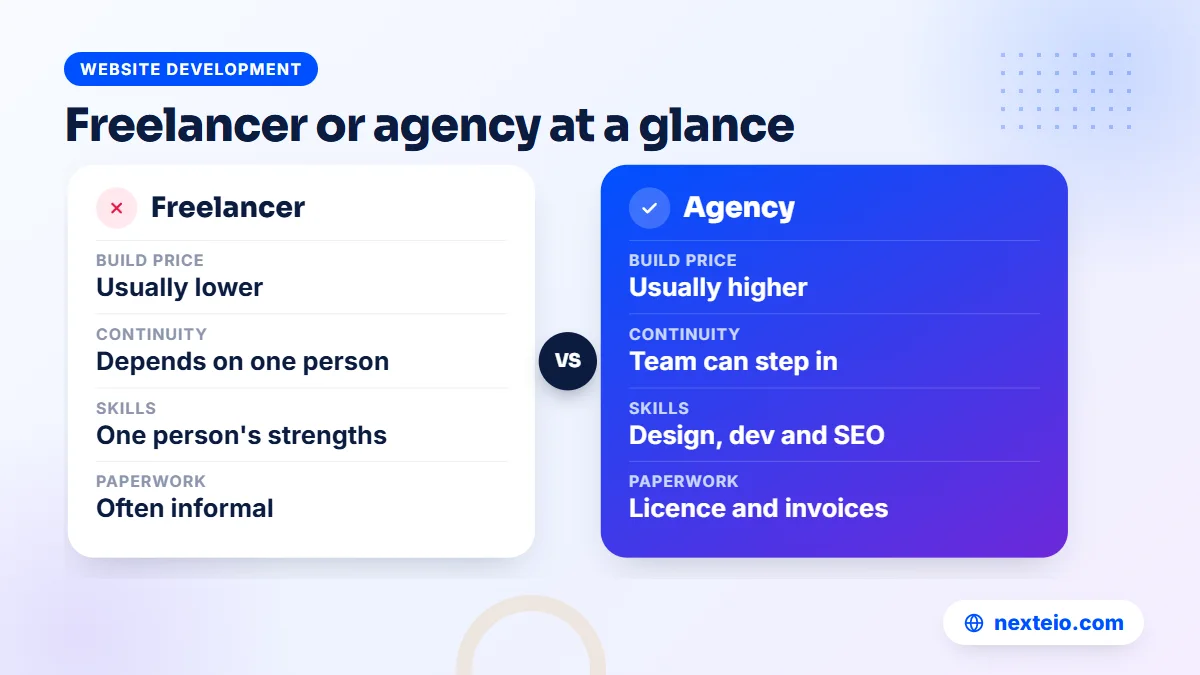
The table below shows how the two options usually compare for a company website. Treat it as a pattern, not a rule. A well-organized freelancer can beat a careless agency on every row.
| Factor | Freelancer | Agency |
|---|---|---|
| Build price | Usually lower, with few overheads | Usually higher, because it pays a team |
| Communication | Direct and often fast | Through a project manager |
| Skills on hand | One person's strengths | Design, development, SEO and content |
| Continuity | Depends on one person | Another team member can step in |
| Paperwork | Often informal, paid to a personal account | Trade licence, quotation, invoices, contract |
| Workload risk | Juggles several clients alone | Shared across the team |
| Best fit | Small sites with a clear, fixed scope | Company sites, integrations, long-term support |
Read the table with your own situation in mind. A five-page profile for a new trading firm does not need a team of five people. A group of companies with a tender page, a careers portal and investor notices probably does.
When a Freelance Web Developer Is the Right Choice
A freelancer often makes sense when the scope is small and clear, the budget is tight, and someone on your side can manage the project. Typical examples include a startup's first company profile, a landing page for one product, a consultant's personal site, or a quick fix on an existing WordPress site.
The strengths are real. You talk directly to the person building your site, so nothing gets lost through an account manager. Decisions are quick, and lower overheads mean the same budget can buy more hours of actual work. Good freelancers also specialize, and a freelance web developer who has spent years on WooCommerce or Laravel may know that tool better than a generalist agency team.
A freelancer also works well as a second line of support. Some companies keep an agency for the main site and hire an independent developer for small jobs, such as a landing page for a trade fair or a new form for a recruitment drive. The main build stays stable while small tasks move quickly.
Signs that a freelancer fits your project:
- The site has fewer than about ten pages and no custom integrations.
- You can write or supply all the content yourself.
- Someone in your office can review progress every week.
- You have time to check portfolios and call references.
- A delay of a week or two would not hurt the business.
When an Agency Is the Safer Choice for a Company Website
An agency earns its higher price when the website carries real business weight. That includes sites that take orders or bookings, connect to other systems, run in Bangla and English, or need approval from several managers before anything goes live. It also includes any site where a week of downtime could cost a contract.
Think about a garment manufacturer preparing for a buyer audit. The compliance page, certificates, factory photos and enquiry form all need to be correct before the visit. If the only person who can update the site is sitting an exam or busy with another client, the company waits. With a team, someone else can log in, follow the documentation and make the change.
Agencies also bring process. A decent one gives you a written proposal, a sitemap, design approvals, a staging site for testing and a launch checklist. Those steps feel like paperwork until something goes wrong. Then they are the difference between a fixable mistake and an argument about what was promised.
The other advantage is skill coverage. A company site touches design, development, hosting, security, speed and search. An agency can put the right person on each part instead of asking one developer to be good at all of them, and it can usually design and build a custom company website without handing parts of the job to outsiders.
The Continuity Problem: What Happens When One Person Is Unavailable
The biggest risk with a solo freelancer is not quality. It is continuity. Independent developers fall ill, take full-time jobs, move abroad, get pulled onto a larger client or simply stop replying. None of this needs bad faith. It is the normal life of someone working alone, and it leaves your company waiting.
The trouble usually appears months after launch. The site works, everyone forgets about it, and then the SSL certificate stops renewing or a plugin update breaks the contact form. You send a message and wait. Meanwhile, buyers see a security warning or enquiries quietly disappear.
A simple test helps. Ask every candidate: "If you are unavailable for two weeks, who fixes an urgent problem on our site, and how would they get access?" A good freelancer has an answer, such as a trusted colleague who knows their setup or clear notes you can hand to someone else. A good agency names a second person. A shrug from either tells you what will happen on the bad day.
Agencies are not immune. Small agencies close, and staff turnover means the developer who built your site may leave. The difference is that a properly run agency keeps code and notes in shared systems, so the knowledge stays with the business. Ask any provider how they handle this before you sign.
Ownership: Domain, Hosting, Code and Admin Access
Whoever builds the site, your company should own everything it runs on. Many organizations discover only during a dispute that the domain is registered under someone's personal email and the hosting is paid from that person's card. Getting it back can take weeks and a lot of paperwork.
Before the build starts, agree on these points in writing:
- Domain: registered with your company as the owner and an official email as the contact, renewed from your side.
- Hosting: an account opened in your company's name, with a separate login for the developer.
Then cover the code, the admin panel and the tools around the site:
- Source code: kept in a repository your company controls, such as a private GitHub repository, with the developer added as a collaborator.
- Website admin: at least one administrator account owned by the company. On WordPress, give each staff member the lowest user role that lets them do their job.
- Licences: paid themes and plugins bought under the company's account, so updates do not stop if the developer leaves.
- Google tools: Search Console and Analytics owned by a company account, with the provider added as a user.
These rules apply to agencies just as much as to freelancers. Some agencies keep client domains in their own reseller accounts for convenience. That is acceptable only if the domain is clearly registered to you and will be moved on request without conditions. Our guide to choosing a web design company lists more ownership checks worth adding to any contract.
Cost Over Three Years, Not Just the Build Price
Freelancers usually quote less for the build, and the gap can be large. For a fair comparison, look at what the site will cost over three years, including hosting, domain, maintenance, fixes and any rebuild if the first version does not hold up.
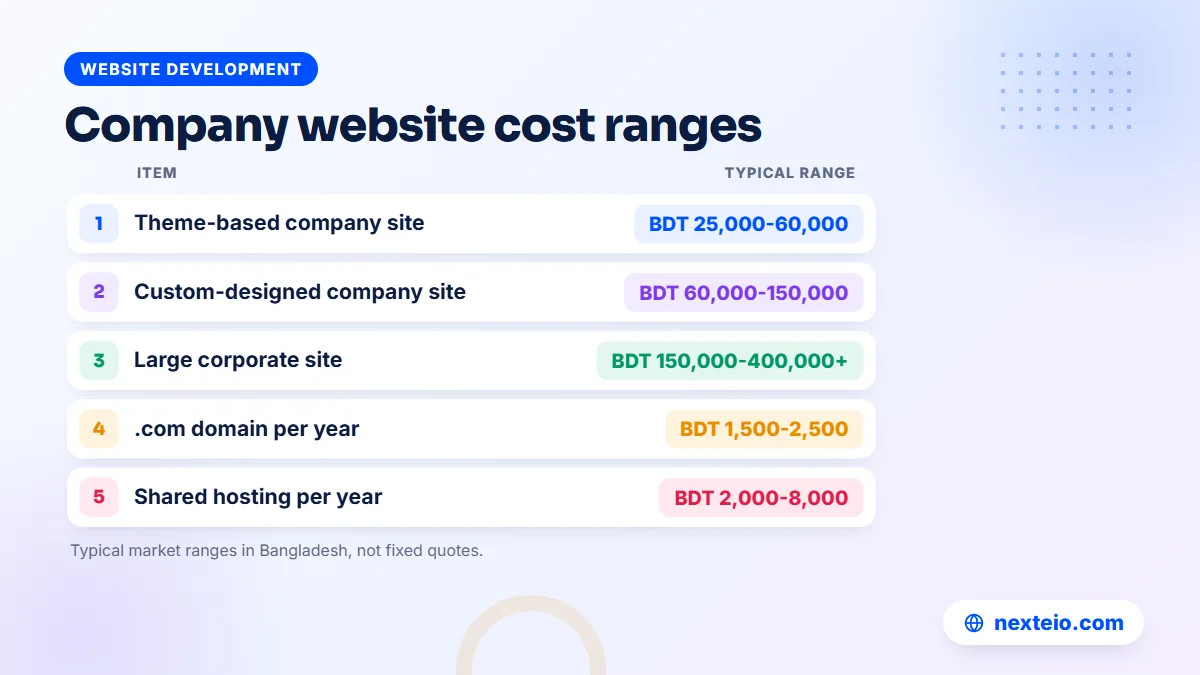
For reference, these are typical market ranges in Bangladesh for a company or business website. Freelancers often sit at the lower end of each range and agencies in the middle or upper end, but scope moves the price more than the provider type does.
| Item | Typical market range | What usually drives the price |
|---|---|---|
| Theme-based company site | BDT 25,000-60,000 | Number of pages, content entry, small design changes |
| Custom-designed company site | BDT 60,000-150,000 | Original design, Bangla and English, custom sections |
| Large corporate site with integrations | BDT 150,000-400,000+ | Several business units, portals, ERP or HR links |
| .com domain, per year | About BDT 1,500-2,500 | Registrar and renewal price |
| Shared hosting, per year | About BDT 2,000-8,000 | Storage, email accounts and server quality |
Then add the running costs. A site that nobody maintains still needs updates, backups and security fixes. If your freelancer charges per task and is often busy, those jobs either wait or go to someone new who must learn the site first. An agency's maintenance plan usually costs more per month but bundles these jobs together.
The most expensive outcome is a rebuild. A site built on a nulled (pirated) theme, with no notes and the code held by one person, often has to be rebuilt within two or three years. At that point, the cheaper original quote has cost you twice. Our comparison of WordPress and custom websites explains how the platform choice also affects long-term cost. If you want a realistic figure for your own scope, send us a short brief and compare it with the quotes you already have.
Related guides for planning your hire:
- What to check before hiring a WordPress developer
- How to hire the right Laravel developer
- How to build a professional business website that gets results
How to Vet a Freelance Web Developer Before You Pay
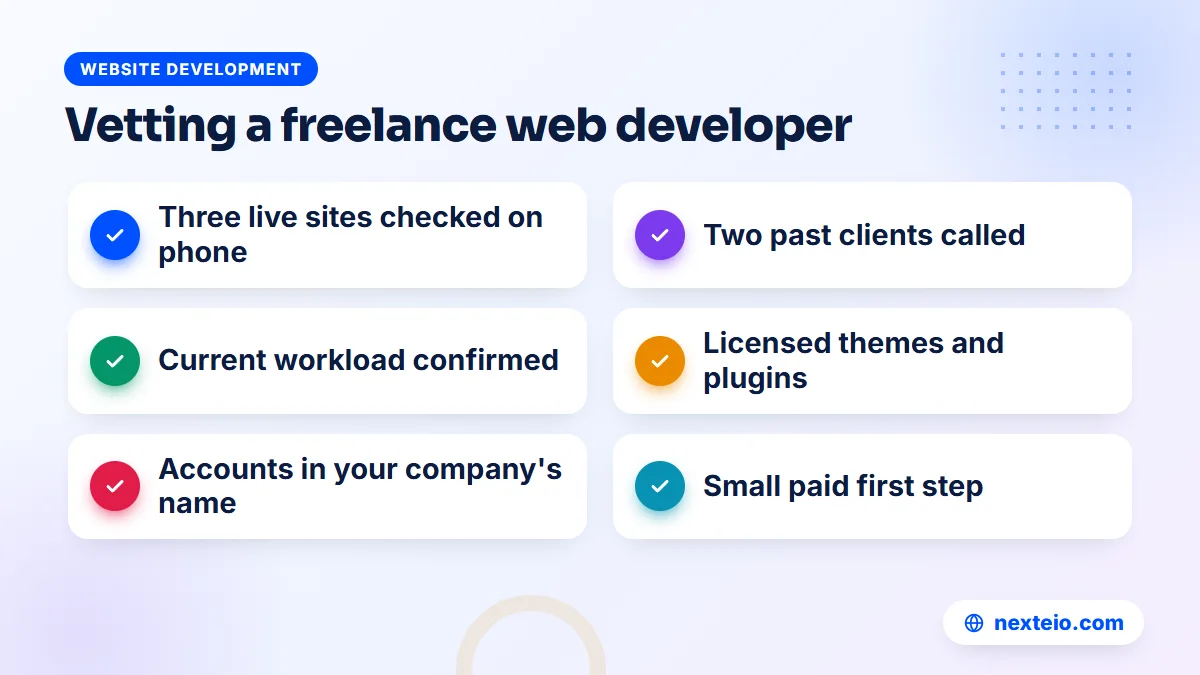
Marketplace ratings and a polished portfolio page are a starting point, not proof. To vet a freelance web developer properly, look at real, live work and talk to the people who paid for it.
- Open three live sites they built. Check them on your phone with mobile data, not office Wi-Fi. Are they fast, readable and free of broken links?
- Ask what they did on each site. Design, development, content, or only a small fix? Portfolios often include work done as part of a larger team.
- Call two past clients. Ask whether the project finished on time, how changes were handled and whether the developer still answers messages.
Once a candidate passes those checks, test how they work:
- Ask about current workload. A freelancer running eight projects at once will not give your site much attention.
- Ask about tools and licences. Will they use licensed themes and plugins bought in your name? Nulled software is a security risk and a sign of shortcuts.
- Check basic habits. Do they test on a staging copy, keep backups and write any notes on how the site is built?
- Agree on a small paid first step. A sitemap and homepage design, paid separately, shows how they work before you commit to the whole project.
A good freelancer will not mind these questions. The best ones usually raise ownership and backups before you do. If a candidate gets defensive about references or refuses to work on accounts in your name, move on.
The same checks apply when you hire a designer for the visual side only. Ask to see the files they will hand over, and confirm that the fonts, icons and stock photos in the design can be used legally by whoever builds the site.
How to Judge an Agency Beyond the Sales Pitch
Agencies are better at presentations, so you need different questions. A polished proposal tells you little about who will actually build your site. Some agencies have a strong in-house team. Others take the order and pass it to an outside freelancer, which brings back every risk you were trying to avoid, plus an extra margin on top.
Ask the agency these questions directly:
- Who will design and build our site, and are they full-time staff?
- Who is our day-to-day contact, and who covers when that person is away?
- Can we see live sites similar in size to ours and speak to those clients?
- Will we get a staging site to review before launch?
- Which accounts will be in our name, and when do we receive the code and admin access?
- What support do you give after launch, and what does it cost?
Look at the agency's own website as well. A slow site, a layout that breaks on mobile or placeholder text left on live pages shows you its real standards. Google's Core Web Vitals guidance explains what a fast, stable page looks like, and you can feel most of it simply by opening the site on a phone.
Finally, confirm the business details your accounts team will need: trade licence, TIN, a formal quotation and proper invoices. For companies with audit requirements or group procurement rules, these papers often decide the matter before quality is even discussed. If you are comparing agencies, our portfolio shows the kind of sites Nexteio builds, so you can judge finished work rather than a sales deck.
Contracts, Milestones and Payments That Protect Both Sides
Most disputes between companies and web developers come from a vague start. "A modern company website" can mean five pages or fifty. A written scope protects you and the provider, and it matters just as much with a freelancer as with an agency.
A short contract or work order should cover:
- The page list, features and languages included in the price.
- Who supplies the content, photos and translations, and by when.
- How many rounds of design changes are included.
- The timeline, with a date for each milestone.
- What happens to accounts, code and files at handover.
- Support after launch: how long, what it covers and the rate for extra work.
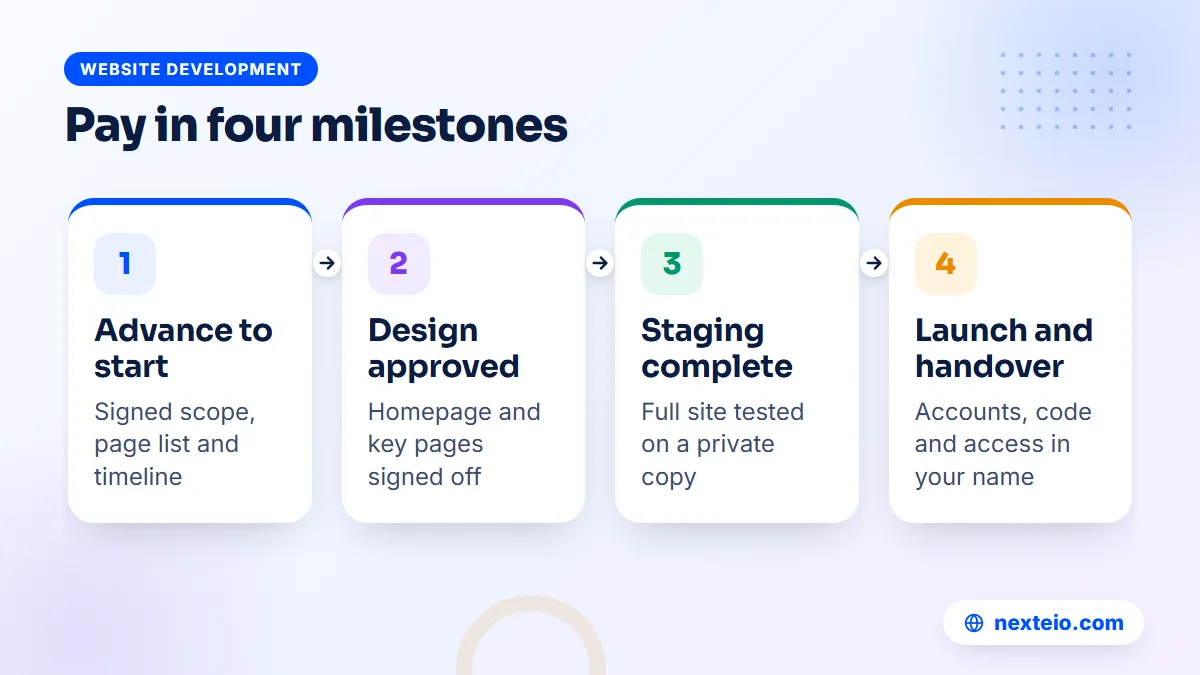
Pay in stages tied to visible progress. A common split is an advance to start, a second payment when the design is approved, a third when the full site is ready on a staging server, and the last payment after launch and handover. Paying by bank transfer from a company account leaves a clear record for audit.
Avoid paying the full amount upfront to anyone, freelancer or agency. Also avoid the opposite. A provider asked to work for months without any payment has every reason to rush. Fair milestones keep both sides committed until the end.
Hybrid Setups That Work Well
The choice does not have to be all or nothing. Many companies get good results by mixing the two, as long as each person's role is written down.
Agency build, freelancer for small jobs
The agency plans and builds the main site, sets up hosting and documents everything. Later, a freelance web developer handles small additions such as an event landing page, under clear rules about backups and testing. This works when the notes are good and everyone agrees on who touches what.
Freelancer build, agency for upkeep
A capable freelancer builds a modest site on a well-known platform, then a maintenance provider takes over updates, backups and security. The key is a clean handover with every account in your name. The new team will usually audit the site first and may find problems that need fixing before regular care starts.
In-house developer plus outside help
Larger companies sometimes keep a developer on staff for daily changes and an agency for security reviews, larger projects and cover during leave. This gives speed and depth together. It costs more, so it only makes sense when the site changes almost every day.
Launch Checks to Demand From Either Option
Whoever builds your site, judge the result by the same launch checks. Many problems that appear later, from weak search visibility to lost enquiries, start with a launch that skipped the basics.
- Mobile: every page readable and usable on a mid-range phone over mobile data.
- Speed: compressed images, caching turned on and no heavy slider delaying the first screen.
- Search basics: unique page titles and descriptions, a sitemap, clean URLs and the site added to Google Search Console. Google's own SEO starter guide explains each of these.
The other half of the list protects your visitors and your inbox:
- Forms: every form tested, with messages reaching an inbox someone actually reads.
- Security: SSL active, admin logins protected, and no unused plugins or test pages left online.
- Accessibility: readable text, enough color contrast and image descriptions, following the MDN accessibility guidance where you can.
Make this list part of the agreed handover, then check each item yourself or ask a third party to do it. If search traffic matters to your business, plan for it from the start. Our article on technical SEO basics explains what should be in place at launch, and our SEO service can take over if you want help growing traffic afterwards.
A Decision Guide for Different Companies
Here is how the choice often plays out for different organizations in Bangladesh. Use it as a starting point, then adjust for your own budget and tolerance for risk.
New trading company or consultancy. A five to eight page profile with a contact form and a WhatsApp button. A vetted freelance web developer on WordPress is often enough, provided the domain and hosting are in the company's name from day one.
Garment or manufacturing exporter. Buyers check certifications, capacity and compliance before meetings, and the site may need product catalogues and RFQ forms. Reliability matters more than saving a few thousand taka, so an agency or a very established freelancer with a backup arrangement is the safer route for an exporter's company website.
Corporate group with several businesses. Sister concerns, career pages, tender notices and sometimes investor information, often in Bangla and English. This is agency territory, built either as a well-structured WordPress site with roles for each department or as a Laravel web application when the site must run internal processes.
Company selling online. Checkout, stock, courier booking and bKash or Nagad payments all have to keep working after every update. A store built through e-commerce website development needs steady support, which favors a team.
Company with a working site that needs a fix. A short, well-defined job, such as repairing a broken form or speeding up a slow page, suits a freelancer well, as long as they take a backup first.
Common Mistakes Companies Make When Hiring
Choosing on the build price alone. The lowest quote often leaves out content entry, licences, testing or support. Compare what is included line by line before you compare totals.
Hiring a friend's contact without a scope. Informal arrangements feel easy at first and become awkward the moment something goes wrong. Write the scope down, even for someone you know well.
Letting the builder own the accounts. If the domain or hosting sits in a freelance web developer's personal account, the company depends on that person indefinitely. Move both into the company's name before launch.
Paying everything upfront. A full advance removes the provider's reason to finish on time. Milestones protect both sides.
Not preparing content. Many projects stall for months because nobody wrote the About page or collected product photos. Give one person inside the company ownership of the content and its deadlines.
Assuming an agency means a team. Some agencies are one person with a logo. Ask who will do the work, then check. A properly staffed provider of company website design and development should be able to name the people involved.
Forgetting life after launch. A site needs updates, backups and the occasional fix. Decide before signing who will handle them and at what cost.
How Nexteio Can Help With Your Company Website
Nexteio is a website development agency serving companies and organizations across Bangladesh, so we sit on the agency side of this comparison. If you are weighing us against a freelancer, run the same tests from this guide on us: ask who will work on your site, look at live work, and ask how ownership and support are handled. Our custom website design service covers planning, design and development, from a focused company profile to a larger corporate site.
We build content-led company sites on WordPress, and build Laravel applications when the site has to run a process, such as a portal or a booking system. We are happy to agree in writing that the domain, hosting, admin access and code belong to your company. After launch, we can look after updates, backups and fixes under a maintenance agreement: you give us access to the hosting and the website, and both sides sign a contract that sets out the work.
If you already have a site built by a freelancer, we can review it and take over its upkeep once the accounts are in your name. To get a clear scope and price, tell us about your project, read more about Nexteio, or reach the team through our contact page.
Keep reading: why a website gets traffic but no customers, common SEO mistakes that hurt business websites, or browse all our website development guides.
Frequently asked questions
Is it cheaper to hire a freelance web developer than an agency in Bangladesh?
For the build itself, usually yes, because a freelancer has fewer overheads. Over three years the gap often narrows once you add maintenance, fixes and the cost of finding someone new if the original developer becomes unavailable. Compare the full scope and the support terms, not just the first quote.
How do I find a reliable freelancer for a company website?
Start with referrals from businesses similar to yours, then check at least three live sites the person built and call two of those clients. Ask about their current workload and how they handle backups and handovers. A small paid first step, such as a sitemap and homepage design, shows how they work before you commit.
What is the difference between a freelance web designer and a freelance web developer?
A designer mainly decides how the site looks and how pages flow, and may or may not build it. A developer builds the working site: code, forms, integrations, hosting setup and fixes. Many freelancers in Bangladesh offer both, so ask which parts they personally handle and which they pass to someone else.
Can one freelancer build a large corporate website?
Some experienced freelancers can, but a large site with several business units, two languages and connections to HR or ERP systems is a lot for one person to build and support. If you go this route, make sure the code, notes and accounts are kept so that another developer could take over without starting again.
Who should own the domain and hosting when a freelancer builds our site?
Your company should, in every case. Register the domain and open the hosting account in the company's name with an official email, then give the developer their own login. That way the site stays under your control even if the working relationship ends.
What should we do if our web developer stops responding?
First check that you can still log in to the domain registrar, hosting and website admin. If you can, take a full backup and ask a new provider to review the site. If the accounts sit in the developer's name, contact the registrar and hosting company with your company documents to start recovering them, which can be slow.
Do agencies pass work to freelancers?
Some do, especially for overflow or specialist tasks. That is not always a problem, but you should know about it. Ask who exactly will design and build your site, whether they are staff, and who will support it after launch.