Custom Software Development Companies: How to Choose the Right One
In this article 14 sections
- 1.What Custom Software Development Companies Actually Do
- 2.Write a Short Brief Before You Contact Anyone
- 3.Building a Shortlist of Three to Five Firms
- 4.How to Judge Technical Ability Without Being a Developer
- 5.The Discovery Meeting: What a Good Firm Asks You
- 6.Comparing Proposals From Custom Software Development Companies
- 7.Pricing Models: Fixed Price, Time and Materials, or Phased
- 8.Contract Terms That Protect Your Organization
- 9.Reference Checks and Talking to Past Clients
- 10.Red Flags When Evaluating Custom Software Development Companies
- 11.Working With the Company After You Sign
- 12.Notes for Schools, Hospitals, NGOs and Government Offices
- 13.How Nexteio Can Help With Your Custom System
- 14.Frequently asked questions
Custom software development companies build systems that do not exist off the shelf: a production tracker for a factory, an admission and fee portal for a college, a dealer ordering system for a distributor. Choosing the right one is harder than choosing a website designer, because you are buying something you cannot see until months after you sign.
Most buyers in Bangladesh go through the same experience. They send a short message to a few firms, receive quotes where the highest is three or four times the lowest, and have no clear way to compare them. One company promises everything in six weeks. Another asks twenty questions before giving a number. The cheapest offer looks attractive until the project is half built and the developer stops answering.
A careful selection process avoids most of that. It does not need technical knowledge, only a clear brief, the right questions and a contract that protects your organization.
This guide walks through that process in order: what to prepare, how to build a shortlist, how to judge technical ability as a non-developer, how to compare proposals and pricing models, which contract terms matter, and the warning signs that should make you walk away.
What Custom Software Development Companies Actually Do
A software company turns your process into a working system. That covers far more than writing code. A complete project includes understanding how your organization works, writing down requirements, designing screens, building and testing features, moving old data, training staff, hosting the system and supporting it after launch.
Many firms describe themselves as offering software development and services, and the phrase can hide very different things. Some only build to a specification you provide. Some sell a ready-made product and customize it. Others do the full job from discovery to long-term support. Before you compare prices, find out which of these each firm is actually offering.
You will also meet different kinds of providers. Each has a place, depending on the size and risk of the project:
| Provider type | Strengths | Weak points | Usually suits |
|---|---|---|---|
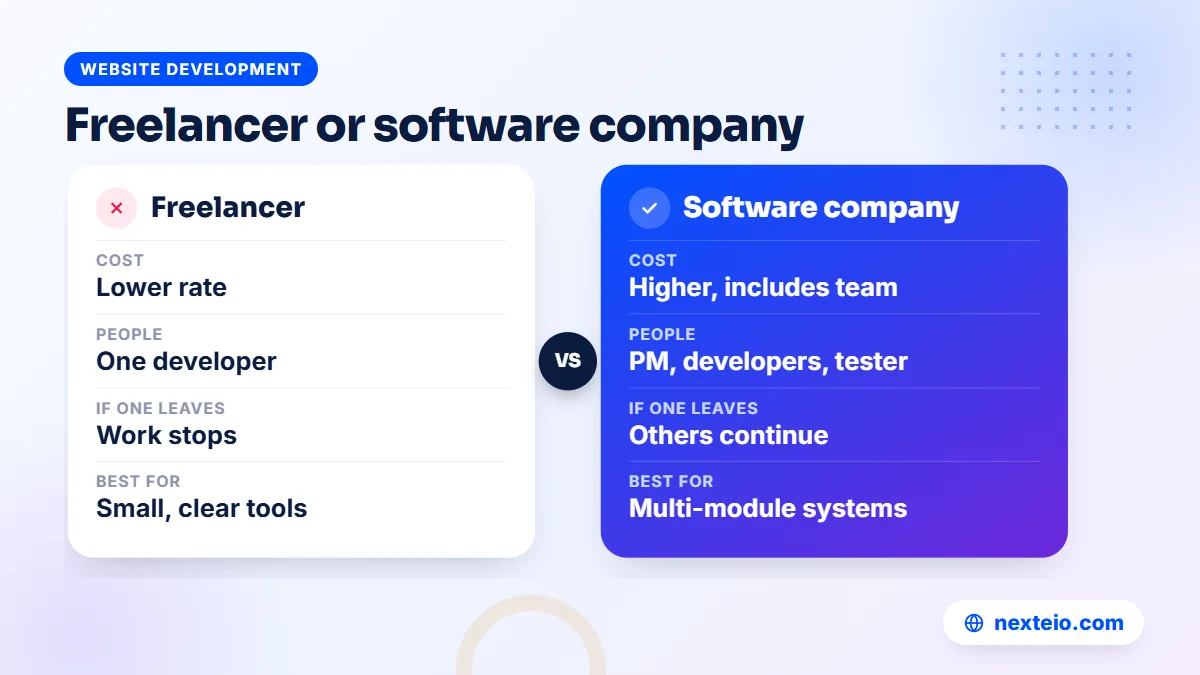
| Freelance developer | Lower cost, direct contact | One person, no cover during illness or leave | Small, well-defined tools |
| Small agency | Several skills, flexible, personal attention | Limited capacity for very large systems | Portals, booking systems, internal tools |
| Mid-sized software firm | Dedicated project managers and testers | Higher rates, more process | Multi-module systems with many users |
| Product vendor | Ready features, faster start | Limited changes, ongoing license fees | Standard needs such as basic accounting |
Whether you hire a freelancer, a custom software development agency or a larger firm, the selection steps below still apply. The difference is how much weight you give to cover and continuity. A system that runs your admissions or your production floor should never depend on one person's phone number.
Write a Short Brief Before You Contact Anyone
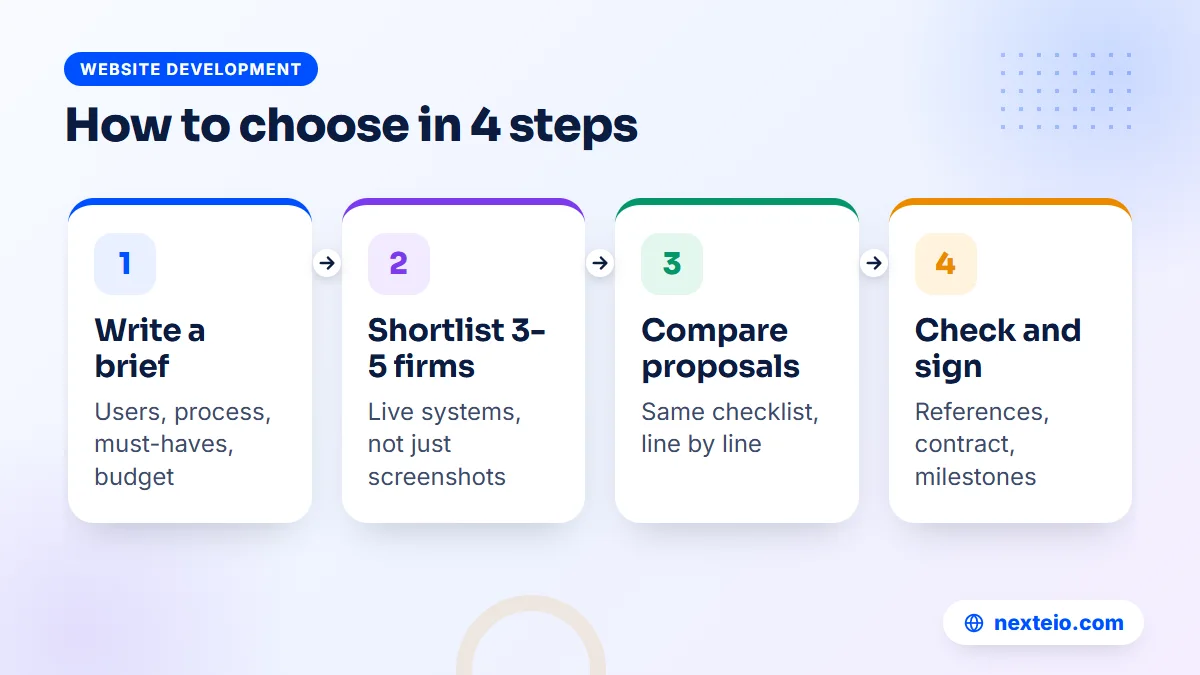
The quality of the quotes you receive depends on the quality of what you send. A two-line message such as "We need software for our school" invites guesses. A two-page brief invites real proposals and lets you compare them fairly.
A useful brief does not need technical language. The first half describes your situation:
- Who you are: the organization, its size, number of branches and who will use the system.
- The problem today: how the work is done now, with spreadsheets, paper files or messaging groups, and what goes wrong.
- Users and roles: for example, admin officer, accounts, branch manager, teacher, guardian or dealer, and roughly how many of each.
The second half describes what you want the new system to do:
- Must-have features: the five to ten things the system cannot launch without.
- Nice-to-have features: things that can wait for a second phase.
- Reports: attach samples of the reports management already uses.
- Integrations: SMS, bKash, Nagad, card payments, accounting software or an existing website.
- Budget range and timeline: even a rough range helps firms propose something realistic.
Sharing a budget range feels risky to many buyers, but it usually saves time. A firm that knows you have a modest budget can suggest a smaller first phase instead of a full system you cannot afford. If you have no idea of the range, say so, and ask each firm to explain how they would phase the work.
Keep the brief honest about internal constraints too. If approvals pass through a board, a principal or a head office abroad, mention it. Good firms plan their timelines around your decision process. Once the brief is ready, you can also send it to us through our project form as one of your comparisons.
Building a Shortlist of Three to Five Firms
When you shortlist custom software development companies, three to five serious candidates are enough. More than that turns selection into a paperwork exercise, and fewer gives you no real comparison. Start wide, then narrow quickly using a few public signals.
Where to find candidates
Ask peers in your sector which systems they use and who built them. A college principal, a hospital administrator or a factory's commercial manager will usually tell you honestly whether their developer was reliable. Look at the websites of firms you hear about, and check whether they describe real systems or only list technologies.
What to check before the first call
- Do they show systems similar to yours, such as portals, dashboards or booking tools, rather than only brochure websites?
- Can they name the technologies they use and explain why, in plain words?
- Is there a real business address, a registered company and a working phone number?
- Do their own website and contact forms work properly on a phone?
- Do they mention support and maintenance, or does their offer end at launch?
Be careful with portfolios that show only screenshots. Screens are easy to design and hard to make work. A firm that can show a live system, even a demo login with sample data, is giving you much more evidence than a gallery of pictures.
Also separate website firms from software firms. Many custom software design companies are excellent at visual design but have limited experience with databases, permissions and integrations. That is fine for a company profile site. It is a risk for a fee collection system that must reconcile every taka, which needs a properly built web application with a well-designed database behind it.
How to Judge Technical Ability Without Being a Developer
You do not need to read code to find out whether a firm builds solid software. You need to ask how they work and listen for specific answers. Vague answers to specific questions are the clearest warning you will get.
Questions that reveal real experience
- "Can you show us a system you built that is in daily use?" Ask them to walk through it live, including a report and a permission setting.
- "How do you test before release?" Look for a test server, written test cases and testing by someone other than the developer who wrote the feature.
- "Where is the code stored, and will we have access?" The answer should be a version control repository, such as one hosted on GitHub or a similar service, with access for your organization.
- "How do you handle security?" Expect mentions of HTTPS, password hashing, role checks on the server, backups and updates.
- "What happens if the developer on our project leaves?" A good firm has shared code reviews and documentation so another person can continue.
The answers matter more than the technology names a firm mentions.
Version control is worth understanding at a basic level. It records every change to the code, who made it and when, so work can be reviewed and rolled back if needed. GitHub's own guide about repositories explains the idea briefly. If a firm keeps your code only on one developer's laptop, your system is one hard-drive failure away from trouble.
Security knowledge you can check
For systems that handle payments, personal records or medical data, ask whether the firm follows a recognized checklist. The OWASP Application Security Verification Standard is a public list of security requirements for web applications. A firm does not need to follow every level of it, but serious custom software development firms will know what it is and which parts apply to your project.
Technology choice matters less than people think, as long as it is mainstream and well supported. For most web-based business systems, a framework such as Laravel works well and is easy to staff for later, which is why it is the base of our Laravel development service for portals and dashboards. Our guide on hiring the right Laravel developer lists more technical questions if you want to go deeper.
The Discovery Meeting: What a Good Firm Asks You
The first proper meeting tells you more about a firm than any proposal. Pay attention to the questions they ask. The best custom software development companies spend most of that meeting asking, not presenting.
Signs of a firm that understands the job:
- They ask to speak with the people who will use the system daily, not only with management.
- They ask for sample forms, spreadsheets and reports.
- They ask what happens in unusual cases: a partial payment, a canceled order, a student who changes section mid-year.
- They ask about your approval chain and who signs off each stage.
- They suggest a smaller first phase if your list is long.
- They ask about hosting, backups and who will own the accounts.
Signs of a firm that is selling rather than solving: a long slide presentation about themselves, a firm price given in the first meeting, promises that every feature is "easy", and little interest in how your staff actually work.
For larger projects, many firms offer a paid discovery phase. They spend a few weeks mapping your process and produce a requirements document, screen mockups and a fixed estimate. This costs money up front, but it often saves more later. You also end up owning a document you can take to other firms if you decide not to continue.
Related guides for buyers comparing providers:
- A buyer's checklist for choosing a web design company in Bangladesh
- WordPress vs custom website: which is right for your business
- What to check before hiring a WordPress developer
Comparing Proposals From Custom Software Development Companies
Proposals from different firms rarely line up neatly. One lists forty features, another lists eight modules, and a third gives one total with a paragraph of description. Before comparing prices, rebuild each proposal against the same checklist so you are comparing like with like.
| Item | What a good proposal says | Why it matters |
|---|---|---|
| Scope | Features listed by module and role | Shows what is and is not included |
| Assumptions | What you must provide, and when | Prevents delays being blamed on you later |
| Timeline | Phases with dates and demos | Lets you track progress |
| Testing | Test server and acceptance testing | Bugs are found before launch, not after |
| Data migration | Which data is imported and who cleans it | Often forgotten, often expensive |
| Training and documentation | Sessions per user group, user guide | Adoption depends on it |
| Support | Warranty period and maintenance terms | Defines what happens after launch |
| Ownership | Source code, database and accounts belong to you | Protects you if you change provider |
Once proposals are aligned, the gaps become obvious. A low quote frequently drops testing, migration or documentation. A high quote may include a long support period or extra modules you did not ask for. Neither is wrong, but you can only judge them fairly side by side.
Use a simple scoring sheet
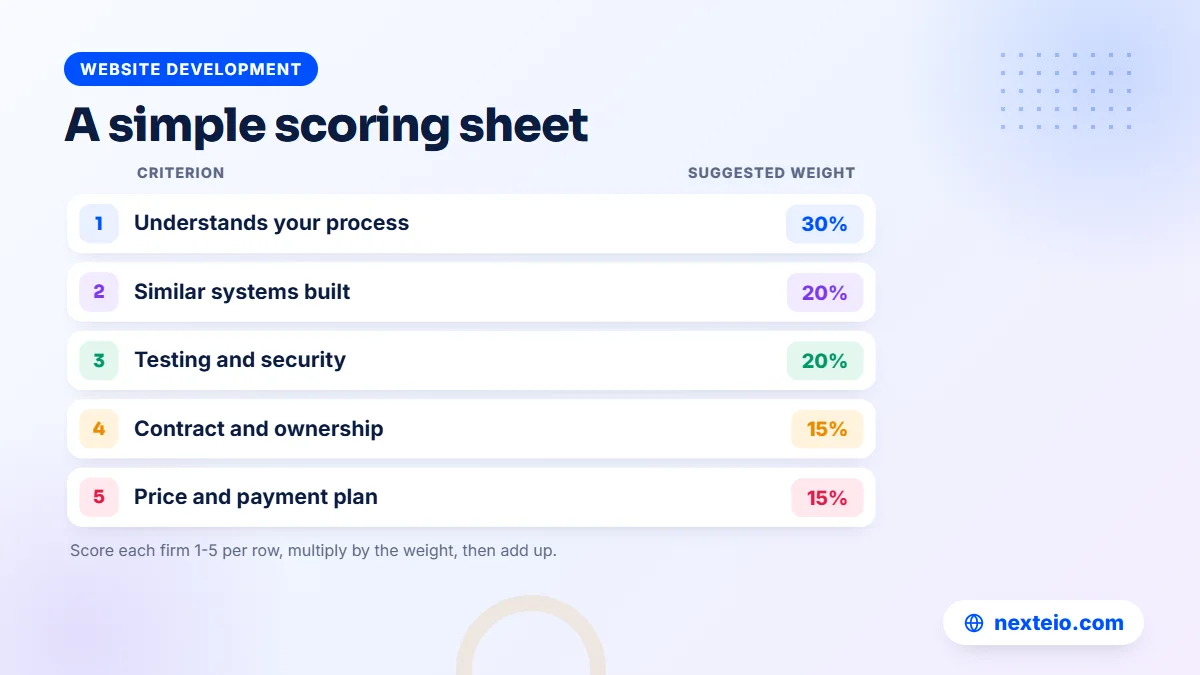
A scoring sheet keeps the decision objective, which helps when several people in an organization must agree. Score each firm from one to five on each criterion, multiply by the weight, and add up the totals. Agree the weights before you open the proposals, not after.
Price matters, but it should rarely be the heaviest weight. A system that costs a little less but fails to fit your process will cost far more in lost time, workarounds and eventually a rebuild.
Pricing Models: Fixed Price, Time and Materials, or Phased
How a project is priced shapes how it is managed. There are three common models, and each suits a different level of certainty about the requirements.
Fixed price
A fixed price covers an agreed scope for an agreed amount. It suits projects with clear, stable requirements and gives your accounts office a firm number to approve. The risk is rigidity. Every change becomes a change request with its own cost, and firms often add a margin to cover unknowns.
Time and materials
Here you pay for the hours actually worked, usually at an agreed rate. It suits projects where requirements will change as you learn. It needs more trust and closer tracking, with regular timesheets and demos, because the final cost is not fixed in advance.
Phased fixed price
Many organizations find a middle path works best. A first phase with a clear scope is priced as a fixed amount. After it launches and people use it, the next phase is scoped and priced in the same way. This keeps each approval manageable and lets real use shape later features.
On cost, be wary of custom software development companies that name a fixed price before they understand your process. For custom systems, portals and management software, prices are normally quoted after a requirements review. As a broad guide, typical market ranges in Bangladesh run from about BDT 150,000 to BDT 1,200,000 or more, depending on the number of modules and users. A simple internal tool sits at the lower end, and a multi-branch system with payments and integrations sits at the upper end or beyond.
Payment terms deserve as much attention as the total. A common and fair pattern is an advance at signing, further payments tied to agreed milestones, and a final payment after acceptance testing. Avoid paying most of the amount up front, since it removes your bargaining power if the project slips.
Contract Terms That Protect Your Organization
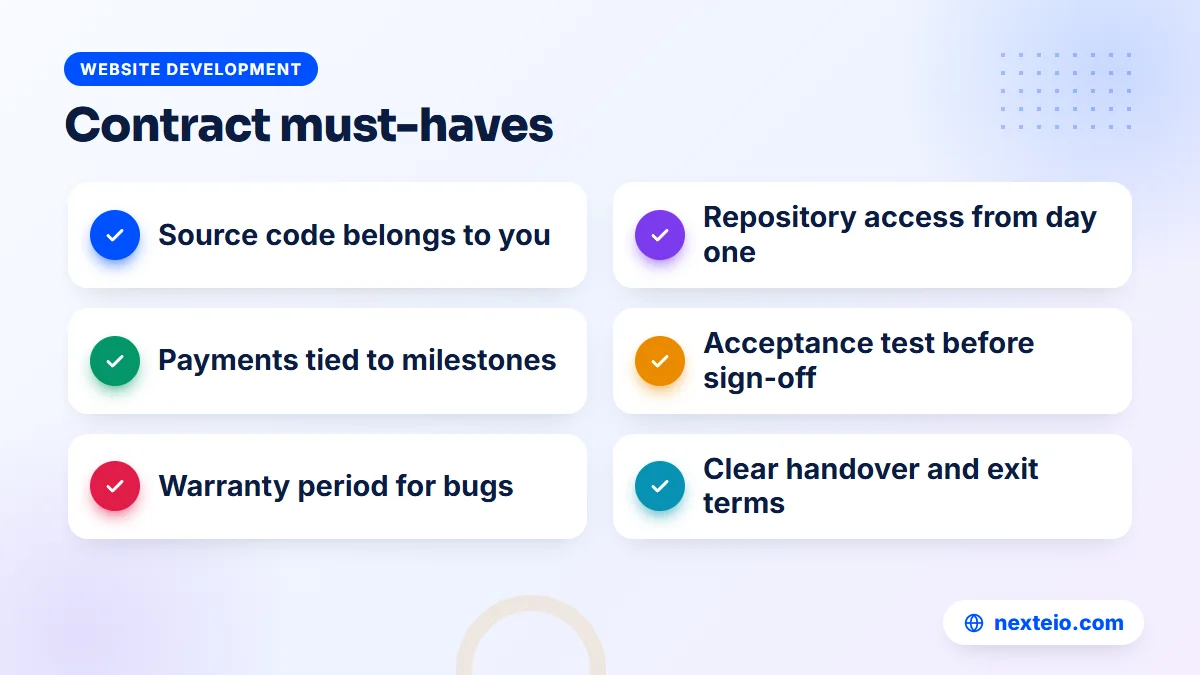
The contract is where a good selection process pays off. Many disputes between buyers and custom software development companies come from contracts that were too short to cover what actually happened. Read these clauses carefully before anyone signs:
- Ownership of the source code: state that the code, database and design files built for you belong to your organization once paid for.
- Repository access: your organization should have access to the code repository during the project, not only at the end.
- Accounts in your name: domain, hosting server, SMS and payment gateway accounts should be registered to your organization.
The second group covers how the project runs and how it ends:
- Acceptance testing: define how features are tested and approved before a milestone payment.
- Warranty period: a period after launch during which bugs in the agreed scope are fixed at no extra cost.
- Change requests: how new requests are estimated, approved and billed.
- Confidentiality: your data and business processes are not shared or reused.
- Handover and exit: what the firm hands over if the relationship ends, including code, documentation and credentials.
Ownership of reusable components needs a sensible approach. Many firms use their own libraries or frameworks across projects. That is normal and keeps costs down. What matters is that you receive a license to use those parts indefinitely, and that nothing in the system stops working if you move to another provider.
If your organization has a legal adviser, ask them to review the contract. If not, at least make sure every promise made in meetings appears in writing. A verbal promise of "free support for a year" is worth nothing when the person who made it has left the company.
Reference Checks and Talking to Past Clients
References are the most underused tool for judging custom software development companies. Most buyers either skip them or ask questions that only produce polite answers. A good reference call takes fifteen minutes and tells you how a firm behaves when things go wrong, which is the information you actually need.
Ask the firm for two or three clients with systems similar to yours, ideally ones that have been running for more than a year. Then ask those clients:
- Was the system delivered close to the agreed time and budget? If not, why?
- How did the firm handle changes and disagreements?
- How quickly do they respond when something breaks today?
- Did you receive the source code and documentation?
- Would you hire them again for your next system?
The last question is the most revealing. Listen for hesitation. A client who says "yes, but" is giving you the real answer in the part after "but".
If possible, ask to see the client's system in use. Ten minutes watching a receptionist book appointments, or a merchandiser update an order, tells you whether the software is actually liked by the people who use it.
Red Flags When Evaluating Custom Software Development Companies
One warning sign is a reason to ask more questions. Several together are a reason to look elsewhere. These are the patterns that most often come before a failed project:
- A firm price in the first conversation, before they understand your process.
- Reluctance to put your organization's name on the domain, hosting or repository.
- No test server, so you will only see the system when it is "finished".
- A request for most of the payment before any working screens exist.
- Every answer is "yes, that is easy", with no questions back.
- No written contract, or a one-page agreement with no scope attached.
- A portfolio made only of screenshots, with no live system to show.
- No mention of maintenance, updates or support after launch.
Watch, too, for a mismatch between the person who sells and the people who build. If the sales contact disappears after signing and you cannot reach anyone who knows the project, communication will become your biggest problem.
The opposite extreme is also a warning. A firm that insists on a huge, complex system when your problem is small may be selling capacity rather than solving your problem. Often a well-built website with one or two features, such as a WordPress site with a custom form and admin panel, does the job for far less. If your needs grow later, a custom Laravel web application can be added on top.
Working With the Company After You Sign
Choosing well is half the work. The other half is being a good client. Even the best custom software development companies depend on clear, timely input, and the buyer's behavior affects the result as much as the developer's skill.
Set a rhythm early. A short weekly update and a demo at the end of each phase keep everyone aligned. Name one person on your side who collects feedback from all departments and gives a single, consistent answer. Conflicting instructions from different managers are one of the most common causes of delay and rework.
Test properly when you are asked to. Acceptance testing is your chance to catch problems before launch. Ask the staff who will use each feature to try it with realistic data, including unusual cases. Log every issue in one place, with a screenshot and a short description, rather than scattered across calls and chat messages.
Plan the launch with care. Choose a quiet period, not the week of admissions, an export shipment or the end of the financial year. For critical systems, run old and new methods side by side for a short time. After launch, agree on a maintenance plan so updates, backups and small changes have an owner. For systems built through our Laravel application service, that is a separate maintenance agreement with its own scope. Software that is left alone becomes harder and more expensive to change each year.
If the system has a public side, such as an online store or an admission page, think about traffic as well. Our SEO service helps public pages show up on Google, and a new store may be better started through our e-commerce website development work than as a fully custom build.
Notes for Schools, Hospitals, NGOs and Government Offices
When schools, hospitals, NGOs and public offices evaluate custom software development companies, they face extra considerations that a small private business may not. Planning for them early prevents delays at the approval stage.
Approval chains. Requirements, contracts and payments may need sign-off from a governing body, a managing committee or a head office. Build those approval dates into the timeline, and ask the firm to provide documents in a format your committee can review easily.
Procurement rules. Government offices and many donor-funded projects must follow formal procurement procedures, which can include tender documents, evaluation committees and specific payment terms. Choose a firm that has worked within such rules before and can supply the paperwork they require.
Sensitive data. Hospitals hold medical records, schools hold children's data and NGOs often hold beneficiary information. Ask how data is stored, who can see it, how access is logged and where backups are kept. The NIST Cybersecurity Framework is a useful public reference for organizing these questions, even for smaller institutions.
Accessibility and language. Public-facing systems should work for older users, people with weaker eyesight and people more comfortable in Bangla. The MDN accessibility guides explain how to make web systems usable for more people. Ask the firm how they handle font sizes, contrast and Bangla input, and check speed on a phone too, since our guide on website speed shows how slow pages lose visitors.
Continuity. Institutions keep systems for many years, often longer than staff stay in their roles. Insist on documentation and an admin guide, so a new IT officer or a new provider can take over without starting again.
How Nexteio Can Help With Your Custom System
We build custom web systems through our Laravel web application service: portals, dashboards, booking and fee systems, order and stock records, and internal workflow tools for companies and institutions across Bangladesh.
We start where this guide starts: by learning how your team works today, looking at the forms, spreadsheets and reports you already use, and agreeing on what the first version must do. Because every process is different, the price is quoted after that requirements review rather than guessed from a short message. If your list is long, we will suggest which parts belong in a first phase and which can wait.
We are happy to be compared against other firms using the checklist and scoring sheet above, and we encourage clients to keep the domain, hosting and admin accounts in their own organization's name. After launch, we can look after the system through a maintenance agreement, which starts once you give us access to the server and the application and both sides sign a contract that sets out the work. If you also need a public website, we can handle it through our custom website design service.
To discuss your project, send us a short brief through the project form, see examples in our portfolio, browse all our services or get in touch through the contact page.
Keep reading: how to build a professional business website that gets results, common SEO mistakes that hurt business websites, or more website development guides.
Frequently asked questions
How many software companies should we ask for proposals?
Three to five is usually enough. Fewer gives you no real comparison, and more creates a lot of paperwork without much extra insight. Send all of them the same written brief so their answers can be compared fairly.
Is it safer to hire a software company than a freelancer?
For small, well-defined tools, a skilled freelancer can be a good choice. For systems that run daily operations, such as admissions, billing or production tracking, a company with several people gives you cover when someone is sick, on leave or leaves the job. Either way, make sure you hold the code and the accounts.
Why do quotes for the same software project differ so much?
Firms often quote different scopes without saying so. One may include testing, data migration, training and a support period, while another covers only the coding. Rebuild each proposal against the same checklist before comparing prices, and ask each firm what is excluded.
Should we pay for a separate discovery phase?
For medium and large projects, it is often worth it. A paid discovery phase produces a requirements document and screen mockups that reduce surprises later. You own that document, so you can still take it to another firm if you decide not to continue.
Who should own the source code of custom software?
Your organization should, once the agreed payments are made. Put this in the contract, ask for access to the code repository during the project, and make sure the domain, hosting and service accounts are registered in your organization's name.
What payment structure is fair for a custom software project?
A common and balanced structure is an advance at signing, further payments when agreed milestones are delivered and accepted, and a final payment after acceptance testing. Avoid paying most of the total before you have seen working screens.
What happens if we are unhappy with the firm halfway through?
This is where the contract matters. With clear exit terms, repository access and milestone payments, you can pay for the accepted work, take the code and documentation, and continue with another provider. Without them, you may have to start again from nothing.