Web Design Portfolio: How to Judge an Agency's Work Before Hiring
In this article 16 sections
- 1.What a Web Design Portfolio Can and Cannot Tell You
- 2.Before You Open Any Portfolio: Write Down What You Need
- 3.Step 1: Check That the Work Is Real and Still Live
- 4.Step 2: Test the Sample Sites on Your Own Phone
- 5.Step 3: Look Past the Homepage
- 6.Step 4: Check the Technical Basics Behind the Design
- 7.Matching a Web Design Portfolio to Your Type of Organization
- 8.Case Studies: Separating a Real Story From a Gallery
- 9.Red Flags in an Agency's Web Portfolio
- 10.A Scoring Sheet for Comparing Each Web Design Portfolio
- 11.Questions to Ask About Specific Portfolio Projects
- 12.When a Small or New Agency Has a Thin Portfolio
- 13.How Portfolio Quality Relates to Price
- 14.Turning Your Review Into a Decision
- 15.How Nexteio Can Help
- 16.Frequently asked questions
A web design portfolio is the closest thing you get to a test drive before you hire an agency. It shows the sites a team has already built, and it should tell you whether they can build the one you need. The trouble is that most portfolios are designed to impress, not to inform. A row of polished screenshots says very little about speed on mobile data, what happens behind the contact form, or whether the client was happy two years later.
Picture a procurement officer at a corporate group with four sister concerns. Three agencies have sent proposals, and each one links to a gallery of thirty projects. All three galleries look professional. The prices differ by a factor of three. On paper, there is no way to tell which team will deliver a site that the chairman, the buyers and the HR department will all accept.
This guide shows you how to read a web design portfolio the way an experienced buyer does. You will learn how to check that the work is real, how to test sample sites on your own phone, what to look for past the homepage and which technical basics take five minutes to verify.
It also gives you a scoring sheet for comparing agencies, the questions to ask about specific projects, and how to judge a newer team with only a handful of samples.
What a Web Design Portfolio Can and Cannot Tell You
A good portfolio answers three questions well. Can this team produce a clean, modern layout? Have they worked for organizations like yours? And do they finish projects, rather than leaving them half-built? If the samples are live, varied and recent, you can answer all three in an afternoon.
What it cannot show you directly is just as important. A screenshot hides load time, broken links and forms that send email to nowhere. It hides how the agency behaved when the client changed the brief halfway through. It also hides who actually did the work. Some agencies list projects that a former employee or a subcontractor built, and some show design concepts that never went live.
Treat every portfolio as a set of leads, not as proof. Each sample is a claim that you can check. The rest of this guide is about checking those claims quickly, so you can spend your meetings on the two or three agencies that deserve them.
One more point before you start. The look of a site matters less than most buyers think. A corporate site that is calm, readable and fast will usually serve you better than one with heavy animation that loads slowly on a phone. Judge each sample by how well it would work for the people who will visit your site, not by how exciting it looks on the agency's own page.
Before You Open Any Portfolio: Write Down What You Need
Buyers who skip this step end up choosing the prettiest gallery. Buyers who do it end up choosing the team that fits. Spend thirty minutes writing a short list of what your own site must do, and keep it next to you while you review every web design portfolio.
Your list does not need to be technical. For most organizations, these points are enough:
- Who visits: foreign buyers, local customers, guardians, patients, donors, job seekers or government officials.
- What they must do: read a company profile, send an enquiry, download a catalog, book an appointment or pay online.
- Languages: English only, Bangla only, or both with a switch between them.
- Size: a ten-page profile, a group site with several concerns, or a site with a news section updated every week.
- Special features: product catalogs, job applications, notice boards, a client login or an online store.
- Who will update it: your own office staff, the agency, or both.
Share the list with everyone who will help choose the agency.
With this list in hand, each sample in a portfolio either matches some of your needs or it does not. A beautiful fashion boutique site tells you little about a team's ability to build a garment exporter's compliance pages. A simple school site tells you little about a group with ten business units and a careers portal.
If you need help turning your needs into a written brief, our guide to building a professional business website covers the pages and features most organizations need.
Step 1: Check That the Work Is Real and Still Live
The first test is simple. Can you open each sample as a working website? A portfolio that only shows images, with no links, is a warning sign. There can be honest reasons, such as a client who asked not to be named, but an agency with years of work should have at least several live examples it can share.
For each linked sample, check these points:
- The site loads, and it is the same design shown in the screenshot.
- The footer credit, if there is one, names this agency and not someone else.
- The content looks current, with a recent news post, notice or copyright year.
- The business itself is real, with a working phone number and address.
If the live site looks completely different from the screenshot, ask why. Often the client redesigned it with another provider, which is normal but worth knowing. Sometimes the screenshot was a concept that the client never approved. Neither is a reason to reject the agency, but both mean that sample proves less than it appears to.
You can also check when a sample domain was registered with the ICANN lookup tool. If the agency says it built a site in 2019 but the domain was first registered last year, the dates do not fit. This takes a minute and catches a surprising number of padded portfolios.
Finally, watch for theme demos. Many ready-made themes come with demo sites full of stock photos and placeholder text. Some agencies list these demos as their own work. If several samples share the same layout, the same stock images or text like "Your Company Name", you are looking at a theme catalog, not a web portfolio of client work.
Step 2: Test the Sample Sites on Your Own Phone
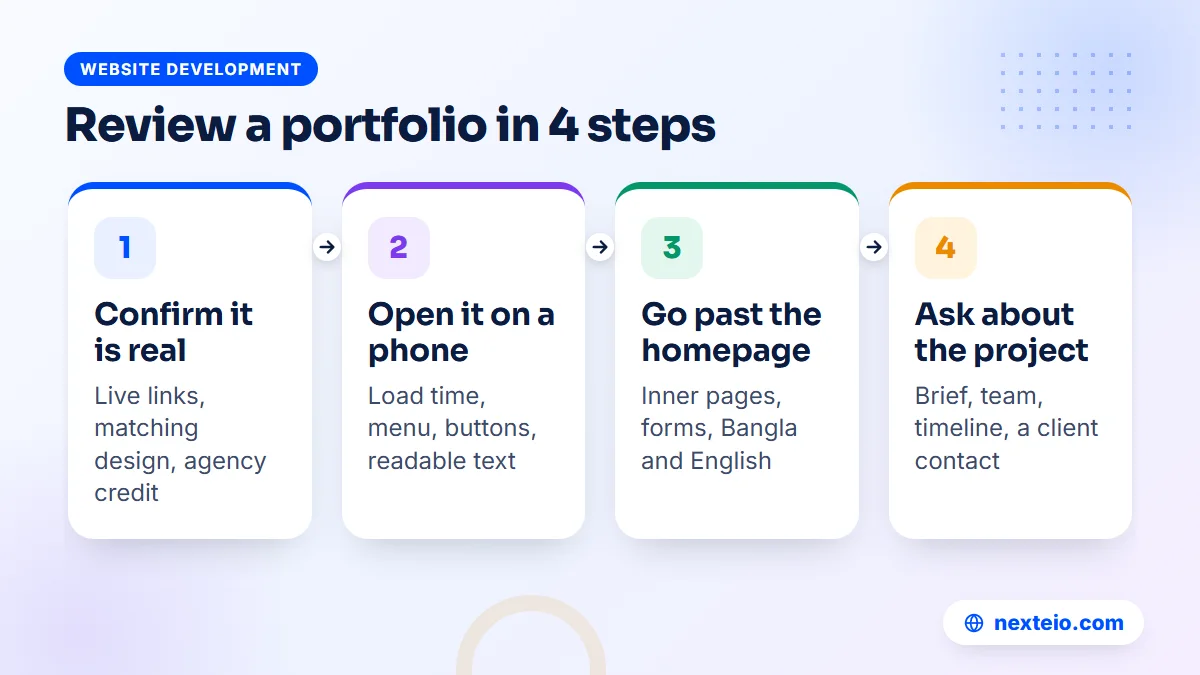
Most visitors to an organization site in Bangladesh arrive on a phone, often on mobile data rather than office Wi-Fi. So open every sample on your own phone, with Wi-Fi switched off. This is the single most useful test you can run on any web design portfolio, and it costs nothing.
As each page loads, pay attention to what you actually experience:
- Does the main text and the top image appear within a few seconds, or do you stare at a blank screen?
- Can you read the text without zooming, and tap the buttons without hitting the wrong one?
- Does the menu open and close cleanly, and can you find the contact page in two taps?
- Do large images, sliders or videos make the page jump around while it loads?
- Does the phone number open the dialer when you tap it?
Note anything that annoys you, because your own visitors will notice it too.
For a more objective view, run two or three of the agency's best samples through PageSpeed Insights. It reports Google's Core Web Vitals, which measure loading, responsiveness and visual stability. Do not reject an agency over one weak score, since the client may have added heavy content after launch. A pattern of slow samples across the whole portfolio, though, tells you how this team builds.
Speed matters for more than comfort. Slow pages lose visitors before they read anything and can hold back search visibility, as our guide on website speed and SEO explains. A team that builds fast sites by habit will usually build a fast site for you.
Step 3: Look Past the Homepage
Homepages get the most design attention in any web design portfolio. Inner pages show whether the agency carried the same care through the whole project. Pick two samples that are closest to your needs and spend ten minutes on each one, clicking through like a real visitor would.
Inner pages and content layout
Open an About page, a service or product page and a news or notice page. Check whether headings, spacing and fonts stay consistent. Look at how long text is laid out. Good designers break long content into readable sections with clear headings, while weaker ones leave walls of text or squeeze everything into tiny columns.
For corporate groups, open the page for each sister concern. A well-planned group site gives every concern a clear page with its own products, certifications and contacts, linked back to the group. A poor one lists the concerns as logos with nothing behind them. Planning that structure is a large part of any custom-designed company website.
Forms and calls to action
Find the contact or enquiry form. Is it short and clear, with labels that make sense? Does it work on a phone without the keyboard hiding the submit button? You do not need to submit a real enquiry to someone else's client, but you can see whether the form looks cared for or forgotten.
Look at how each sample asks visitors to act. Is there a clear next step on each page, such as a quote request, a call button or a catalog download? An agency that understands enquiries designs for them. Our guide on why a website gets traffic but no customers shows how often this gets missed.
Bangla, English and real content
If you need a bilingual site, look for samples that already have one. Switch languages and check whether the Bangla pages are complete, readable and set in a clean font, or whether they are a few half-translated pages. Bilingual sites take real planning, and a team that has done it well will have examples to show.
Notice whether samples use real photos of the client's people, premises and products. Real photography takes coordination, and agencies that push clients to provide it usually produce sites that build more trust.
Step 4: Check the Technical Basics Behind the Design
You do not need to be a developer to check a few technical points. These take five minutes per sample and tell you whether the agency builds properly or only decorates.
| What to check | How to check it | What a good result looks like |
|---|---|---|
| HTTPS | Look for the padlock in the browser address bar | Every page loads securely, with no warning |
| Page titles | Search Google for the client's name and read the results | Each page has a clear, specific title, not "Home" or a theme name |
| Contact links | Tap the phone number and email address on a phone | They open the dialer and the mail app directly |
| Broken pages | Click footer links and old menu items | No error pages or links to "#" |
| Platform | Ask the agency, or look for clues in the page footer | The platform suits the client's needs, not only the agency's habit |
Each check is quick, but together they show habits that affect your site for years.
Accessibility is also worth a quick look. Text should have enough contrast against its background, buttons should be large enough to tap and images should not carry text that a screen reader cannot read. The MDN accessibility guide explains the basics in plain terms, and an agency that cares about this will be happy to discuss it.
The platform question deserves a real conversation. A company profile that the office must update every week often suits WordPress, while a portal with logins and approvals may need a framework such as Laravel. Our comparison of WordPress and custom websites explains the trade-offs. A strong portfolio shows the agency choosing the right tool for each client, rather than forcing every project into one template.
Search basics matter too. Google's own SEO starter guide lists the foundations: clear titles, descriptive text, sensible page addresses and crawlable links. If the agency's samples get these right by default, you will not pay later to fix them. Our article on technical SEO basics explains each check in more detail, and ongoing ranking work belongs with an SEO service rather than the design team alone.
Related guides for buyers comparing agencies:
- A buyer's checklist for choosing a web design company
- What to check before hiring a WordPress developer
- How to hire the right Laravel developer
Each of these covers a different part of the hiring decision, so read the one that matches the platform you expect to use.
Matching a Web Design Portfolio to Your Type of Organization
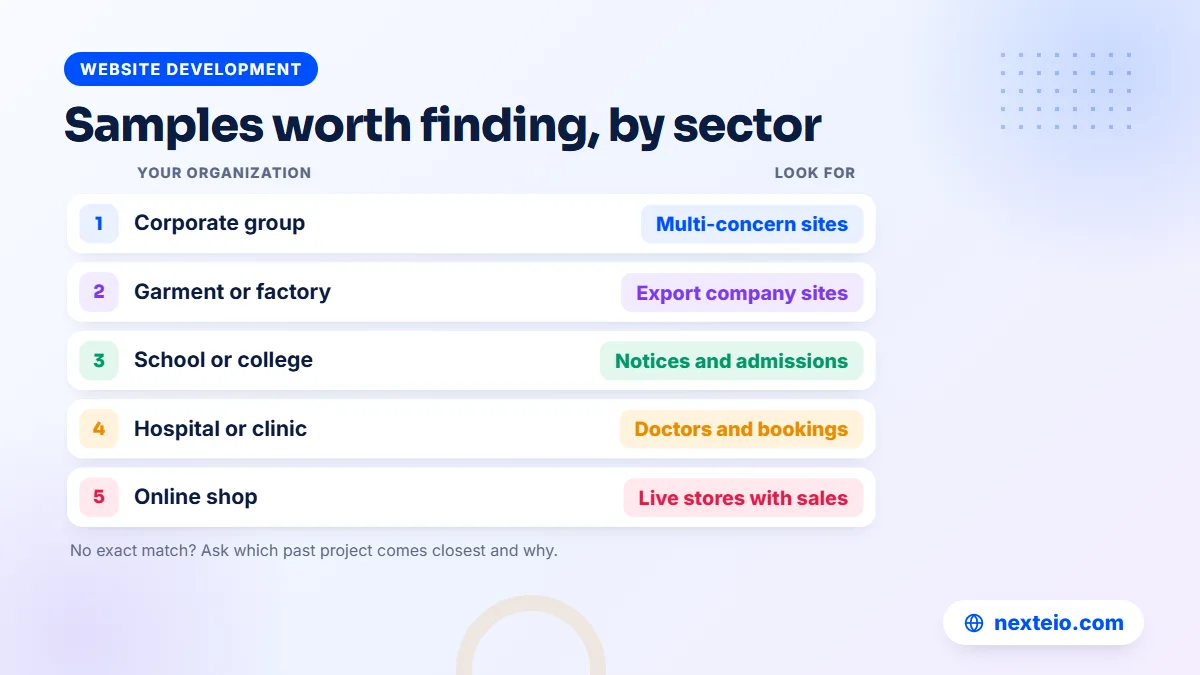
Variety in a portfolio is good, but relevance matters more. An agency does not need ten projects exactly like yours. It does need at least one or two that faced similar problems. The table below shows what to look for, depending on who you are.
| Your organization | Samples worth finding | What those samples should prove |
|---|---|---|
| Corporate group | Sites with several concerns or divisions | Clear structure, consistent branding, a page per concern |
| Garment or factory | Export-focused company sites | Product ranges, certifications, capacity and buyer contact made easy |
| School, college or madrasa | Education sites with notices and admissions | Easy notice posting, results, admission forms and a staff directory |
| Hospital or clinic | Healthcare sites with doctors and departments | Doctor schedules, departments, appointment requests and clear phone numbers |
| NGO | Non-profit sites with projects and reports | Project pages, annual reports, donor information and partner logos |
| Online shop | Live stores with real orders | Product pages, checkout on a phone, cash on delivery and mobile payment options |
If the agency has no close match, that is not automatically a problem.
Ask how they would approach your type of site and which of their existing projects comes closest. A team that built a hospital's appointment system can usually handle a diagnostic center. A team that has only built single-page sites for small shops may struggle with a university or a corporate group.
For online stores, look harder. A store sample should be a live shop that takes orders, not a demo with sample products. Ask whether the client runs cash on delivery, bKash or Nagad through the site, and whether the store still runs today. If e-commerce is your plan, see how we approach e-commerce website development for the way people in Bangladesh actually buy.
Sector experience also shows up in small details. A web design portfolio with real factory sites will show compliance badges placed where buyers look for them. A portfolio with real school sites will show notice boards that staff can update without calling the agency every time.
Case Studies: Separating a Real Story From a Gallery
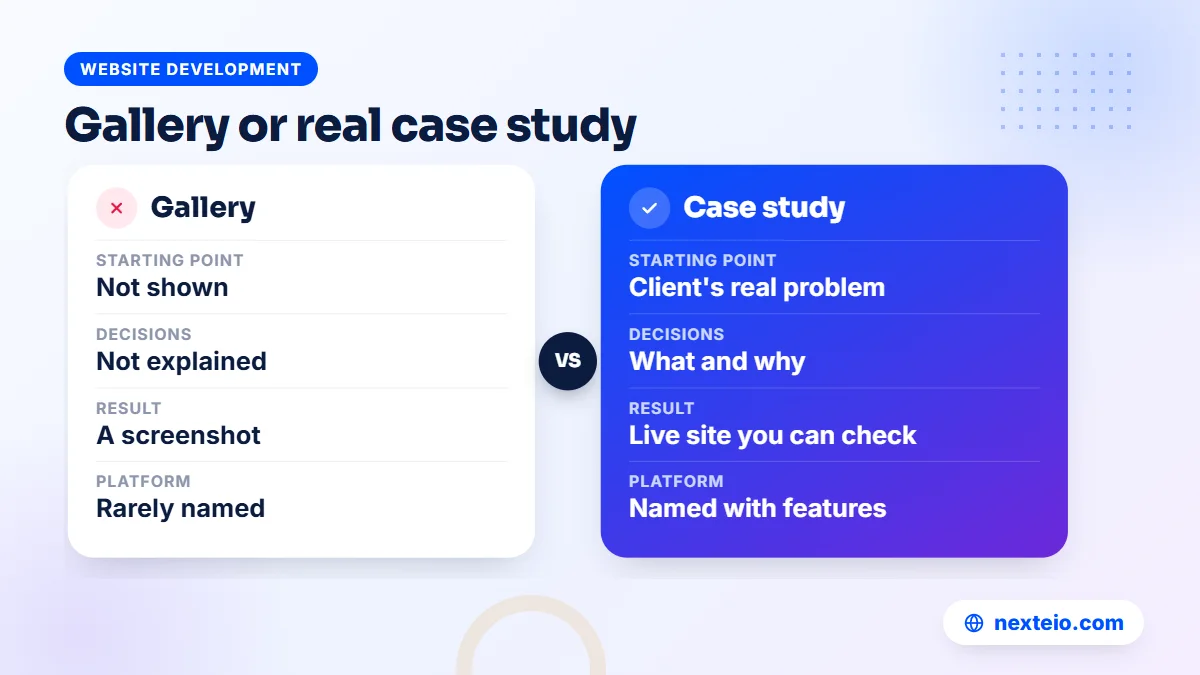
Some agencies go beyond screenshots and write case studies. A good case study is the most useful part of any portfolio, because it shows how the team thinks. A weak one is a gallery with a paragraph of marketing copy added.
A useful case study usually covers four things. It describes the client's situation before the project, in specific terms. It explains what the agency decided and why, including what it chose not to do. It shows the result, in plain words and in honest terms. And it names the platform and main features, so you can judge whether the work matches your needs.
Be careful with numbers in case studies. A claim such as "traffic increased 300%" means little without the starting point, the time period and what else changed. Honest agencies explain their numbers or avoid them. If a case study is full of large percentages and nothing else, ask for the context.
Also check whether the case study names the client, links the live site and still matches what you see. A detailed story about a project you cannot verify is still a claim, not proof. The best case studies make it easy for you to check every part of the story yourself.
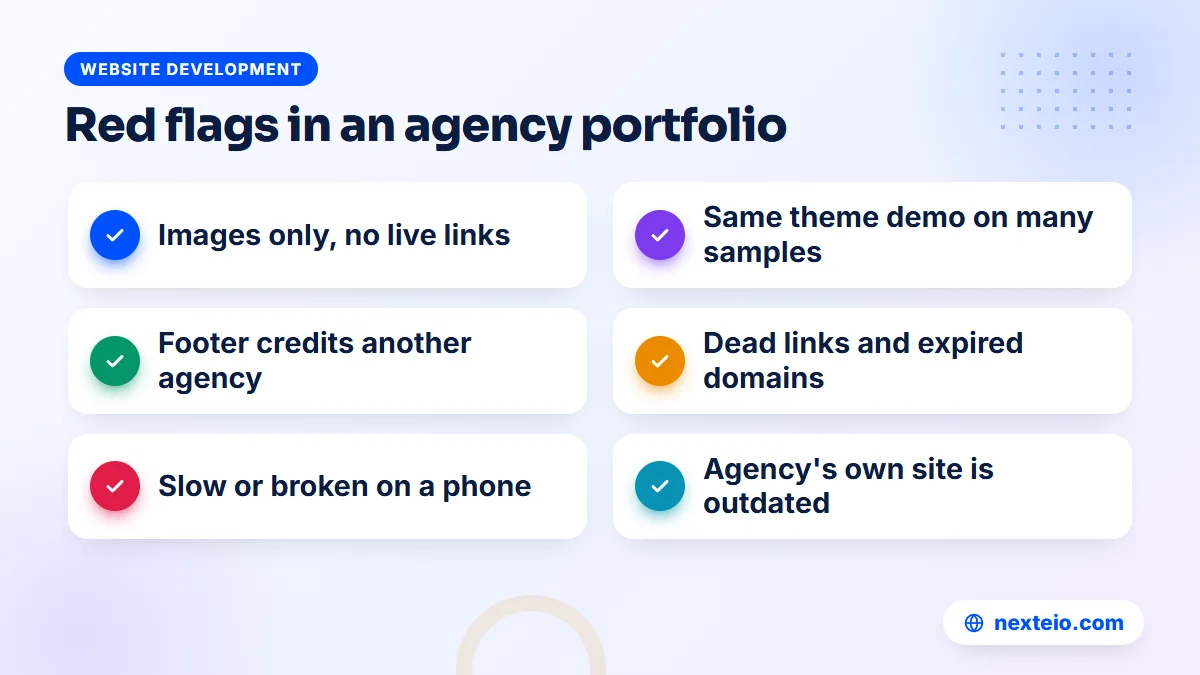
Red Flags in an Agency's Web Portfolio
Almost every web design portfolio has a weak sample or two, and that is normal. The signs below are different. They point to a pattern that should make you slow down, ask more questions or move on to the next agency on your list.
- No live links at all, only images or mockups.
- Several samples that share one theme demo, stock photos or placeholder text.
- Live sites credited to another agency in the footer.
- Many dead links or expired domains among recent projects.
- Only international brands, with no way to confirm the agency worked on them.
- Samples that break, overlap or load very slowly on a phone.
- Very old work only, with nothing from the last two years.
- The agency's own website is slow, outdated or broken.
One flag deserves a question. Several together deserve a firm no.
The last flag is often the easiest to spot. An agency's own site is the one project where it had full control of design, content and budget. If that site is slow, full of errors or clearly abandoned, it is hard to believe the agency will do better for you.
Be fair with older or offline samples, though. Clients redesign, close or change providers, and a site built well five years ago may have been altered by others since. What matters is whether the agency can explain each sample honestly when you ask.
A Scoring Sheet for Comparing Each Web Design Portfolio
When you compare three agencies, impressions blur together quickly. A simple scoring sheet keeps the comparison fair and gives you something to show your managing director or purchase committee. Pick the three samples from each agency that best match your needs, then score each area from one to five.
| Area | What a score of 5 means | Weight |
|---|---|---|
| Relevance | At least two samples close to your type of organization | High |
| Verified and live | All samples open, match the screenshots and credit the agency | High |
| Mobile experience | Fast, readable and easy to use on your own phone | High |
| Inner pages | Consistent design and clear content beyond the homepage | Medium |
| Technical basics | HTTPS, clear page titles, no broken links | Medium |
| Content and language | Real photos, clean Bangla and English where needed | Medium |
| Case studies | Clear stories with context you can check | Low to medium |
Score with two people if you can, separately, then compare.
Give high-weight areas double points. Then look at the totals alongside price and the proposal itself. The highest score does not automatically win, but a large gap in relevance or mobile experience is hard to justify with a lower price. A sheet like this also makes office approval easier, because the decision rests on reasons rather than taste.
Keep the sheet after you hire. It doubles as a list of expectations for your own project. If the agency scored well on mobile speed in its web design portfolio, your own site should meet that same standard at launch.
Questions to Ask About Specific Portfolio Projects
Once you have a shortlist, meet each agency and talk through two or three samples in detail. General questions get general answers. Questions about a specific project show you how the team really works.
- What did this client ask for, and what did you change from their first idea?
- Who from your team worked on it, and are they still with you?
- How long did it take from the first meeting to launch?
- Was it built on a theme, a page builder, or designed from a blank page?
- Who updates the content now, and how did you train them?
- What went wrong during the project, and how did you handle it?
- Do you still maintain this site? If not, who does?
- Can I speak to someone at this organization?
Listen for specifics. "The client wanted a slider, but we suggested a single strong photo because the slider slowed the page on mobile" is a real answer. "We always deliver the best quality" is not.
The question about what went wrong is often the most revealing. Every project has problems, such as late content, a change of decision maker or a hosting issue. A team that can describe a problem and how it solved it is one you can work with. A team that claims nothing ever goes wrong is either new or not being straight with you.
Reference calls are worth the effort. Ask the client contact whether the project finished on time, whether the cost stayed close to the quote and whether they would hire the agency again. Two short calls can save months of trouble.
When a Small or New Agency Has a Thin Portfolio
Every agency starts with an empty web design portfolio. A newer team with five strong samples can be a better choice than an older one with fifty weak ones, especially if the senior people give your project more attention. You just need to judge them differently.
With a thin portfolio, look at depth instead of breadth. Ask to see the full process for one project: the brief, early sketches or wireframes, design drafts and the final site. Ask who will do your work and look at their individual experience. A designer or developer with solid past work at another company brings that skill with them.
Personal projects and rebuilt concepts can also help, as long as the agency labels them honestly. A redesign concept for a well-known local brand shows design thinking, but it should be presented as a concept, not as client work.
Reduce your risk with structure. Split payments by milestone, agree on a written scope, and make sure the domain and hosting are in your organization's name from day one. These steps protect you with any agency, but they matter most when the track record is short.
How Portfolio Quality Relates to Price
A strong portfolio does not guarantee a high price, and a high price does not guarantee strong work. Still, the samples you see should roughly match the price you are quoted. If an agency shows large custom corporate sites but quotes you the price of a template site, ask what will be different about your project.
For reference, these are typical market ranges in Bangladesh for a company or business website:
- Theme-based site: about BDT 25,000 to 60,000.
- Custom design: about BDT 60,000 to 150,000.
- Large corporate site with integrations: about BDT 150,000 to 400,000 or more.
School and madrasa sites usually fall around BDT 20,000 to 60,000, colleges around 50,000 to 120,000 and universities 150,000 to 400,000 or more.
Use the web design portfolio to understand which band each agency really works in. If most samples are theme-based sites with stock photos, expect theme-based work even if the proposal says "custom". If the samples show unique layouts, real photography and features built around each client, a custom website design quote in the middle or upper band makes more sense.
Also compare what each quote includes. Content writing, photography, Bangla translation, training, hosting setup and post-launch support are often listed separately. Two quotes with the same total can buy very different projects. For a deeper look at how proposals differ, see our website development guides.
Turning Your Review Into a Decision
By this point you have a scoring sheet, notes from meetings and perhaps one or two reference calls. Bring them together in a short summary for whoever approves the budget. In many organizations, that means a one-page note for the managing director, the principal or a purchase committee.
A clear decision note usually covers:
- The three agencies reviewed and their total scores.
- The two or three samples from each that matched your needs best.
- Any red flags found and how the agency answered them.
- Price, timeline and what each quote includes.
- Your recommendation and the main reason for it.
Keep the note short enough to read in five minutes. Decision makers rarely read long reports, but they do respect a clear comparison.
Before signing, ask the chosen agency to confirm in writing which past project is closest to what you will get. That sample becomes a shared reference point. If the design, speed or quality of your site falls short of it, you have a concrete standard to point to. Ask, too, whether your finished project may appear in their portfolio, and agree on what can be shown.
How Nexteio Can Help
We build websites for companies, corporate groups, factories, schools, clinics and NGOs across Bangladesh, and we are glad to be judged by the same checks in this guide. Our portfolio links to work you can open on your own phone, and we can talk through how any sample was planned, built and handed over.
Most of our projects start with your needs, not a theme. Through our custom website design service, we plan the page structure, design layouts around your real content and build sites that load well on mobile data. Where WordPress suits the client better, we build on WordPress so your office can update notices and news. Where you need logins, approvals or records, we build Laravel web applications.
If you are comparing agencies now, send us your requirements and we will point you to the samples that best match your type of organization. You can share your project details on our brief form, learn more about Nexteio, or reach us through the contact page. When you are ready, start a project and we will walk you through a plan for your custom site, step by step.
Keep reading: how to write website content people actually read or how to build a landing page that turns visits into enquiries.
Frequently asked questions
How many samples should a web design portfolio include?
There is no fixed number. Six to ten live, recent and varied samples are usually enough to judge an agency, as long as one or two are close to your type of organization. A long list of old or broken sites tells you less than a short list of strong ones you can open and test.
Is it fine if an agency cannot share some client projects?
Yes, some clients ask not to be listed, especially for internal portals or government work. A good agency can still describe those projects in general terms and show other work that is public. It becomes a concern only when almost nothing can be shown or verified.
How can I tell whether a sample site was built on a theme?
Look for the same layout, stock photos or placeholder text appearing across several samples, and for a theme name in the page footer. Simply asking the agency is often the quickest route. Theme-based sites are not bad in themselves, but you should know what you are paying for.
Should the agency's own website count as part of its portfolio?
Yes. It is the one project where the agency had full control over design, content, speed and budget. If its own site is slow, outdated or full of errors, that is a fair signal about how it treats client work.
What if a sample looks great but loads slowly on my phone?
Ask about it before drawing a conclusion. The client may have added large images or extra plugins after launch. If several samples are slow, though, it is likely a habit of the agency, and you should ask how they would keep your site fast on mobile data.
Can I ask to speak with one of the agency's past clients?
Yes, and a confident agency will usually arrange it. Ask the client whether the project finished on time, whether the cost stayed close to the quote and how the agency handled problems. One or two short calls are often more useful than any gallery.
Will my finished website appear in the agency's portfolio?
Many agencies ask to show completed work, and most clients agree. If you prefer to keep it private, or want only certain pages shown, say so before you sign and put it in the agreement. Internal systems such as staff portals are normally kept out of public galleries.