Stripe Payment Gateway in Bangladesh: Can Your Website Use It?
In this article 15 sections
- 1.The Short Answer: Is the Stripe Payment Gateway Available in Bangladesh?
- 2.What Stripe and PayPal Actually Do
- 3.What "Not Supported" Means in Practice
- 4.Workarounds People Try, and Why Most Go Wrong
- 5.The Foreign Company Route: When a Stripe Payment Gateway Makes Sense
- 6.Local Payment Gateways That Work Today
- 7.bKash, Nagad and Mobile Wallet Payments on a Website
- 8.Cash on Delivery and Manual Payments Still Matter
- 9.Stripe Payment Gateway vs Local Gateways: Side by Side
- 10.Taking Payments From Customers Abroad
- 11.What You Need to Apply for a Local Gateway
- 12.Building Checkout Into Your Website
- 13.Fees, Settlement and Refunds: Questions to Ask
- 14.How Nexteio Can Help
- 15.Frequently asked questions
If you run a business in Bangladesh and want customers to pay by card on your website, the Stripe payment gateway is usually the first name that comes up. Developers love its documentation, international shops use it everywhere, and PayPal is the other name people mention in the same breath. The problem is simple: neither service lets a business based in Bangladesh open a normal merchant account today.
That does not mean you cannot take online payments. Shops, schools, coaching centres, clinics and exporters in Bangladesh collect money online every day. They use local gateways that accept Visa and Mastercard, mobile wallets such as bKash and Nagad, internet banking, and still a lot of cash on delivery.
This guide explains what Stripe and PayPal actually do, why the common workarounds are risky, when a foreign company route makes sense, and which local options suit which kind of seller. It ends with the practical side: what a gateway application needs, how checkout is built into a website, and the questions to ask about fees, settlement and refunds.
The Short Answer: Is the Stripe Payment Gateway Available in Bangladesh?
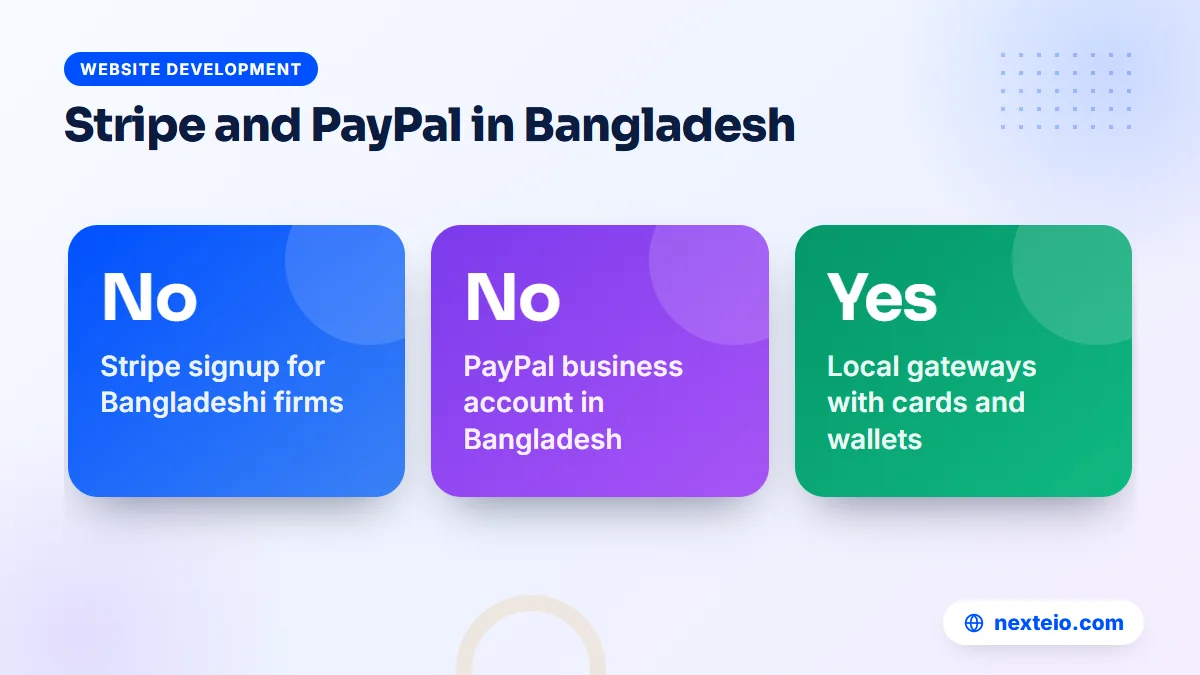
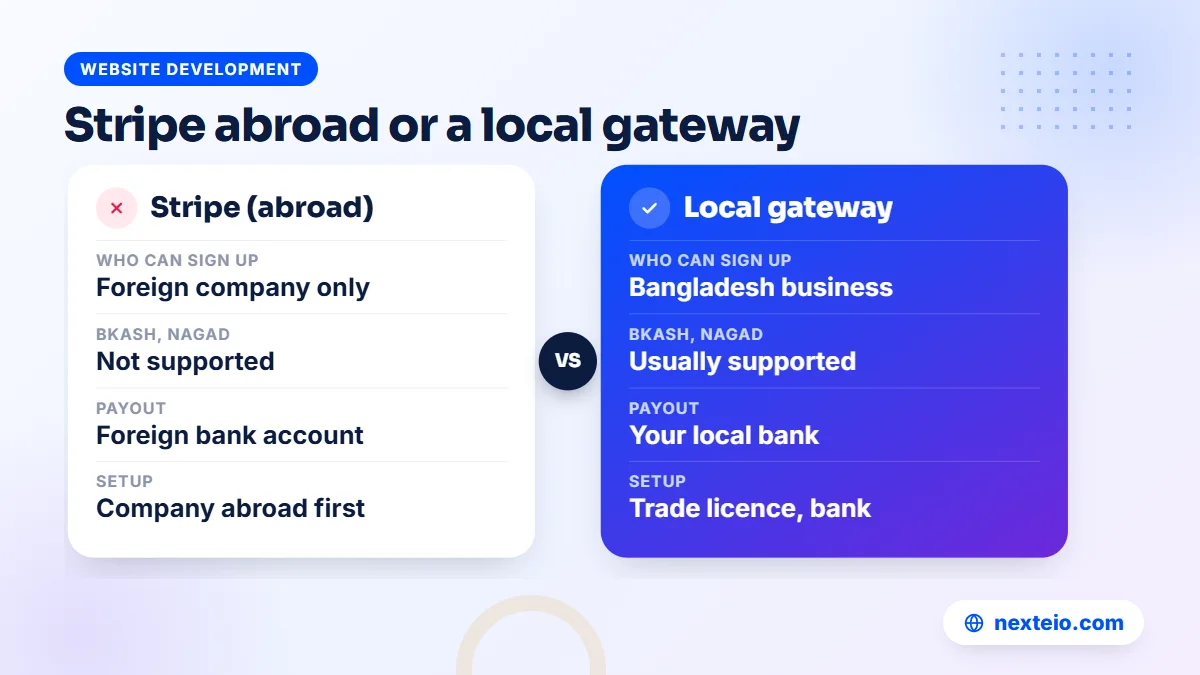
No, not for a business registered in Bangladesh. Stripe lets businesses sign up only from the countries on its list of supported countries, and Bangladesh is not on that list at the time of writing. When you create a Stripe account, you must choose the country where your business is registered, and the bank account for payouts must be in a supported country too.
PayPal is in a similar position. A person in Bangladesh may be able to pay with a card on a site that uses PayPal, but a Bangladeshi business cannot open a PayPal business account to receive payments into a local bank. PayPal keeps its own worldwide country list, and it is worth checking that page yourself before you plan around it, because these lists do change.
So the honest answer for most readers has three parts:
- You cannot simply add a Stripe or PayPal button to a Bangladeshi business website and receive the money in a local bank.
- There is a legitimate route through a company registered abroad, but it involves legal, tax and foreign exchange questions, and it only suits certain businesses.
- For selling to customers inside Bangladesh, local gateways and mobile wallets are usually the better choice anyway, because they support how people here actually pay.
The rest of this guide takes each of these points in turn.
What Stripe and PayPal Actually Do
It helps to know what the Stripe payment gateway would give you, so you can judge the local alternatives fairly. Stripe is a payment processor and a developer platform. As a Stripe payment provider, it takes the card details on a secure form, checks the payment with the card network and the customer's bank, holds the funds for a short period and pays them out to your bank account. It also handles refunds, disputes, recurring billing and fraud screening.
What made Stripe popular is less the processing itself and more the tools around it. The Stripe payment processor comes with clean APIs, ready-made checkout pages, test modes that copy real behavior, and plugins for most shop platforms. Each Stripe payment method, such as cards, Apple Pay, Google Pay or bank debits in some countries, is turned on from one dashboard. The Stripe payments documentation shows how much of this is ready to use.
PayPal works a little differently. Customers often pay from a PayPal balance or a card saved in their PayPal account, so they never type card details on your site. Buyers abroad trust it, which is why freelancers and exporters ask about it. As a PayPal payment gateway on a website, it shows a PayPal button at checkout and sends the buyer to PayPal to confirm.
What any payment gateway does
Strip away the brand names and every gateway does the same core jobs. Knowing them makes it easier to compare a local provider with Stripe on equal terms:
- Shows a secure payment page or form, so your website never stores card numbers.
- Sends the payment request to the card network, bank or wallet for approval.
- Tells your website whether the payment succeeded, usually through a server-to-server message.
- Collects the money and settles it to your bank account after a set period, minus its fee.
- Handles refunds and disputes when a customer asks for their money back.
Local gateways in Bangladesh do all five. The differences are in the quality of the developer tools, the payment methods offered, the speed of settlement and how support works when something goes wrong.
What "Not Supported" Means in Practice
Some people read "not supported" as meaning the Stripe payment gateway is just harder to set up. It is more serious than that. A Stripe account is tied to a legal business, a country and a bank account in that country. Stripe checks identity and business details, often again later as the account grows. If the details do not match reality, the account can be closed and the money in it held.
This is the part most shortcuts ignore. Stripe online payment accounts are not judged once at signup. Payment providers keep reviewing accounts, especially when sales jump, when refunds or disputes rise, or when the person logging in seems to be in a different country from the business. A store that runs well for three months can be frozen in the fourth, with customer money inside.
PayPal follows the same logic. Its user agreement requires accurate information about who you are and where you live, and limited or closed accounts can have funds held for a long period. For a small business, losing access to a few months of income is far worse than never having used the service at all.
Workarounds People Try, and Why Most Go Wrong
You will find plenty of videos and posts explaining how to "get Stripe in Bangladesh". Most describe one of a few methods. Here is how they compare on risk:
| Workaround | How it works | Main risk |
|---|---|---|
| A relative's or friend's account abroad | Payments go into someone else's Stripe or PayPal account | The account belongs to them, not you; closure or a family dispute ends your income |
| A false address in a supported country | Signing up with an address where you do not live or trade | Breaks the provider's terms; accounts are often closed and funds held |
| Buying a ready-made verified account | Paying a stranger for a "verified" account | Identity fraud risk, no legal claim to the funds, very likely to be shut down |
| A real company registered abroad | Forming a legal company in a supported country with its own bank account | Legitimate, but brings tax, accounting and Bangladesh foreign exchange questions |
The first three are not clever shortcuts.
Each of them puts your income in an account you do not legally control. The fourth is a real route, and the next section explains who it suits.
There is also a quieter cost. A website built around a borrowed or false account cannot grow normally. You cannot show a clear refund policy tied to your own company, you cannot answer a payment provider's review honestly, and you cannot plan around income that may vanish. Customers who pay and then find the order delayed because the account was frozen do not come back.
The Foreign Company Route: When a Stripe Payment Gateway Makes Sense
Some Bangladeshi founders form a company in a country Stripe supports, open a bank account for it there, and use the Stripe payment gateway through that company. Stripe itself offers Stripe Atlas, a service that helps founders form a US company and set up the accounts that go with it. Other founders use company formation services in the UK, Singapore or the UAE.
This can make sense when most of your customers are abroad and pay in foreign currency. Examples include a software company selling monthly subscriptions to users in Europe, a design studio selling templates to buyers worldwide, or an online course aimed at an international audience. For these businesses, cards and wallets that foreign buyers already use matter more than bKash.
It makes much less sense for a shop selling to customers in Bangladesh. Your buyers mostly pay by mobile wallet or cash, your costs are in taka, and the foreign company adds yearly fees, separate accounts and tax filings in another country. A local store does not need any of that to take payments.
Questions to settle before you go abroad
- Foreign exchange rules: Bangladesh regulates how residents invest, hold money and own companies abroad. Read the rules published by Bangladesh Bank and get advice before moving money or forming a company outside the country.
- Tax in two places: the foreign company may owe tax and filings where it is registered, and you may have obligations in Bangladesh too.
- Bringing money home: plan how earnings will reach Bangladesh legally, and what documents your bank will ask for.
- Ongoing costs: registered agent fees, accounting, annual reports and bank charges continue whether you sell or not.
- Who controls it: the company, the bank account and the Stripe account should all be in the founders' names, with proper records.
A chartered accountant and a lawyer who know cross-border business are worth paying here.
A website developer, including us, can build the checkout. We cannot give tax or legal advice, and you should not rely on anyone who claims the setup is simple and risk-free.
Local Payment Gateways That Work Today
For most businesses selling inside Bangladesh, the practical answer is a local payment gateway. These companies sign merchant agreements with Bangladeshi businesses, connect to local banks and mobile wallets, and settle money into your local bank account in taka. SSLCOMMERZ is one of the best-known names, and there are several others, including aamarPay and shurjoPay.
A typical local gateway shows customers one payment page with several choices. Exact options depend on the provider and your agreement, but they commonly include:
- Visa, Mastercard and American Express cards issued in Bangladesh.
- Cards issued abroad, where your agreement and the acquiring bank allow it.
- Mobile wallets such as bKash, Nagad, Rocket and Upay.
- Internet banking from several local banks.
- Local debit cards such as DBBL Nexus.
For a local buyer, this page is often more useful than a Stripe checkout would be. Many customers here do not hold a credit card, but nearly everyone who shops online has a mobile wallet. A gateway that offers both catches far more of your buyers.
Bangladesh Bank licenses and supervises payment system operators and payment service providers. Before you sign, ask the gateway about its regulatory status, which bank handles its settlements and how disputes are resolved. A reputable provider answers these questions without hesitation.
If you are building a shop and want the payment side planned from the start, our e-commerce website development work covers gateway selection, integration and testing. Our planning guide to ecommerce website development in Bangladesh also explains how payments fit into the wider budget.
bKash, Nagad and Mobile Wallet Payments on a Website
Mobile wallets deserve their own section because they are how a large share of online orders in Bangladesh are paid. There are two ways to accept them on a website.
The first is through an aggregator gateway, such as the local providers above, which shows bKash and Nagad alongside cards on one payment page. You sign one agreement, receive one settlement and manage one integration. This is the simpler route for most small and mid-sized shops.
The second is a direct merchant integration with the wallet provider itself, such as the bKash payment gateway for merchants. This usually suits larger sellers with high wallet volume, because it can mean lower costs per payment and a checkout that opens the wallet directly. It also means a separate application, a separate integration and separate reconciliation for each wallet.
The manual "send money" method
Many small shops still ask customers to send money to a personal or merchant wallet number and type the transaction ID into a form. It costs nothing to set up, which is why it is popular. It also creates work and risk: staff must check every transaction by hand, fake or mistyped transaction IDs slip through, and personal wallet numbers are not meant for business income.
If you take more than a handful of orders a day, move to a proper merchant account or gateway. The order is then marked paid automatically, the customer gets a confirmation at once, and your records match the money in your account without anyone copying numbers from SMS messages.
Cash on Delivery and Manual Payments Still Matter
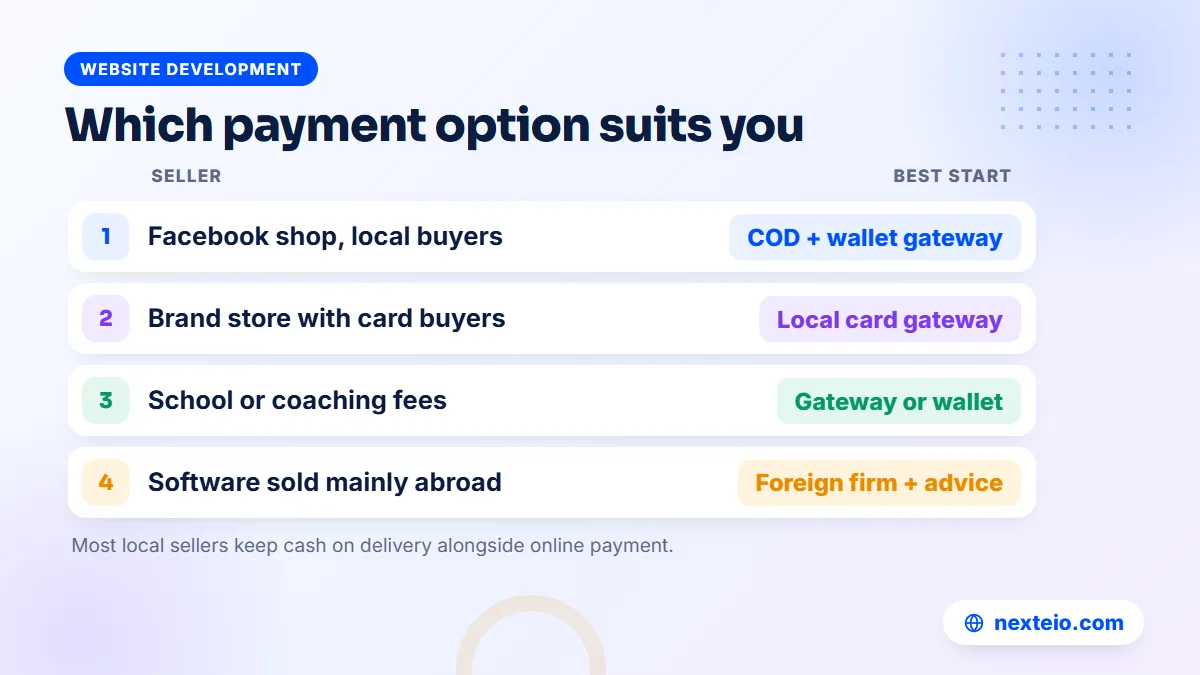
No gateway removes cash on delivery from Bangladeshi e-commerce. Many first-time buyers will only order if they can pay when the parcel arrives, especially from a shop they found through a Facebook ad. Turning off cash on delivery to push online payment often reduces orders more than it reduces returns.
A sensible setup offers both, and uses the website to nudge buyers toward paying in advance. These steps work well in most online shop builds:
- Show the online payment option first, with a short line on why it is faster.
- Ask for a small advance to cover delivery charges on cash orders, especially to distant districts.
- Confirm cash orders by phone before shipping, so fake orders are caught early.
- Track return rates by payment method, so you know what cash on delivery really costs you.
Schools, coaching centres and clinics have a different version of the same question. Parents may prefer paying fees at the counter or by bank deposit. An online option through a gateway or wallet adds convenience, but the office must still accept other methods and record them in one place.
Related guides for shop owners planning checkout:
- Why a website gets traffic but no customers
- How to create a high-converting landing page
- What an ecommerce SEO service includes
Stripe Payment Gateway vs Local Gateways: Side by Side
The table below compares the options a Bangladeshi business realistically has. It is a summary for planning; the details of any one provider depend on its current terms and your agreement with it.
| Option | Who can use it | How customers pay | Money arrives in | Best for |
|---|---|---|---|---|
| Stripe through a foreign company | A legally formed company in a supported country | International cards and wallets | The foreign company's bank account | Software, courses and products sold mainly abroad |
| PayPal through a foreign company | Businesses in countries PayPal serves | PayPal balance or cards | The foreign company's account | Buyers abroad who prefer PayPal |
| Local aggregator gateway | Businesses registered in Bangladesh | Local and foreign cards, wallets, internet banking | Your local bank account, in taka | Most shops, institutions and service firms |
| Direct wallet merchant account | Registered businesses that meet the wallet's terms | That wallet only | Your merchant wallet or bank account | High-volume sellers with many wallet payments |
| Cash on delivery | Any seller with courier support | Cash to the courier | Your account after courier settlement | First-time buyers and low-trust orders |
Read across the "best for" column and the decision usually makes itself.
A Stripe payment gateway is the right tool for a narrow group of businesses selling abroad. For everyone else, a local gateway plus cash on delivery covers nearly every buyer.
Taking Payments From Customers Abroad
Some readers ask about Stripe because their customers are outside Bangladesh. The answer depends on what you sell and how much.
Garment and other exporters usually do not need a website checkout at all. Large orders are paid by letter of credit or bank transfer through the formal banking system, and the website's job is to win the buyer's trust before the meeting. A clean, fast company site with product lines, certifications and a clear enquiry form does more for an exporter than any payment button. Our custom website design work is often about exactly that.
Smaller sellers with foreign customers, such as a handicraft shop or a tour operator, can often accept foreign cards through a local gateway, provided the merchant agreement includes international cards. Ask for this specifically, because it is sometimes a separate approval with its own checks.
NGOs and charities that collect donations from abroad face extra rules on foreign contributions, and should confirm what is allowed before adding any donation button. Freelancers paid by foreign clients usually use marketplace payouts or bank transfers rather than a payment gateway on their own site.
What You Need to Apply for a Local Gateway
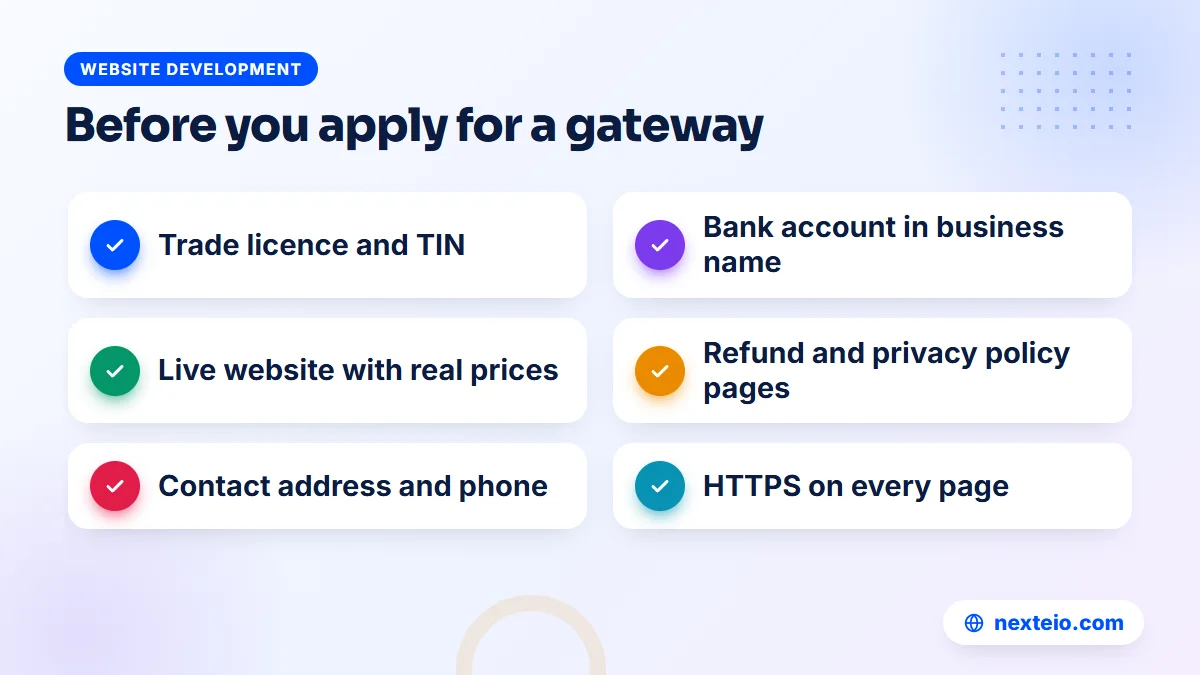
Gateways check both the business and the website before they approve a merchant account. Requirements vary by provider, but applications usually ask for:
- A valid trade licence for the business.
- A tax identification number (TIN), and a BIN where VAT registration applies.
- The national ID of the owner or directors.
- A bank account in the business's name, often with a cheque leaf or bank letter.
- Company documents for a limited company, such as the incorporation certificate and memorandum.
- A live website or app where the gateway can review your products and policies.
The website review is where many applications stall. A gateway wants to see a real business: products or services with clear prices, a physical address, a phone number and email, and published policies. At a minimum, prepare these pages:
- Refund and return policy: when customers can return items, how refunds are paid and how long they take.
- Delivery policy: delivery areas, charges and expected times.
- Privacy policy: what customer data you collect and how you use it.
- Terms and conditions: the rules of buying from you.
- About and contact pages: who runs the business and how to reach you.
These pages help more than the application. They answer the questions buyers have before they pay, and they make disputes easier to settle. A site built by an experienced team will include them as standard, and our guide to building a professional business website covers the rest of what buyers look for.
Building Checkout Into Your Website
Once a gateway approves you, it provides credentials for a test environment, usually called a sandbox, and later for the live system. The integration then depends on how your website is built.
WordPress and WooCommerce shops
For a WordPress website running WooCommerce, most local gateways offer a plugin. Installing it takes minutes; configuring it properly takes longer. Set the store currency to BDT, enter the sandbox credentials, place test orders with every payment method, and check that orders move to the right status when a payment succeeds, fails or is cancelled. Only then switch to live credentials.
Laravel and custom applications
For a custom store, school fee portal or booking system, a developer connects to the gateway's API directly. This gives more control over the checkout and the order records, but it needs care. Our Laravel web application projects handle payment integration this way, and our article on hiring the right Laravel developer explains what experience to look for.
Rules that apply to every checkout
- Never store card numbers on your own server. Let the gateway's page or form collect them.
- Confirm payments through the gateway's server notification or validation API, not only the page the customer lands on after paying.
- Check that the amount and currency in the gateway's response match the order before marking it paid.
- Run the whole site on HTTPS, not just the checkout page.
- Log every payment response, so disputes and missing payments can be traced.
The second point is the one that catches new developers. A customer can close the browser before the return page loads, or a dishonest user can try to open the success page directly. Orders should only be marked paid when the gateway itself confirms the payment from server to server.
Fees, Settlement and Refunds: Questions to Ask
Gateway pricing in Bangladesh is usually a percentage of each successful payment, and the rate often differs by method: local cards, foreign cards, mobile wallets and internet banking may each carry a different rate. Some providers also charge setup or yearly fees. Rates can be negotiated as your volume grows, so ask for the current schedule in writing rather than relying on a sales call.
Before you sign, get clear answers to these questions:
- What is the fee for each payment method, and are there setup, yearly or withdrawal charges?
- How many working days after a payment does money reach our bank account?
- Is there a minimum settlement amount or a holding period for new merchants?
- How are refunds made, who pays the fee on a refunded payment, and how long do refunds take to reach the customer?
- How are card disputes and chargebacks handled, and what evidence will you need from us?
- Which reports can we download for our accounts team, and in what format?
- Who do we contact when a payment is stuck, and during what hours?
Settlement matters more than many sellers expect.
A shop running an Eid campaign can take a large volume of payments in a few days. If settlement is slow, stock purchases and courier bills can squeeze cash flow at exactly the wrong time. Bank holidays also delay settlement, so plan for them.
Payment choice affects marketing too. If you run ads, the checkout must report successful purchases back to your ad accounts, or the platforms optimize blindly. Our guide to Meta Ads conversion tracking explains how purchase events are set up, and our Facebook ads service uses that data to spend your budget on buyers who complete payment.
How Nexteio Can Help
We build online stores and payment-enabled websites for businesses and institutions in Bangladesh, and we plan the payment side around how your customers actually pay. Through our e-commerce website service, we help you choose between a local gateway, direct wallet payments and cash on delivery, prepare the pages and policies gateways ask to see, and integrate the gateway you sign with.
On the technical side, our work covers sandbox testing, server-side payment confirmation so orders are only marked paid when the gateway confirms them, and testing of every payment method and failure case before going live. For WooCommerce stores we configure the gateway plugin properly; for custom shops, fee portals and booking systems we build the integration in Laravel.
If your business sells mainly abroad and has a legally formed foreign company, we can build checkout on the Stripe payment gateway for that company, while your accountant and lawyer handle the legal side. You can learn more about how we work, see examples in our portfolio, or tell us about your store and payment needs. For a quick question, our contact page reaches the team directly, and our online store development page lists what a build includes.
Keep reading: WordPress or a custom website for your store, a buyer's checklist for choosing a web design company, or browse all our website development guides. When you are ready to plan your checkout, share a short project brief with us.
Frequently asked questions
Can I open a Stripe account with a Bangladeshi trade licence?
No. Stripe asks for the country where your business is registered, and Bangladesh is not one of its supported countries at the time of writing. A trade licence from Bangladesh cannot be used to open a Stripe account that pays out to a local bank.
Is it legal to use the Stripe payment gateway through a US company?
Forming a real company abroad and using Stripe through it is a legitimate business structure, but Bangladeshi residents must also follow Bangladesh's foreign exchange and tax rules. Those rules affect owning a company abroad and bringing money home. Get advice from a chartered accountant and a lawyer before you set it up.
Can customers in Bangladesh pay on websites that use Stripe or PayPal?
Often yes, as buyers. A customer with an international-enabled card can usually pay a foreign website that uses Stripe or PayPal, subject to the card's limits and the bank's rules. The restriction is on businesses in Bangladesh receiving payments, not on paying.
What is the best alternative to the Stripe payment gateway for a local shop?
For a shop selling inside Bangladesh, a local aggregator gateway is usually the best starting point, because one integration covers cards, bKash, Nagad and internet banking. Most shops keep cash on delivery as well. Large sellers with many wallet payments may later add a direct wallet merchant account.
Can a local gateway accept cards issued abroad?
Many can, but it is not always switched on by default. International card acceptance may need separate approval and extra checks on your business and website. Ask for it during the application if you expect foreign customers.
How long does it take to get a local payment gateway approved?
It depends on the provider and how complete your documents and website are. Applications move faster when the trade licence, TIN, bank details and owner ID are ready and the website already shows prices, policies and contact details. Missing refund or privacy pages are a common reason for delays.
Do I need a developer to add a payment gateway to my website?
For a standard WooCommerce store, a plugin and careful setup may be enough, though testing every payment and failure case still takes some skill. For custom shops, fee portals and booking systems, a developer is needed to connect the gateway's API and confirm payments safely on the server.