Free Blog Sites: What You Really Get and Where the Limits Are
In this article 16 sections
- 1.What "Free" Really Means on Free Blog Sites
- 2.The Main Free Blog Sites Compared
- 3.Blogger: The Free Blog Website With the Fewest Strings
- 4.WordPress.com Free Plan vs the Free WordPress Software
- 5.Medium and Substack: Readers First, Ownership Second
- 6.Wix, Google Sites and Other Free Blog Builders
- 7.The Real Limits of Free Blog Sites
- 8.Who Owns Your Posts on Free Blogging Platforms
- 9.Free Blog Sites and SEO: What Google Sees
- 10.Earning From a Free Blog in Bangladesh
- 11.When a Free Blog Is Enough and When to Pay
- 12.Starting a Free Blog Without Boxing Yourself In
- 13.Moving From a Free Blog to Your Own Site Later
- 14.Common Mistakes People Make With Free Blog Sites
- 15.How Nexteio Can Help With Your Blog
- 16.Frequently asked questions
Free blog sites let anyone publish online without paying for hosting, a domain or a developer. You sign up, pick a theme and write your first post in under an hour. For a student, a hobby writer or a small organization testing an idea, that is a real gift.
The catch is that "free" always comes with conditions. Some platforms place their own ads on your pages. Some keep your address on their subdomain unless you upgrade. Some let you write but not earn, and a few make it hard to leave with your posts and readers intact.
Those conditions matter more for a business, school or NGO than for a personal diary. A coaching centre that builds a following on a free platform and then finds it cannot run its own ads, or cannot move its address, has lost time it will not get back.
This guide compares the main free options people in Bangladesh actually use, explains what each one gives and holds back, and shows when a free blog is the right call and when paying a little each year saves you trouble later.
What "Free" Really Means on Free Blog Sites
Every platform has server, staff and storage costs, so a free plan has to be paid for somehow. Knowing how a platform earns from you tells you where its limits will show up. There are four common models.
- Upselling: the free plan is a trial in disguise. Your own domain, more storage, removing branding or adding plugins all sit behind a paid plan.
- Platform ads: the company shows its own adverts on your pages and keeps the income.
- Audience and data: the platform grows by hosting your writing for its readers, and your posts help it attract visitors.
- A cut of your earnings: publishing is free, but the platform takes a share when readers pay you.
None of these models is unfair. They just shape what you can do. Free blog sites that run on upselling will keep nudging you toward a plan. One that runs on platform ads will not let you place your own ads in the same spots. Read the plan page before you write anything, not after you have fifty posts.
The Main Free Blog Sites Compared
Six options come up most often when people ask which free blogging platforms are worth using. The table shows what each one gives on its free tier. Features change over time, so treat this as a starting point and check each platform's current plan page before you commit.
| Platform | Free address | Platform ads or branding | Own domain on free use | Easy to export posts |
|---|---|---|---|---|
| Blogger | name.blogspot.com | No platform ads | Yes (you pay only for the domain) | Yes, as a backup file |
| WordPress.com free plan | name.wordpress.com | Yes, platform ads shown | No, needs a paid plan | Yes |
| Medium | A profile on medium.com | No ads, but a reader paywall | Not on a free account | Partly, as an archive |
| Substack | name.substack.com | No ads | Paid add-on | Yes, posts and email list |
| Wix free plan | A wixsite.com address | Yes, Wix banner shown | No, needs a paid plan | Very limited |
| Google Sites | A sites.google.com address | No ads | Yes | Not a true blog |
Two things jump out. Blogger is the only one that combines no platform ads, a free custom domain connection and your own display ads. And the more a platform helps you find readers, as Medium and Substack do, the less control it gives you over the page itself.
Blogger: The Free Blog Website With the Fewest Strings
Blogger has belonged to Google since 2003 and is still completely free. You sign in with a Google account, choose a blogspot.com address and start writing. There is no paid tier to upgrade to, which means there is also no plan page pushing you to spend.
For a free blog website, its strengths are hard to match. You can connect your own domain at no extra cost beyond the domain itself, and HTTPS works on both blogspot and custom addresses. Google AdSense is built into the dashboard. You can edit the theme's HTML, add gadgets to the sidebar, set a search description for each post and download a backup of all your content from the settings.
The limits are real too. There are no plugins, so features such as booking forms, online payments or member logins need outside tools or custom code. The editor is basic, and many free themes found online are poorly coded or carry hidden links. Google also sets Blogger content policies, and a blog that breaks them can be removed.
Blogger suits news pages, personal and niche blogs, school notice blogs and small publishers who want to earn from AdSense. If you want a cleaner theme, your own domain and the basic SEO settings done properly, our Blogger website setup service covers exactly that.
WordPress.com Free Plan vs the Free WordPress Software
This is the most common confusion among people searching for a free blog builder. There are two different things called WordPress, and only one of them is a hosted free blog.
WordPress.com is a hosting company. Its free plan gives you a wordpress.com subdomain, a small storage allowance, a limited set of themes and platform ads on your pages. You cannot install plugins, you cannot connect your own domain and you cannot run AdSense on the free plan. Each of those needs a paid plan.
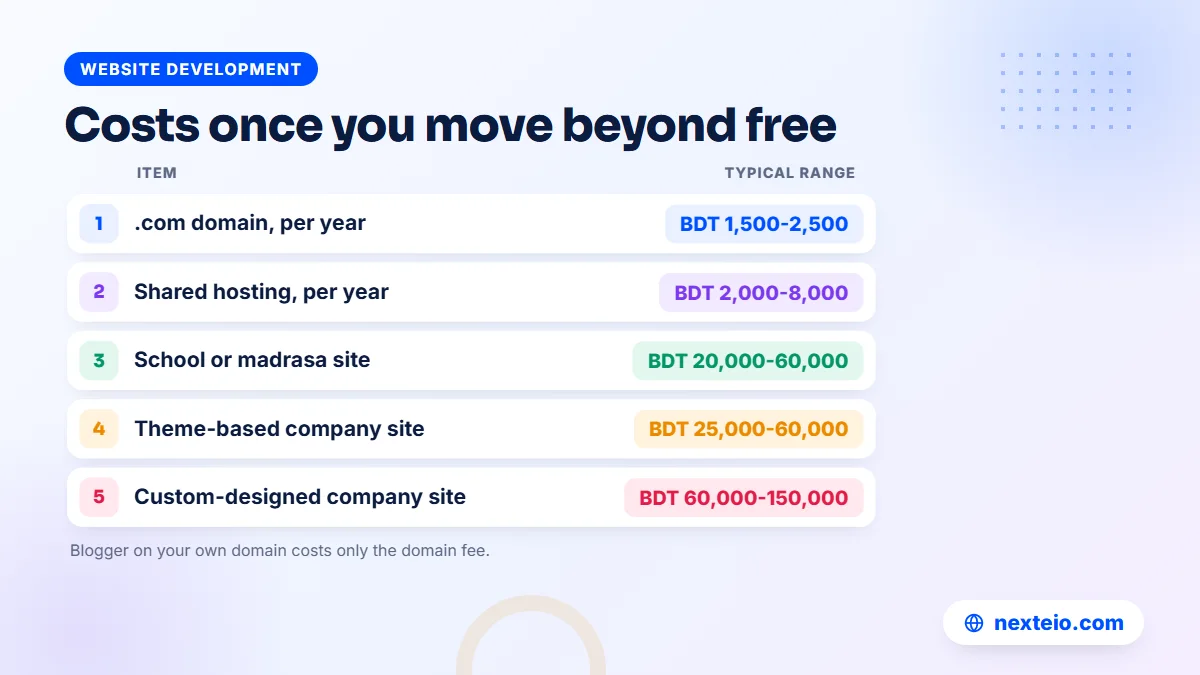
WordPress.org is the free, open-source software that powers a large share of the web. The software costs nothing, but you need your own hosting to run it. In Bangladesh, shared hosting usually costs around BDT 2,000-8,000 a year, and a .com domain about BDT 1,500-2,500 a year. In return you get full control: any theme, any plugin from the WordPress plugin directory, your own ads and your own data.
So "WordPress is free" is half true. The software is free. A useful WordPress blog on your own domain has a modest yearly running cost, plus setup work if you want it done properly. Our guide on WordPress versus a custom website explains where WordPress fits once a blog grows into a full company site.
Medium and Substack: Readers First, Ownership Second
Medium and Substack work differently from a classic blog host. Both are free to write on, and both help you find readers. Medium recommends stories across its own network, and Substack sends every post straight to your subscribers' inboxes.
That reach is the reason to use them. A consultant who writes thoughtful posts about export compliance can find an audience on Medium faster than on a brand-new blogspot address. A writer who wants a direct relationship with readers can build an email list on Substack from the first post.
The trade-offs are about control and money:
- The design is the platform's, not yours. You cannot add a contact form, a services menu or a WhatsApp button the way a business site would.
- Readers remember the platform as much as your name. Many people say "I read it on Medium", not "I read it on your blog".
- Earnings run through the platform's payment system. Medium's partner program is limited to certain countries, and Substack's paid subscriptions use Stripe.
That last point matters in Bangladesh. Check Stripe's list of supported countries before you plan to earn from a Substack or Medium audience. At the time of writing, Bangladesh is not on it, so writers based here usually cannot receive those payouts directly.
Wix, Google Sites and Other Free Blog Builders
Drag-and-drop site builders also offer free plans with a blog section. They appeal to people who want a blog maker online free of any coding, where you move blocks around until the page looks right.
Wix free plan
Wix is often the first free blog maker people try, because it gives you a visual editor, many templates and a blog app. On the free plan, your site sits on a wixsite.com address and shows a Wix banner. Connecting your own domain and removing the banner both need a paid plan. Wix sites also cannot be moved to another host as a working site, so leaving later usually means rebuilding the pages somewhere else.
Google Sites
Google Sites is free, shows no ads and can use your own domain. It works well for a simple information page, an internal staff portal or a class page. It is not really a blog, though. There are no dated posts, no categories, no comments and no feed that readers can follow. Schools sometimes try to run a notice blog on it and end up with one long page of announcements nobody can search.
Free blog sites to avoid
People who look for blog hosting sites free of charge often land on small, unknown services. These appear and disappear often. Some fill your pages with aggressive ads, some sell your address later, and some simply shut down with little notice. If a service does not say clearly who runs it, how it earns money and how you can export your posts, do not trust it with writing you care about.
Related guides for people choosing where to publish:
- How to write SEO-friendly website content that people actually read
- How to build a professional business website that gets results
- Content strategy for every stage of the customer journey
Each of these applies whichever platform you finally choose.
The Real Limits of Free Blog Sites
Every platform above is honest about its plans if you read carefully. The problem is that most people read the plan page only after something stops working. Here are the limits that cause trouble most often, roughly in the order people hit them.
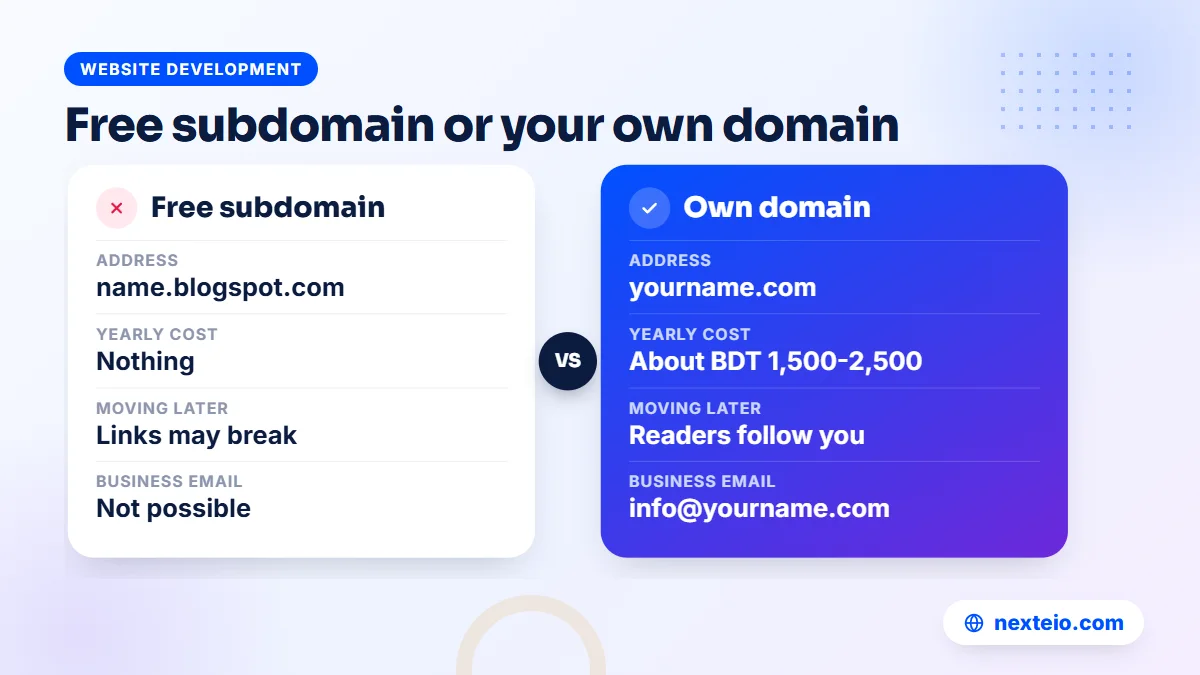
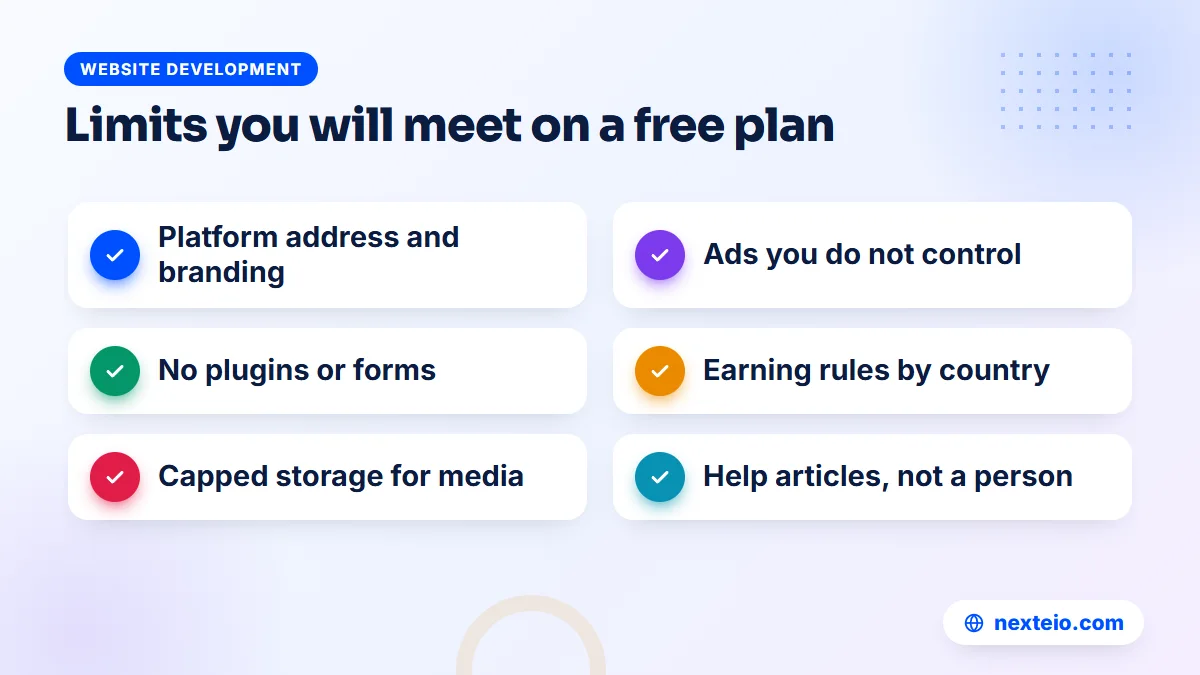
- The address. A subdomain such as yourschool.blogspot.com or yourshop.wixsite.com looks temporary to some readers, especially buyers and guardians who judge you on first sight.
- Branding and ads you do not control. A platform banner or an advert for a competitor can appear next to your own message.
- Design limits. You choose from the platform's themes and settings. Custom layouts, Bangla fonts that render properly and fast-loading pages are not always possible.
- No plugins or integrations. Booking, payment, admission forms, live chat or a product catalogue usually need a paid plan or a different platform.
The next group of limits tends to appear once the blog has regular readers and you start to depend on it.
- Earning restrictions. Some free plans ban your own ads or affiliate links, or only pay out in certain countries.
- Storage and media. Free plans cap uploads, which hurts photo-heavy blogs and anyone who uploads PDFs such as notices or brochures.
- No business email. A free subdomain cannot give you an address like info@yourname.com.
- Support. Free users usually get help articles and forums, not a person to call when the blog breaks.
Not every limit matters to every blog. A personal travel diary may never notice any of them. A company blog meant to bring enquiries will notice most of them within the first year.
Who Owns Your Posts on Free Blogging Platforms
On most free blog sites, you keep the copyright to what you write. What you do not own is the account, the address or the platform's decision to keep hosting you. That difference only becomes clear on a bad day.
Accounts can be suspended for policy problems, sometimes by mistake. A Google account can be locked if its owner loses the phone used for two-step login. A staff member who set up the school blog on a personal email can leave and take access with them. In each case the posts may still exist, but you cannot reach or move them.
Protect yourself with a few simple habits:
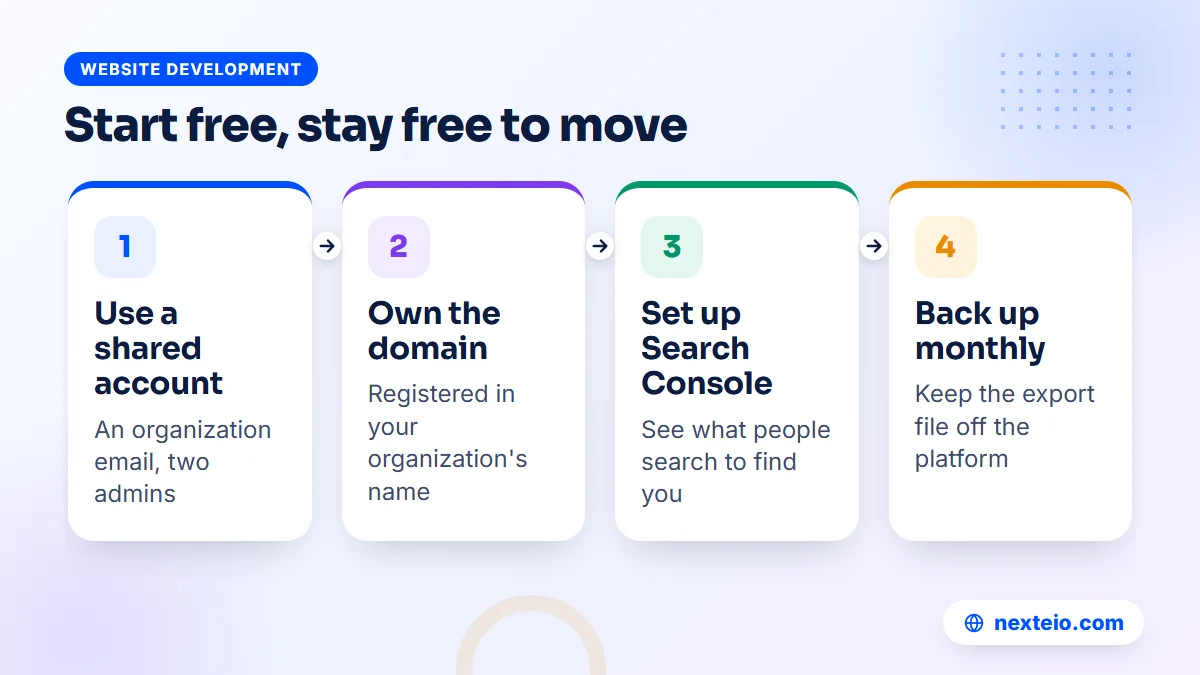
- Create the blog with an organization account, not a staff member's personal email.
- Add a second administrator, so one lost password does not lock everyone out.
- Download a full backup every month and store it outside the platform.
- Keep the original photos and documents in your own drive.
- Use your own domain early, so your address does not depend on the platform.
The last habit is the strongest. If your readers know you as yourname.com, you can move the blog behind that address to another platform later and they will barely notice.
Free Blog Sites and SEO: What Google Sees
Google does not rank a page lower just because it sits on a free platform. Blogspot posts, Medium stories and WordPress.com pages all appear in search results every day. What matters is whether the content answers the searcher's question well, as Google explains in its guidance on creating helpful, reliable content.
Free blog sites do differ in how much SEO control they give you, though:
| SEO control | Blogger | WordPress.com free | Medium or Substack | Wix free |
|---|---|---|---|---|
| Custom post descriptions | Yes, per post | Basic | Limited | Yes, per post |
| Clean post URLs | Partly, dated paths | Yes | Set by the platform | Mostly |
| Search Console verification | Yes | Supported | Not usually | Limited |
| Robots and indexing settings | Yes, custom | Basic | None | Basic |
| Speed and theme code control | Theme HTML editable | No | Not possible | Very little |
Treat this as a rough guide, since platforms adjust these settings over time.
The bigger SEO issue is the address. Every link and ranking you earn on a subdomain belongs to that subdomain. If you later move to your own domain without proper redirects, much of that work is lost. Starting on your own domain from day one, even on a free platform like Blogger, avoids the problem completely.
Whatever platform you pick, connect it to Google Search Console so you can see which searches bring visitors and whether pages are indexed. Our list of simple SEO tips for small business websites covers the next steps, and the technical SEO basics guide explains indexing in more detail.
Earning From a Free Blog in Bangladesh
Many people in Bangladesh start a free blog hoping to earn from it. That is possible, but the platform decides a lot of the outcome before you write a word.
Blogger with AdSense is the most common route here. You apply for AdSense from the Earnings section, and once approved, ads appear on your posts. Approval depends on Google's review of your content and policies, not on the platform. Nobody can promise it, but thin posts, copied text and missing pages such as About and Contact are common reasons for rejection. Our guide to Google AdSense help in Bangladesh explains what reviewers usually look for.
WordPress.com free does not allow your own ads. You would need a paid plan or self-hosted WordPress.
Medium and Substack pay through systems that, at the time of writing, do not support payouts to Bangladesh-based accounts directly.
Affiliate links and sponsored posts work on most platforms, but check each one's rules on disclosure and allowed links first.
Earnings from free blog sites take time. A new blog with ten posts rarely earns much. Most blogs that earn steadily have months of useful, original posts behind them and a clear topic that a defined group of readers searches for. If AdSense is your main goal, our AdSense support service helps fix the problems that usually cause rejection.
When a Free Blog Is Enough and When to Pay
The right answer depends on what the blog has to do. A free plan is fine when the blog is an experiment, a hobby or a simple notice board. It becomes expensive in hidden ways when the blog is supposed to bring customers, admissions or donations.
| Your situation | Sensible choice | Typical yearly cost |
|---|---|---|
| Personal writing, hobby or practice | Any free blog site | Nothing |
| Niche blog aiming for AdSense | Blogger with your own domain | About BDT 1,500-2,500 for a .com |
| School or coaching centre notices | Blogger on the institution's domain, or a proper school site | Domain only, or a site build |
| Company news and expert articles | A blog section inside the company website | Domain, hosting and the site |
| Writer building a paid newsletter | An email platform that pays out in your country | Varies |
Read the costs as a rough guide, not a quote.
When a business needs a full website rather than a blog alone, typical market ranges in Bangladesh are about BDT 25,000-60,000 for a theme-based company site and BDT 60,000-150,000 for a custom design. A school or madrasa site usually costs BDT 20,000-60,000. These include the blog as one section, so news and articles live on the same address as your services.
Many organizations take a middle path. They start with Blogger on their own domain, prove that they can publish regularly, and move to a WordPress website or a custom-designed site once the blog is bringing visitors. Because the domain stays the same, readers and search rankings come along.
Organizations should also think about approvals. In many schools, NGOs and companies, a domain renewal or a hosting bill has to pass through accounts and a head of department. Free blog sites skip that step at the start, which is part of their appeal. The risk is that nobody budgets for the domain later, and it lapses. Put the yearly domain fee in the annual budget from the first year, even if it is the only cost.
Think about your readers' connections as well. Many visitors in Bangladesh read on a phone over mobile data, sometimes during load-shedding when Wi-Fi is down. A light theme with compressed images matters more than a fancy layout, and that applies on a free platform just as much as on a paid one.
Starting a Free Blog Without Boxing Yourself In
If you decide a free platform is right for now, set it up so that the next step is easy. A few choices in the first hour save weeks later.
- Write down the blog's purpose and audience in one sentence, such as "admission and exam notices for guardians" or "fabric sourcing tips for small buyers".
- Create the account with an organization email that more than one person can reach.
- Register your own domain in the organization's name, even if you start on a subdomain for a week or two.
- Pick a simple, fast theme that reads well on a phone over mobile data.
- Write the About and Contact pages before the first post, with a phone number and address in Bangladesh.
Once the basic setup is done, add the habits that keep the blog healthy:
- Connect Google Search Console and submit the blog's sitemap.
- Plan your first ten posts around real questions your readers ask.
- Set a monthly reminder to download a backup.
Following these steps turns a free blog into a stepping stone instead of a dead end. If you need help with the setup, you can tell us about your blog through our project form.
Moving From a Free Blog to Your Own Site Later
Moves are where weak early choices become costly. The difficulty depends almost entirely on two things: whether you used your own domain, and whether the platform lets you export.
The easy case
If your blog already runs on your own domain, the move is mostly technical. You export the posts, import them into the new platform, recreate the main pages and point the domain to the new host. With careful URL matching or redirects, visitors and search engines follow without much loss.
The harder case
If your blog lives on a subdomain, you need the old platform to send visitors to the new address. On Blogger, the usual route is to connect your own domain first, so the blogspot address forwards to it, and then move that domain. WordPress.com sells a paid site redirect. Medium and Wix offer far less help. Without a redirect, old links in social posts, WhatsApp groups and search results simply stop working.
Before any move, list every post and its current address in a spreadsheet. Check images, because some platforms keep images on their own servers and they may disappear when you close the old account. Then test the new site fully before you switch the domain. Our Blogger website service includes moving a blogspot blog onto your own domain, and larger moves to WordPress are handled through the WordPress work mentioned above.
Common Mistakes People Make With Free Blog Sites
The same handful of problems shows up again and again on free blogs that never get going. Most of them are choices made in the first week.
- Choosing by looks alone. A flashy template with sliders and animations often loads slowly on mobile data and hides the actual posts.
- Using a personal account for an organization blog. When that person leaves, access leaves too.
- Copying content. Copied posts rarely rank, can break platform rules and are a common reason for AdSense rejection.
- Publishing in bursts. Twenty posts in one month and then nothing for six months tells readers the blog is abandoned.
- Ignoring Bangla readers. If your audience searches in Bangla, write at least some posts in Bangla and check that the theme shows Bangla text clearly.
- Never backing up. Most people only discover the export button after losing access.
Fixing these early costs nothing. Fixing them after two years of posts can mean weeks of clean-up work, and sometimes starting again on a new address.
How Nexteio Can Help With Your Blog
We help people across Bangladesh get more from a free blog, and move beyond it when the time is right. Through our Blogger website service, we set up or clean up a Blogger site with a mobile-friendly theme, connect your own domain, fill in the search description and indexing settings, and add Search Console so you can see how people find you.
If you already have a blog on a subdomain, we can move it to your own domain with redirects, so old links keep working. If you plan to apply for AdSense, we check the issues that commonly cause rejection before you submit. And if your organization has outgrown a free platform, we plan the next step with you: a WordPress site, a custom design or keeping Blogger with a better setup.
The first conversation is about your goals, not a package. Tell us who the blog is for and what it should achieve, and we will suggest the simplest setup that does the job. You can see examples of our work in our portfolio, learn more about Nexteio, start a project with a short brief or ask a quick question on our contact page. A properly set up Blogger blog on your own domain is often the best low-cost starting point.
Keep reading: how long SEO takes to show results, why page speed matters for rankings, or browse all our website development guides.
Frequently asked questions
Which free blog site is best for beginners in Bangladesh?
For most beginners, Blogger is the simplest choice. It is free with no paid tiers, works with a normal Google account, lets you connect your own domain later and supports AdSense. If your main goal is to write for an existing audience rather than build your own site, Medium is also easy to start.
Can I earn money from a free blog?
Yes, but it depends on the platform. Blogger allows Google AdSense once your blog is approved, and most platforms allow honest affiliate links. Some free plans, such as WordPress.com's free plan, do not allow your own ads, and some platforms only pay out in countries their payment partner supports.
Is a blogspot address bad for SEO?
No. Google ranks pages on blogspot addresses when the content is useful. The bigger risk is moving later: rankings built on a subdomain can be lost if you switch addresses without proper redirects. Connecting your own domain early avoids that problem.
What is the difference between a free blog and a free website?
A blog is built around dated posts, categories and feeds, so readers can follow new writing. A free website builder such as Google Sites gives you static pages but no real post system. Many organizations need both: fixed pages for services or admissions and a blog section for news and articles.
Can I move my free blog to my own domain later?
Usually yes. Blogger lets you connect a custom domain at any time, and the old blogspot address forwards to it. Other platforms vary: some charge for redirects and some offer only a partial export. Check the export and redirect options before you start publishing seriously.
Do free blog sites delete inactive blogs?
Policies differ by platform and can change, so read each one's terms. The safer habit is not to rely on any platform's goodwill: download a backup of your posts every month and keep your original images and files in your own storage.
Should a school or company use a free blogging platform?
It can work for a simple notice blog or a trial period, especially on Blogger with the institution's own domain. Once the blog needs forms, admissions, online payments or a consistent brand with the main website, a blog section inside a proper website is usually the better long-term choice.