B2B Lead Generation for Factories, Exporters and Service Firms
In this article 14 sections
- 1.What B2B Lead Generation Means and How It Differs From Consumer Sales
- 2.Define Your Ideal Buyer Before You Spend on Leads
- 3.Your Website Is the Center of B2B Lead Generation
- 4.Eight B2B Lead Generation Channels That Work in Bangladesh
- 5.Writing Outreach Messages That Get Replies
- 6.Capturing Leads: Forms, Quote Requests and Offers
- 7.Qualifying Leads: Separating Buyers From Browsers
- 8.Follow-Up and the Sales Handoff
- 9.Budgeting for B2B Lead Generation in Bangladesh
- 10.Measuring B2B Lead Generation: The Numbers That Matter
- 11.Common B2B Lead Generation Mistakes
- 12.A 90-Day B2B Lead Generation Plan
- 13.How Nexteio Can Help With B2B Lead Generation
- 14.Frequently asked questions
B2B lead generation is the work of finding businesses that may buy from you and getting the right person in those businesses to start a conversation. For a garment or packaging factory, that person might be a sourcing manager abroad. For an IT firm, a logistics company or a corporate training provider, it might be an admin head or a finance director at a company down the road.
Selling to businesses is slower and more careful than selling to consumers. A shopper buys a shirt in two minutes. A buyer choosing a new supplier compares several options, checks your website, asks for samples or references, and usually needs someone else to approve the decision. One good client can be worth years of orders, which is why each lead matters so much.
Many firms in Bangladesh still rely almost entirely on personal networks, a few agents and an occasional trade fair. Those work, but they are hard to grow and easy to lose when a key person leaves. A steady system for finding and following up leads gives the business a second engine that does not depend on one phone book.
This guide covers how to define the buyers you want, what your website must show them, which channels work for factories, exporters and service firms, how to capture, qualify and follow up leads, and how to measure what each channel brings.
What B2B Lead Generation Means and How It Differs From Consumer Sales
A lead is a person or company that has shown interest and given you a way to reach them: a quote request, a form, an email, a call, a business card at an exhibition. B2B lead generation, sometimes shortened to B2B lead gen, is everything you do to create a steady flow of those contacts from businesses that fit what you sell.
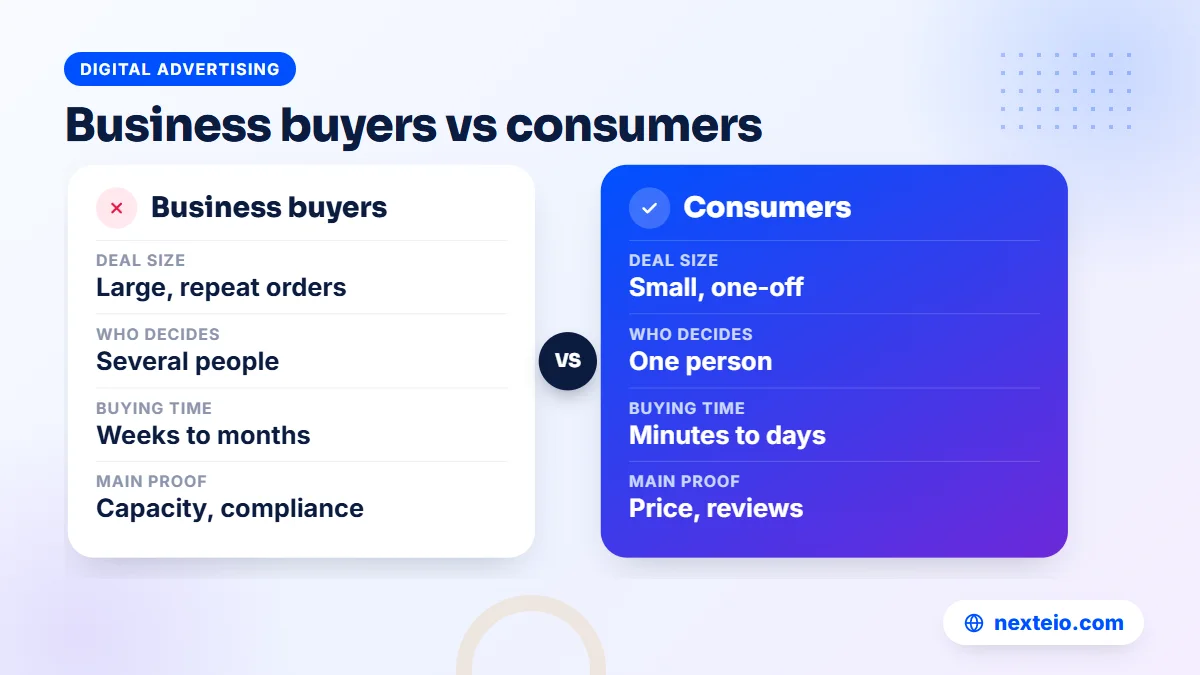
The difference from consumer marketing is not only the size of the deal. It changes how people buy, what they need to see and how long it takes.
| Point | Selling to businesses | Selling to consumers |
|---|---|---|
| Who decides | Several people: user, manager, finance, owner | Usually one person or a family |
| Buying time | Weeks or months, sometimes a full season | Minutes to a few days |
| Deal value | High, often with repeat orders | Low to medium per order |
| What builds trust | Capacity, compliance, references, samples | Price, reviews, delivery speed |
| Typical first step | Quote request, meeting or sample | Order or inbox message |
Because of this, B2B campaigns aim for fewer, better leads.
A consumer brand may want thousands of messages a month. A machinery supplier may be delighted with ten serious inquiries, if three of them turn into meetings and one becomes a long-term client. Plan your channels and budgets around that reality, not around the large numbers seen in consumer advertising.
Define Your Ideal Buyer Before You Spend on Leads
The most expensive mistake in B2B lead generation is chasing everyone. A knitwear factory that tries to reach "all clothing buyers" spends money on boutiques that order 200 pieces, while the importers it really wants never see the message. Start by writing down who your best clients are and what they have in common.
A simple ideal buyer profile answers these questions:
- Industry: which sectors buy from you most, and which ones pay on time?
- Location: which countries or areas of Bangladesh can you serve well?
- Size: what order size or contract value makes a client worth the effort?
- Roles: who finds suppliers, who approves them and who signs the payment?
- Triggers: what makes a company look for a new supplier now?
- Deal breakers: which certifications, capacities or terms must you meet?
Write the answers on one page and share it with sales and marketing.
Triggers are worth extra thought, because timing decides who answers. A buyer whose current supplier missed a shipment, a company opening a new office, a school moving to a digital system or a brand entering a new market is far more likely to reply than someone who is satisfied. Content, ads and outreach that speak to these moments do better than general messages about quality.
Also map the buying group. In a factory deal, a merchandiser may find you, a technical manager may check samples and a director may approve the supplier. Each of them needs different information, so your website and follow-up should serve all three, not only the first contact.
Your Website Is the Center of B2B Lead Generation
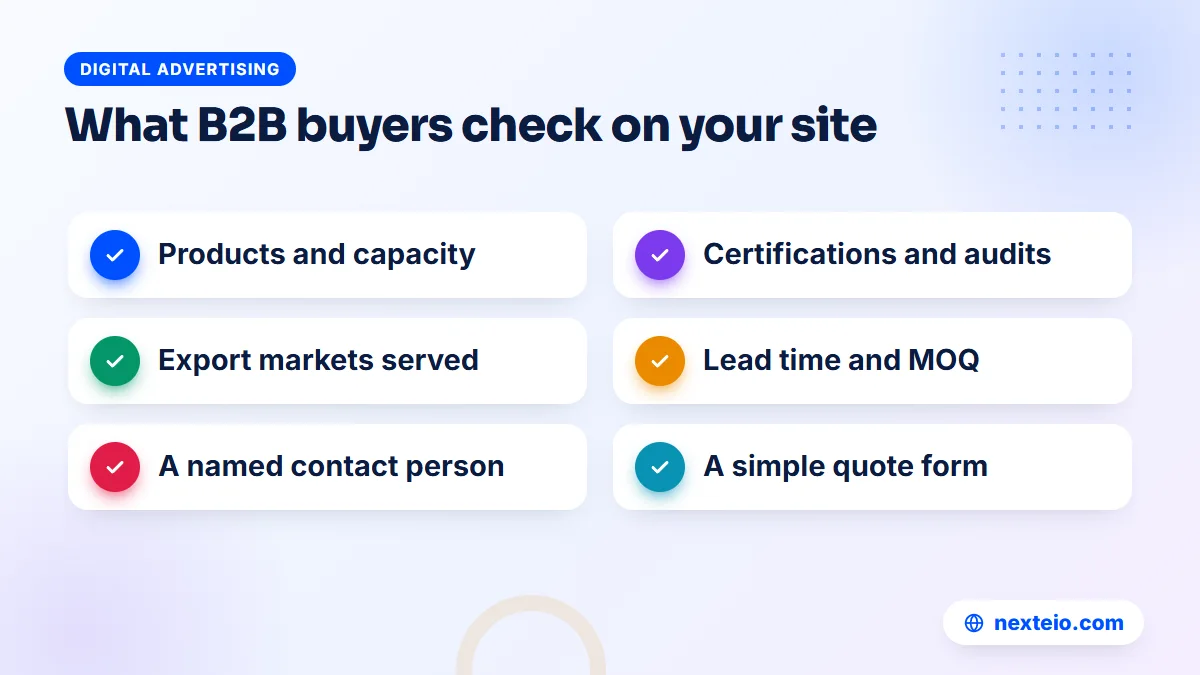
Almost every serious B2B buyer looks at your website before replying to an email or agreeing to a meeting. They are checking that you are real, that you can handle their order and that you look like a supplier their own boss will approve. A weak website quietly rejects leads you never knew you had.
For factories and exporters, the website should answer the questions a sourcing team asks in the first call:
- What exactly do you make, and in what range of styles, materials or specifications?
- What is your monthly capacity, minimum order quantity and usual lead time?
- Which certifications and audits do you hold, with dates and issuing bodies?
- Which markets and types of buyers do you already supply?
- Who is the contact person, with a direct email and a phone or WhatsApp number?
Real photos of the floor, machines and finished goods support every answer.
Service firms need the same clarity in a different form. An IT company should show its services, the kind of clients it works with, how projects run and a few case studies. A logistics or training company should explain coverage, process and how pricing works, even if exact prices depend on the job. Our guide to building a professional business website covers the structure in more detail.
Speed and language matter as well. Overseas buyers often open your site from a laptop in an office abroad, while local decision makers may check it on a phone between meetings. Keep pages light, write in clear English, and add Bangla where your local buyers prefer it. If the current site is old or hard to update, a rebuild through our custom website design service is often the first step of any lead plan.
Eight B2B Lead Generation Channels That Work in Bangladesh
No single channel works for every business. A garment exporter, an office furniture maker and a software company will each lean on different ones. Most firms do best with two or three channels run properly, rather than eight run badly. An ads campaign service can help you choose and balance the paid ones.
1. Google search ads
Search ads reach people at the moment they look for a supplier or service, such as "corrugated carton manufacturer", "corporate event management" or "ERP software for garment factory". The intent is clear, so even a small budget can bring useful inquiries if the keywords are chosen carefully. Exclude job seekers, students and people looking for free information with negative keywords. Our guide on getting more leads from Google Ads explains the setup, and our Google Ads service manages it for you.
2. SEO and helpful content
Ranking for the searches your buyers make brings leads without a cost per click, but it takes months. Product pages, capability pages and practical articles, such as how to choose a carton supplier or what to check before outsourcing payroll, can attract buyers early in their search. Google's guidance on creating helpful, reliable content is a good standard to write against. For an introduction, read what SEO means for a business.
3. LinkedIn
Many procurement managers, HR heads and directors keep a professional profile on this network. A complete company page, active profiles for the owner and sales team, and useful posts build recognition. Direct messages work best when they are short, personal and relevant to the person's role. LinkedIn also sells ads with lead forms, which can reach people by job title and industry, though clicks there often cost more than on other platforms.
4. Facebook and Instagram ads
Meta platforms are not only for consumer brands. Local B2B offers, such as corporate gifts, office interiors, training courses, catering or IT support for small offices, can work well because owners and managers use Facebook every day. Lead forms that open inside the app make it easy to respond, but add a qualifying question or two, or you will collect many contacts with little intent. Our Facebook ads service covers both lead forms and website campaigns.
5. Email outreach
A short, well-researched email to the right person can open doors that ads never reach. The keys are a small, accurate list, a message that shows you understand their business, and a clear, easy next step. Use a proper business domain, set up email authentication and follow Google's email sender guidelines, or your messages will land in spam. Mass sending to bought lists usually damages your domain's reputation more than it helps.
6. Trade fairs and buyer visits
Exhibitions still matter for manufacturing and export sectors. The Export Promotion Bureau supports participation in trade fairs, and sector associations organize their own events. The common weakness is follow-up: cards collected at a fair often sit in a drawer for weeks. Treat each contact as a lead, enter it the same day and send a follow-up within a few days, while your stand is still fresh in their memory.
7. B2B marketplaces and directories
Online marketplaces and industry directories bring inquiries from buyers who are actively sourcing. Quality varies a lot. Some send serious requests, others mostly bring price-shoppers and spam. Keep your listing complete and accurate, answer quickly, and track which platform produces real orders before paying for premium plans.
8. Referrals and partnerships
Happy clients, suppliers and partners are often the best source of leads. Ask for introductions after a successful delivery, not months later. Partnerships work too: a software firm and a hardware supplier can refer clients to each other. A complete Google Business Profile also helps local buyers find your office, check reviews and call you directly.
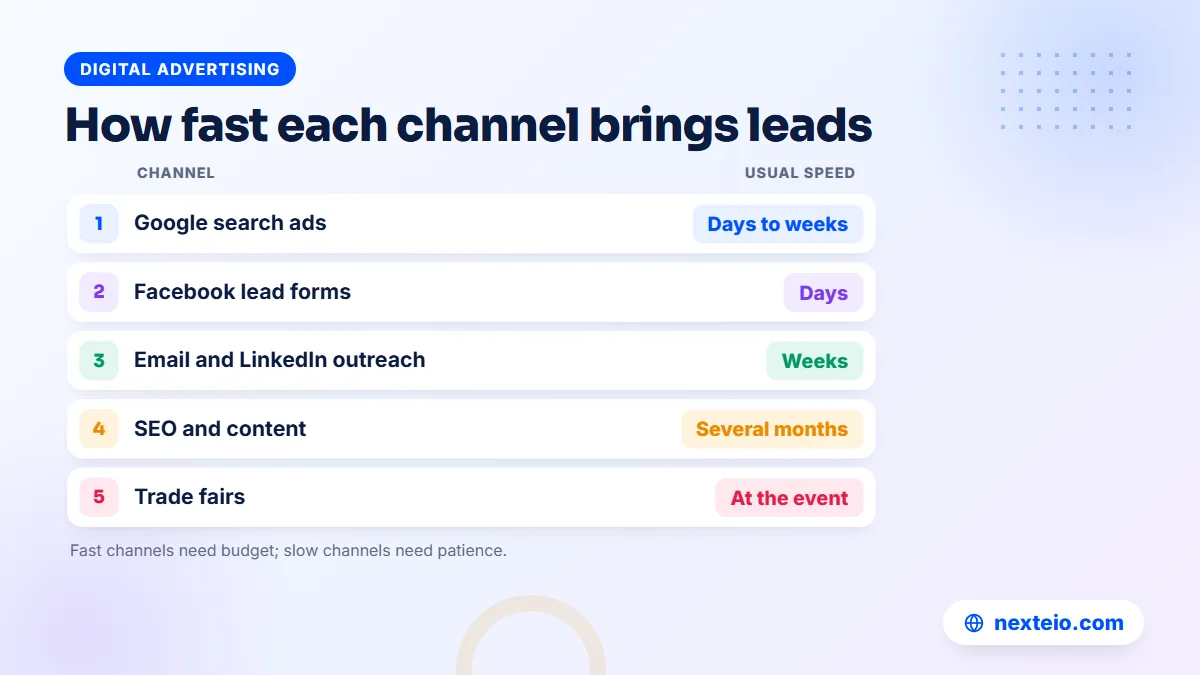
These channels feed each other, so the table below compares them side by side.
| Channel | Best for | Speed to first leads | Main cost |
|---|---|---|---|
| Google search ads | Active supplier searches | Days to weeks | Ad spend and management |
| SEO and content | Long-term steady inquiries | Several months | Writing and site work |
| Reaching roles and companies | Weeks | Time, or ad spend | |
| Facebook and Instagram | Local B2B offers | Days | Ad spend and creatives |
| Email outreach | Named target accounts | Weeks | Research time |
| Trade fairs | Export and industrial sectors | At the event | Stand, travel and follow-up |
Pick two channels that suit your buyers and run them well first.
Related guides that go deeper on these channels:
- How an ads campaign service works for small businesses in Bangladesh
- How to find high-intent keywords for Google Ads
- Content for every stage of the customer journey
Writing Outreach Messages That Get Replies
Whether it goes by email or LinkedIn, a first message to a stranger has a few seconds to earn attention. Most cold messages fail because they talk only about the sender: founded in a certain year, a list of machines, "best quality at competitive prices". The buyer has read that line hundreds of times.
A better message follows a simple shape:
- A specific opening that shows you looked at their company, such as a product line they launched or a market they entered.
- One relevant fact about you that matters to them, such as a certification their brand requires or a lead time that fits their season.
- A small, easy next step, such as sending a short capability profile or a sample swatch card, rather than asking for a meeting straight away.
Keep it under about 120 words and sign with a real name and direct contact details.
Write in plain English and avoid heavy attachments in the first email, since large files and many links can push a message into spam. If there is no reply, one or two polite follow-ups a week apart are reasonable. After that, stop, and try again only when you have something new to offer.
Capturing Leads: Forms, Quote Requests and Offers
Traffic is not a lead until the visitor tells you who they are. In B2B, the best way to capture interest is usually a request that matches how buyers already work: a quote request, a sample request, a catalog download or a meeting booking.
A quote form for a factory might ask for the company name, country, product type, estimated quantity and target delivery date. A service firm might ask for company size, the service needed and the timeline. These questions do two jobs at once: they give your team what it needs to reply properly, and they quietly filter out people who are not real buyers.
Keep the form short enough to finish on a phone. Five to seven fields is usually plenty, with a free text box for details. Always show a direct email and a WhatsApp or phone number next to the form, because some buyers, especially senior ones, prefer to write directly.
Offers that work well for B2B include:
- A downloadable product catalog or capability profile in PDF form.
- A free sample, trial or site visit for qualified buyers.
- A short checklist or guide related to the buyer's problem.
- A free initial review, such as an audit of their current setup.
Each offer should lead naturally to a conversation with your team.
If you run Google Ads, lead form assets let people send their details directly from the ad. They are convenient, but the leads still need the same qualification and fast follow-up as any website form. The landing page itself matters too, and our guide to a high-converting landing page explains what to put on it.
Qualifying Leads: Separating Buyers From Browsers
Not every lead deserves the same attention. A sourcing manager from an established brand asking about 20,000 pieces is different from a student researching a project. Qualification is how your team decides who gets a call today, who gets a polite email and who gets nothing.
Keep the criteria simple. Four questions cover most cases:
- Fit: does the company match your ideal buyer profile?
- Need: do they have a real requirement, with a product, service or quantity in mind?
- Timing: are they buying this month, this season or someday?
- Authority: is this person a decision maker, or can they bring one into the conversation?
A lead that scores well on all four goes straight to a senior salesperson.
Leads that fit but are not ready yet should not be thrown away. Add them to a list for occasional, useful updates, such as a new product range, a certification or a capacity expansion. B2B buying cycles are long, and the company that stayed in touch politely is often the one called when the time comes.
Follow-Up and the Sales Handoff
Many firms lose more leads after the inquiry than before it. The form arrives in a shared inbox, nobody owns it, and by the time someone replies the buyer has already received three quotations. Speed and ownership fix most of this.
Set a simple rule: every new lead has one named owner and gets a first reply within one working day, faster for hot leads. For overseas buyers, check their time zone and reply during their working hours where possible. Then follow a clear sequence:
- Day 0: a personal reply that answers their question and proposes a next step.
- Day 2 to 3: send the catalog, price range or sample details they need.
- Day 7: a short check-in with one useful piece of information.
- Day 14 to 21: a final follow-up, then move them to a slower update list.
Adjust the timing to your sector, but never leave a lead without a next action.
Track every lead in one place. A shared spreadsheet works for a small team: company, contact, source, date, status, next step and owner. As volume grows, a CRM saves time and keeps history when staff change. Some firms need something more specific, such as a buyer portal, a quotation system or a sample tracker connected to production. That kind of system can be built as a web application through our Laravel development service.
Budgeting for B2B Lead Generation in Bangladesh
A B2B lead budget has three parts: the foundation, the running costs and the time of your own team. Skipping the foundation to spend more on ads is a common and expensive shortcut.
The foundation is mainly the website. Typical market ranges in Bangladesh for a company or business website are about BDT 25,000-60,000 for a theme-based site, 60,000-150,000 for a custom design and 150,000-400,000 or more for a large corporate site with integrations. Custom systems such as buyer portals or CRMs are usually quoted after a requirements review, since cost depends on modules and users.
Running costs include ad spend, which you control, plus management, content writing and any paid tools. Your team's time is the cost most often ignored: someone has to reply, qualify, follow up and prepare quotations.
To judge whether the spend is worth it, work backwards from a client's value. Suppose a new buyer is worth BDT 500,000 in gross profit over two years, and one in ten qualified leads becomes a buyer. Then each qualified lead is worth about BDT 50,000 on average. Spending a few thousand taka to win one is sensible, even if it feels high next to consumer advertising costs. These are planning figures for illustration only, so replace them with your own.
Start with a fixed test period of about three months and a budget you can sustain. B2B results build slowly, and a single month rarely gives a fair picture. If you want help sizing a realistic test, send us your target buyers and current numbers.
Measuring B2B Lead Generation: The Numbers That Matter
Clicks and form fills are only the start. The numbers that show whether your lead generation works sit further down the funnel, and most of them live in your sales records, not in an ad dashboard.
- Leads by source: how many inquiries each channel brought.
- Qualified leads: how many of those met your criteria.
- Meetings or samples: how many moved to a real conversation.
- Quotations sent and won: how many became business.
- Cost per qualified lead: spend divided by qualified leads, per channel.
- Time to close: how long a typical deal takes from first contact.
Review these monthly, by channel, with sales and marketing together.
On the website, mark form submissions, quote requests and catalog downloads as tracked conversions, so ad platforms can learn which clicks lead to inquiries. If you use Google Ads, you can also import later outcomes, such as qualified leads or won deals, back into the account as offline conversions. That teaches the system to look for buyers, not just form fillers.
Ask every new client how they first heard of you, and record the answer. In B2B, the path is often mixed: a buyer sees you at a fair, searches your name later, reads the website and then emails. Without asking, the fair gets no credit and the search ad gets too much.
Common B2B Lead Generation Mistakes
These problems show up again and again in firms that feel their marketing is not working:
- Targeting everyone. Broad campaigns bring cheap leads that never buy.
- Sending traffic to the homepage. Buyers want the page for their product or service.
- Hiding behind a generic form. No named contact, no direct email, no phone.
- Slow replies. A two-day delay is enough for a buyer to move on.
- No qualification. Senior staff waste hours on people who were never buyers.
- Judging by lead count alone. Ten good leads beat a hundred poor ones.
- Stopping too early. B2B channels often need a full quarter to show results.
Fixing the first four usually helps more than any new channel.
If your site already gets visits but few inquiries, the cause is often on the page itself rather than in the ads. Our guide on why a website gets traffic but no customers walks through the most common reasons and how to fix them.
A 90-Day B2B Lead Generation Plan
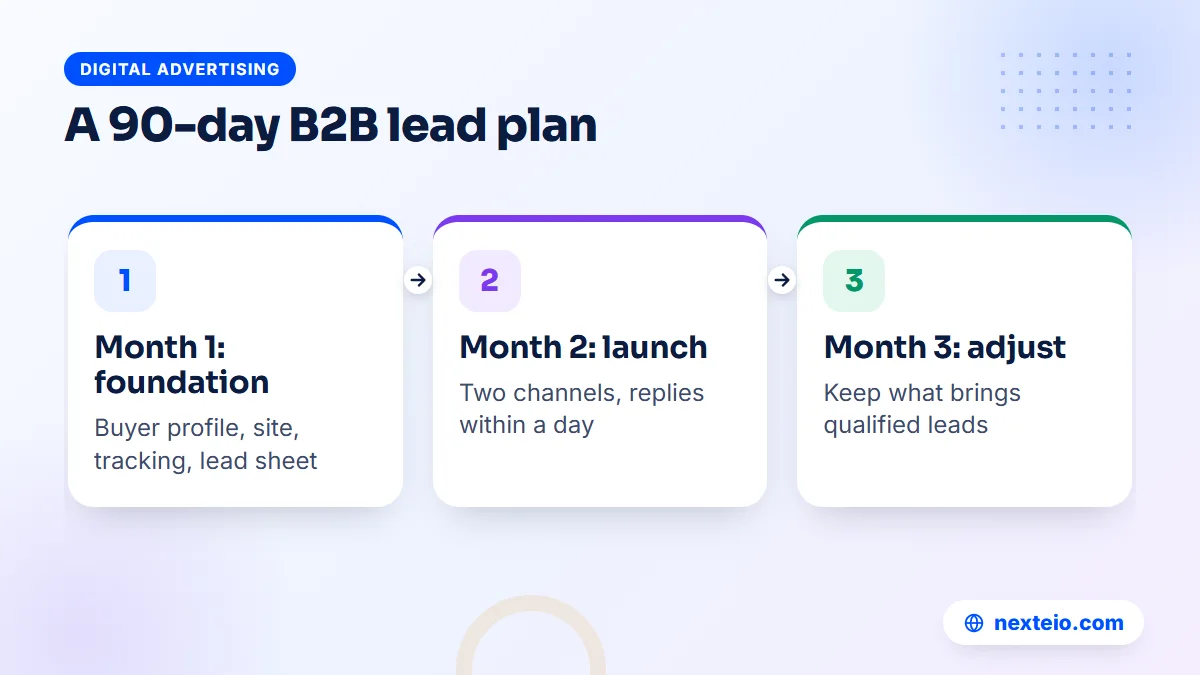
A short, focused plan works better than a long list of ideas. Here is a simple three-month structure that suits most factories, exporters and service firms.
Month one: foundation. Write the ideal buyer profile. Fix the website so it shows capacity, certifications, case studies and a clear quote form. Set up conversion tracking and a lead sheet with owners. Prepare one strong offer, such as a capability profile or a sample program.
Month two: launch. Start two channels that match your buyers, for example search ads plus targeted email outreach, or LinkedIn plus a trade fair follow-up campaign. Reply to every lead within one working day and record the outcome.
Month three: review and adjust. Compare channels by qualified leads and meetings, not by clicks. Cut what does not bring real conversations, raise the budget on what does, and improve the pages and messages based on the questions buyers asked.
After 90 days, you will have real numbers for your own business instead of guesses. That is the point where an ads campaign plan across several platforms becomes far easier to justify to directors or partners.
How Nexteio Can Help With B2B Lead Generation
We help factories, exporters and service firms in Bangladesh build B2B lead generation that runs as a system rather than a set of one-off posts. It usually starts with the website: we check whether it shows buyers what they need, then improve or rebuild the key pages and the quote form.
Through our ads campaign service, we choose the channels that fit your buyers, whether that is Google search, Meta lead forms, LinkedIn outreach or a mix, and set up tracking so you can see which channel brings qualified inquiries. We can also support content through our SEO service and design simple lead sheets or a custom system for follow-up. You keep ownership of every account and every lead list.
If you would like a plan for your business, read more about how we work, see examples in our portfolio, share your goals and target buyers on our project form, or contact us to talk through your multi-channel campaign first.
Keep reading: how to write website content people actually read, what to expect from a Google Ads service, or browse all our digital advertising guides.
Frequently asked questions
What is B2B lead generation in simple words?
It is the process of finding companies that may need what you sell and getting the right person there to contact you or agree to talk. The lead can come from a quote form, an email, a call, a trade fair or a referral. The goal is a steady flow of inquiries from businesses that fit your ideal buyer.
Which B2B lead generation channel works best for exporters in Bangladesh?
Most exporters do well with a strong website, search ads or SEO aimed at the products buyers search for, and disciplined follow-up from trade fairs and direct outreach. LinkedIn helps reach sourcing and procurement roles. The right mix depends on your product and target countries, so test two channels for a few months and compare qualified leads, not clicks.
How long does B2B lead gen take to show results?
Paid search and social ads can bring first inquiries within days or weeks, while SEO and content usually take several months. Turning those leads into clients takes longer, because business buyers compare suppliers and need approvals. Plan on at least one full quarter before judging a channel.
How many fields should a B2B quote form have?
Usually five to seven: name, company, email, phone or WhatsApp, product or service needed, estimated quantity or scope, and timeline. That is enough to qualify the lead and reply properly without putting people off. Add a free text box for details and show a direct email next to the form.
Is buying email lists a good idea for B2B lead generation?
Usually not. Bought lists are often outdated, contain people who never agreed to hear from you and can damage your domain's email reputation, sending even your normal emails to spam. A small list you research yourself, aimed at the right roles in the right companies, gives far better results.
What is the difference between B to B lead generation and B2C marketing?
B to B lead generation aims at fewer, higher-value buyers, where several people share the decision and the buying process takes weeks or months. B2C marketing aims at individual consumers who decide quickly, often on price and convenience. The channels can overlap, but the message, proof and follow-up are very different.
Should a small service firm hire an agency for lead generation?
It depends on your team's time and skills. An agency can set up the website, ads, tracking and reporting faster, but your own team still needs to reply, qualify and close leads. A good arrangement keeps all accounts in your name and reports on qualified leads and meetings, not only clicks and impressions.