B2B Ecommerce Platform Guide for Factories, Garments and Wholesalers
In this article 14 sections
- 1.What a B2B Ecommerce Platform Does Differently From a Retail Shop
- 2.Who Needs B2B Ordering in Bangladesh
- 3.12 Features a B2B Ecommerce Platform Needs
- 4.Pricing Rules: Tiers, Minimums and Customer Price Lists
- 5.Quotes, Samples and the RFQ Flow
- 6.Payments, Credit and Invoices in B2B Trade
- 7.Choosing a B2B Ecommerce Platform: Shopify, WooCommerce or Custom Laravel
- 8.Your Own Platform or an Online Wholesale Market
- 9.Connecting Orders to Stock, Accounts and the Factory Floor
- 10.Catalog Content That Trade Buyers Trust
- 11.B2B Ecommerce Platform Costs and Timelines in Bangladesh
- 12.Getting Buyers to Use the New System
- 13.How Nexteio Can Help With Your B2B Ecommerce Platform
- 14.Frequently asked questions
A B2B ecommerce platform lets other businesses, not individual shoppers, browse your catalog, see their own prices and place repeat orders online. For a factory, a garment exporter or a wholesaler in Bangladesh, that usually means replacing a mix of phone calls, WhatsApp photos, emailed price lists and handwritten order books with one system that buyers can use at any hour.
The idea sounds simple, but business buyers behave very differently from retail customers. A shop owner restocking soap orders forty cartons, not one bar. A foreign buyer wants a spec sheet and a sample before talking about price. A dealer expects 30 days of credit because that is how your sales officer has always worked with him.
A normal online shop cannot handle these habits. It shows one price to everyone, expects payment at checkout and treats every visitor as a stranger. That is why so many manufacturers try a retail store theme, find that buyers ignore it, and go back to the phone.
This guide is for owners, sales heads and IT managers who want to move trade orders online without losing the relationships that hold their business together. It covers the features that matter, how pricing and credit should work, which platforms fit which kind of company, what it costs in Bangladesh and how to get your existing buyers to actually use it.
What a B2B Ecommerce Platform Does Differently From a Retail Shop
The easiest way to understand the difference is to compare the same task in both settings. In a retail store, the customer finds a product, pays and waits for delivery. In trade, the buyer is a known account, the price depends on who they are and how much they take, and payment often comes weeks later.
| Area | Retail online shop | B2B ordering platform |
|---|---|---|
| Who buys | Anyone with a phone | Approved business accounts |
| Price | One public price | Separate lists by buyer, tier or volume |
| Order size | One or a few items | Cartons, dozens, rolls or pallets, often with a minimum |
| Payment | Card, bKash, Nagad or cash on delivery | Bank transfer, credit terms, part advance, sometimes cheque |
| Ordering pattern | New basket each time | Reorders of the same lines every week or month |
| Documents | Order email and a receipt | Quotation, proforma invoice, VAT invoice, delivery challan |
| Decision | One person, minutes | Several people, days or weeks |
Every row in that table becomes a feature request.
A B2B ecommerce platform has to know who is logged in, apply the right price, enforce the right quantity, accept the right payment method and produce the paperwork your accounts team already uses. If any of those pieces is missing, staff end up fixing orders by hand and the system becomes extra work instead of less.
There is also a difference in what success looks like. A retail store measures new customers and conversion rates. A trade portal is judged by how many existing buyers reorder through it, how many order errors it removes and how much time your sales team gets back.
Who Needs B2B Ordering in Bangladesh
Not every company with business customers needs a full ordering system. The ones that benefit most share a pattern: many repeat buyers, a large or changing product list, and orders that currently pass through several hands before they reach the warehouse.
Manufacturers selling to dealers and retailers
Think of a packaging or plastics manufacturer with 300 dealers across Bangladesh. Each dealer phones a sales officer, who writes the order, who sends it to the depot, who checks stock and calls back. A portal lets the dealer see current stock, his own price and his outstanding balance, then place the order directly. The sales officer still owns the relationship but spends less time copying numbers.
Garment and textile exporters
Most export garment orders will never go through a checkout button. Foreign buyers work through sampling, costing, approvals and a letter of credit or a bank contract. What a garment factory needs online is a private buyer area: a product and fabric library, development samples with reference codes, compliance documents, and a simple way to request a quotation or a sample. That is still B2B ecommerce in the sense that matters, because it moves the sales conversation online and keeps it organized.
Wholesalers and distributors
A wholesaler of electrical goods, stationery, cosmetics or hardware often carries thousands of product lines. Shop owners want to order late at night after closing, check whether a brand is back in stock and see what they paid last time. This is where a full B2B ecommerce platform with reorder lists and tier pricing pays off fastest, because the order volume is high and each order has many lines. Some wholesalers also sell to the public, and a well-planned online store build can serve both groups from one product list.
Suppliers to institutions
Companies that supply hospitals, schools, offices or factories with consumables face long approval chains on the buyer side. A purchasing officer prepares a requisition, a manager approves it and accounts releases payment. An ordering system that lets the buyer save a draft, download a quotation for internal approval and convert it into an order later fits that process far better than a shopping cart.
12 Features a B2B Ecommerce Platform Needs
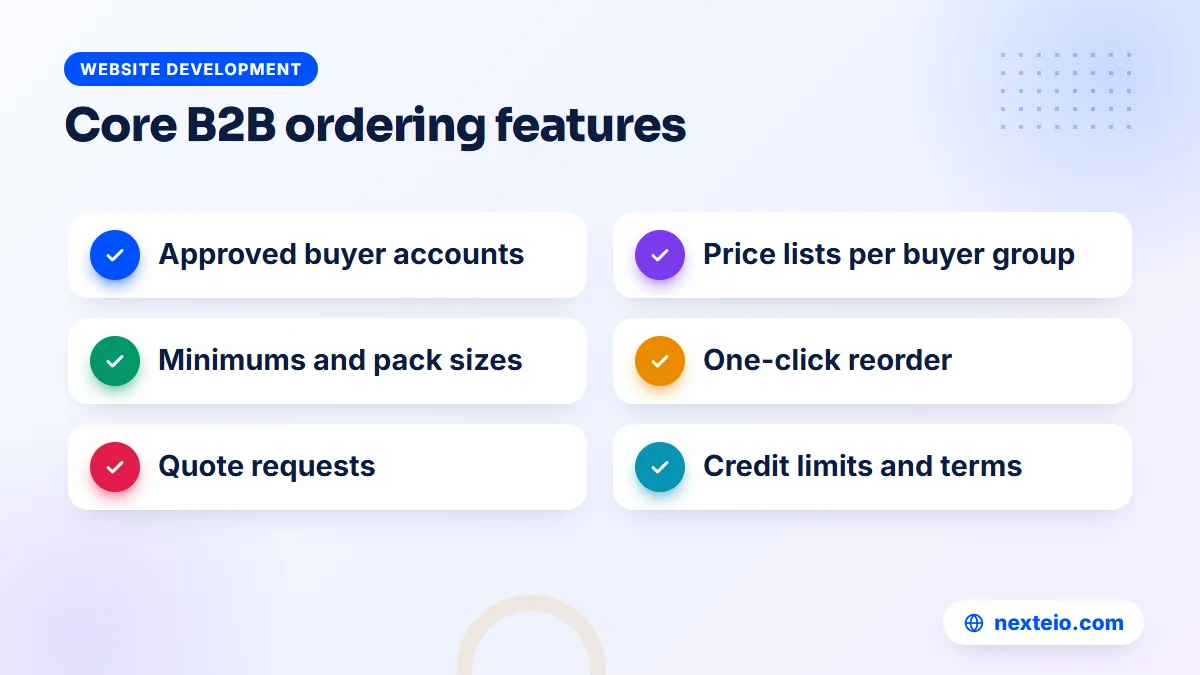
Feature lists from software vendors can run to hundreds of items. In practice, these twelve decide whether buyers will use your system or ignore it. Use them as a checklist when you compare options or brief a developer. The first five cover buyer accounts and pricing:
- Approved buyer accounts. New buyers apply, your team checks their trade license or references, then approves them. Only approved accounts see prices.
- Several users per company. A buyer's owner, purchase officer and accountant each get their own login under one company account.
- Customer-specific price lists. Each buyer, or group of buyers, sees the price you agreed with them.
- Volume and tier pricing. The unit price drops automatically at set quantities.
- Minimum order quantities and pack sizes. The system blocks an order for 7 units when the carton holds 12.
The other seven cover ordering, payment and the back office:
- Quick order and reorder. Buyers can type product codes, upload a list or repeat a past order in one click.
- Request for quotation. For custom or large orders, buyers ask for a price and accept your quote online.
- Credit limits and payment terms. Approved accounts can order on credit up to a limit, with the due date shown on every invoice.
- Order approval inside the buyer's company. A junior user can build an order that a manager approves before it reaches you.
- Documents on demand. Quotations, invoices and delivery challans download as PDF.
- Live or regularly synced stock. Buyers see what is available, so orders never promise goods you do not have.
- Sales rep access. Your sales officers can log in on behalf of a buyer, place orders for them and see their history.
You do not need all twelve on day one.
A wholesaler might start with accounts, price lists, pack sizes and reorder, then add credit and approvals later. A garment exporter might only need accounts, a private catalog and quotation requests. What matters is that the platform you choose can grow into the rest without a rebuild. When we plan ecommerce websites for trade sellers, this list is usually where the first meeting starts.
Pricing Rules: Tiers, Minimums and Customer Price Lists
Pricing is where most B2B projects get stuck, because the rules usually live in the heads of senior sales staff rather than in any document. Before any developer writes code, sit down with sales and accounts and write every rule out in plain words. You will often find exceptions nobody remembered.
The three common pricing models
- Group pricing: buyers are sorted into groups such as distributor, dealer and retailer, and each group has its own price list.
- Volume pricing: the price per unit falls as quantity rises, the same for every buyer.
- Contract pricing: a few large buyers have individually negotiated prices on specific products.
Most companies use a mix. A dealer might get group pricing on most items, volume breaks on fast movers and a contract price on one product line he buys in bulk.
A worked example
Say a manufacturer sells a cleaning liquid in cartons of 12 bottles. The table below shows how a simple rule set might look once it is written down.
| Buyer group | 1 to 9 cartons | 10 to 49 cartons | 50 cartons or more |
|---|---|---|---|
| Retailer | BDT 1,440 per carton | BDT 1,400 | BDT 1,360 |
| Dealer | BDT 1,380 | BDT 1,340 | BDT 1,300 |
| Distributor | Not offered | BDT 1,280 | BDT 1,240 |
These figures are invented for illustration only. The point is the structure: two dimensions (who the buyer is and how much they take), a minimum for distributors, and prices in whole cartons. Once the rules are this clear, any decent B2B ecommerce platform can apply them automatically, and buyers stop calling to ask "what is my rate this month?"
Also decide how price changes are handled. Raw material costs move, and a manufacturer may revise prices every quarter. The system should let you schedule a new price list from a given date, and it should be clear whether open quotations keep the old price until they expire.
Quotes, Samples and the RFQ Flow
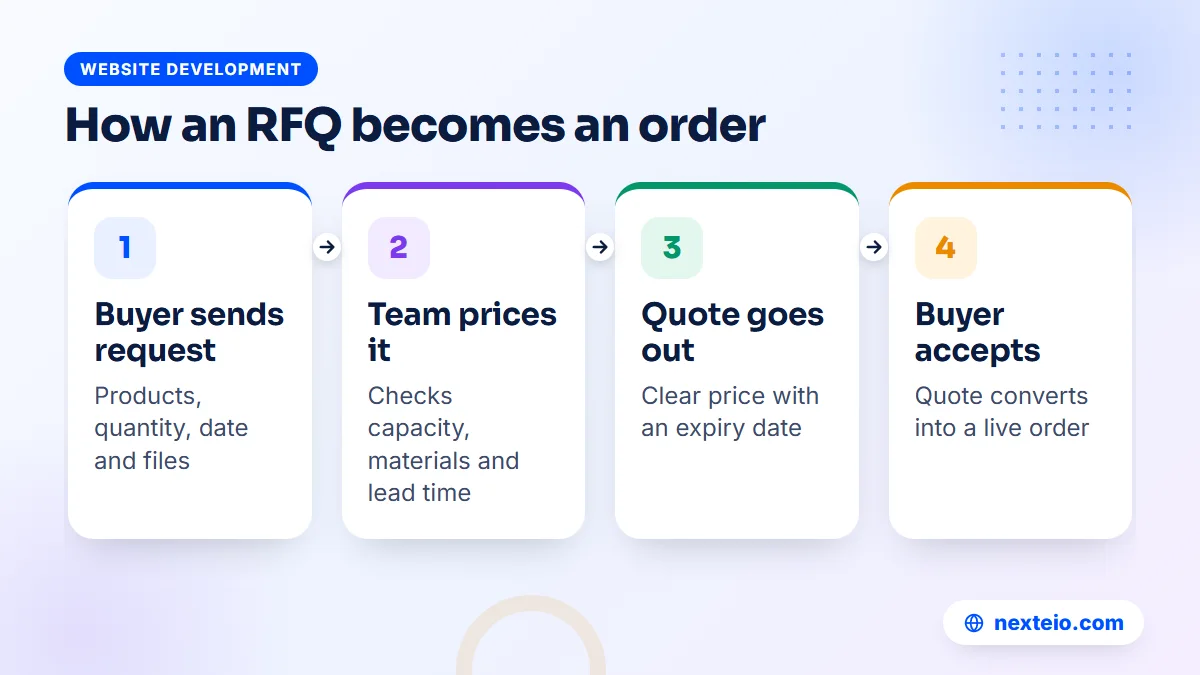
For many manufacturers, the most valuable part of the platform is not the cart at all. It is the request for quotation, often shortened to RFQ. Large or custom orders always need a human to check capacity, materials and delivery dates, so the system's job is to collect a clean request and keep the conversation in one place.
A good RFQ flow has four stages. The buyer picks products or describes what they need, adds quantities and a target date, and attaches files such as artwork or a tech pack. Your team receives the request, prices it and sends back a quote with an expiry date. The buyer accepts, asks for changes or lets it lapse. An accepted quote becomes an order without anyone retyping it.
Samples follow a similar path. A garment buyer might request a counter sample of a specific style in two colors, and a packaging buyer might want five sample boxes before committing to 20,000. Track samples as their own request type, with a reference number, so that when the bulk order comes three weeks later, everyone can see which sample it relates to.
Keep the forms short. A buyer who has to fill thirty fields before sending a simple inquiry will phone instead. Ask for what you truly need to price the job, and let your team follow up for the rest.
Payments, Credit and Invoices in B2B Trade
Retail stores in Bangladesh are built around bKash, Nagad, cards and cash on delivery. Trade orders mostly run on bank transfers, credit terms and sometimes cheques or advance deposits. Your ordering system has to support that reality rather than forcing every buyer through an online payment gateway.
Payment options to plan for
- Order now, pay on terms: the buyer orders on account and pays by the due date. The system tracks the balance and blocks new orders once the credit limit is reached.
- Advance or part advance: common with new buyers and custom work. The buyer pays a percentage before production starts.
- Bank transfer with reference: the invoice shows your bank details and an order reference, and accounts marks it paid once the money arrives.
- Online payment for small accounts: small retailers may prefer bKash, Nagad or a card through a local payment gateway, especially for small top-up orders.
Most companies end up offering two or three of these, set per buyer account.
Export payments usually go through a letter of credit or a bank-to-bank arrangement and are handled by your commercial team and your bank, not by the website. The online platform can still store the proforma invoice, shipping documents and order status so the buyer has one place to check.
Invoices and VAT documents
Business buyers need proper paperwork for their own books. Make sure the system can produce invoices in the format your accounts team uses, with your BIN and the VAT details required under National Board of Revenue (NBR) rules. In many companies the official VAT invoice still comes from the accounting software, and the website simply passes the order across. That is fine, as long as the buyer can download the final document from their account page.
Agree with accounts early on who is the source of truth for balances. If the website shows one outstanding figure and the ledger shows another, buyers lose trust quickly.
Choosing a B2B Ecommerce Platform: Shopify, WooCommerce or Custom Laravel
There are three practical routes for most companies in Bangladesh. Each one can work. The right choice depends on how unusual your pricing and order rules are, how many products and buyers you have, and whether the system has to talk to other software.
Shopify B2B
Shopify is a hosted platform, so you do not manage servers or updates. Its B2B features include company accounts, catalogs with their own prices, payment terms and quantity rules. Shopify B2B has historically been tied to its higher-tier plans, so check the current plan details before you budget. Subscription fees are billed in US dollars, usually to an international card, and Shopify Payments is not available for businesses in Bangladesh, so you need to confirm how local payments or manual payment methods will work.
WooCommerce on WordPress
WooCommerce is a free, open-source store plugin for WordPress. On its own it is a retail cart, but wholesale and B2B plugins add buyer roles, price lists, minimum quantities, quote requests and hidden prices for guests. It is often the most cost-effective route for wholesalers with standard rules, and local payment gateways generally offer WooCommerce plugins. The trade-off is that every added plugin is something else to update and test, and very large catalogs need good hosting and careful setup. A WordPress website team that knows WooCommerce well makes a big difference here.
A custom Laravel build
When pricing rules are complex, when the portal must sync with an ERP or accounting system, or when dealers, depots and sales officers each need their own dashboards, a custom application is often the cleaner answer. Laravel is a PHP framework well suited to this kind of system. It costs more upfront and takes longer, but the software follows your business instead of the other way round. Our guide on hiring a Laravel developer explains what to check before you commit.
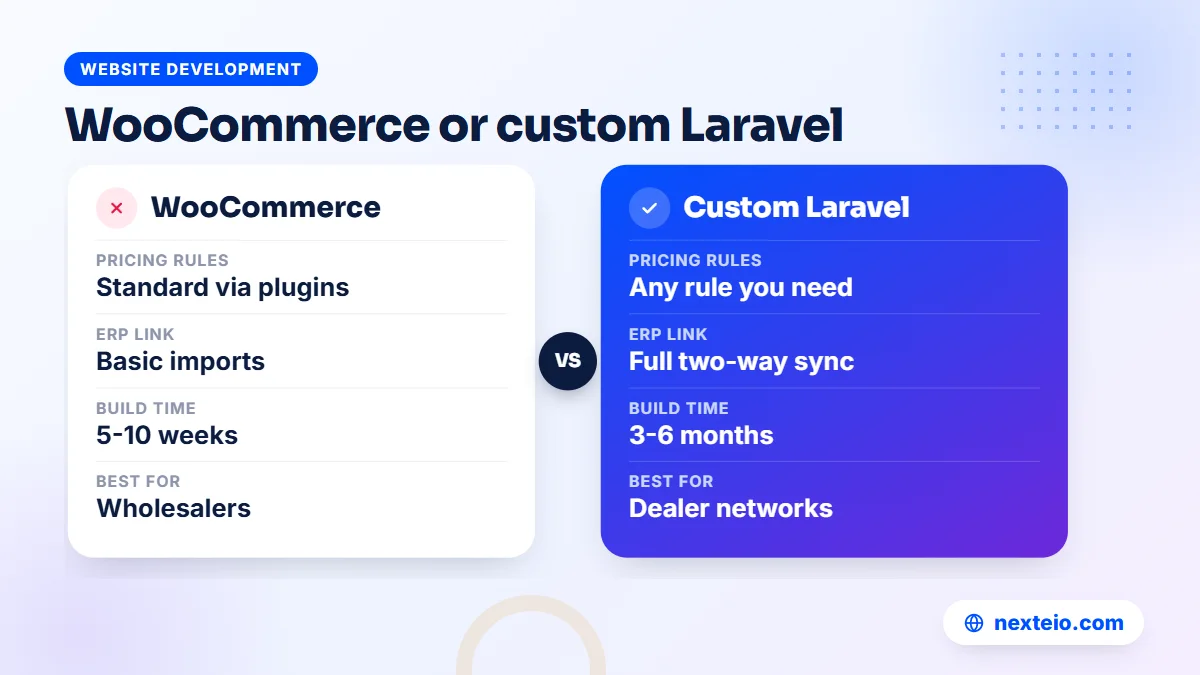
A quick way to decide: if a WooCommerce or Shopify demo can handle your top five pricing and ordering rules with settings and well-known extensions, start there. If two or more of those rules need custom code, you are probably better off building on Laravel from the start. Our comparison of WordPress and custom websites goes deeper into the long-term trade-offs.
Your Own Platform or an Online Wholesale Market
An online wholesale market is a marketplace where many suppliers list products and many business buyers search across them. Global sourcing marketplaces and local wholesale apps both work this way. They bring buyers you would never reach alone, which is a real advantage for a new manufacturer or one looking for export leads.
The costs are just as real. You compete side by side with every other supplier, usually on price. The marketplace owns the buyer relationship and the data, sets the rules, and can change fees or rankings at any time. Membership fees and commissions also add up, and your listing looks much like everyone else's.
Your own platform works the other way round. It does little to find strangers, but it serves the buyers you already have far better, with their prices, their history and your brand. It also keeps every order and every buyer record in your hands.
Many companies use both. They list on a marketplace to find new buyers, then move repeat buyers to their own portal once trust is built. If you go this way, keep your product data in one master list so you are not maintaining two catalogs by hand.
Connecting Orders to Stock, Accounts and the Factory Floor
A B2B ecommerce platform that does not talk to the rest of the business becomes another place for errors. Someone has to copy each online order into the accounting software, check stock in a separate sheet and update the website when a product runs out. After a few weeks, the website shows the wrong stock and buyers stop trusting it.
Decide early which system owns which data. A common pattern looks like this:
- Products and prices: owned by the ERP or accounting software, pushed to the website on a schedule.
- Stock: owned by the warehouse system, synced to the website every few minutes or every hour.
- Orders: created on the website, sent to the ERP for invoicing and dispatch.
- Payments and balances: owned by accounts, shown on the website as read-only figures.
Integration can be as simple as a scheduled CSV or Excel import, or as complete as a live API connection. Many Bangladeshi companies use local accounting software that has no public API, and in that case a well-structured daily file exchange is a sensible first step. A custom build on Laravel handles either approach, and a careful Laravel web application team will ask about your existing software in the first meeting.
Think about the factory floor as well. For made-to-order goods, an accepted order might need to create a production job. Even a simple status that the buyer can see, such as "in production", "quality check" or "ready for dispatch", saves your merchandisers a lot of phone calls.
Catalog Content That Trade Buyers Trust
Business buyers read product pages differently from shoppers. They want specifications, not slogans. A good B2B product page answers the questions a purchase officer would otherwise email you about.
- Product code, size, weight, material and pack size.
- Minimum order and normal lead time.
- Clear photos on a plain background, plus close-ups of finish or fabric.
- A downloadable spec sheet or data sheet.
- Certificates or test reports your buyers usually ask for.
- Related items, such as caps for bottles or matching trims.
Write in clear English for export buyers, and add Bangla where your local dealers prefer it. Keep units consistent, since a catalog that mixes inches and centimeters or dozens and pieces causes real ordering mistakes.
Public pages still matter for search. Many companies keep prices behind a login but leave product pages open, so new buyers can find them on Google. Google's guidance on ecommerce sites in Search explains how product pages, structure and markup help. If organic visibility is part of the goal, our e-commerce SEO service works on exactly those category and product pages, and our article on writing SEO-friendly website content covers the writing side.
Related guides for planning the wider project:
- What to plan and budget for ecommerce website development in Bangladesh
- How to build a professional business website that gets results
- How faster pages help you rank and sell
B2B Ecommerce Platform Costs and Timelines in Bangladesh
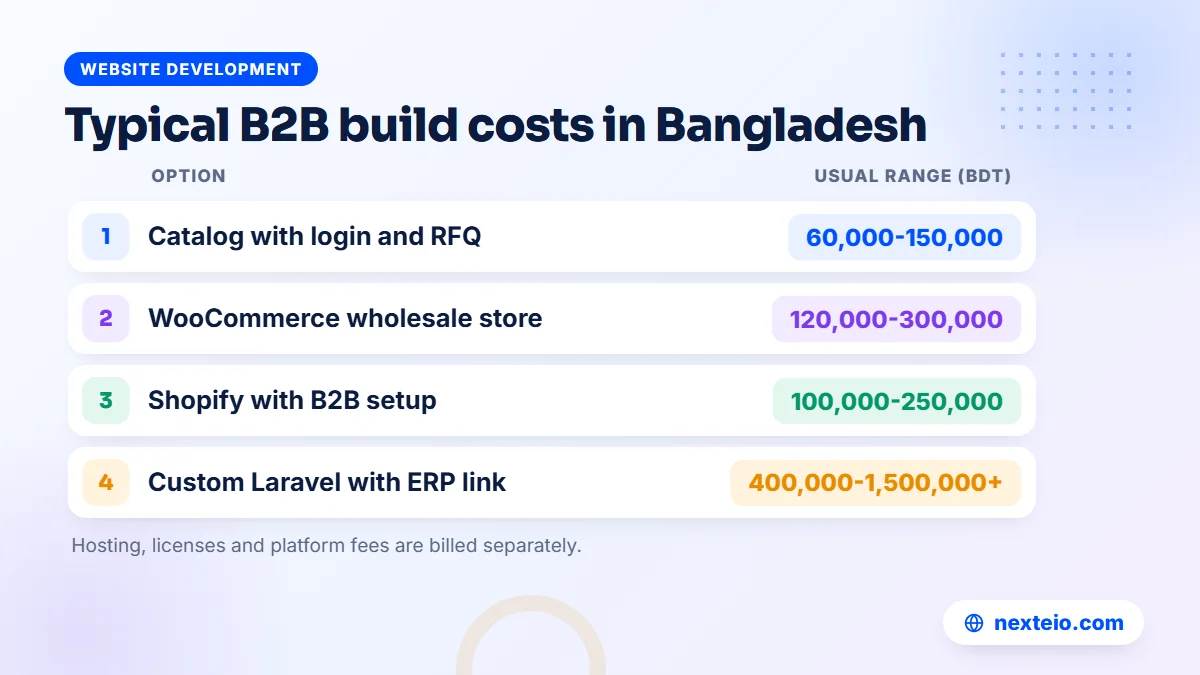
Costs vary more in B2B than in retail because the rules vary so much. The ranges below are rough market figures in our experience, not fixed prices, and they cover the build only. Hosting, plugin licenses, platform subscriptions and ongoing support are separate.
| Option | Typical build range | Typical timeline | Usually suits |
|---|---|---|---|
| Catalog with buyer login and RFQ | BDT 60,000 to 150,000 | 3 to 6 weeks | Garment and textile exporters, custom manufacturers |
| WooCommerce wholesale store | BDT 120,000 to 300,000 | 5 to 10 weeks | Wholesalers and distributors with standard pricing |
| Shopify with B2B setup | BDT 100,000 to 250,000 plus monthly fees in USD | 4 to 8 weeks | Brands that prefer hosted software and fit Shopify's rules |
| Custom Laravel portal with ERP link | BDT 400,000 to 1,500,000 or more | 3 to 6 months | Manufacturers with dealer networks, depots and complex pricing |
What moves the price most is not the number of pages. It is the number of rules, integrations and user roles. A portal with three price groups and no integration is a small project. One with contract pricing, credit limits, approvals, sales rep access and a live ERP link is a large one.
Budget for the running costs too. A hosted platform has a monthly subscription. A self-hosted WooCommerce or Laravel system needs a reliable server, backups, updates and someone to fix problems quickly, because a broken ordering system during a busy month costs real sales. If you want an estimate for your own rules, send us your requirements through the project form.
Getting Buyers to Use the New System
The technology is the easier half. The harder half is changing habits that have worked for years. Dealers who have phoned the same sales officer for a decade will not switch because you sent them a link.
A rollout plan that respects relationships
- Start with a pilot group of ten to twenty friendly buyers who order often.
- Let sales officers place orders through the portal on behalf of buyers first, so the data builds up.
- Show each buyer their own order history and balance, which is often the feature that wins them over.
- Give a small, clear reason to order online, such as faster dispatch or early access to new stock.
- Collect feedback for a month, fix the friction, then open it to the next group.
Never punish buyers who still phone. The goal is to make online ordering the easier choice, not the only one. Keep sales officers involved and make sure their incentives still count orders that buyers place themselves, or they will quietly steer buyers back to the phone.
Mobile matters more than you expect
Many shop owners and dealers in Bangladesh will use the portal only on a phone, often on mobile data. Test the quick order screen, the reorder button and the invoice download on a mid-range Android phone. Check speed using Core Web Vitals as a guide, and keep the order screen light. A desktop-style table with fifty columns is useless on a 6-inch screen.
Mistakes that sink B2B projects
- Launching with prices that sales staff have not checked, so the first buyers see wrong rates.
- Copying a retail checkout and forcing payment at the time of order.
- Showing stock figures that are a day old during a busy season.
- Building every feature before a single buyer has tried the system.
- Leaving nobody in charge of approving new accounts, so applications sit for weeks.
How Nexteio Can Help With Your B2B Ecommerce Platform
We build B2B ordering systems for manufacturers, wholesalers and exporters in Bangladesh as part of our e-commerce website development work. The first step is always the rules: we sit with your sales and accounts teams, write down your buyer groups, price lists, minimums, credit terms and document formats, and agree on which system owns stock and balances.
From there we recommend the route that fits. For standard wholesale pricing, that is often WooCommerce with carefully chosen extensions. For dealer networks, contract pricing or an ERP link, it is usually a custom Laravel application. For exporters who mainly need a private catalog and quotation requests, a lighter build is often enough. Where you also want new buyers to find you, we can plan search-friendly product pages from the start, and our Google Ads team can run campaigns for trade search terms.
You get a system in your company's name, with your domain, hosting and admin accounts under your control. You can see examples of our work in the portfolio, read more about Nexteio, or describe your ordering process on our project form. If you prefer to talk first, use the contact page and tell us about your buyers and products. Our online store and ordering system service page also shows how we approach retail and trade builds.
Keep reading: a buyer's checklist for choosing a web design company, why some websites get traffic but no customers, or browse all our website development guides.
Frequently asked questions
What is the difference between B2B and B2C ecommerce?
B2C sells to individual consumers at one public price, usually with payment at checkout. B2B sells to other businesses, so buyers log in, see prices agreed with them, order in bulk and often pay later on credit terms. The paperwork is heavier too, with quotations, proforma invoices and VAT documents.
Can I run retail and wholesale from the same website?
Yes. Many businesses keep one product list and show different prices depending on who is logged in. Guests and retail customers see the public price, while approved trade accounts see their wholesale price, minimums and payment options. It needs careful setup so retail shoppers never see trade prices by mistake.
Is Shopify B2B available to businesses in Bangladesh?
Businesses in Bangladesh can use Shopify, but the B2B tools have been tied to higher-tier plans, and Shopify Payments does not support Bangladeshi merchants. You would pay the subscription in US dollars and rely on manual payments or a third-party gateway. Check Shopify's current plan and payment pages before deciding.
Do garment exporters really need online ordering?
Most export garment orders still go through sampling, costing and bank-backed payment, so a public checkout makes little sense. What helps is a private buyer area with your product library, sample references, compliance documents and quotation requests. It keeps buyer communication organized and gives a good first impression during sourcing.
How do online orders reach our accounting software?
The simplest method is a scheduled export of new orders as a CSV or Excel file that accounts imports each day. Where the accounting or ERP system has an API, orders, stock and prices can sync automatically. The right choice depends on your current software, so share its name with your developer early.
How long does it take to build a B2B ordering system?
A catalog with buyer logins and quote requests can be ready in a few weeks. A WooCommerce wholesale store usually takes one to two and a half months. A custom portal with ERP integration, credit control and several user roles often takes three to six months, plus time for a pilot with real buyers.
Should we list on an online marketplace instead of building our own system?
A marketplace helps you find new buyers, while your own system serves existing buyers better and keeps the data with you. Many suppliers use both: the marketplace for discovery and their own portal for repeat orders. Keep one master product list so prices and stock stay consistent across both.