How Web Design Fees Are Calculated: Fixed Price, Hourly and Retainer

In this article 15 sections
- 1.What Web Design Fees Actually Pay For
- 2.Fixed-Price Projects: How the Number Is Built
- 3.Hourly and Daily Rates: Paying for Time
- 4.Retainers: Paying Monthly for Ongoing Work
- 5.Packages and Value-Based Pricing
- 6.Fixed Price, Hourly and Retainer Compared
- 7.What Moves Web Design Fees Up or Down
- 8.Typical Web Design Cost in Bangladesh
- 9.Payment Schedules and Advance Payments
- 10.Change Requests and Scope Creep
- 11.Costs That Sit Outside the Design Fee
- 12.How to Compare Two Quotes Fairly
- 13.Web Design Fees Over Three Years, Not Three Weeks
- 14.How Nexteio Can Help With Your Website Budget
- 15.Frequently asked questions
Web design fees in Bangladesh can look random from the outside. One provider quotes BDT 30,000 for a company website, another asks for BDT 120,000, and a third wants to bill by the hour. The gap usually has less to do with greed or generosity than with how each provider calculates the price and what they put inside it.
Picture a procurement officer at a corporate group with three quotations on the desk for the same ten-page brief. None of them line up. One lists pages, one lists hours, and one is a single number with no breakdown at all. Comparing them feels like comparing rice sold by the sack, the kilo and the plate.
The fix is to understand the pricing model first and the number second. Once you know how web design fees were worked out, you can ask the right questions, spot what is missing and compare offers on equal terms.
This guide explains the three main models, fixed price, hourly and retainer, along with the package and value-based variations you will also meet. It covers what pushes the price up or down, typical market ranges, payment schedules, change requests, the costs that sit outside the quote, and a worked example of comparing two offers line by line.
What Web Design Fees Actually Pay For
Before looking at pricing models, it helps to know what the money buys. A website is mostly people's time. Whatever the model, web design fees are built from hours spent on a handful of jobs, plus a margin for the provider's overheads and risk.
- Discovery and planning: meetings, the brief, a sitemap and decisions about pages and features.
- Design: layouts for the homepage and inner pages on desktop and mobile, plus revision rounds.
- Development: turning the design into a working site with an admin panel, forms and integrations.
- Content work: entering text, resizing photos, and sometimes writing or translating copy.
- Testing and launch: checking phones, browsers and forms, then moving the site live.
- Project management: emails, calls, approvals and keeping the timeline on track.
Project management is the line people forget. In an organization where three people must approve every page, it can take as many hours as the design itself.
Overheads matter too. A registered agency pays rent, salaries, software licenses and tax, and those costs sit inside every quote. A freelancer working from home has lower overheads but less cover when they fall ill or take on too much work. Neither choice is wrong. You are simply buying a different level of risk.
Fixed-Price Projects: How the Number Is Built
Fixed price is the most common model for a new website in Bangladesh, and for good reason. You know the total before work starts, finance can approve one figure, and the provider carries the risk if the job takes longer than planned.
Behind that single number, a careful provider still estimates hours. They list the pages and features, estimate the time for each, apply an internal rate, then add a buffer for revisions and delays. A five-page profile on a ready theme might take a few working days. A custom website design project with a product catalog, Bangla and English versions and an enquiry system can run to several weeks.
What makes fixed price work
Fixed price only works when the scope is written down. The quote or agreement should list:
- The number of pages and what each one contains.
- Features, such as forms, a gallery, a notice board or a product catalog.
- How many design concepts you will see and how many revision rounds are included.
- Who writes the content and who enters it.
- What happens at launch: hosting setup, training and handover of logins.
Anything not on that list sits outside the fixed price. That is not a trick. It is how the model protects both sides.
The weak point: change
The weak point is change. If the managing director sees the finished homepage and asks for a new section on CSR projects, the provider will treat it as extra work. Agree in advance how extras are priced, either as a set rate per page or by the hour, so a change request does not turn into an argument a week before launch.
Hourly and Daily Rates: Paying for Time
With hourly or daily billing, you pay for the time actually spent. The provider keeps a time log and invoices weekly, monthly or at agreed points. Some freelancers prefer this model because they cannot predict how long a client's feedback will take.
Hourly billing suits work where the scope is unclear or keeps moving. Think of fixing an old site whose code nobody documented, adding small features over several months, or finding out why a contact form stopped sending email. It is a poor fit for a full new website, because the final bill stays unknown until the end.
How to keep hourly work under control
- Ask for an estimate range before work starts, even if billing is hourly.
- Set a cap: the provider must stop and ask before going past an agreed number of hours.
- Request a time log that shows the task, the date and the hours, not just a total.
- Agree the rate in writing, including whether urgent or weekend work costs more.
A good provider will not mind any of these. A provider who refuses to estimate or share a log is asking for trust they have not yet earned.
Rates vary widely with experience. A junior developer and a senior one may take very different times for the same fix, so a higher rate does not always mean a higher bill. Judge the total for a task, not the rate alone.
Retainers: Paying Monthly for Ongoing Work
A retainer is a fixed monthly fee for an agreed amount of work or availability. It is common after launch, when a site needs updates, security care, content changes and small design jobs every month. Instead of a new quote for every request, you pay a steady amount and the provider keeps time free for you. In effect, the retainer spreads web design fees for small jobs evenly across the year, which many finance teams prefer.
In Bangladesh, monthly maintenance retainers usually fall around BDT 2,000-5,000 for a basic plan, 5,000-12,000 for a standard plan and 12,000-30,000 or more for an advanced plan, depending on the site and the work included. A retainer that also covers fresh design work, such as new landing pages each month, sits higher. At Nexteio, a maintenance plan starts when the client gives us access to the hosting server and the website and both sides sign an agreement that sets out the work.
What a retainer agreement should say
- Which tasks are covered, such as backups, updates, content edits or design hours.
- How many hours or requests are included each month.
- Whether unused hours roll over or expire.
- How extra work beyond the plan is charged.
- How much notice either side must give to end it.
Retainers work best for organizations with a steady flow of updates: a school posting notices and results, a hospital changing doctor schedules or a corporate group adding news and tenders. A small office whose site barely changes may do better with a light plan and separate payment for occasional edits.
Packages and Value-Based Pricing
Many providers bundle web design fees into packages: a set number of pages, a domain, a year of hosting and a few features for one price. Packages make website design prices easy to compare at a glance, and they suit small businesses with standard needs. The catch is in the details. A package that says "five pages" may limit revisions, use a theme shared by dozens of other sites, or charge extra for a contact form.
Value-based pricing works the other way round. The provider prices the project by what it is worth to you rather than by hours. A website that will handle admissions for a large college, or supplier enquiries for an exporter, may be priced above the hours it takes because the outcome matters more. You will see this mostly with larger agencies and complex projects.
Neither approach is unfair if it is explained. For a package, ask for the full list of what is included in writing. For a value-based quote, ask what you get that a cheaper hourly quote would leave out.
Fixed Price, Hourly and Retainer Compared
The table below puts the main models side by side for a typical organization.
| Model | How you pay | Best for | Main risk |
|---|---|---|---|
| Fixed price | One agreed total, in stages | New websites with a clear brief | Extras cost more if scope changes |
| Hourly or daily | Time spent, from a log | Fixes, audits and unclear work | Final bill unknown at the start |
| Retainer | Same fee every month | Ongoing updates and care | Paying for hours you do not use |
| Package | One price for a set bundle | Small sites with standard needs | Limits hidden in the small print |
Many projects mix models: a fixed price for the build, then a retainer for care after launch.
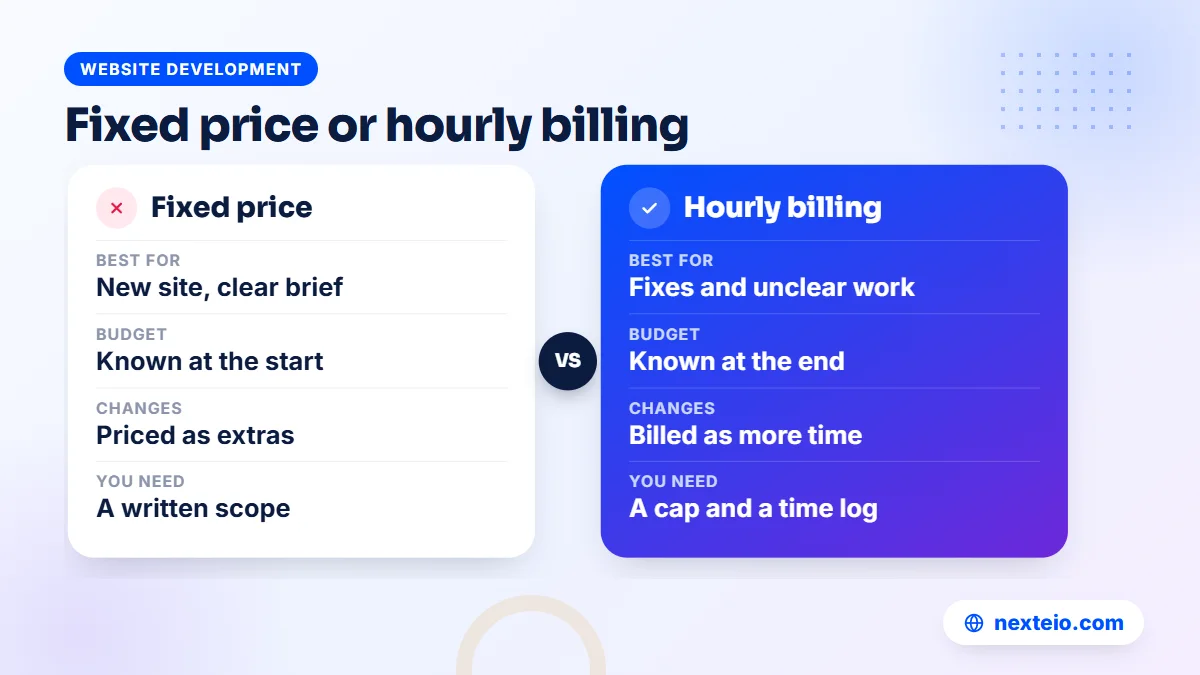
If you are unsure which to choose, start with the work itself. A new site with known pages fits fixed price. A messy rescue job fits hourly billing with a cap. Monthly updates fit a retainer.
What Moves Web Design Fees Up or Down
Two quotes for "a company website" can describe very different jobs. These factors change web design fees the most, roughly in order of impact:
- Custom design or a theme: a custom-designed website drawn from a blank page takes far more hours than adjusting a ready theme.
- Page templates: twenty pages built from three layouts cost less than ten pages with ten unique layouts.
- Features: online payment, SMS alerts, ERP links or a student portal each add work.
- Languages: a full Bangla and English site roughly doubles content work and adds testing.
- Content: if the provider writes copy, sources photos or films a factory tour, the price rises.
- Deadline: a two-week rush usually costs more than a relaxed six-week plan.
- Approvals: more decision-makers means more meetings and more revision rounds.
A clear brief that covers these points is the fastest way to get quotes you can compare.
The platform deserves its own thought. WordPress is free, open-source software, and the WordPress license lets you use and change it, so you pay for setup and design rather than the software itself. A WordPress website suits most company profiles, schools and NGOs. A Laravel web application costs more to build but fits processes a plugin cannot handle, such as a dealer portal or a booking system. Our comparison of WordPress and custom websites explains the trade-off in detail.
Payments are a common surprise. Adding bKash, Nagad or card payments means a merchant account, a payment gateway, testing and sometimes paperwork with the gateway company. That work is easy to underestimate in a quick quote, so ask whether it is included before you compare totals.
Typical Web Design Cost in Bangladesh
These are typical market ranges in Bangladesh for building a business website or online store. They are not quotes from any single provider. They show where most projects land, so you can tell whether an offer sits in a normal range.
| Business site | Typical market range |
|---|---|
| Company website, theme-based | BDT 25,000-60,000 |
| Company website, custom design | BDT 60,000-150,000 |
| Large corporate site with integrations | BDT 150,000-400,000+ |
| Online store, ready theme | BDT 25,000-60,000 |
| Online store, custom design | BDT 60,000-150,000 |
| Online store, custom-built with integrations | BDT 150,000+ |
Institutions follow a similar pattern, scaled by the number of departments and users:
| Institution or system | Typical market range |
|---|---|
| School or madrasa website | BDT 20,000-60,000 |
| College website | BDT 50,000-120,000 |
| University website | BDT 150,000-400,000+ |
| Custom software, portal or LMS | Quoted after a requirements review, often BDT 150,000-1,200,000+ |
Running costs come on top. A .com domain usually costs about BDT 1,500-2,500 a year, and shared hosting about BDT 2,000-8,000 a year.
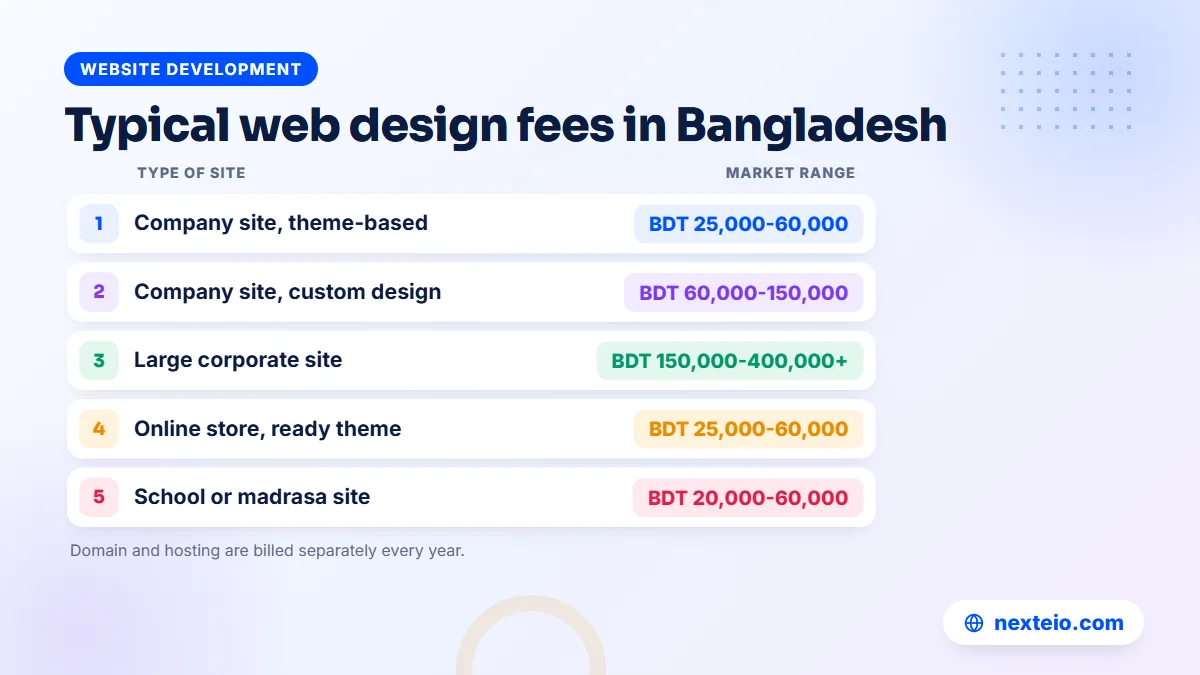
Use these ranges as a sanity check, not a target. If a custom website build is quoted at the price of a theme-based one, ask what is different. A web design cost far below the range usually means something is missing, such as content entry, mobile testing or a proper handover. A quote far above it should come with a clear reason, like integrations, a large page count or original photography. If your project is a shop, our guide to planning and budgeting an e-commerce website breaks down the store-specific costs, and our e-commerce website service page shows what a store build covers.
For a figure based on your own pages and features, send a short brief through our project form. A real scope always beats a guess from a price list.
Related guides for planning the project itself:
- How to build a professional business website that gets results
- What to check before hiring a WordPress developer
- How to hire the right Laravel developer
Payment Schedules and Advance Payments
How you pay web design fees matters almost as much as how much you pay. Most fixed-price projects are paid in stages tied to progress, so neither side carries all the risk. A common pattern has three stages:
- An advance when the agreement is signed, which books the provider's time.
- A second payment when you approve the design of the homepage and key inner pages.
- The balance at launch, once the site is live and the accounts are handed over.
Many providers ask for an advance of somewhere between a third and a half of the total. Larger projects may add more stages, for example after development on a test link and after content entry.
Protecting yourself at each stage
- Tie each payment to something you can see, such as an approved design or a working test link.
- Keep the final payment until the domain, hosting and admin logins are in your organization's name.
- Pay through traceable channels, such as a bank transfer or a merchant payment, and keep every receipt.
- Ask for an invoice or money receipt for each payment.
You can check who holds a domain with the ICANN registration lookup before you release the last payment.
If a provider wants the full amount up front for a large project, ask why. A small fixed-price job may justify it. A six-figure build does not.

Change Requests and Scope Creep
Scope creep is the slow growth of a project beyond what was agreed. It rarely starts with one big request. It starts with "can you just add" a careers page, then a second language, then a new gallery style after the design was approved. Each request seems small, and each one adds hours.
Most budget fights on website projects start here, not with the original price. The fix is a simple change process that both sides follow:
- You send the request in writing, even as a short email or message.
- The provider replies with the cost and time impact before starting.
- Someone with budget authority approves it.
- The change appears on the final invoice as a separate line.
This sounds formal for a small business, but it keeps the relationship friendly. Nobody is surprised by the last invoice, and the provider is not quietly absorbing work they will later resent.
Revision rounds belong in the same conversation. Two or three rounds at each design stage is a common arrangement. Beyond that, extra rounds are fair to charge for, because every round costs the designer real hours. The easiest way to save rounds is to collect feedback from every decision-maker at once instead of sending the designer one opinion at a time.
Costs That Sit Outside the Design Fee
A web design quote often covers the build and nothing else. These items are frequently billed separately, so check each one:
- Domain registration and the yearly renewal.
- Hosting, usually billed yearly, and an SSL certificate if the host does not include a free one.
- Paid themes, plugins or fonts, many of which need yearly license renewals.
- Copywriting, translation between Bangla and English, and proofreading.
- Professional photography or video, especially for factories, hospitals and hotels.
- Ongoing SEO work and advertising budgets.
- Maintenance after launch.
Ask the provider to mark which of these are included and which are not.

A quote that looks cheaper may simply leave more of these items for you to pay later. Copywriting is the one most often skipped. Many organizations plan to write the text themselves and then stall for weeks, so the finished design sits empty. If your team will write the text, set a deadline for it in the project plan just like any other stage.
Search visibility is another grey area. A good build includes basic on-page setup such as page titles, descriptions and a sitemap, the kind of groundwork described in Google's SEO starter guide. Growing rankings month after month is separate work, handled by an SEO service. Paid traffic is separate again: Google Ads management has its own fee on top of the money you spend on clicks.
VAT and tax deduction
Organizations should also check tax early. Many companies, NGOs and government bodies must deduct VAT and income tax at source when they pay suppliers, under National Board of Revenue rules. Ask whether the quote includes VAT and whether the provider can issue the invoice and documents your accounts team needs. Sorting this out before the work order saves weeks at payment time.
How to Compare Two Quotes Fairly
Comparing web design fees means comparing scope, not just totals. Here is a simple example. A corporate group asks two providers to quote for a website of about ten pages, in Bangla and English, with a news section and an enquiry form.
| Item | Quote A | Quote B |
|---|---|---|
| Total | BDT 45,000 | BDT 110,000 |
| Design | Ready theme, adjusted | Custom design, two concepts |
| Languages | English only, Bangla extra | Both included |
| Content entry | Client enters | Provider enters |
| Revisions | One round | Three rounds per stage |
| Handover | Not mentioned | Training, accounts in client's name |
Both totals sit inside normal market ranges for their type of site.
On paper, Quote A is less than half the price. Add the Bangla version, the content entry and the extra revision rounds you will almost certainly need, and the gap narrows. Quote A may still be the right choice for a tight budget. The point is to choose knowingly, with the same scope written on both sides.
Questions to ask every provider
- What exactly is included, page by page and feature by feature?
- How many revision rounds are included, and what does an extra round cost?
- Who writes the content, and who enters it?
- How are change requests priced?
- What is the payment schedule, and what triggers each payment?
- Whose name will the domain, hosting and admin accounts be in?
- What support is included after launch, and for how long?
Vague answers to clear questions are a warning sign in themselves.
Ask to see live sites the provider has built, not just screenshots, and open them on your phone. Our buyer's checklist for choosing a web design company covers more of these checks, including how to speak to past clients before you sign.
Red flags in a quote
- A single total with no list of pages, features or revision rounds.
- The domain or hosting registered in the provider's name "for convenience".
- Full payment demanded up front on a large build.
- No mention of mobile testing, backups or handover.
- A price far below the market range with no word on what was left out.
Any one of these deserves a direct question before you sign. A provider with a sound process will answer it without fuss.
Web Design Fees Over Three Years, Not Three Weeks
The cheapest build is not always the cheapest website. A site that loads slowly on mobile data, breaks after its first plugin update or cannot be edited by your staff costs money every month after launch. When you weigh web design fees, look at the total over three years.
Here is a rough example for a theme-based company website, using typical market ranges:
- Build: about BDT 40,000, paid once.
- Domain: about BDT 2,000 a year, so roughly BDT 6,000 over three years.
- Shared hosting: about BDT 5,000 a year, so roughly BDT 15,000 over three years.
- Basic maintenance: about BDT 3,000 a month, so roughly BDT 108,000 over three years.
In this example, running and care costs over three years add up to more than three times the build fee.
That is why a slightly higher build price for a cleaner, lighter site can pay for itself. Fewer plugins mean fewer updates and fewer things to break. A site your staff can edit without calling the developer saves small fees every month.
Speed is a good example of long-term value. Google publishes the Core Web Vitals measures for loading, responsiveness and visual stability, and a site designed with them in mind usually needs fewer fixes later. Our guide on website speed and SEO explains how faster pages help with both rankings and enquiries.
The other long-term question is whether the site brings in work at all. A clear structure, strong calls to action and a fast mobile layout matter more than an extra animation on the homepage. Spending part of the budget on a design built around how your customers decide is usually a better use of money than features nobody asked for.
How Nexteio Can Help With Your Website Budget
We plan, design and build websites for companies, schools, clinics, NGOs and other organizations across Bangladesh. Through our custom website design service, each site starts from your brief rather than a bought theme, so it fits your brand, loads quickly on mobile data and makes it easy for visitors to contact you.
If you are comparing web design fees, send us your brief with the pages, features and languages you need. We will tell you which pricing model suits the job and what the price covers, so you can set it beside other quotes on equal terms. If a simpler approach, such as a WordPress build, fits your budget better, we will say so.
After launch, we can look after the site through a maintenance plan that starts with access to your hosting and website and a signed agreement setting out the work. You can see examples in our portfolio, read more about Nexteio, start your project brief here or reach us through the contact page.
Keep reading: why a website gets traffic but no customers, how to write website content people actually read, or browse all our website development guides.
Frequently asked questions
What is the usual website design cost for a small company in Bangladesh?
Typical market ranges are about BDT 25,000-60,000 for a theme-based company website and BDT 60,000-150,000 for a custom design. Large corporate sites with integrations often start around BDT 150,000. Domain and hosting are usually billed separately each year.
Is fixed price or hourly billing better for a new website?
For a new website with a clear list of pages and features, fixed price is usually better because you know the total in advance and finance can approve one figure. Hourly billing suits repair work, audits or projects where the scope is still unclear. If you do pay hourly, set a cap and ask for a time log.
Why do quotes for the same website differ so much?
Providers often quote different scopes without saying so. One may adjust a ready theme and leave content entry to you, while another designs from scratch, enters all the content and includes several revision rounds. Overheads, experience and how much risk the provider builds in also change the figure. Put the same written brief in front of every provider to narrow the gap.
How much advance payment is normal for a website project?
Many providers ask for somewhere between a third and a half of the total when the agreement is signed, with the rest paid at design approval and at launch. Smaller jobs may be paid fully in advance. For larger projects, keep the final payment until the site is live and the accounts are in your organization's name.
Are domain and hosting included in web design fees?
Sometimes for the first year, especially in package deals, but not always. A .com domain usually costs about BDT 1,500-2,500 a year and shared hosting about BDT 2,000-8,000 a year in Bangladesh. Check who pays the renewals from the second year and make sure both accounts are registered in your organization's name.
How can we lower the price without hurting the website?
Prepare your text and photos before the project starts, use fewer unique page layouts, and launch with the features you need now while planning extras for a second phase. A good ready theme adjusted to your brand can also cost far less than a fully custom design. Avoid cutting mobile testing, backups or a proper handover, because those savings usually cost more later.
What happens if we want changes after the design is approved?
Most providers treat changes after approval as extra work, priced per page or by the hour. Ask for the cost and time impact in writing before the work starts, and have someone with budget authority approve it. Collecting feedback from all decision-makers before each approval is the easiest way to avoid these charges.