Web Design and Hosting From One Provider: Pros, Risks and Checks

In this article 16 sections
- 1.What Web Design and Hosting in One Package Means
- 2.Three Common Setups Compared
- 3.The Real Benefits of One Provider
- 4.The Risks You Should Know Before Agreeing
- 5.Who Should Own the Hosting Account
- 6.Email Hosting: The Part People Forget
- 7.What Good Hosting Looks Like, Whoever Provides It
- 8.Security: Who Is Responsible When Something Goes Wrong
- 9.Web Design and Hosting Costs: Bundled vs Separate
- 10.Which Setup Suits Your Organization
- 11.9 Questions to Ask Before a Web Design and Hosting Deal
- 12.Setting Up Hosting During a New Website Project
- 13.How to Leave a Bundled Provider Safely
- 14.Warning Signs in an Existing Arrangement
- 15.How Nexteio Can Help With Web Design and Hosting
- 16.Frequently asked questions
Buying web design and hosting from the same provider sounds like the obvious choice. One company builds the site, puts it on a server, renews everything each year and fixes problems when they appear. For a busy office with no IT staff, that convenience is real, and many arrangements like this run smoothly for years.
The trouble starts when something changes. The designer stops answering the phone, the renewal price doubles, or your organization wants to move to a new agency and finds that the hosting, the domain and even the company email all sit in someone else's account. A school principal or a factory's admin manager then spends weeks chasing logins that should have been theirs from the start.
Neither setup is right for everyone. A bundled package can be the best option for a small business, and a bad choice for a corporate group with an approval chain and an audit trail.
This guide sets out the real benefits, the risks, who should own each account, what good hosting looks like, typical costs in Bangladesh, which setup suits which kind of organization, the questions to ask before you sign, and how to leave a bundled provider without losing your site or your email.
What Web Design and Hosting in One Package Means
A website needs two different things. Design and development produce the site itself: its pages, layout, content and features. Hosting is the server space where those files and the database live, connected to the internet around the clock so visitors can reach them.
When a provider offers web design and hosting together, they handle both. In practice, that can mean several quite different arrangements:
- The designer buys hosting from a larger company in bulk, known as reseller hosting, and places your site on it under their own account.
- The designer runs their own server, often a VPS, and hosts several clients on it.
- The designer opens a hosting account in your organization's name, pays for it on your behalf and manages it for you.
- The designer sets up hosting you buy yourself and only keeps a login to look after it.
All four can be sold as the same package, so ask which one you are getting.
The difference matters far more than the price. In the first two, the provider controls the server and your site lives inside their account. In the last two, you control the account and the provider works inside it. That single detail decides how easy it will be to change providers later, who can see the renewal price and who gets the final say if something goes wrong.
Three Common Setups Compared
Most real arrangements fall into one of three patterns. The table shows how they differ on the points that usually cause trouble.
| Setup | Who owns the account | Main benefit | Main risk |
|---|---|---|---|
| Hosted by the designer | The designer | Simplest for you | Hard to leave, prices hidden |
| Your account, designer manages | Your organization | Convenience with control | Needs clear access rules |
| Separate host and designer | Your organization | Full independence | Two parties to coordinate |
For most organizations, the middle row offers the best balance.
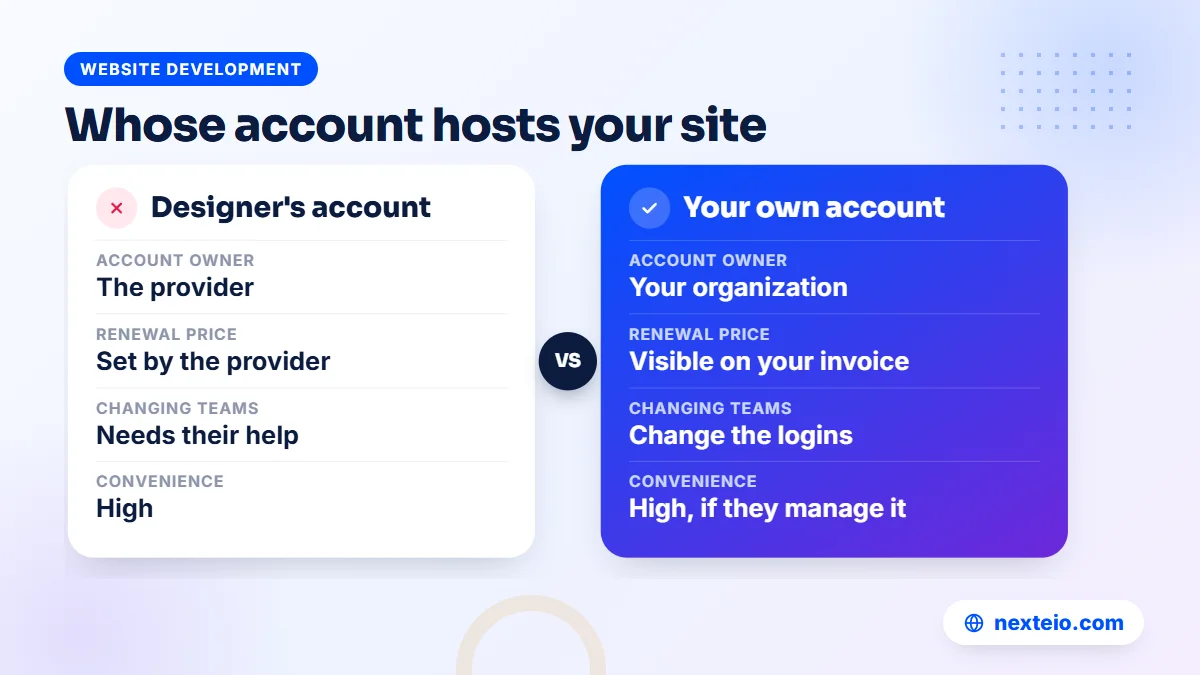
The middle option keeps nearly all the convenience of a bundle. The provider still sets up the server, installs the SSL certificate, watches the site and handles renewals. The difference is that the account, the invoices and the main login belong to you, so the relationship can end without a hostage situation.
The Real Benefits of One Provider
It is easy to focus on the risks, but bundling exists for good reasons. For many small organizations, these benefits outweigh the downsides.
One number to call
When a site goes down, the first question is always whether the problem is the website or the server. With separate providers, each can blame the other while your site stays offline. When one team handles both, they check both and fix whatever is broken, without a three-way email thread.
A server set up for your site
A designer who hosts your site can choose the PHP version, memory limits, caching and security settings that suit how it was built. A WordPress site with a page builder needs different settings from a Laravel application with scheduled tasks. Generic shared hosting bought on the cheapest plan often ships with settings that slow the site down or break features. Planning the server alongside a custom website build avoids that mismatch from day one.
Fewer renewals to track
Domains, hosting and SSL certificates all expire. A good provider tracks the dates and renews on time. For a school office or an NGO with a small admin team, removing those reminders from their desk is a genuine relief.
Faster fixes and updates
With server access, the provider can restore backups, update software and investigate errors without waiting for a hosting company's support ticket. That speed matters most when a site is hacked or broken during a busy week, such as admission season or an Eid sale.
The Risks You Should Know Before Agreeing
The risks are not about bad intentions. Most of them come from unclear ownership, which only becomes visible when the relationship ends or the provider has a problem of their own.
- Lock-in: if the hosting sits in the designer's account, you cannot move without their cooperation.
- Domain control: some providers register the domain in their own name, which can make it very hard to recover.
- Hidden renewal prices: the first year may look cheap, then the renewal jumps with little explanation.
- Weak backups: backups stored only on the same server disappear with the server.
- Crowded servers: a reseller account packed with dozens of client sites can slow everyone down.
- Single point of failure: if a one-person provider falls ill or closes, nobody else has the keys.
Each of these can be prevented with a few lines in the agreement.
Consider a garment exporter whose original web developer moved abroad. The site still runs, but nobody at the factory can log in to the hosting, the domain renews from the developer's card, and the company email sits on the same server. A buyer audit is coming, and the site still shows an old compliance certificate. Fixing that is now a recovery project rather than a five-minute edit.
Who Should Own the Hosting Account
The simplest rule is this: your organization should own every account, and your provider should have access to do their work. Ownership and access are different things, and good providers are comfortable keeping them separate.
What ownership looks like in practice
- The hosting account is registered in your organization's name, with an official email address as the contact.
- Invoices are issued to your organization, even if the provider pays them on your behalf.
- You hold the main login and the provider has a separate user or a shared login you can change.
- The domain is registered to your organization, which you can confirm with the ICANN lookup tool.
- You keep a recent backup of the site somewhere you control.
If you already have a bundled setup, you do not need to end it to fix ownership.
Ask your provider to move the account into your name, or to open a new account in your name and migrate the site. A provider who refuses, or who quotes an unreasonable fee for a simple transfer, is telling you something about how the exit would go.
When a new site is being built, settle this before the work starts. Any custom website design project should end with the hosting, domain and admin accounts in your organization's name and a written access sheet in your hands.
Email Hosting: The Part People Forget
Many bundled packages put your company email on the same server as the website. That is cheap and simple, and it works for small teams. It also means a website problem can become an email problem. If the server is overloaded, suspended or hacked, your staff may lose email at the same moment the site goes down.
Shared hosting email also tends to have smaller mailboxes and weaker spam filtering than dedicated email services. For an organization that depends on email for buyer orders, tenders or admissions, consider keeping email on a separate business email service and only the website on the hosting plan.
Whichever you choose, make sure you know where your email lives. The domain's DNS records decide where mail goes, and those records are usually managed at the domain registrar or the hosting provider. When you change website providers, email often breaks simply because nobody copied the mail records across. Write them down before any move.
What Good Hosting Looks Like, Whoever Provides It
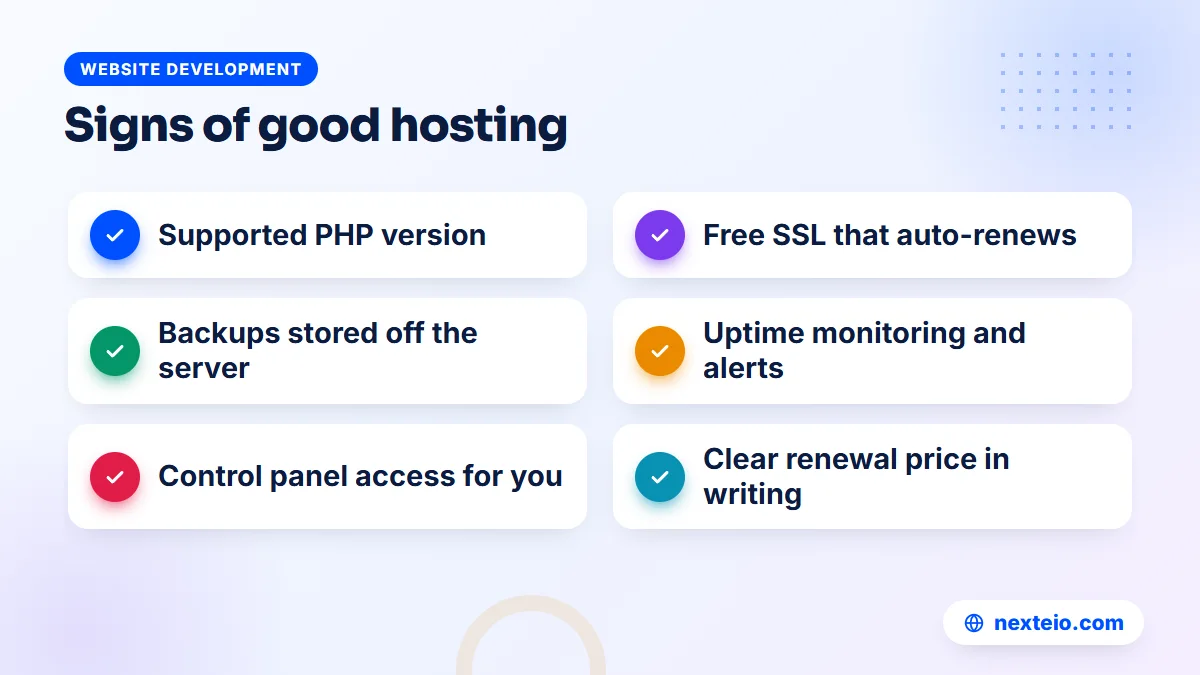
Whether hosting comes from your designer or a separate company, the standard should be the same. A well-run hosting plan for an organization site has a few clear features:
- A supported PHP version, checked against the official PHP supported versions list.
- A free SSL certificate that renews automatically, such as one from Let's Encrypt.
- Daily or weekly backups, with at least one copy stored away from the server.
- Uptime monitoring that alerts someone when the site stops responding.
- Enough memory and processing power for your site's real traffic.
- Control panel access that you can use or hand to another provider.
For WordPress sites, compare the plan with the official WordPress hosting requirements.
Server location affects speed. A site hosted far from Bangladesh can still be fast with good caching, but a slow or overloaded server feels slow everywhere, especially on mobile data. Our guide on website speed and SEO explains how loading time affects both visitors and rankings, and our article on technical SEO basics covers the server-side checks that keep pages visible in Google.
One Bangladesh-specific point is worth clearing up. Office load-shedding does not take a website offline if the site is hosted in a proper data center. It does affect a system running on a computer inside your office, which some institutions still use for internal portals. If that describes your setup, moving to real hosting is usually the first upgrade to make.
Related guides for planning the website side of the decision:
- How to build a professional business website that gets results
- What to check before hiring a WordPress developer
- Common SEO mistakes that hurt business websites
Security: Who Is Responsible When Something Goes Wrong
Hacks, malware and server failures are where unclear arrangements hurt most. In a web design and hosting bundle, the provider controls both the site and the server, so in principle they can respond quickly. The question is whether the agreement says they will, and how.
Reseller accounts carry a specific risk. When many client sites share one hosting account without proper separation, malware on one site can spread to the others. Ask whether each client site runs in its own isolated account or user, and whether one infected site can reach your files.
Put the basics of incident handling in writing:
- Who notices a problem first, and how they tell you.
- Whether cleaning up a hacked site is included or charged separately.
- How quickly a backup can be restored, and from how far back.
- Who contacts Google if the site is flagged as unsafe.
A provider who has thought about these questions will answer them quickly.
With separate providers, responsibility splits. The hosting company looks after the server and usually its own backups, while the web team looks after the site, its software and its plugins. That can work well, but only if both sides know where their job ends. Otherwise each assumes the other is watching.
Web Design and Hosting Costs: Bundled vs Separate
Bundled offers often look cheaper because the hosting is folded into the build price or described as "free for the first year". That is not dishonest, but it hides the real yearly running cost. Separate the numbers before you compare offers. These are typical market ranges in Bangladesh:
| Item | Typical market range | How often |
|---|---|---|
| .com domain | BDT 1,500-2,500 | Every year |
| Shared hosting | BDT 2,000-8,000 | Every year |
| Company website, theme-based | BDT 25,000-60,000 | Once |
| Company website, custom design | BDT 60,000-150,000 | Once |
| Basic maintenance plan | BDT 2,000-5,000 | Every month |
VPS and cloud servers for larger sites cost more than shared hosting.

If a bundled package charges far above these ranges for hosting alone, ask what the extra pays for. It may cover real work such as monitoring, off-server backups and security updates, which is fair. It may also be simple markup on a basic reseller plan.
Here is a simple example. A school receives two offers. The first is a bundle at BDT 50,000 with the first year of hosting and domain included, then a combined renewal of BDT 15,000 a year for "hosting and support". The second is a BDT 45,000 build, with the school paying about BDT 5,000 a year for hosting and BDT 2,000 for the domain directly. Over three years, the first offer costs more, unless that support fee covers real monthly work such as backups, updates and content changes. Ask exactly what it includes before deciding.
Watch the second year. A common pattern is a low first-year bundle followed by a renewal invoice that combines hosting, domain and a vague "support" fee. Ask for the renewal price of each item in writing before you sign, and ask whether you can move the hosting yourself if you think the renewal is too high.
Online stores need a closer look. A shop built through e-commerce website development handles payments, stock and customer data, so it needs stronger hosting and more frequent backups than a five-page profile. Cheap shared hosting is rarely enough once orders pick up.
Which Setup Suits Your Organization
The right arrangement depends on your size, your internal approval process and how much the website matters to daily work.
| Organization | Usually works well | Why |
|---|---|---|
| Small business or shop | Your account, designer manages | Convenience without lock-in |
| School, college or madrasa | Your account, designer manages | Staff change often, so the account must stay with the institution |
| Factory or exporter | Your account, designer manages | Buyers and audits need a reliable site and email |
| Corporate group with IT staff | Separate host and designer | IT controls servers, agencies build sites |
| Freelancer or personal blog | Bundled or free platform | Low cost matters most |
Few organizations are best served by a setup where the designer owns everything.
NGOs deserve a special mention. Donors and auditors often expect every expense to be backed by an invoice in the organization's own name. A hosting bill paid through a designer's personal account can raise awkward questions at audit time, so ask for direct invoices from the start.
Very small publishers have another option. A Blogger website runs on Google's own hosting at no hosting cost, with your own domain connected. It suits simple blogs and news pages, though not company sites that need custom pages and forms. For most company profiles, a WordPress website on decent shared hosting is the practical middle ground, while portals and booking systems built as Laravel web applications usually need a VPS or cloud server.
Our comparison of WordPress and custom websites explains how the platform choice affects hosting needs over time.
9 Questions to Ask Before a Web Design and Hosting Deal
Before you agree to any web design and hosting package, put these questions to the provider and ask for the answers in writing:
- In whose name will the hosting account and the domain be registered?
- Will we get our own login to the hosting control panel?
- What is the renewal price for hosting, domain and support, item by item?
- Where are backups stored, how often are they taken and how long are they kept?
- Is our site on a shared reseller account, a VPS or a dedicated server?
- Is company email included, and where does it run?
- Who monitors uptime, and how will we hear about downtime?
- What happens to our site, files and email if we end the arrangement?
- Is there any fee for transferring the hosting or domain to us?
Clear answers to all nine are a good sign.
Vague answers, especially to the first and the last two questions, are the most common warning sign in web site design and hosting deals. Our buyer's checklist for choosing a web design company covers further checks on the design side.
If you are comparing providers now, you can send Nexteio your requirements and we will explain how we would set up the hosting and who would own each account.
Setting Up Hosting During a New Website Project
The cleanest time to sort out web design and hosting is at the start of a new build. Nothing is live yet, so there is no risk of downtime, and every account can be opened in the right name from day one.
A sensible sequence looks like this. The provider builds the site on a staging copy, a private test address where you can review pages without the public seeing them. While the build runs, your organization opens or approves the hosting account in its own name and confirms who will pay renewals. Once the site is approved, the provider moves it to the live server, connects the domain, installs SSL and checks every page and form.
Use the build period to settle the details that are hard to change later: where email will run, how often backups are taken, who watches uptime and which staff need admin logins. A website designed and built for your organization should hand over with all of these answered in a short access sheet.
Plan the hosting size for the next two or three years, not just launch day. A school that expects to add result publishing, or a company planning an online catalog, may outgrow the cheapest shared plan sooner than expected. Moving up a plan with the same host is usually simple, but it is easier still to start on the right one.
How to Leave a Bundled Provider Safely
Sometimes the arrangement has to end. The provider may be closing, prices may have become unreasonable, or your organization may simply want a different agency. A careful move avoids downtime and lost email. Follow this order:
- Make a list of every account: domain, hosting, DNS, email, website admin and analytics.
- Ask the provider for full access or a transfer of each account, in writing.
- Take a complete backup of the site files, the database and every mailbox.
- Set up the new hosting account in your organization's name.
- Copy the site to the new server and test it on a temporary address.
- Copy the DNS records, including mail records, before changing anything.
- Point the domain to the new server and check the site and email the same day.
- Keep the old hosting for a week or two, then cancel it and confirm the old access is closed.
Done in this order, most visitors will never notice the move.

If the domain itself needs to move to a new registrar, you will need the transfer authorization code from the current registrar. The ICANN transfer policy sets the rules for generic domains such as .com, including when a registrar may refuse a transfer. Domains ending in .bd follow their own process through the national registry, so plan extra time for them.
Search visibility should survive a hosting move if the URLs stay the same. Check Google Search Console after the switch for crawl errors, and keep an eye on page speed for the first few weeks. If rankings drop, our SEO service can find out why.
Warning Signs in an Existing Arrangement
You may already have a bundled setup that has worked for years. That is fine, as long as it would survive a change. Check your current web design hosting arrangement against these signs:
- Nobody in your organization can log in to the hosting control panel.
- The domain renewal reminders go to the designer's personal email.
- You have never received a hosting invoice with your organization's name on it.
- The provider cannot tell you where backups are stored.
- Your site still runs on a PHP version that is no longer supported.
- Small requests take weeks because one person handles everything.
Two or more of these signs mean it is time for a frank conversation.
That conversation does not have to be hostile. Explain that your organization needs the accounts in its own name for audit and continuity reasons. Most honest providers agree straight away, because it changes nothing about the work they do for you. The ones who resist are the ones you most need to plan around.
If the site itself is old, slow or hard to update, moving it may be the right moment for a rebuild, and a chance to set up web design and hosting properly from the start. A redesigned, lighter website on hosting you own can cost less to run over the next few years than patching the old one.
How Nexteio Can Help With Web Design and Hosting
At Nexteio, we build websites for companies, schools, clinics, NGOs and other organizations across Bangladesh through our custom website design service, and we help clients choose and set up hosting that fits the site we build. Our aim is a site that loads quickly on mobile data and an arrangement where your organization holds its own domain, hosting and admin accounts.
If you already have a site trapped in someone else's account, we can help you list what you have, plan the move and set up new hosting in your name before anything is switched. If you want us to look after the site afterwards, our maintenance plans start with access to your hosting and website and a signed agreement that sets out the work.
Whatever setup you choose, you should always be able to walk away with your site, your domain and your email. See examples of our work in the portfolio, learn more about Nexteio, start a project brief or reach us through the contact page.
Keep reading: how to hire the right Laravel developer, simple SEO tips for small business websites, or browse all our website development guides.
Frequently asked questions
Is it a good idea for my web designer to host my website?
It can be, as long as the hosting account and domain are in your organization's name and you hold your own login. That way you get the convenience of one team handling everything without being locked in. The arrangement to avoid is one where the designer owns every account and you have no direct access.
How much does website hosting cost in Bangladesh?
Shared hosting for a typical organization website usually costs about BDT 2,000-8,000 a year, and a .com domain about BDT 1,500-2,500 a year. VPS and cloud servers for larger sites and web applications cost more. Ask for each item's renewal price separately rather than one combined figure.
What is reseller hosting?
Reseller hosting is when a web designer or agency buys a large hosting plan and divides it among their clients. It is common and can work well if the provider manages it carefully. The risk is that your site sits inside their account, so moving away depends on their cooperation, and a crowded account can slow sites down.
Can I move my website to another host without losing my email?
Yes, if you plan it. Back up every mailbox, write down the existing DNS records including the mail records, and copy them to the new setup before you point the domain anywhere. Most email problems after a move happen because the mail records were not copied.
Who should own the domain name?
Your organization should always be the registered owner of the domain, with an official email address as the contact. The provider can manage renewals and settings, but the registration should never be in their name. You can check the current registrant details with the ICANN lookup tool for generic domains such as .com.
Does free first-year hosting in a website package save money?
It saves money in year one, but check the renewal price from the second year. Some bundles recover the cost through a higher renewal or a combined support fee. Compare offers on their three-year total, including domain, hosting and maintenance, rather than the launch price.
Should company email run on the same hosting as the website?
For a small team it is often fine and costs nothing extra. Organizations that depend heavily on email, such as exporters or institutions handling admissions, are usually safer with a separate business email service, so a website problem does not take email down with it.