Hosting Website Price in Bangladesh: What a Business Should Pay

In this article 15 sections
- 1.What a Hosting Website Price Actually Pays For
- 2.Typical Hosting Website Price Ranges in Bangladesh
- 3.First-Year Offers Versus Renewal Prices
- 4.Reading a Hosting Plan: The Specs That Decide the Price
- 5.The Costs That Sit Outside the Hosting Plan
- 6.Web Hosting Cost by Type of Organization
- 7.Local or Foreign Hosting: Price, Payment and Speed
- 8.Why the Lowest Hosting Website Price Often Costs More
- 9.A Three-Year Hosting Budget, Worked Out
- 10.Setting a Hosting Website Price Budget in Five Steps
- 11.How to Compare Hosting Quotes Side by Side
- 12.Paying for Hosting Inside an Organization
- 13.Signs You Are Paying Too Much or Too Little
- 14.How Nexteio Can Help With Hosting and Your Website Budget
- 15.Frequently asked questions
A hosting website price in Bangladesh can look as low as a few hundred taka a month or run into tens of thousands, and the advert rarely tells you which level your site actually needs. The number on a sales page is usually a first-year offer for the smallest plan. What you pay over three years, once renewals, the domain, email and backups are added, is often much higher.
For a company, school or clinic, hosting is not a large line in the budget. It is, however, a line that repeats every year, and it decides whether the website loads quickly and stays online when people need it.
Pay too little and you may get a slow site that goes down during admission week or an Eid sale. Pay too much and you fund server power that nobody uses.
This guide breaks the web hosting cost into its real parts, gives typical market ranges in BDT, and shows yearly budgets for different kinds of organizations. It also covers renewal traps, local versus foreign hosting, and the questions to ask before you approve a quote.
What a Hosting Website Price Actually Pays For
Hosting is rented space and computing power on a server that stays connected to the internet day and night. Your website's files and database live there, and often your email too. When someone types your address, that server sends the pages to their phone or computer.
The price you pay covers several things at once:
- Server resources: processor time, memory (RAM) and disk storage, usually SSD or NVMe on current plans.
- Network: the data your site sends to visitors and the data centre's connection to the wider internet.
- Power and cooling: generators, UPS units and air conditioning at the data centre, which keep the server running through load-shedding.
- Software: the control panel, the web server and database software, and basic security tools.
- Support: someone who answers when the server misbehaves, and how quickly they answer.
- Backups: some plans include good ones, many include a basic version, and a few include none.
Two plans with the same price can differ a lot on each of these points. That is why comparing hosting by the headline number alone so often goes wrong.
Hosting is also separate from the domain name and from the website itself. The domain is your address, such as yourcompany.com, and is billed on its own. The website is the design and code that sit on the hosting, built once through a project such as a custom website design and then looked after. Keeping these three bills apart in your head makes every quote easier to read.
Typical Hosting Website Price Ranges in Bangladesh
Prices move with the exchange rate, the provider and the offer of the month, so treat the figures below as typical market ranges in Bangladesh rather than fixed prices. They describe what providers usually charge for plans that are fit for a business website, not the cheapest promotional plans.
| Hosting type | Typical market range | Usually suits |
|---|---|---|
| Shared hosting | About BDT 2,000 to 8,000 a year | Company profiles, school and NGO sites, small blogs |
| Unmanaged VPS | About BDT 700 to 6,000 a month | Teams with their own server administrator |
| Managed VPS | About BDT 4,000 to 15,000 a month | Busy stores, portals and web applications |
| Dedicated server | About BDT 8,000 to 50,000 or more a month | Large portals and very high traffic |
| .com domain (billed apart) | About BDT 1,500 to 2,500 a year | Every website |
Most organization websites in Bangladesh sit comfortably in the first row.
A company website of ten to fifteen pages, a school site with notices and results, or a clinic site with doctor profiles rarely needs more than a good shared plan. Shared hosting means many websites share one server, each inside set limits. On a well-run server with sensible limits, that is enough for a steady flow of visitors every month.
The move to a VPS, a private slice of a larger machine, usually makes sense for an online store with daily orders, a portal where students or staff log in, or a custom application that runs scheduled jobs. Within shared hosting, the spread in hosting website price, from about BDT 2,000 to 8,000 a year, mostly comes down to resource limits, the number of sites and mailboxes allowed, backup quality and support.

First-Year Offers Versus Renewal Prices
The most common surprise in web hosting price is the renewal. The hosting website price on an advert is almost always the first-term figure. Many providers, local and foreign, advertise a low monthly figure that applies only when you pay for one to three years upfront, and only for that first term. When the term ends, the plan renews at the regular rate, which can be noticeably higher.
This is not a trick if it is disclosed, but it is easy to miss. Before you pay, find these three numbers on the order page or in the terms:
- The price for the first term, and how long that term lasts.
- The renewal price for the same plan after the first term.
- Any setup, migration or cancellation fee.
A simple habit helps here: budget with the renewal price, not the offer price. If the offer is good, treat the first-year saving as a bonus. Then the second-year invoice will not shock your accounts team.
Free extras often follow the same pattern. A plan may include a free domain for the first year, which then renews at the normal rate, or free email that turns out to have very little storage. None of this is wrong, but all of it belongs in your yearly budget.
Reading a Hosting Plan: The Specs That Decide the Price
Hosting plans come with a long list of numbers. Some matter a great deal for an ordinary business website, and some are mostly marketing. Here is how to read the common ones.
Storage
SSD or NVMe storage is now normal. A typical company website with images needs only a few gigabytes, while email can need far more if mailboxes live on the same plan. If you plan to keep email on the hosting, size the storage for the mailboxes, not just for the website.
Bandwidth and the word "unlimited"
Bandwidth is the data your server sends to visitors. Many plans say "unlimited", but almost every unlimited plan carries a fair-use policy in its terms. If your site uses far more than an average customer, the provider can ask you to upgrade or limit the account.
CPU, memory and inode limits
CPU and memory limits, sometimes shown as entry processes or resource limits, decide how many visitors the site can serve at the same moment. Inodes count files and folders, and a WordPress site with many plugins, cache files and years of email can reach that limit long before the disk is full. These numbers matter more than the storage figure, yet many plans hide them in a help article.
Software versions
Check which PHP and database versions the server offers. WordPress publishes its recommended server requirements, and each PHP version reaches the end of its support on a schedule shown on the PHP supported versions page. A cheap server stuck on old PHP saves money now and costs you later in security and repair work.
If a provider will not tell you the CPU, memory, entry process and inode limits in writing, that silence tells you something about the plan.
The Costs That Sit Outside the Hosting Plan
The plan fee is only one part of the real web hosting cost. Most websites also need several smaller items, and a few of them are easy to forget until the day they are needed.
| Item | Typical cost | Notes |
|---|---|---|
| .com domain | About BDT 1,500 to 2,500 a year | .bd names follow BTCL's own fees |
| SSL certificate | Often free | Let's Encrypt certificates renew automatically |
| Off-site backups | Small monthly or yearly fee | Kept apart from the host's own copies |
| Business email | Charged per user | Or mailboxes included in the plan |
| Paid plugins or themes | Yearly licences | Common on WordPress sites |
| Website maintenance | About BDT 2,000 to 5,000 a month at a basic level | Updates, security and backups |
Not every site needs every row, but each one should be a deliberate choice.
SSL is a good example of a cost that should usually be zero. Most hosting control panels issue free certificates through Let's Encrypt, and those certificates renew on their own. Paying extra for a basic certificate on an ordinary company or school site is rarely needed. Paid certificates still have a place for organizations with specific compliance needs, but they are the exception.
Email deserves its own decision. Mailboxes on shared hosting are cheap, but they share the server's storage and sending reputation. A separate email service costs more per person, tends to deliver more reliably, and is easier to manage when staff join and leave. Many organizations keep the website on shared hosting and email on a separate service, so trouble with one does not take down the other.

Web Hosting Cost by Type of Organization
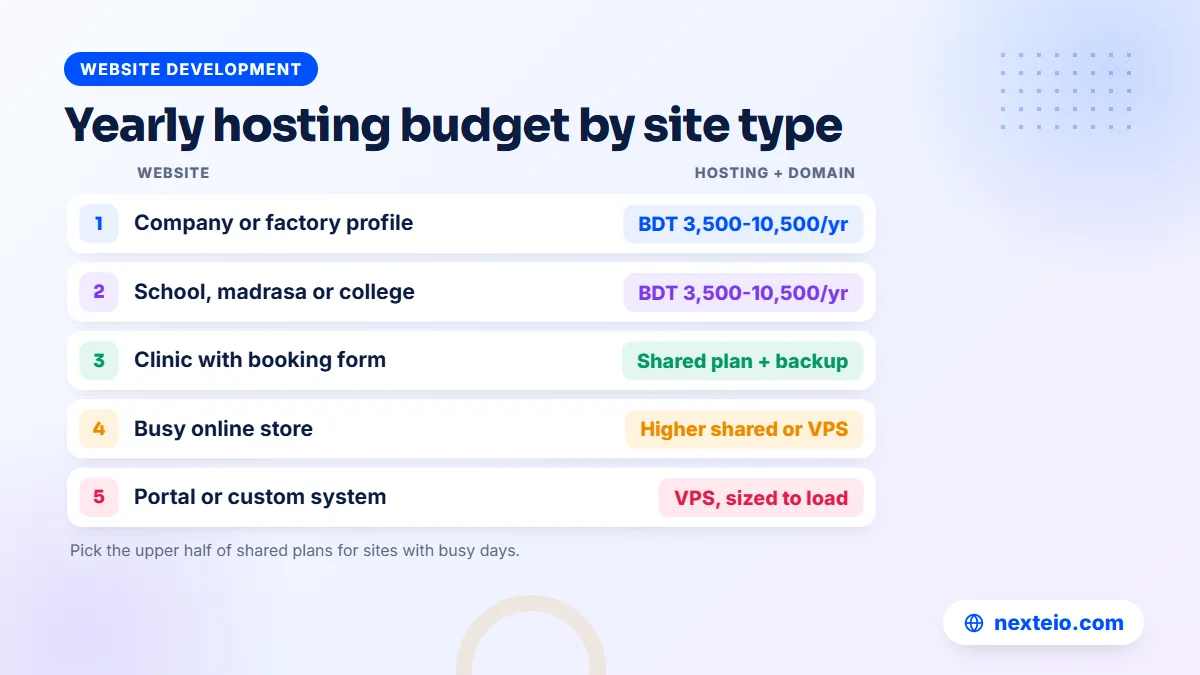
Numbers mean more when they are attached to real sites. The examples below show what a sensible hosting website price, plus the domain, usually looks like each year for common types of organizations in Bangladesh. They use typical market ranges and leave out the one-time cost of building the website.
A company or factory profile website
A garment exporter or trading company with ten to fifteen pages, a product gallery and a contact form needs a good shared plan, a .com domain and SSL. Buyers abroad often open the site before a meeting, so speed from outside Bangladesh matters too. If the site is being rebuilt, plan the hosting together with the new website design rather than after it. A realistic yearly budget is roughly BDT 3,500 to 10,500 for hosting and the domain together, plus business email if staff use it.
A school, madrasa or college website
A school site posts notices, class routines and results, and traffic jumps on result day and during admissions. A shared plan from the upper half of the price range is usually enough, with the domain on .com or .edu.bd. The yearly total sits in the same range as a company site, but the stronger plan helps the site hold up on those busy days.
A clinic or diagnostic centre
A clinic site with doctor schedules and an appointment request form is light on traffic but heavy on trust. A shared plan works well. Here, backups and reliable email delivery for the form matter more than extra storage, so set aside money for an off-site backup and for email that does not end up in spam.
An online store
A WooCommerce or custom store with daily orders, bKash or Nagad payments and courier updates needs more than the cheapest shared plan. Many stores start on a higher shared tier and move to a managed VPS as orders grow, at roughly BDT 4,000 to 15,000 a month. That is a real cost, but it is small next to orders lost to a slow checkout. When we plan a store through our e-commerce website development service, we size the hosting around the expected order volume. Our guide to planning and budgeting an online store covers the other costs.
A portal or custom application
Admission portals, learning platforms, HR systems and booking tools usually run on a VPS, because they need scheduled jobs, background queues and more memory. For these systems the server is part of the software design. It is best chosen together with the developer who builds the system, as we do on Laravel web application projects.
Local or Foreign Hosting: Price, Payment and Speed
Hosting sold in Bangladesh falls into two groups: local providers, who may run servers in the country or resell space abroad, and international providers who bill in US dollars. Both can serve you well. The differences show up in payment, support and where your visitors are.
- Payment: local providers usually accept BDT by bank transfer, bKash or Nagad. Foreign providers want an international card with a US dollar limit, and the price moves with the exchange rate.
- Paperwork: a local provider can usually issue an invoice in the organization's name that your accounts team can process without extra steps.
- Support: local support works in your time zone and often in Bangla. Large foreign providers usually offer round-the-clock chat in English.
- Speed: a server in or near Bangladesh can respond faster to local visitors, while a server in Asia or Europe may suit exporters whose buyers sit abroad.
None of these points makes one group better for everyone. Match the provider to who your visitors are and how your office pays.
Speed is the point most worth testing yourself. Server response time is the first step of every page load, and Google's guide to Time to First Byte explains why a slow server delays everything after it. Ask for a trial or a test site, then open it on mobile data at different times of day. Our article on website speed and SEO covers the other things that affect load time.
Why the Lowest Hosting Website Price Often Costs More
A very low hosting website price usually means the provider packs many sites onto one server, keeps support thin or skips backups. Each of those choices has a cost that arrives later, usually at a bad moment:
- Downtime on the days you need the site most, such as results, admissions, product launches or Eid sales.
- Slow pages that lose visitors on mobile data and can hold back search rankings.
- Account suspension when a traffic spike crosses a hidden CPU limit.
- Email landing in spam because another site on the same server sent junk.
- No usable backup when a plugin update breaks the site or malware gets in.
Picture a coaching centre on the cheapest plan it could find. On the night results go up, the site stops responding, and the provider explains that the account hit its process limit. The centre loses a day of enquiries and pays for an upgrade anyway.
None of this means the most expensive plan is best. The right comparison is the yearly cost of a plan that does the job, including the problems it avoids. Slow, unstable hosting is one of the common mistakes that hurt business websites, and it is one of the cheapest to fix.

Related guides for planning the site that sits on your hosting:
- How to build a professional business website that gets results
- WordPress or a custom website: which suits your business
- Technical SEO basics every website owner should know
A Three-Year Hosting Budget, Worked Out
Hosting decisions last for years, so budget them over three years instead of one. The example below is for a typical company profile website on a mid-range shared plan with a .com domain and free SSL. The figures are examples chosen inside the typical market ranges above, not a quote from any provider.
| Item | Year 1 | Year 2 | Year 3 |
|---|---|---|---|
| Shared hosting (offer, then renewal) | BDT 3,000 | BDT 5,000 | BDT 5,000 |
| .com domain | BDT 1,800 | BDT 1,800 | BDT 1,800 |
| SSL certificate (free) | BDT 0 | BDT 0 | BDT 0 |
| Total | BDT 4,800 | BDT 6,800 | BDT 6,800 |
Over three years that comes to BDT 18,400, or a little over BDT 6,100 a year on average. That figure is far more useful for planning than the BDT 3,000 on the advert.
Add maintenance if you want someone to keep the site updated, secure and backed up. Basic monthly plans in Bangladesh usually fall around BDT 2,000 to 5,000, with higher levels for stores and portals. Business email, if you use a separate service, is charged per user on top.
The website build is a separate, one-time cost. Typical market ranges in Bangladesh are about BDT 25,000 to 60,000 for a theme-based company website, 60,000 to 150,000 for a custom-designed business website, and 150,000 to 400,000 or more for a large corporate site with integrations. If you want a realistic total for your own project, send us a short brief so we can suggest a setup that covers both the build and the running costs.
Setting a Hosting Website Price Budget in Five Steps
Before you ask anyone for a quote, decide what the site needs. A clear brief keeps you from buying a plan that is too small and from being sold one that is far too large. Work through these steps with the person who manages the website:
- List what the site does. Pages and notices only, a contact or admission form, online payments, logins for students or staff, or scheduled tasks such as SMS alerts.
- Estimate the busy days. Result days, admission weeks, sale campaigns and trade fairs set the load the server must handle, not the quiet average.
- Decide where email lives. On the hosting plan or on a separate service, since that changes the storage you need.
- Set the backup rule. How often a copy is taken, where it is kept and who can restore it.
- Price it over three years. Use renewal rates, the domain, backups and maintenance, then divide by three to get a fair yearly figure.
With these five answers written down, a provider can quote a real hosting website price instead of guessing.
The brief also helps inside your organization. When the accounts team or the board asks why one quote is higher than another, you can point to the busy days, the backup rule and the email decision instead of arguing about the headline number. A short written brief tends to shorten the approval chain as well.
How to Compare Hosting Quotes Side by Side
When two or three providers send quotes, put them in one sheet and compare the same points. Ask each provider these questions in writing:
- What is the renewal price after the first term?
- What are the CPU, memory, entry process and inode limits?
- Where is the server located, and can we test its speed?
- How often are backups taken, where are they stored, and is a restore free?
- Which PHP and database versions are available, and how are upgrades handled?
- Is free SSL included, and does it renew automatically?
- How many email accounts are included, and are there sending limits?
- Which support channels exist, and in which hours?
- Can we pay in BDT, and will the invoice carry the organization's name?
- If we leave, how do we get a full copy of our files and database?
A provider who answers clearly before the sale is likely to answer clearly after it.
Read uptime promises with care. A stated uptime figure is only useful if the terms explain what happens when it is missed, such as a credit on the next bill. Also check that the plan you compare is the plan you will actually get, because some providers quote the smallest tier and then suggest an upgrade once the site is live.

Paying for Hosting Inside an Organization
In companies, schools, NGOs and government offices, hosting problems are often caused by approval chains rather than technology. The renewal invoice arrives, waits for a signature and moves from desk to desk while the site goes offline. A few habits prevent most of this:
- Put the hosting and domain accounts in the organization's name, with an official email address that more than one person can read.
- Record renewal dates in a shared calendar, with reminders 60 and 30 days ahead.
- Pay for two or three years at a time where the budget allows, which cuts paperwork and often lowers the yearly rate.
- Keep the main login inside the organization, and give your developer or maintenance provider a separate login.
Multi-year payment has one condition. Commit to a longer term only after you have used the provider for a few months, because three years with a slow host is a hard decision to undo.
When a web company offers to "include hosting" in its price, ask whose name the account is in and what the renewal costs from the second year. Bundled hosting can be convenient, but you should still know the real figures. Our buyer's checklist for choosing a web design company lists more questions worth asking before you sign.
Signs You Are Paying Too Much or Too Little
Signs you are paying too much
- A VPS or dedicated server runs a ten-page site with modest traffic.
- You pay separately for a basic SSL certificate that could be free.
- The invoice carries add-ons nobody uses, such as site builders or extra IP addresses.
- Old hosting accounts still renew for websites that closed years ago.
Signs you are paying too little
- The site is slow on mobile data, especially at busy times of day.
- The control panel shows "resource limit reached" warnings.
- Contact form emails keep landing in spam.
- Nobody can say when the last backup ran or how to restore it.
- The server still runs a PHP version that no longer gets security fixes.
Some organizations see signs from both lists at once. The answer is usually a right-sized plan with a reliable provider, not simply a bigger bill.
Hosting problems also show up in search results, as slow responses and server errors that Google reports in Search Console. If your rankings have slipped and you are not sure why, a review through our SEO service checks the server side as well as the content.
How Nexteio Can Help With Hosting and Your Website Budget
When we build a website through our custom website design service, hosting is part of the conversation from the start, not an afterthought at launch. We look at what the site has to do, how many people will use it and when the busy days fall, then recommend a hosting setup that fits that need and a budget your office can approve.
For most company, school, clinic and NGO sites, that means a well-run shared plan with sensible limits and free SSL. For stores, portals and systems we build on WordPress or Laravel, it may mean a VPS sized for the expected load. Our advice is always to keep the hosting and domain accounts in your organization's name, so you stay in control whoever looks after the site.
If you already have a website and suspect you are paying too much or too little, send us the plan details and the site address. We can look at the limits, the renewal price and the speed, and tell you plainly whether your current hosting website price makes sense or a change would help. Start with our project brief form, see the kind of sites we build in our portfolio, read more about Nexteio or reach us through the contact page.
Keep reading: what to check before hiring a WordPress developer, why a website gets traffic but no customers, or browse all our website development guides.
Frequently asked questions
How much does hosting cost for a small business website in Bangladesh?
A small company or office website usually runs well on shared hosting, which typically costs about BDT 2,000 to 8,000 a year in Bangladesh. Add roughly BDT 1,500 to 2,500 a year for a .com domain. Budget with the renewal price rather than the first-year offer, since the second year is often more expensive.
Why did my hosting renewal cost more than what I paid the first time?
Many providers sell the first term at a discount and renew at their regular rate. The renewal price is usually written in the terms or on the order page, but it is easy to overlook. When you compare providers, look at the renewal price and any multi-year discount, not only the offer.
Is free hosting good enough for a business website?
Free hosting is fine for practice or a personal test site, but it rarely suits a business. It often limits storage and speed, may show the provider's branding or ads, and offers little support or backup. A low-cost paid plan in your own organization's name is a far safer base for a site customers rely on.
Do I need a VPS for a WordPress website?
Not usually. Most WordPress company, school and NGO sites run well on a good shared plan with sensible resource limits. A VPS starts to make sense for busy WooCommerce stores, membership sites or sites that hit resource limits regularly even after caching and image optimization.
Is local hosting faster for visitors in Bangladesh?
A server in or near Bangladesh can respond faster to local visitors, but the quality of the provider and its network matters as much as the location. If many of your visitors are abroad, such as buyers of an exporter, a server in another region with a CDN can work better. Test a sample site on mobile data before you decide.
Is an SSL certificate included in the hosting price?
On most current hosting plans, yes. Control panels usually issue free certificates from Let's Encrypt and renew them automatically. Ask the provider to confirm this before you buy, and be careful of plans that charge separately for a basic certificate that you could get free.
Can we pay for hosting with bKash or Nagad?
Many local hosting providers in Bangladesh accept bKash, Nagad or bank transfer and can issue an invoice in your organization's name. International providers usually need a card with a US dollar limit. If your office needs a local invoice for its records, ask for a sample before you order.