Custom Website Design: What It Means and When a Company Needs One
In this article 16 sections
- 1.What Custom Website Design Actually Means
- 2.Custom Website Design vs a Ready-Made Theme
- 3.Signs Your Company Needs a Custom Website
- 4.When a Theme Is the Smarter Choice
- 5.Custom Website Design for Different Kinds of Organizations
- 6.What You Should Receive at Each Stage
- 7.Custom Website Development: Building the Design
- 8.Designing Around Real Content
- 9.Mobile Speed and Slow Connections
- 10.Accessibility and SEO Belong in the Design
- 11.What Custom Website Design Costs in Bangladesh
- 12.Timelines and Approvals Inside an Organization
- 13.How to Brief and Choose a Custom Website Developer
- 14.Mistakes That Make Custom Websites Disappoint
- 15.How Nexteio Can Help With Custom Website Design
- 16.Frequently asked questions
Custom website design means your site is planned and drawn for your organization from a blank page, instead of starting from a ready-made theme that thousands of other businesses also use. The layout follows your content, your customers and your goals. The look follows your brand. Nothing is there just because the theme came with it.
That sounds like an obvious improvement, but it is not always the right choice. A custom site costs more and takes longer. For a new shop testing an idea, a good theme may be the smarter spend. For a garment exporter whose buyers judge the factory by its website, or a corporate group with five companies and three audiences, a theme often becomes the thing holding the site back.
This guide explains what the term really covers, how it differs from a theme, the signs that your company has outgrown a template, and what you should receive at each stage of a custom project. It also covers costs in Bangladesh, realistic timelines, how to brief a developer, and the mistakes that make expensive sites disappoint.
What Custom Website Design Actually Means
The phrase is used loosely, so it helps to separate three levels of work that agencies often sell under similar names.
- Ready-made theme: a bought or free design is installed, and your logo, colors, text and photos are dropped into its existing layouts.
- Customized theme: the same starting point, with some sections rearranged, a few pages adjusted and the colors changed more deeply.
- Custom design: a designer plans the pages around your content and audience, draws the layouts from scratch, and a developer builds exactly that design.
All three can look professional. The difference is where the decisions start. With a theme, the layout comes first and your content is made to fit. With custom web design, your content and goals come first and the layout is made to fit them.
Design and development are two different jobs
Custom web design is the planning and visual side: page structure, layout, typography, color, images and how a visitor moves from one page to the next. Custom web development is the building side: turning that design into working code, connecting forms, setting up the content system and making the site fast and secure.
A custom design does not have to be coded from zero. Many custom websites are built on WordPress with a theme written specially for that one site. Others are built on Laravel when the site needs features a content system cannot handle well. What makes the site custom is that the design was made for you, and the code was written to match it rather than bent from someone else's template.
Older proposals sometimes call this a "custom web site" build, written as three words. The meaning is the same. What matters is whether the proposal describes a real design stage with wireframes and page designs you approve, or simply promises to "customize" a theme.
Custom Website Design vs a Ready-Made Theme
Neither option is good or bad in itself. Each fits a different situation, and the table below sets the two side by side on the points that matter most to a business owner or an office manager.
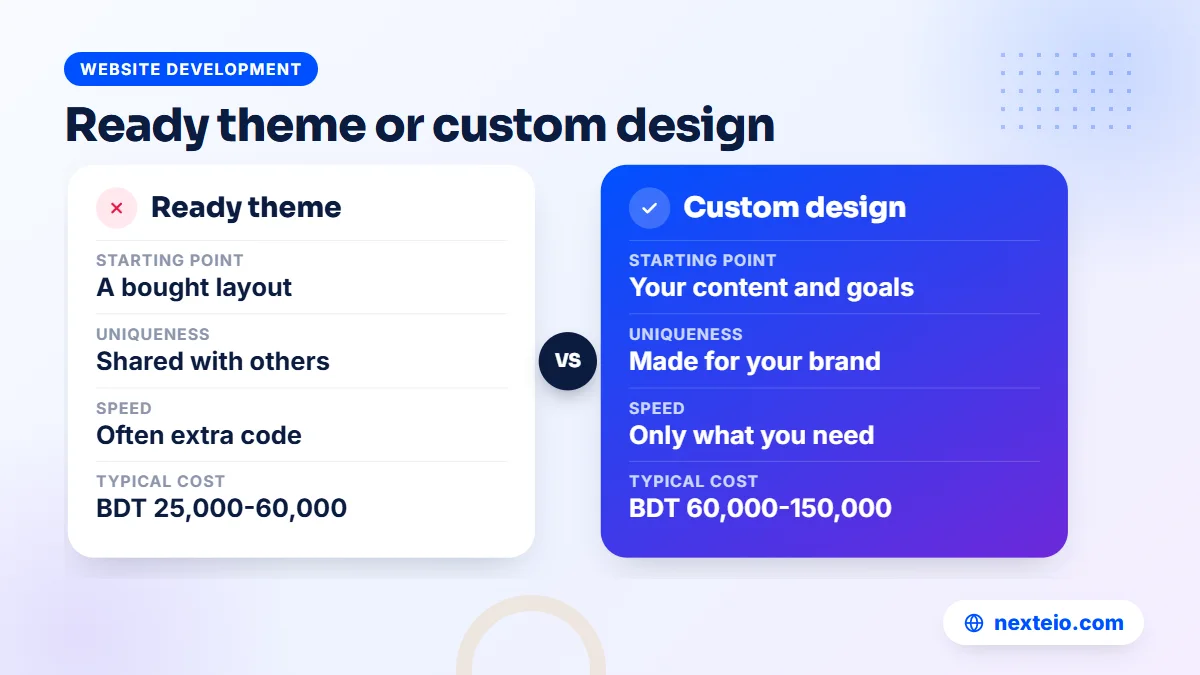
| Point | Ready-made theme | Custom design |
|---|---|---|
| Starting point | A layout someone else designed for general use | Your content, audience and goals |
| How it looks | Can be attractive, but others use the same layout | Made for your brand and no one else's |
| Fit to content | Your text is cut or stretched to fill the template | Pages are shaped around what you need to say |
| Speed | Often carries code for features you never use | Only what the site needs, so lighter pages are easier |
| Time to launch | Faster, often a few weeks | Longer, because design is a stage of its own |
| Cost | Lower at the start | Higher at the start, often better value over several years |
The longer-term column is where custom work earns its keep. A theme that needs heavy changes tends to fight every later update.
Theme updates can undo changes, page builders add weight, and each new section becomes a workaround. A custom site has none of that history, so later additions follow the same design rules as the original pages. Our comparison of WordPress and custom websites looks at the platform side of the same decision.
Signs Your Company Needs a Custom Website
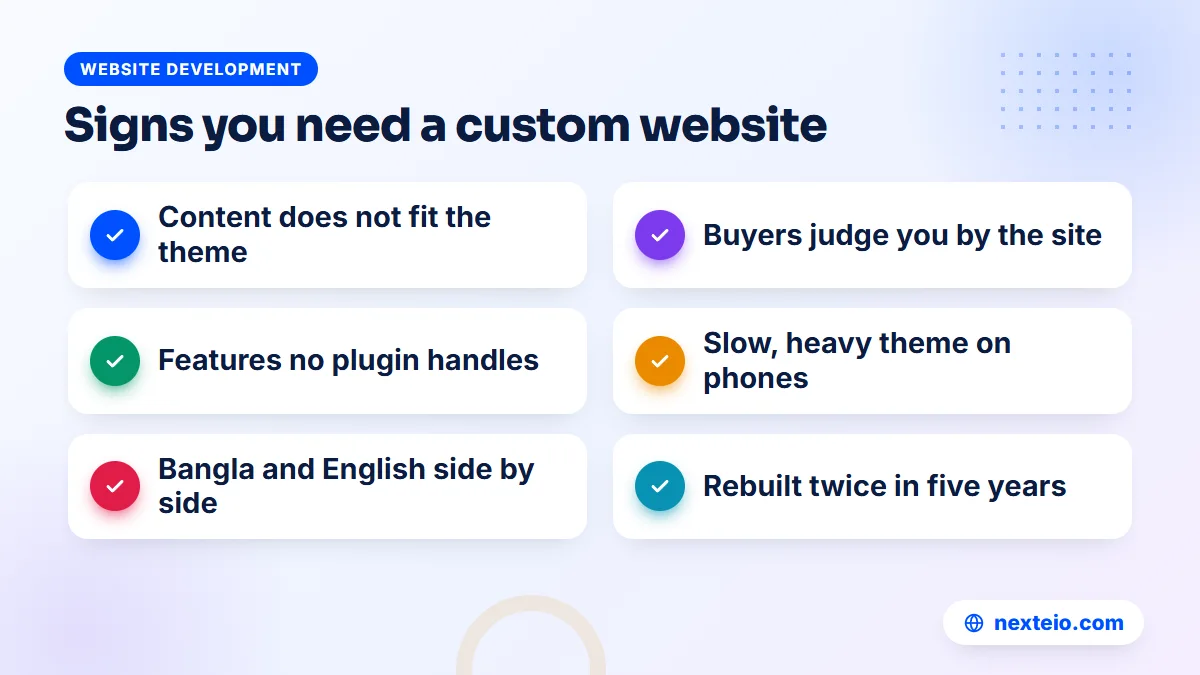
Most companies do not need custom work on day one. They need it when the website starts to cost them business, time or credibility. These are the signs we see most often, starting with the business ones:
- Your content does not fit the theme. A factory needs to show machinery, capacity, certifications and buyer brands. A theme built for a café or a startup has no natural place for any of that.
- Buyers or partners judge you by the site. Foreign buyers, donors and corporate clients often check the website before a meeting. A template they have seen on other sites does not help you look established.
- You serve several audiences. A corporate group may need to speak to buyers, job seekers, investors and local customers, each with a different path through the site.
- You need features no plugin handles well. Dealer locators, quotation builders, booking flows or member areas often end up stitched together from plugins that do not match.
The other three signs are practical and technical:
- The site is slow on phones. Heavy themes with sliders, animations and page builders struggle on mid-range Android phones over mobile data.
- You publish in Bangla and English. Many themes handle Bangla text poorly, with cramped lines, broken fonts or layouts that only work at English text lengths.
- You have rebuilt the site twice in five years. Each rebuild on a new theme starts again from someone else's layout and keeps the same basic problems.
If two or three of these sound familiar, custom website design is probably worth pricing, and our website design team can tell you which of the problems a new design would actually solve. If none of them apply, a well-chosen theme may serve you well for years.
When a Theme Is the Smarter Choice
An honest provider will sometimes advise against a custom build. A theme makes good sense in these situations:
- You are a new business testing an idea and expect the offer to change within a year.
- Your budget is firm and small, and the money is better spent on content or advertising.
- The site is a simple blog or a short company profile with a few pages.
- You need to be online within days for an event, a tender or a trade fair.
In these cases, choose a well-supported theme from a reputable source, keep plugins to a minimum and write your own content. You can always move to a custom design later, once you know what your visitors need. Our WordPress website service covers both theme-based and custom-theme builds, so the step up later does not mean starting again from nothing.
The worst choice is the middle one done badly: a cheap theme so heavily changed that it is neither quick and simple nor truly custom. It costs nearly as much as a proper design and keeps the weaknesses of both.
Custom Website Design for Different Kinds of Organizations
The word "custom" means something different for each type of organization, because each has a different visitor to satisfy. Here is what custom website design usually focuses on in the sectors we work with most.
Exporters and manufacturers
The visitor is a buyer or a sourcing manager, often abroad, deciding whether your factory is worth a meeting. The design leads with capacity, product range, compliance and real photos of the floor, and makes the enquiry form easy to find on every page. Clean English matters more than decoration.
Corporate groups
A group site must introduce the parent company and give each sister concern a clear space of its own, without looking like five different websites glued together. A custom design sets one visual system that every company follows, with room for each to show its own products, contacts and job openings.
Schools, colleges and madrasas
Guardians and students want notices, results, routines and admission details, mostly on phones and often in Bangla. The design puts the notice board and admission information one tap from the homepage, and gives the office staff a simple way to post updates without touching the layout.
Hospitals and clinics
Patients look for doctors, schedules, departments and a phone number, sometimes in a hurry. A good custom website design keeps the call and appointment buttons visible on every screen, lists doctors in a format that is easy to search, and avoids heavy pages that load slowly when someone is anxious.
In every case, the starting question is the same: who arrives, and what do they need to do next? A theme cannot know that answer. A custom design is built around it.
What You Should Receive at Each Stage
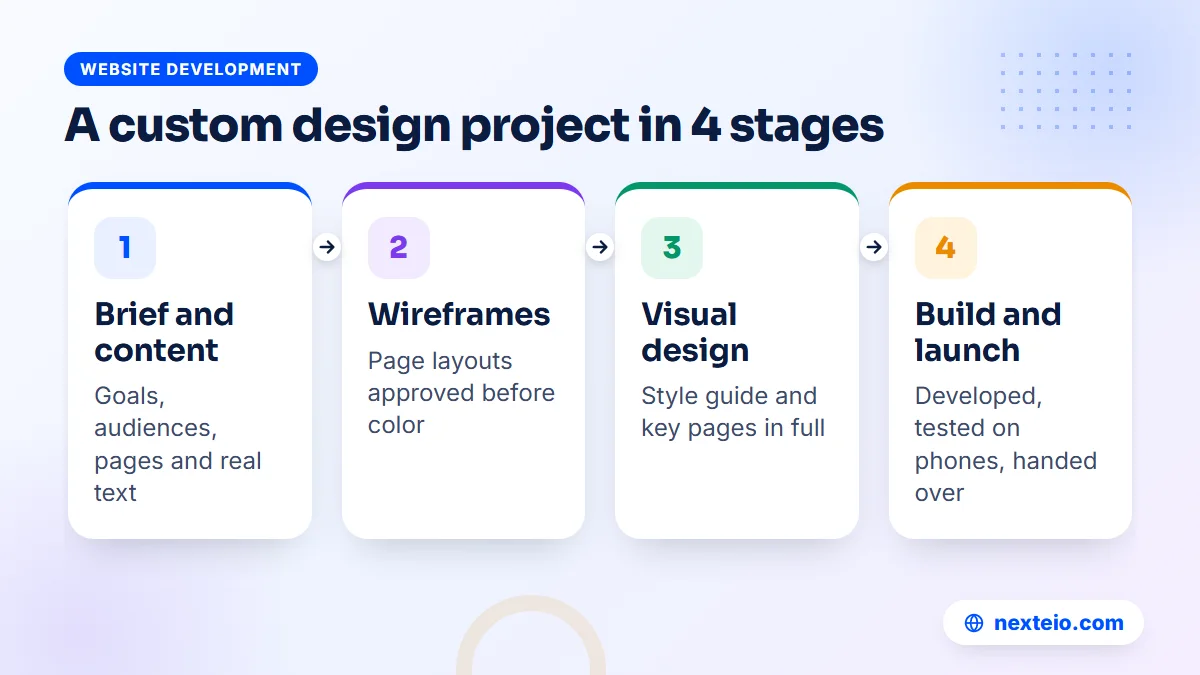
Many buyers sign a custom project without knowing what they will see along the way. That leads to surprises at the end, when changes cost the most. A proper custom project produces something you can review and approve at every stage, and this is how you judge whether the work is really custom.
| Stage | What you receive | What you approve |
|---|---|---|
| Discovery | A written brief covering goals, audiences and must-have features | That the brief describes your organization correctly |
| Structure | A sitemap and a content plan listing every page and who writes it | The page list and the content owners |
| Wireframes | Plain black-and-white layouts of the key pages | What goes where, before any color or style |
| Visual design | Full designs of the main pages plus a style guide | The look, fonts, colors and image style |
| Build | A working site on a test address | Content, forms and behavior on phone and desktop |
| Launch | The live site, logins and short training | Final sign-off and the handover checklist |
Ask to see examples of these documents from past projects before you sign.
The wireframe stage deserves special attention. It is the cheapest point to change your mind. Moving a section on a wireframe takes minutes, while moving it after the site is built can take days. Use this stage to involve the people who will judge the site later, such as the managing director or the head of marketing.
The style guide matters more than it looks. It records the fonts, colors, button styles and spacing rules, so every new page added in the future matches the original design. Without one, a custom site slowly turns back into a patchwork.
Custom Website Development: Building the Design
Once the design is approved, a developer turns it into a working site. The platform choice depends on what the site has to do, and a good custom website developer will explain why they recommend one over another.
A custom WordPress theme
For most company, school and NGO websites, the best base is WordPress with a theme written just for your design. Staff get a familiar editor for posting news and updating pages, and the site carries no unused theme code. This route suits sites that are mainly content: company profiles, product catalogs, notice boards and news sections.
A Laravel application
When the site must run a real process, such as a dealer portal, a booking system, a quotation calculator or a member area, a framework like Laravel is often a better fit. Every screen is built for the job, and the data structure follows your workflow instead of a plugin's assumptions. Our Laravel website service handles this kind of custom website development, from the database design to the screens your staff use every day.
What good custom web development includes
- Clean, semantic HTML with proper headings, so search engines and screen readers understand each page.
- Images in modern formats, sized for phones and loaded only when needed.
- Forms that send mail reliably from your own domain and protect against spam.
- An admin area where staff can update content without breaking the layout.
- Code stored in version control and handed to you at the end of the project.
That last point is often missed. If a developer will not hand over the code and the logins, you do not fully own your site, no matter how much you paid for it.
Designing Around Real Content
The biggest advantage of a custom design is that it can be shaped around what you actually have to say. That only works if the content exists early. Designing pages with placeholder text and stock photos, then pouring in real material at the end, throws away most of the benefit.
Start content work during discovery. Gather the facts buyers ask about, such as products, capacity, certifications, service areas and processes. Collect real photos of your people, premises and work. A factory floor photographed well tells a buyer more than any stock image of a handshake. If you plan to add a short brand or factory film, our video editing service can cut raw footage into something that suits the page.
Writing matters as much as layout. Visitors scan, so headings must say something useful and paragraphs must be short. Our guide to SEO-friendly website content explains how to write pages that people actually read and search engines understand.
Bangla and English on the same site
Bangla text needs more room than English. Its letters sit taller, conjuncts need generous line spacing, and the same sentence can run longer or shorter than its English version. A layout designed only for English often breaks when Bangla goes in. A custom design can plan both from the start: fonts that render Bangla cleanly, line heights that suit both scripts, and buttons that do not overflow in either language.
Avoid putting important text inside images, which is common on banners. It cannot be translated, searched or read by screen readers, and it often blurs on small screens.
Mobile Speed and Slow Connections
Most visitors to a Bangladeshi business website arrive on a phone, often on mobile data and sometimes on a weak signal. A design that looks impressive on a large office monitor can feel slow and crowded on a five-inch screen. Custom design should start from the phone layout and grow outward, not the other way around.
Google's guide to responsive web design basics explains the principle, and Google now uses the mobile version of a site for indexing. If the phone version hides content or loads poorly, your search visibility suffers along with the visitor's experience.
Speed is where custom websites can pull clearly ahead of heavy themes. Because the code contains only what the design needs, pages can stay light. Agree a few speed rules during design:
- No auto-playing sliders on the homepage; one strong image and a clear message instead.
- Two font families at most, with only the weights you actually use.
- Images compressed and sized for each screen width.
- Animations kept small, and none that block reading.
- Pages tested on a mid-range Android phone over mobile data before launch.
Google's Core Web Vitals give a common measure for loading, response and visual stability. Ask your developer to report them for the main pages at launch, and read our guide on website speed and SEO for why they matter.
Accessibility and SEO Belong in the Design
Both are far cheaper to build in than to add later. A design stage is the right moment to decide color contrast, heading order, link styles and form layouts, because all of them affect how the site looks.
For accessibility, the basics are clear. Text should have enough contrast against its background. Buttons should be large enough to tap. Every image that carries meaning needs a text description, and forms need visible labels rather than placeholder text that disappears. Mozilla's accessibility learning guide is a clear starting point. These choices help older visitors, people on cracked phone screens and people using screen readers alike.
For search, the design decides the page structure that SEO depends on. Each page needs one clear topic and a sensible heading order. Services and products should have their own pages rather than sitting together on one long page. The site needs clean URLs and internal links that guide both visitors and search engines. Google's SEO starter guide explains these elements in plain terms.
If search traffic is a major goal, involve SEO planning before the sitemap is final. Our SEO service can review a planned structure and keyword targets before design starts, which is much easier than reworking pages after launch.
Related guides for planning a new site:
- How to build a professional business website that gets results
- Content strategy for every stage of the customer journey
- How to create a landing page that converts ad traffic
What Custom Website Design Costs in Bangladesh
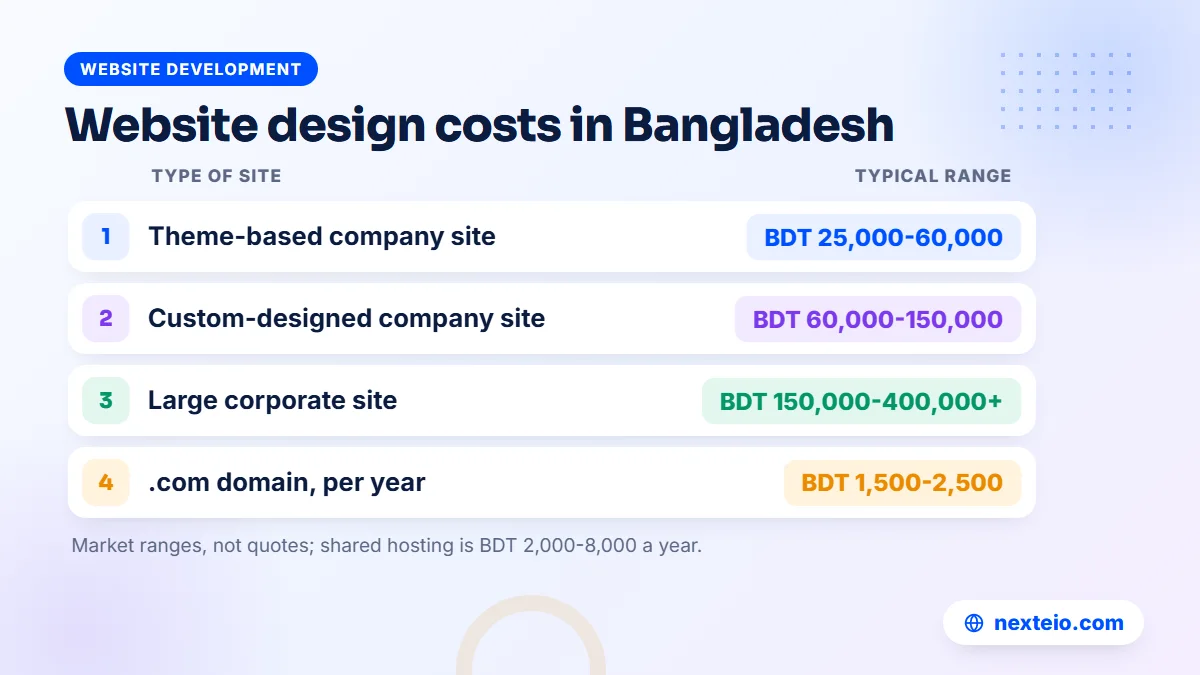
Prices for custom website design vary widely, so it helps to know the usual market ranges before you compare quotes. These are typical market ranges in Bangladesh for a company or business website, not fixed prices from any one provider:
| Type of site | Typical range | What usually drives the price |
|---|---|---|
| Theme-based company website | BDT 25,000 to 60,000 | Number of pages, content entry, small layout changes |
| Custom-designed company website | BDT 60,000 to 150,000 | Pages designed, languages, features and revision rounds |
| Large corporate site with integrations | BDT 150,000 to 400,000 or more | Several audiences, many templates, ERP, CRM or portal links |
Running costs come on top: a .com domain is about BDT 1,500 to 2,500 a year, and shared hosting about BDT 2,000 to 8,000 a year.
Several things move a quote up or down. The number of unique page layouts matters more than the total page count, because twenty product pages can share one template. A bilingual site needs more design and content work. Features such as booking, quotation forms, search filters or links to an ERP add development time. More revision rounds and more people approving the design also add hours.
Compare quotes on deliverables, not just totals. One quote may include wireframes, a style guide, content entry, speed testing and training, while a cheaper one includes only the build. If you sell online, compare against our e-commerce website development options too, since stores carry their own costs for checkout, payments and delivery.
Timelines and Approvals Inside an Organization
A custom website design project usually takes longer than people plan for, and the design work is rarely the slow part. In our experience, the delays come from content and approvals: product details that nobody has written down, photos still to be taken, and feedback waiting for a director who is travelling.
Plan the schedule around your own decision chain. In many organizations, the website passes through marketing, the managing director and sometimes a board or chairman before it can go live. Each layer that sees the design for the first time near the end tends to request changes that would have been easy at the wireframe stage.
A few habits keep the project moving:
- Name one decision-maker who collects everyone's feedback and sends one combined list.
- Show the wireframes to senior people early, not just the final design.
- Agree content deadlines with the people who own each page.
- Book photo and video sessions at the start, not after the design is approved.
- Allow for Eid and other long holidays when setting a launch date.
With content ready and quick feedback, a custom company site can move from brief to launch in a matter of weeks. Without them, the same project can drift for months. Most of that difference sits on the client's side of the table.
How to Brief and Choose a Custom Website Developer
A good brief saves money, because it lets providers quote the same job and lets you compare like with like. It does not need to be technical. A few pages answering these questions are enough:
- Who are the main visitors, and what do you want each of them to do?
- Which pages and sections do you know you need?
- Which features are required, such as forms, booking, search or a members' area?
- Which languages will the site use?
- Who will write content and supply photos?
- Which websites do you like, and what exactly do you like about them?
- What is the budget range and the target launch date?
Then ask providers how they work. Can they show wireframes and style guides from past projects, not just finished sites? Who will design, and who will build? Will you own the domain, hosting, code and logins at the end? How many revision rounds are included, and how are extra changes priced? What happens after launch if something breaks?
Look at live sites they have built, on your own phone, and ask one past client how the project went. Our buyer's checklist for choosing a web design company covers more checks worth running before you sign.
Mistakes That Make Custom Websites Disappoint
An expensive custom design can still fail. These are the patterns behind most disappointing projects:
- Design by committee: every department adds its wish, and the homepage ends up saying ten things at once.
- Looks over purpose: heavy animation and large videos impress in the meeting room but slow the site on phones.
- Content left to the end: pages designed around placeholder text that the real content never fits.
- No style guide: new pages added later drift away from the original look.
- Accounts in the developer's name: the organization cannot update or move its own site.
- No plan after launch: nobody updates software, checks forms or adds fresh content.
Each of these is avoidable with a clear brief, early content work and a written handover. The goal is not a website that wins design awards. It is one that helps buyers, guardians, patients or customers find what they need and contact you.
That is also how to judge custom web designs from any provider. Look past the colors and ask what each page helps a visitor do. A page that cannot answer that question needs rework, however good it looks.
How Nexteio Can Help With Custom Website Design
Custom website design is the core of what we do. Through our custom website design service, we plan and design your site from a blank page, around your content and the people you need to reach, rather than starting from a bought theme.
The work follows the stages described in this guide. We agree a brief and a page plan with you, share wireframes and page designs for approval, and then build the site on the platform that suits the job: a custom WordPress theme for content-led sites, or Laravel when the site needs to run a real process. We design for phones first, plan Bangla and English layouts where you need both, and recommend keeping the domain, hosting and logins in your organization's name.
Our custom website designs are built for companies, factories, schools, hospitals, NGOs and offices across Bangladesh. You can see examples in our portfolio, browse our other services, or share your project details so we can suggest an approach and a budget range. If you prefer to talk first, contact us, or read more about how our website design process works. When you are ready to plan your new company website, our project form is the quickest way to begin.
Keep reading: technical SEO basics for website owners, what to check before hiring a WordPress developer, or browse all our website development guides.
Frequently asked questions
Is a custom website always better than a theme?
No. A custom site fits your content, brand and features exactly, but it costs more and takes longer. For a new business testing an idea, a short company profile or a tight deadline, a well-chosen theme is often the better spend. Custom work pays off when the site has to do more than a template allows.
Can a custom-designed website still use WordPress?
Yes. Many custom sites run on WordPress with a theme written only for that one design. Your staff get the usual WordPress editor, while the layout and code are made for your site rather than adapted from a general theme. Sites that run complex processes are often built on a framework such as Laravel instead.
How long does a custom company website take to build?
It depends mostly on content and approvals rather than design time. With text and photos ready and quick feedback, a custom company site can go from brief to launch in a matter of weeks. Projects where content is written during the build, or where several directors review late, often take months.
What should I prepare before contacting a web designer?
Write down who your visitors are, what you want them to do, the pages and features you know you need, the languages, and a budget range. Collect a few websites you like and note what you like about each. Real photos and draft text help a lot, even if they are rough.
Will I own the design and code of my custom website?
You should, and the contract should say so. Ask for the domain, hosting and admin logins in your organization's name, plus the source code and design files at handover. If a provider refuses to hand these over, you do not fully control a site you paid for.
Does custom design help with Google rankings?
It can, but only if SEO is planned during design. A custom site can have lighter pages, a clean heading structure and one page per service or product, which all help search engines. Design alone does not rank a site, though; useful content and ongoing SEO work matter just as much.
Can my old website content be reused in a new custom design?
Usually some of it can, but treat the redesign as a chance to review every page. Remove outdated material, rewrite thin pages and keep the pages that already bring visitors from Google. Ask your developer to redirect old page addresses to the new ones so you do not lose search traffic.