 Smart Digital Solutions for Sustainable Growth.
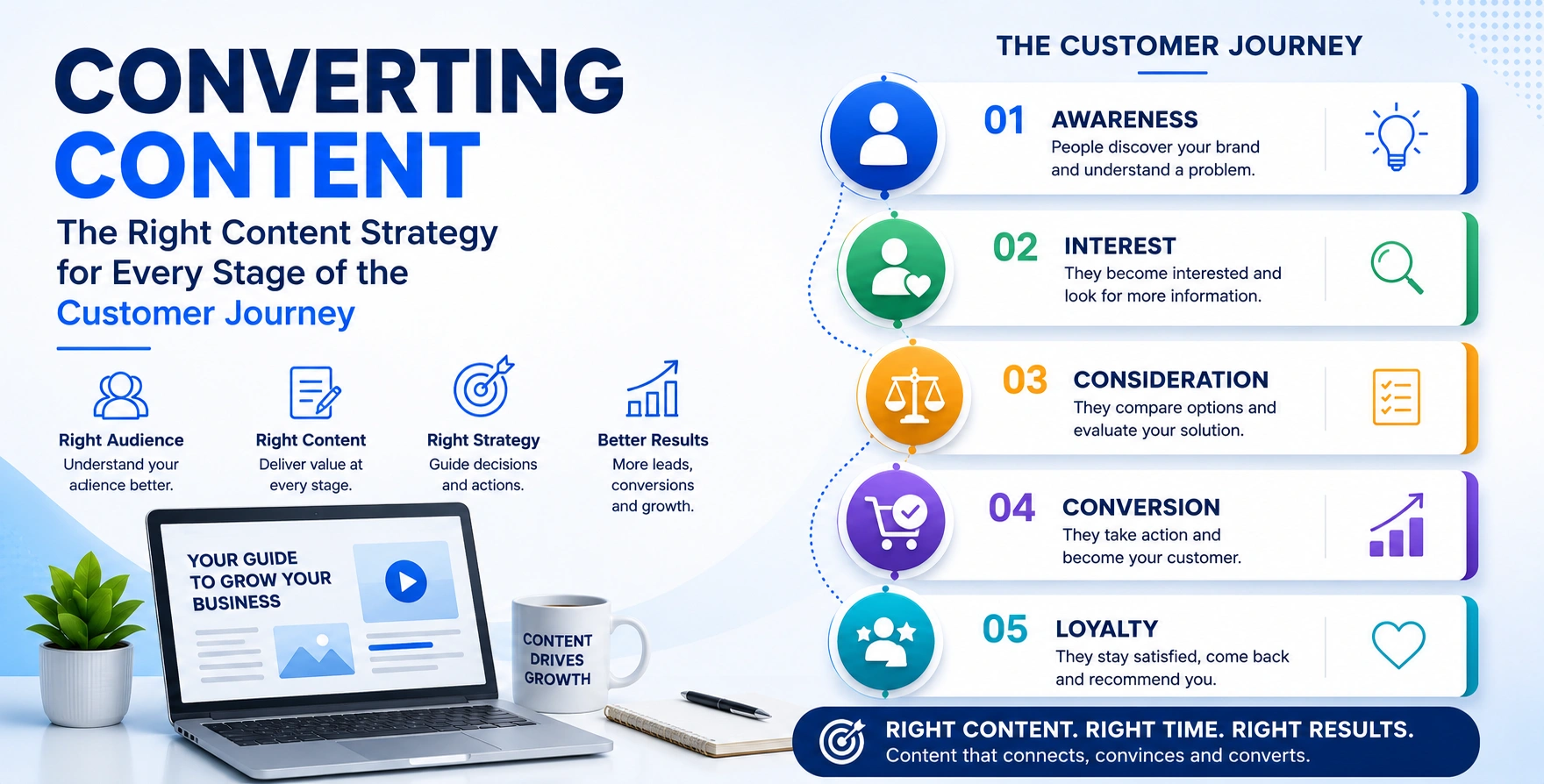
Great content does more than bring visitors to your website. When it is planned around the customer journey, content can turn an unknown visitor into an interested prospect and eventually into a paying customer. This is the foundation of a converting content strategy.
Why Does Good Content Not Always Generate Conversions?
Many businesses publish blog posts, social media content, videos and guides regularly. They may even get a good amount of traffic. But traffic alone does not always lead to more sales, leads or inquiries.
One of the main reasons is simple: the content is being created without thinking about where the customer is in their buying journey.
A person who has just discovered your brand does not need the same information as someone who is ready to buy. A new visitor may want to understand a problem, while an interested prospect may want to compare solutions. A ready-to-buy customer may want proof, pricing, results and a clear reason to trust your business.
Right Person + Right Message + Right Stage + Right Action = Better Conversion.
What Is the Customer Journey?
The customer journey is the complete path a person takes from discovering your brand for the first time to becoming a customer and, ideally, a loyal customer.
Every business has a slightly different customer journey, but most digital marketing journeys can be divided into a few important stages.
The customer discovers your brand, a problem or a possible solution.
The customer wants to learn more and starts consuming your content.
The customer compares options and checks your credibility.
The customer takes an important action such as buying, booking or contacting you.
A good customer experience encourages repeat business and referrals.
Stage 1: Awareness — Create Attention First
At the Awareness stage, the customer may know very little about your business. In some cases, they may not even understand their problem clearly yet.
That is why this is usually not the best stage for aggressive sales messages. Your first goal should be to earn attention and help the audience understand their problem.
Effective Awareness Content
- Educational blog posts
- Short-form social media videos
- Problem-focused Facebook posts
- Infographics
- Beginner-friendly guides
- Educational YouTube videos
- Search-friendly informational content
For example, if you run a digital marketing agency, an Awareness article such as “Why Are Your Facebook Ads Not Generating Sales?” can be more useful than simply telling people to buy your advertising service.
Stage 2: Interest — Give People a Reason to Stay
Once people understand that they have a problem, they start looking for possible solutions. This is where the Interest stage begins.
Your content should now provide more useful information while showing your knowledge and experience.
Explain how customers can understand or solve their problem in a practical and easy way.
Share your experience, processes, insights and knowledge to build authority.
Tutorials, checklists, detailed guides, webinars, useful videos and educational email content can work well at this stage.
Stage 3: Consideration — Build Trust
At this point, the customer understands that they need a solution. But now they have another question: “Which company should I choose?”
This is where trust and differentiation become extremely important. Your content should show why your business is capable of solving the customer’s problem.
Useful Consideration Content
- Case studies
- Customer reviews
- Testimonials
- Before-and-after examples
- Service comparison guides
- Portfolio content
- Detailed service pages
- Frequently Asked Questions
When potential customers see real examples and genuine experiences, making a decision becomes much easier.
A Simple Example
Imagine a business owner looking for a professional website.
First, they read: “Why Does a Professional Website Matter for a Business?”
Then they discover: “10 Things to Know Before Building a Business Website.”
Next, they check your portfolio, client reviews and previous projects.
Finally, they find a clear service page with an easy way to contact you.
That is a content-driven customer journey.
Stage 4: Conversion — Help Customers Take Action
At the Conversion stage, the customer may already be interested in your solution. But being interested and actually taking action are two different things.
Your content should make the final decision simple and comfortable. Avoid unnecessary information that can create confusion.
A Strong Conversion Page Should Include
A CTA Is Not Just a Button — Context Matters
Adding a CTA button does not automatically increase conversions. What matters is what the customer has learned before seeing that CTA.
For example, ending an educational article with a strong “Buy Now” message may feel unnatural. A CTA such as “Get a Free Consultation” or “Explore Our Services” may be more relevant.
Value → Trust → Clear Benefit → Simple Action
Stage 5: After the Purchase — Content Is Not Finished
Many businesses stop their content marketing after a customer makes a purchase. That can be a missed opportunity.
Existing customers already know your business and have some level of trust. With the right follow-up content, you can increase retention, repeat purchases and referrals.
Post-Purchase Content Ideas
- Product or service guides
- Helpful tutorials
- Customer-only updates
- New service announcements
- Helpful email content
- Customer success stories
- Referral and loyalty campaigns
The Role of SEO in Converting Content
SEO and content marketing are closely connected. When used together, they can help your content reach people who are actively looking for information, solutions or services.
Different stages of the customer journey can also have different search intents. Some people search for information, while others are already comparing providers or looking for a specific service.
“How does Facebook advertising work?”
“Best Facebook Ads agency for small business”
These searches represent different levels of intent. That is why content should be created around both keywords and the actual needs behind those searches.
5 Steps to Build a Better Content Strategy
Common Content Mistakes That Reduce Conversions
- Using the same CTA on every piece of content
- Publishing only promotional content
- Ignoring the customer’s real problems
- Not showing social proof
- Using overly complicated language
- Ignoring the mobile experience
- Publishing content without measuring performance
- Using the same message for every type of customer
Final Takeaway: Content Should Do More Than Bring Traffic
A strong content strategy should support the entire customer journey. Awareness creates attention, Interest provides value, Consideration builds trust, Conversion creates confidence and post-purchase content helps build long-term relationships.
Final Thoughts
In today’s competitive digital market, simply creating more content is not enough. What matters is understanding who you are creating content for, why you are creating it and where that person is in the customer journey.
When someone discovers your brand for the first time, do not try to turn them into a customer immediately. Start by providing value. Then demonstrate your expertise, build trust and finally give them a clear next step.
That is the foundation of a converting content strategy.
When your content answers real questions, explains problems, shows the value of your solution and makes the buying decision easier, content does more than generate traffic. It becomes a powerful engine for leads, conversions and long-term business growth.
Frequently Asked Questions
Turn Your Content Into Growth
Build a content strategy that does more than attract visitors. Create content that builds trust, generates leads and supports long-term business growth.
Talk to Nexteio ↗